
By the HMNDP Editorial Team, independent reporting on lawn care and landscaping.
Last reviewed: June 2026
Does baking soda kill weeds? Yes, on hardscape, with limits
Baking soda does kill weeds, but only in the right place. Sodium bicarbonate draws moisture out of leaf tissue and stresses the plant with a sudden salt load, so young weeds in driveway cracks, patio joints, and paver gaps brown out within days. It is cheap and non-selective. It rarely kills established roots, and it should never touch garden soil or lawn.
Think of baking soda as a spot treatment for hardscape weeds, not a lawn or bed product. A 1-pound box costs under $1 and treats dozens of small weeds. That price is the whole appeal for budget-conscious DIY gardeners looking for a natural alternative to synthetic herbicides.
How baking soda kills weeds: desiccation by salt stress
Baking soda kills weeds by dehydration. It is a sodium salt, and when it coats wet foliage it pulls water out of the plant cells through osmosis, the same way table salt does. The sodium also disrupts the plant’s water balance at the roots when it washes into the crack. Leaves wilt, brown, and collapse. The mechanism is physical, not systemic, so it burns what it touches rather than moving through the plant.
Because the effect is osmotic salt stress, baking soda works fastest on tender annual weeds with thin leaves, such as crabgrass seedlings, chickweed, and young oxalis. Waxy or deep-rooted perennials shrug off a single dose.
How much baking soda per weed: the dosage no one gives you
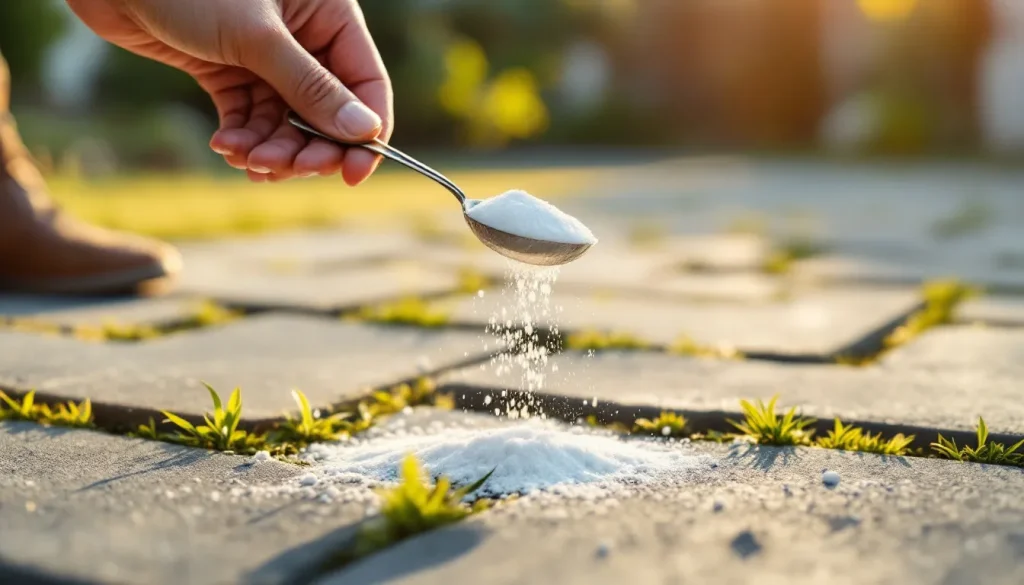
Most pages tell you to “sprinkle it on” and stop there. Here is a measurable rate. For a single small weed, wet the foliage, then apply about 1 tablespoon (roughly 3 teaspoons, about 14 grams) directly on the leaves and packed into the base. For a dense seam of weeds, use roughly 1 cup per square foot of cracks. Reapply every 4 to 6 weeks.
Consistent measuring matters because too little does nothing and too much just wastes product and salts a wider area. Follow this application order:
- Wet the weed first. Spray or pour water on the foliage so the powder sticks instead of blowing away.
- Measure the dose. Use a kitchen tablespoon for single weeds, or a 1-cup scoop for a square foot of cracks.
- Sprinkle on foliage and base. Coat the leaves, then push powder into the crack where the stem meets the pavement.
- Leave it dry. Do not rinse. It needs to sit on the plant to draw out moisture.
- Reapply after rain or every 4 to 6 weeks until the weed stops returning.
Where to use baking soda on weeds (and where it will backfire)
Use baking soda only on hardscape: driveways, sidewalk cracks, patios, and the joints between stones and pavers. In those spots there is nothing you want to keep, so the sodium buildup does no harm. This is the single most important rule, and most top results gloss over it.
Do not use baking soda in garden beds or on a lawn. It is non-selective and it salts the soil. Sodium accumulates, damages soil structure, and can kill nearby grass, flowers, vegetables, and shrub roots. The salt does not break down the way an organic herbicide might, so repeated use in one bed can leave that soil hostile to planting for a season or more.
For weeds inside planted areas, skip baking soda entirely. Our guide on how to kill weeds in flower beds covers safer options that spare your ornamentals. The same soil-salting caution applies to using rock salt as a weed killer, which works by the same sodium mechanism.
How fast does baking soda kill weeds, and how permanent is it?
Baking soda is not an overnight weed killer. Expect visible browning in 2 to 5 days on young annual weeds. Tougher or larger weeds take 2 to 4 weeks and usually need two or three repeat applications. Cool, cloudy, or wet weather slows it further because the salt keeps getting diluted or washed off.
Permanence is where DIY guides overpromise. Baking soda burns top growth but usually does not kill the roots of established perennial weeds like dandelions, bindweed, or thistle. Those regrow from the crown. It is genuinely effective only on young annuals and seedlings, where the whole plant is small enough to die back before it can rebuild from the root.
Baking soda vs vinegar: which kills weeds better?
Vinegar generally works faster and browns weeds harder than baking soda, because concentrated acetic acid strips the waxy leaf cuticle and destroys cells on contact. Baking soda relies on slower osmotic salt stress. Neither reliably kills perennial roots, but for speed on visible top growth, horticultural vinegar (20% acetic acid) usually wins. Baking soda’s edge is cost and zero odor.
| Factor | Baking soda (sodium bicarbonate) | Vinegar (acetic acid) |
|---|---|---|
| How it works | Osmotic salt stress, dries out tissue | Acid burns the leaf cuticle and cells |
| Speed to browning | 2 to 5 days | Hours to 1 day |
| Kills roots? | Rarely, top growth only | Rarely, top growth only |
| Soil effect | Salts soil, sodium lingers | Acidifies briefly, less lasting |
| Best for | Young annuals in cracks | Faster knockdown on wider foliage |
| Cost | Under $1 per pound | Low, higher for 20% strength |
If you go the vinegar route, strength and dilution decide the outcome, which we break down in whether you should dilute vinegar to kill weeds.
Can you mix baking soda with salt or vinegar for a stronger weed killer?
Yes, combining works, with tradeoffs. Adding table salt to baking soda increases the sodium load and hits weeds harder, but it also salts the soil more heavily, so reserve it strictly for cracks you never intend to plant. Mixing baking soda with vinegar is popular but partly self-defeating, because the acid and the base react and neutralize each other.
A practical combination for hardscape: spray weeds with vinegar first for the fast acid burn, let it work, then sprinkle baking soda into the crack afterward for lingering salt stress. Keeping them sequential rather than premixed preserves both effects. For chemistry and safety reasons, do not combine any of these with bleach, a common and dangerous mistake covered in our note on whether bleach kills weeds.
For more low-cost, natural lawn and hardscape tactics, browse the HMNDP guides library.
Frequently Asked Questions
How fast does baking soda kill weeds?
Young annual weeds usually start browning in 2 to 5 days after a proper application on wet foliage. Larger or tougher weeds take 2 to 4 weeks and need repeat treatments. Warm, dry, sunny weather speeds the process because the sodium keeps drawing moisture out. Rain, cool temperatures, and cloud cover slow it by diluting and washing off the powder.
Does baking soda kill weeds overnight?
No. Baking soda is not an overnight weed killer. It works through slow osmotic salt stress, so you will not see dead weeds the next morning. Expect the first visible wilting and browning in 2 to 5 days on small weeds. Anyone promising overnight results with baking soda is overstating it. For faster same-day browning, concentrated vinegar acts quicker on top growth.
Does baking soda kill weeds permanently and down to the roots?
Usually not. Baking soda burns the top growth it touches but rarely kills the roots of established perennial weeds like dandelions, bindweed, or thistle, which regrow from the crown. It is only close to permanent on young annual weeds and seedlings, where the whole plant is small enough to die before regrowing. Tough weeds need repeat applications every 4 to 6 weeks.
How much baking soda do you need to kill a weed, and how do you apply it?
Use about 1 tablespoon (roughly 14 grams) per small weed, or 1 cup per square foot for a dense seam of cracks. Wet the foliage first so the powder sticks, then sprinkle it directly on the leaves and pack it into the base where the stem meets the pavement. Do not rinse. Reapply after heavy rain or every 4 to 6 weeks.
Is it safe to use baking soda on weeds in a garden bed or on a lawn?
No. Baking soda is non-selective and salts the soil with sodium that lingers and damages soil structure. In a garden bed it can kill nearby flowers, vegetables, and shrub roots, and on a lawn it kills the grass it touches and leaves bare patches. Use it only on hardscape: driveways, sidewalks, patios, and paver joints where nothing desirable grows.
Does baking soda keep killing weeds after it rains, or do you have to reapply?
You have to reapply. Baking soda is water-soluble, so rain and irrigation wash it out of the crack and dilute the sodium that does the work. A single rain can end the treatment. Reapply after any significant rainfall, and plan on a fresh application every 4 to 6 weeks through the growing season until the weeds stop returning.
Baking soda vs vinegar, which one kills weeds better?
Vinegar generally acts faster and browns weeds harder because concentrated acetic acid destroys leaf cells on contact, often within hours. Baking soda works more slowly through salt stress over several days. Neither reliably kills perennial roots. Choose vinegar for speed on visible foliage and baking soda for lowest cost and no odor. On hardscape you can use vinegar first, then baking soda after.
Can you mix baking soda with salt or vinegar to kill weeds faster?
Yes, but with caveats. Adding table salt boosts the sodium punch yet salts the soil more, so use it only in cracks you will never plant. Mixing baking soda and vinegar together partly cancels both because acid and base neutralize each other. A better sequence is vinegar first for the fast burn, then baking soda into the crack afterward. Never add bleach.