
By the HMNDP Editorial Team, independent reporting on lawn care, landscaping, and the green industry.
Last reviewed: June 2026
Does bleach kill weeds?
Yes, bleach kills weeds. Household bleach (sodium hypochlorite, usually 5 to 8 percent) browns and kills most weeds it directly contacts, often within 1 to 3 days. It is non-selective, so it kills grass, flowers, and ornamentals too. It also sterilizes soil for weeks, so most lawn-care professionals recommend against it except on bare hardscapes.
The catch is that bleach is a contact desiccant. It destroys the leaf tissue it lands on but moves poorly into roots. On a young annual weed in a sidewalk crack, that is enough. On a dandelion or thistle with a deep taproot, the top browns and the plant grows back in days to weeks.
So the honest answer is yes with conditions: yes it kills visible growth, no it does not reliably kill the plant, and it carries soil and safety costs that cheaper or safer options avoid. For a full rundown of options, see our guide on how to get rid of weeds.
How fast does bleach kill weeds, and at what concentration?
Standard household bleach at 5 to 8 percent sodium hypochlorite browns most soft-leaved weeds within 24 to 72 hours in full sun. Thin, young weeds wilt fastest. Waxy or mature weeds take longer and may need a second application. Heat and direct sunlight speed the reaction; cool, cloudy, or rainy conditions slow it and dilute the bleach.
You do not need to dilute bleach for it to work on top growth. Many DIY users apply it undiluted (full strength, straight from the jug) for the fastest browning. A common diluted mix is 1 part bleach to 1 part water with a teaspoon of dish soap per quart, which helps the liquid stick to leaves.
| Weed type | Typical browning time | Likely outcome |
|---|---|---|
| Young annual weed (chickweed, crabgrass seedling) | 24 to 48 hours | Often killed outright |
| Mature annual | 2 to 4 days | Top killed, may reseed |
| Perennial with taproot (dandelion, thistle, bindweed) | 2 to 3 days for top growth | Regrows from root in 1 to 4 weeks |
| Woody or established weed | 3 to 7 days, partial | Rarely killed by one pass |
Will bleach kill the roots or just the top of the weed?
Bleach usually kills only the top of the weed, not the roots. Sodium hypochlorite is a strong oxidizer that destroys leaf cells on contact but breaks down quickly and does not translocate (move through the plant’s vascular system) the way systemic herbicides do. On annual weeds with shallow roots that is often enough. On perennials with deep taproots or running rhizomes, the crown survives and resprouts.
This is the single biggest gap in most online advice. People spray, watch the weed turn brown, declare victory, then find the same dandelion back in two weeks. To kill a taprooted weed with bleach you would need repeat applications every 1 to 2 weeks as new growth appears, which raises soil and runoff risk each time.
If permanent root-kill matters, a systemic product like glyphosate or a targeted manual dig works better. For lawns specifically, a selective product is the right tool. See our picks for the best weed killer that won’t kill grass.
Does bleach harm soil, and how long until you can plant again?
Yes, bleach harms soil. Sodium hypochlorite kills soil microbes, breaks down organic matter, and raises soil pH (it is alkaline), which can block nutrient uptake. After heavy or repeated application, soil can stay too sterile or chemically altered to support new plants for several weeks to a few months, depending on rainfall, soil type, and how much you used.
The active chlorine itself off-gasses and degrades fairly fast, often within days. The lasting problems are the sodium left behind and the disrupted pH and microbial life. Sandy soils with good rainfall recover faster; clay soils hold residue longer.
Practical rule: do not pour bleach where you intend to grow anything within the next season. If you must replant a treated area, water it deeply several times over 2 to 4 weeks to flush salts, retest pH, and add compost to rebuild microbial life before seeding. This soil cost is also why salt as a weed killer carries the same long-term warning.
Where bleach is acceptable: hardscapes only
Bleach is only defensible on bare hardscapes: driveways, patios, gravel paths, sidewalks, and the cracks between pavers, where you never plan to grow anything. It should never be used in garden beds, on lawns, near tree roots, or close to plants you want to keep, because it is non-selective and will damage or kill them and the surrounding soil.
- Acceptable: concrete driveway cracks, gravel, paver joints, fence-line gravel strips, bare utility areas.
- Avoid: lawns, flower beds, vegetable gardens, mulch beds, anywhere near roots of plants you value, slopes that drain toward gardens or storm drains.
Does bleach kill weeds on a driveway or in concrete cracks?
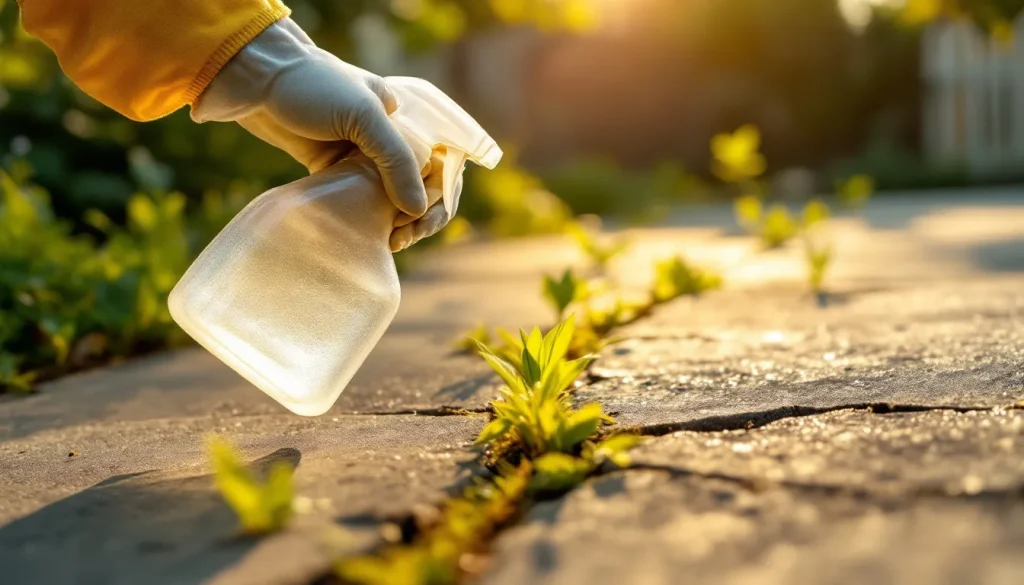
Yes, bleach works well on driveway and concrete-crack weeds because there is no soil to protect and the weeds are usually small annuals. Apply undiluted or 1:1 bleach directly into the crack on a dry, sunny day with no rain forecast for 24 hours. Expect browning in 1 to 3 days. Persistent crack weeds may need a repeat pass.
Two driveway-specific cautions. First, bleach can discolor or lighten colored or stamped concrete and corrode nearby metal (gate hinges, railings, car parts), so rinse over-spray off metal. Second, driveways drain. Bleach poured on a driveway can run to the gutter and reach a storm drain, so apply only what soaks into the crack and never hose the excess into the street.
A non-chemical alternative for cracks is boiling water, which kills small weeds instantly with no residue and no staining. It just does not stop new seeds from germinating.
How to make and apply a DIY bleach weed killer
A basic bleach weed killer is household bleach, optionally cut 1:1 with water, plus a small amount of dish soap as a surfactant so it clings to leaves. Apply in a targeted way on a calm, dry, sunny day. Never broadcast-spray it, and never mix it with anything except water.
- Wear gloves, eye protection, and old clothing. Bleach stains fabric and irritates skin and eyes.
- Mix in a clearly labeled plastic sprayer: undiluted for fastest kill, or 1 part bleach to 1 part water for lighter jobs. Add about 1 teaspoon dish soap per quart.
- Spray only the target weed’s leaves until lightly wet. Avoid runoff and over-spray onto wanted plants, metal, and colored concrete.
- Wait 1 to 3 days. Re-treat any green regrowth, especially on taprooted perennials.
- Keep pets and children off the area until it is fully dry and the smell is gone.
Critical safety rule: never mix bleach with vinegar, ammonia, or commercial cleaners. Bleach plus acid (like vinegar) or ammonia releases toxic chlorine or chloramine gas that can cause serious respiratory injury. Use bleach alone, with water only.
Bleach vs vinegar vs Roundup vs salt vs boiling water
Bleach is fast and cheap but sterilizes soil and rarely kills roots. Vinegar (horticultural strength) is similar but biodegrades faster. Roundup (glyphosate) is the only common option that kills roots systemically. Salt persists in soil the longest. Boiling water is the safest and cheapest for small crack weeds. The table below compares them on what searchers actually weigh.
| Method | Speed (visible kill) | Rough cost | Kills roots? | Soil persistence | Main risk |
|---|---|---|---|---|---|
| Bleach (sodium hypochlorite) | 1 to 3 days | Very low | Rarely | Weeks to months | Soil sterility, runoff, gas if mixed |
| Vinegar (20 to 30% horticultural) | Hours to 2 days | Low to moderate | Rarely | Days | Skin/eye burns, regrowth |
| Roundup (glyphosate) | 5 to 14 days | Moderate | Yes (systemic) | Low in soil | Drift, regulatory and health debate |
| Salt (rock or table) | Days | Very low | Sometimes, with repeat | Months to years | Long-term soil damage, spread |
| Boiling water | Instant to 1 day | Near zero | Small weeds only | None | Burns, only small weeds |
The takeaway: if you want roots dead, glyphosate is the only listed option built for it. If you want a chemical-free crack treatment, boiling water wins. Bleach mainly competes on being already in your laundry room, not on being the best tool.
Safety, pets, and the environment
Bleach poses real risks around pets, children, and waterways. Sodium hypochlorite is toxic if ingested and irritating to skin, eyes, and lungs. It can run off hard surfaces into storm drains, which usually flow untreated to creeks and rivers, where chlorine harms fish and aquatic life. Keep treated areas dry and off-limits until the smell clears.
- Pets and kids: keep off treated areas until fully dry; the residue and fumes can irritate paws, skin, and airways.
- Waterways: never apply before rain and never rinse excess toward gutters or storm drains.
- Storage: label sprayers, store away from acids and ammonia, and never reuse a bleach sprayer for other chemicals.
The verdict: should you use bleach on weeds?
Generally, no. Bleach kills weeds you can see, but it rarely kills perennial roots, it sterilizes soil for weeks to months, it can stain concrete and corrode metal, and it can run off into waterways. The only reasonable use is occasional spot treatment of small weeds on bare hardscapes where nothing will grow again, and even there, boiling water is safer.
For lawns, beds, and gardens, choose a tool matched to the job: selective herbicides for turf, systemic glyphosate for stubborn perennials, or hand-pulling and mulch for a chemical-free approach. Build your plan from our lawn care and weed control learning hub rather than reaching for the bleach jug.
Frequently Asked Questions
Does bleach kill weeds permanently, or do they grow back?
It depends on the weed. Bleach permanently kills young annual weeds with shallow roots. It usually does not kill perennials with deep taproots or rhizomes, such as dandelions, thistle, and bindweed. On those, the top browns in 2 to 3 days but the plant regrows from the root in 1 to 4 weeks unless you repeat the treatment several times.
How fast does bleach kill weeds?
Household bleach at 5 to 8 percent sodium hypochlorite browns most soft weeds within 24 to 72 hours in full sun. Young, thin-leaved weeds wilt fastest, sometimes within a day. Mature or waxy weeds take longer and may need a second pass. Heat and direct sunlight speed the kill, while cool, cloudy, or rainy weather slows it and dilutes the bleach.
What is the best bleach-to-water ratio for killing weeds?
For fastest top-growth kill, many people use undiluted household bleach. A common diluted recipe is 1 part bleach to 1 part water plus about 1 teaspoon of dish soap per quart so it sticks to leaves. Higher concentration browns weeds faster but increases soil sterility and runoff risk. Never add vinegar or ammonia, which creates toxic chlorine gas.
Bleach vs vinegar vs Roundup, which kills weeds better?
Roundup (glyphosate) kills weeds best long-term because it is systemic and kills roots in 5 to 14 days. Bleach and horticultural vinegar both kill top growth fast (hours to 3 days) but rarely kill roots, so weeds regrow. Vinegar biodegrades in days; bleach can sterilize soil for weeks to months. For permanent root-kill, glyphosate wins.
Does bleach kill weeds on a driveway or in concrete cracks?
Yes. Driveway and concrete-crack weeds are usually small annuals with no soil to protect, so bleach works well. Apply undiluted or 1:1 into the crack on a dry, sunny day and expect browning in 1 to 3 days. Watch for discoloration on colored concrete, corrosion of nearby metal, and runoff toward storm drains.
Is bleach safe for soil, and how long until I can plant again?
No, bleach is not safe for soil. It kills microbes, breaks down organic matter, and raises pH. Active chlorine off-gasses in days, but altered pH and leftover sodium can keep soil too hostile to plant for several weeks to a few months. Before replanting, flush with deep watering over 2 to 4 weeks, retest pH, and add compost.
Will bleach kill the roots or just the top of the weed?
Usually just the top. Sodium hypochlorite is a contact oxidizer that destroys leaf tissue but does not translocate through the plant to the roots. Shallow-rooted annuals often die outright. Perennials with taproots or rhizomes survive at the crown and resprout, so root-kill requires repeated applications or a systemic herbicide instead.
Is it safe to spray bleach around pets, kids, and storm drains?
Use caution. Bleach is toxic if ingested and irritates skin, eyes, and lungs, so keep pets and children off treated areas until fully dry and odor-free. Never apply before rain or rinse excess toward gutters, because bleach can reach storm drains and harm fish and aquatic life downstream. Apply only what soaks into the target spot.