
By the HMNDP Editorial Team, independent reporting on lawn care, landscaping, and the green industry.
Last reviewed: June 2026
Does salt kill weeds? Yes, and here is how it works
Salt does kill weeds. Sodium chloride pulls water out of plant cells through osmosis, dehydrating leaves, stems, and roots until the plant collapses. It works on almost any weed it touches in high enough concentration. The catch is that salt does the same thing to soil, and it stays there for months or years, so it belongs only on hardscape, never in garden beds.
The mechanism is straightforward. When salt dissolves around a plant’s roots, it raises the salt concentration in the soil water above the concentration inside the root cells. Water then moves out of the plant to balance the two, a process called osmotic dehydration. The plant essentially dies of thirst while sitting in moisture.
That same power is why salt is a poor choice almost everywhere except cracks in paving, gravel, and stone. If you want a weed killer for planted areas, see our guide on weed killers that won’t kill grass instead.
The exact salt-to-water ratio to kill weeds
For a sprayable salt weed killer, dissolve 1 cup of table salt in 2 cups of hot water (a 1:2 salt-to-water ratio by volume) for light weeds, or 3 cups salt in 1 cup water (3:1) as a saturated heavy-duty mix for established weeds. Add 1 tablespoon of dish soap per quart so the solution clings to leaves. Apply only to hardscape.
Strength scales with the weed. Use the table below as a starting point. Hot water dissolves more salt and helps it penetrate faster.
| Weed situation | Salt-to-water ratio (by volume) | Notes |
|---|---|---|
| Young seedlings in cracks | 1:3 (1 cup salt : 3 cups water) | Lightest mix, spot spray |
| Established broadleaf weeds | 1:2 (1 cup salt : 2 cups water) | Add 1 tbsp dish soap per quart |
| Deep-rooted or woody weeds | 3:1 (saturated, 3 cups salt : 1 cup water) | Repeat in 7 to 10 days |
Apply on a dry, sunny day with no rain forecast for 24 to 48 hours, because rain dilutes and washes the solution off target. Use a labeled spray bottle and keep it off any surface where you want plants to grow later.
How to apply salt to weeds in pavers and driveway cracks
For paver, patio, and driveway cracks, pour roughly 1 to 2 teaspoons of dry rock salt or table salt directly into each crack, then drizzle a little hot water to dissolve it, or spray the 1:2 salt solution into the seam. Salt settles into the joint, dehydrates the weed, and discourages quick regrowth. Expect visible wilting in 2 to 3 days.
- Pull or cut the largest weeds first so the salt reaches the crown and roots.
- Pour 1 to 2 teaspoons of dry salt per crack, or spray the saturated solution until the crack is wet.
- Add a splash of hot water over dry salt to start dissolving it into the joint.
- Keep foot traffic and pets off the area until it dries.
- Wait 7 to 14 days, then reapply to any survivors.
This is the same approach we cover for non-selective options in our weed and grass killer rundown. On hardscape, salt is cheap and effective. On a lawn or bed, it is a mistake.
Will rock salt kill weeds on stones and gravel?
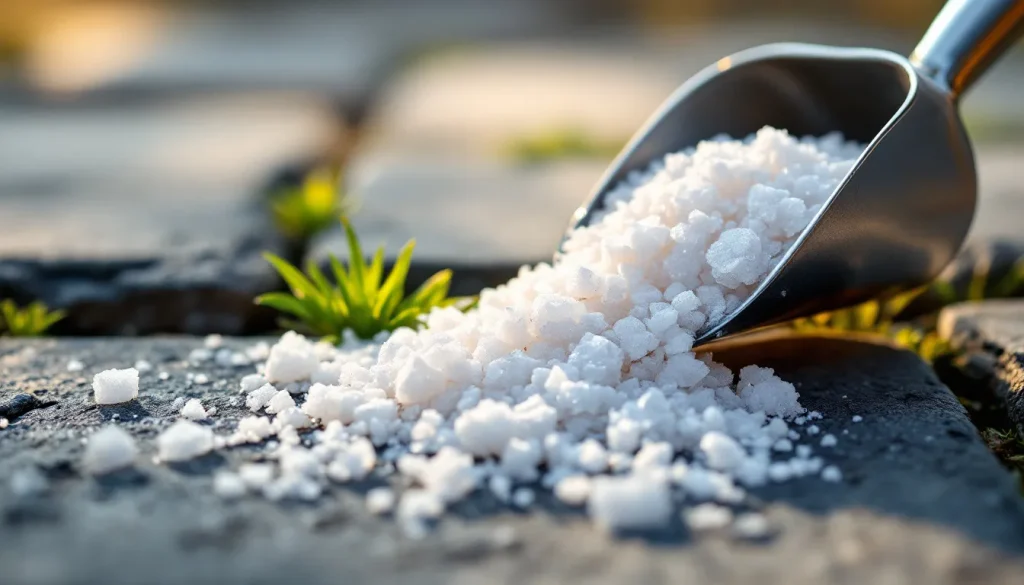
Yes. Rock salt, the coarse sodium chloride sold for de-icing, kills weeds on gravel, stone paths, and paving joints. The larger crystals dissolve slowly, so they keep releasing salt over several rains, which extends the kill window. Sprinkle a thin, visible layer over the weeds or pack it into joints, then wet it to start the reaction.
Rock salt is the right form for areas where you never intend to grow anything: gravel driveways, stone borders against a fence, and wide paver gaps. Avoid scattering it within a few feet of lawn edges, beds, or tree roots, because the slow release also means a longer leaching trail toward those plants.
Salt vs vinegar for killing weeds: a side-by-side
Vinegar (acetic acid) burns weed foliage on contact and is gentler on soil than salt because acetic acid breaks down within days. Salt kills more thoroughly and lingers longer, but it sterilizes soil. For a quick top-kill in a bed you will replant, vinegar wins. For long-term suppression in a gravel path you never plant, salt wins. The table makes the trade-offs concrete.
| Factor | Salt (sodium chloride) | Vinegar (5% to 30% acetic acid) |
|---|---|---|
| Speed of visible kill | 2 to 4 days | Hours to 1 day |
| Root kill | Good at high doses, reaches roots through soil water | Poor, mostly top growth, weeds often regrow |
| Soil persistence | Months to years until rain leaches it out | Breaks down in days, low residual |
| Approximate cost | About 1 to 2 USD per pound (table or rock salt) | About 3 to 6 USD per gallon (household 5%) |
| Reapplication | Every few weeks until salt load builds | Often weekly, regrowth is common |
| Best use | Permanent hardscape, gravel, joints | Spot kill where you will replant later |
Many people mix salt, vinegar, and dish soap into a homemade killer. That combination is more aggressive but combines salt’s soil persistence with vinegar’s corrosiveness, so reserve it for hardscape only. For planted areas, our overview of how to get rid of weeds covers safer methods.
Does salt kill weeds permanently? How long it stays in soil
No, salt is not a permanent solution, and that is the part competitors gloss over. Salt does not break down the way vinegar or organic herbicides do. It only leaves the soil when water leaches it downward and away. Until then it stays in place, killing whatever tries to grow. New weed seeds blow in and germinate once the surface salt washes out, which is why you reapply.
How long soil stays sterile depends on the salt load and rainfall. The estimates below are practical ranges, not lab guarantees, and vary with soil type and drainage.
| Salt load applied | Approximate sterile period | Conditions |
|---|---|---|
| Light spray (single 1:2 application) | 3 to 8 weeks | Regular rain, well-drained soil |
| Moderate (repeated sprays in cracks) | 2 to 6 months | Average rainfall |
| Heavy (thick rock salt layer) | 6 months to 2 years or more | Low rainfall, clay or poorly drained soil |
In dry climates or compacted clay, where water moves slowly, salt can keep soil bare for years. In rainy regions with sandy, fast-draining soil, the same dose may flush out in a couple of months.
Will salt damage concrete, pavers, and nearby plants?
Yes, salt can damage hardscape and harm desirable plants. Sodium chloride is corrosive: repeated salting can cause surface pitting, scaling, and spalling on concrete and some pavers, especially through freeze-thaw cycles. Salt also moves with water, so it can leach sideways and down into the root zones of lawns, shrubs, and tree roots several feet away, browning or killing plants you wanted to keep.
The risks worth weighing before you pour:
- Concrete and paver corrosion: chloride accelerates pitting and can corrode any embedded metal, so avoid heavy salting on newer or decorative concrete.
- Lateral leaching to plants: salt travels with rain and irrigation toward lawn edges, beds, and tree roots downhill from the treated spot.
- Runoff and legality: chloride runoff can reach storm drains, streams, and groundwater. Some local rules may restrict it, so check municipal guidance, especially near waterways.
- Pet safety: concentrated salt can irritate paws and is harmful if a dog or cat licks large amounts, so keep animals off treated areas until rinsed or dry.
Because the damage and leaching are hard to undo, salt is best kept far from anything green you value.
How to fix or detox soil after using salt
To remediate salted soil, the goal is to displace sodium and flush it below the root zone. Apply gypsum (calcium sulfate) at roughly 2 to 4 pounds per 100 square feet. Calcium swaps places with sodium on soil particles, freeing the salt to wash away. Then water deeply and repeatedly so the salt leaches downward, out of the top layer where roots live.
- Spread gypsum at about 2 to 4 pounds per 100 square feet over the affected area and work it lightly into the surface.
- Water slowly and deeply, applying several inches over a week or two, to drive salt below the root zone.
- Add 2 to 4 inches of compost or organic matter to improve structure and help future plants tolerate residual salt.
- Test by planting fast-growing seeds (radish or grass) after a few weeks. Healthy germination signals the salt has cleared enough.
- Repeat the gypsum and deep-watering cycle if seedlings still struggle.
Heavily salted soil can take a full season or longer to recover. Improving drainage and adding organic matter speeds the process. To plan replanting and treatment, our lawn and landscaping learning hub has step-by-step guides.
Frequently Asked Questions
Does salt kill weeds permanently?
No. Salt is not permanent because it does not break down. It only leaves soil when water leaches it away, and new weed seeds germinate once surface salt washes out. A single application keeps an area bare for weeks to a few months. Heavy rock salt loads in dry or clay soil can suppress growth for a year or more, but eventually rain flushes it out.
What is the best salt-to-water ratio to kill weeds?
For most weeds, dissolve 1 cup of salt in 2 cups of hot water, a 1:2 ratio, and add 1 tablespoon of dish soap per quart so it sticks. Use a lighter 1:3 mix on seedlings and a saturated 3:1 mix on deep-rooted or woody weeds. Apply only to hardscape on a dry, sunny day with no rain expected for 24 to 48 hours.
Is salt or vinegar better for killing weeds?
It depends on the spot. Vinegar burns top growth in hours and breaks down in days, making it safer where you will replant. Salt kills more thoroughly and suppresses regrowth for weeks to months but sterilizes soil and lingers. Use vinegar for quick spot kills in beds and salt for permanent hardscape like gravel paths and paver joints you never intend to plant.
Does salt kill weeds in pavers and driveway cracks?
Yes. Pour 1 to 2 teaspoons of dry salt into each crack, or spray a saturated salt solution into the joint, then add hot water to dissolve it. Weeds wilt in 2 to 3 days. Reapply after 7 to 14 days to any survivors. This works well on hardscape because nothing should grow there, but keep salt away from lawn edges and bed borders.
Will rock salt kill weeds?
Yes. Rock salt, the coarse de-icing form of sodium chloride, kills weeds on gravel, stone, and paving joints. Its larger crystals dissolve slowly across several rains, extending the kill window. Sprinkle a thin layer over weeds or pack it into joints and wet it. Keep it several feet from lawns, beds, and tree roots, because the slow release also means a longer leaching trail toward desirable plants.
How long does salt stay in the soil after killing weeds?
A light spray clears in roughly 3 to 8 weeks with regular rain and good drainage. Repeated applications can keep soil bare for 2 to 6 months. A heavy rock salt layer in low-rainfall or clay soil can persist 6 months to 2 years or more. Salt only leaves as water leaches it downward, so dry climates and poor drainage extend how long it lingers.
Will salt damage my concrete, pavers, or nearby plants?
It can. Chloride is corrosive and repeated salting can pit, scale, or spall concrete and some pavers, especially with freeze-thaw cycles. Salt also moves with water and can leach sideways into the root zones of lawns, shrubs, and trees several feet away, browning or killing them. Keep salt off decorative or new concrete and well away from anything green you want to keep.
How do I fix or detox soil after using salt to kill weeds?
Apply gypsum at about 2 to 4 pounds per 100 square feet so calcium displaces sodium, then water deeply over a week or two to flush salt below the root zone. Add 2 to 4 inches of compost to rebuild structure. Test with fast-growing seeds after a few weeks, and repeat the cycle if needed. Heavily salted soil can take a full season or longer to recover.