
By the HMNDP Editorial Team, independent reporting on lawn care, landscaping, and the green industry.
Last reviewed: June 2026
Backyard hardscape ideas, sorted by budget and yard size
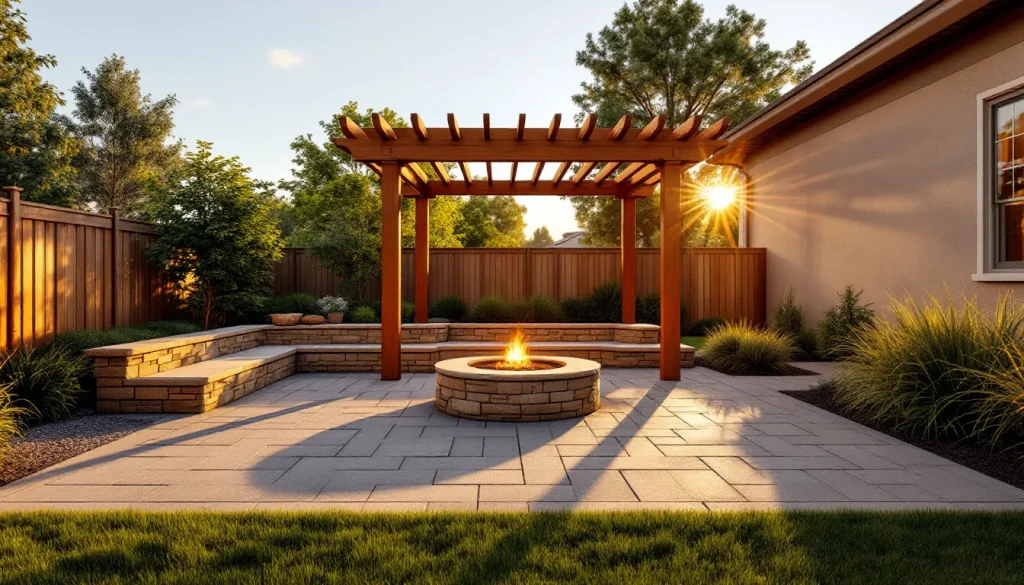
Backyard hardscape ideas are the permanent, non-living features of an outdoor space: patios, walkways, retaining walls, fire pits, seating walls, and structures like pergolas. In 2026, a small paver patio starts near $2,000, a basic fire pit near $700, and a full outdoor kitchen can pass $20,000. This guide gives you the pictures, the prices, and a material decision framework so you can plan before you spend.
Most galleries show you pretty photos and stop there. We added the cost table, the material comparison, and the permitting and build steps that turn inspiration into a finished project. Budget-conscious and small-yard readers get their own sections first because that is what the related searches ask for.
Hardscape vs softscape: what actually counts as hardscape
Hardscape is every hard, non-living element of a landscape: stone, concrete, pavers, brick, gravel, wood structures, and metal. Softscape is the living layer: lawn, garden beds, shrubs, trees, and mulch. A backyard needs both. Hardscape gives structure, drainage control, and usable flat surfaces. Softscape adds color, softness, and shade. A good design usually runs 60 to 70 percent softscape by area with hardscape anchoring the high-use zones.
The distinction matters for budgeting and permits. Hardscape is where most of the money goes (masonry and labor are expensive) and where local rules most often apply, because permanent structures and paved surfaces affect drainage and setbacks. If you want more on balancing both layers across a whole property, see our 2026 yard design guide.
What backyard hardscaping costs in 2026 (the table every gallery skips)
Backyard hardscaping in 2026 typically runs $15 to $50 per square foot installed for patios and walkways, with premium natural stone reaching $60 or more. Standalone features price separately: a fire pit runs $700 to $4,500, a retaining wall $40 to $90 per square foot of face, and an outdoor kitchen $8,000 to $25,000. The table below gives realistic installed ranges before you call a contractor.
| Project | Typical installed cost (2026) | DIY material-only cost | Notes |
|---|---|---|---|
| Paver patio | $18 to $35 / sq ft | $6 to $14 / sq ft | Base prep drives labor cost |
| Poured concrete patio | $10 to $20 / sq ft | Not DIY-friendly at scale | Stamped adds $8 to $18 / sq ft |
| Flagstone / natural stone patio | $25 to $60 / sq ft | $12 to $30 / sq ft | Irregular shapes raise labor |
| Gravel patio or path | $6 to $12 / sq ft | $2 to $5 / sq ft | Cheapest, needs edging |
| Walkway (paver or stone) | $15 to $40 / sq ft | $5 to $15 / sq ft | Narrow runs cost more per foot |
| Retaining wall (block) | $40 to $90 / sq ft of face | $18 to $35 / sq ft | Over 4 ft usually needs an engineer |
| Fire pit (kit or built) | $700 to $4,500 | $300 to $1,200 | Gas lines add cost |
| Seating wall | $100 to $250 / linear ft | $40 to $90 / linear ft | Caps and lighting extra |
| Outdoor kitchen | $8,000 to $25,000+ | $3,000 to $8,000 | Utilities and appliances dominate |
| Pergola (kit) | $3,000 to $9,000 | $1,200 to $4,000 | Cedar and aluminum cost more than pine |
| Water feature (pondless) | $3,000 to $9,000 | $1,000 to $3,500 | Pumps and liner drive price |
These ranges reflect mid-2026 U.S. averages and shift with region, site access, and grade. Sloped yards, poor soil, and long material carries all push labor up. Always price base prep and drainage separately, because that hidden work is where quotes diverge most.
Best budget backyard hardscape ideas (under $2,500)
Budget backyard hardscape ideas start with gravel, DIY paver kits, and salvaged material. A pea-gravel patio can cost under $800 in materials for 200 square feet. A prefab paver fire pit kit runs $300 to $700. Reclaimed brick paths and mulch-and-stepping-stone walkways deliver a finished look for a few hundred dollars if you do the labor yourself.
- Pea-gravel patio with steel edging. Roughly $3 to $5 per square foot in materials. Level, lay landscape fabric, add a base, and pour gravel. Add a fire bowl for an instant gathering spot.
- Prefab paver fire pit kit. Home-center kits from brands like Pavestone or RumbleStone assemble in an afternoon for $300 to $700.
- Stepping-stone path through mulch. Large concrete pavers spaced in mulch or gravel cost under $150 for a short run and read as intentional design.
- Gabion planters or low walls. Wire baskets filled with rock create modern low walls for $30 to $60 per linear foot in materials.
- Reclaimed brick edging and borders. Salvaged brick from marketplace listings defines beds and paths for pennies per unit.
- Concrete paver “dry-lay” patio. A small 100-square-foot dry-laid paver patio can land near $1,000 to $1,400 in materials without renting heavy equipment.
The budget rule: buy fewer square feet of a nicer material rather than a big expanse of cheap material. A tight, well-built 120-square-foot flagstone landing looks better than a sprawling, uneven concrete slab. For hauling gravel and mulch correctly, our guide on how many cubic feet are in a yard helps you order the right volume and avoid overpaying.
Small backyard hardscape ideas that beat the square footage
Small backyard hardscape ideas use vertical elements, multi-purpose features, and single strong focal points instead of large paved areas. A seating wall doubles as a border and a bench. A corner fire pit anchors a compact patio. Light-colored pavers and diagonal patterns make tight spaces read larger. The goal is one well-defined outdoor room, not several half-used zones.
- Corner patio with a built-in seating wall. A wall that wraps a corner adds seating without eating floor space, freeing the center for a table.
- Vertical hardscape: stone or gabion privacy screens. A 6-foot masonry or gabion screen adds privacy and structure where a fence would feel heavy.
- Diagonal paver layout. Running pavers at 45 degrees draws the eye across the longest dimension and makes a small yard feel wider.
- Compact water feature. A wall-mounted or bubbling-urn fountain adds sound and a focal point in under 6 square feet.
- Single-material patio. Using one paver and one color across a small space avoids visual clutter and expands perceived size.
- Fold-down or built-in bar ledge. A narrow masonry ledge along a wall replaces a bulky outdoor kitchen in a courtyard-sized yard.
In small yards, drainage errors show up fast because water has nowhere to go. If your compact space floods, pairing hardscape with a backyard rain garden can absorb runoff from the new paved surface instead of pushing it toward the house.
Paver, concrete, flagstone, and gravel patios
A patio is the anchor of most backyard hardscape plans and the single largest surface you will build. The four common surfaces are pavers, poured concrete, natural stone (flagstone), and gravel. Pavers offer the best repairability, concrete the lowest cost per square foot, flagstone the most premium look, and gravel the cheapest and most permeable option. Match the material to your budget, climate, and DIY appetite.
- Paver patios use interlocking concrete or clay units over a compacted base. They flex with freeze-thaw, and you can lift and reset a single unit if it settles.
- Poured concrete patios cost the least per square foot but crack over time and are hard to repair invisibly. Stamped and colored finishes mimic stone.
- Flagstone patios use irregular natural slabs set in gravel, sand, or mortar. The look is high-end; the labor is high because every stone is fitted by hand.
- Gravel patios drain freely and cost the least overall, but need edging to contain them and occasional topping up.
Walkways, pathways, and steps for grade changes
Walkways connect zones and control where people (and water) move through a yard. Primary paths should be 36 to 48 inches wide so two people can pass; secondary garden paths can drop to 24 inches. On slopes, steps and terraced landings turn an unusable grade into a design feature. Any run with more than about a 6-inch drop over a short distance usually needs formal steps for safety.
Steps and grade changes are where amateur builds most often fail. Consistent riser height (6 to 7 inches) and deep treads (12 inches or more) prevent trips, and every step needs a compacted base and drainage behind it. For steep yards, a series of low retaining walls with planted terraces both holds the grade and creates layered planting beds.
Retaining walls and seating walls
Retaining walls hold back soil on a slope and create flat, usable terraces; seating walls are lower freestanding walls (16 to 18 inches tall) that double as benches. Block retaining walls run $40 to $90 per square foot of face installed, and any wall over 4 feet tall typically requires engineering and a permit. Seating walls run $100 to $250 per linear foot and often frame a patio or fire pit.
Retaining walls live or die on drainage. Water pressure behind a wall (hydrostatic load) is the number one cause of failure, so every properly built wall needs gravel backfill and a perforated drain pipe. Seating walls carry no soil load, which makes them a friendlier DIY project. Cap both with a flat coping stone for a finished edge and comfortable seating.
Fire pits and fire features
A fire pit is the highest-return focal point per dollar in backyard hardscaping. Wood-burning kits cost $300 to $700 in materials and $700 to $1,500 installed; gas fire pits and linear fire tables run $1,500 to $4,500 once a gas line is added. Fire features extend the usable season into spring and fall and reliably become the gathering point of a yard.
Placement rules matter. Keep any fire feature at least 10 feet from structures, fences, and overhanging trees, and check local burn ordinances before buying wood-burning. Gas models need a licensed plumber for the line in most jurisdictions. A ring of pavers or a low seating wall around the pit turns it from an object into an outdoor room.
Water features
Water features add sound, movement, and a focal point, and they range from a $150 self-contained fountain to a $9,000 installed pondless waterfall. Pondless (disappearing) waterfalls are the most popular backyard choice in 2026 because they hide the reservoir underground, eliminate standing water and mosquito concerns, and need less maintenance than a full pond. Bubbling urns and wall fountains suit small yards.
Budget for the pump and ongoing electricity, not just the installation. A recirculating pump runs continuously in season and is the part most likely to need replacement every 3 to 5 years. Site any water feature where you can see and hear it from a patio or window, because the payoff is sensory, not visual alone.
Outdoor kitchens and dining zones
An outdoor kitchen is the most expensive common hardscape project, running $8,000 to $25,000 or more installed. Cost is driven by utilities (gas, water, electrical, sometimes a drain), masonry for the counter structure, and appliances. A budget “grill surround” with a built-in gas grill and stone counter can land near $4,000, while a full setup with a sink, refrigerator, and pizza oven passes $20,000 quickly.
Plan utilities before masonry. Running gas, water, and 120/240-volt electrical to a fixed location is the expensive, disruptive part, and it usually requires permits and licensed trades. If budget is tight, build the masonry base and counter now and add appliances in phases. Position the kitchen near the house so plumbing and gas runs stay short.
Pergolas, structures, and shade
Pergolas and shade structures define an outdoor room overhead and make a patio usable in summer heat. Kit pergolas run $3,000 to $9,000 installed depending on material: pressure-treated pine is cheapest, cedar and aluminum cost more but last longer, and motorized louvered “smart” pergolas top the range. A pergola over a dining zone or seating area instantly reads as a designed space rather than an afterthought.
Match the structure to your climate. Open-slat pergolas filter light but do not stop rain; add a retractable canopy or louvered roof for real shelter. Anchor posts to concrete footings below the frost line so the structure does not heave or lean. Freestanding pergolas are more flexible than attached ones and rarely need a house-tie permit.
Focal points, zones, and outdoor rooms
Good backyard design breaks the space into zones (outdoor rooms) each anchored by a focal point. A focal point is one strong feature that pulls the eye: a fire pit, a water feature, a specimen tree, or a pergola. Zones give a yard purpose, a dining area, a lounge area, a play area, and hardscape (paths, walls, changes in paving) signals the transition between them.
Use a change in material or level to separate zones without walls. A shift from paver patio to gravel lounge, or a single step down to a fire-pit area, tells the eye “new room” while keeping sight lines open. In small yards, one focal point is enough; multiple competing features make a compact space feel busy and smaller.
Material types: pavers vs concrete vs natural stone vs brick vs gravel
The right hardscape material depends on budget, climate, durability needs, and how much repair you want to deal with. Pavers win on repairability and freeze-thaw performance, poured concrete on upfront cost, natural stone on looks and longevity, brick on classic style, and gravel on price and drainage. The table below is the decision framework the image galleries never provide.
| Material | Installed cost / sq ft | Lifespan | Repairability | Best for | Watch out for |
|---|---|---|---|---|---|
| Concrete pavers | $18 to $35 | 25 to 50 yrs | Excellent (lift and reset) | Patios, driveways, freeze-thaw climates | Base prep quality is everything |
| Poured concrete | $10 to $20 | 20 to 30 yrs | Poor (cracks show) | Budget patios, clean modern look | Cracking, hard to repair invisibly |
| Natural stone / flagstone | $25 to $60 | 50 to 100+ yrs | Good | Premium patios, timeless look | High labor, uneven surfaces |
| Clay brick | $15 to $30 | 50 to 100 yrs | Good | Classic paths, edging, traditional homes | Can chip in hard freezes if low-fired |
| Gravel / decomposed granite | $6 to $12 | 10 to 20 yrs (with topping) | Easy (rake and refill) | Budget patios, paths, drainage areas | Migrates without edging, not stroller-friendly |
Climate is the tiebreaker. In freeze-thaw regions, pavers and their flexible base outperform rigid poured concrete, which cracks as the ground heaves. In hot, dry climates, decomposed granite and concrete perform well and cost less. In poorly draining clay soil, choose permeable options (gravel, permeable pavers) or add a drainage plan, because water trapped under a slab is the fastest route to failure.
Driveways and edging (the secondary hardscape)
Driveways and edging are the finishing hardscape that ties a yard together. Paver and permeable-paver driveways cost more upfront ($15 to $30 per square foot) than asphalt but last longer and manage stormwater better. Edging, steel, aluminum, stone, or brick, keeps gravel and mulch in place and gives beds a crisp line for $5 to $20 per linear foot installed.
Edging is the cheapest upgrade with the biggest visual payoff. A clean, continuous border between lawn and bed makes an entire yard look maintained. For driveways, permeable pavers can help with local stormwater rules and reduce runoff, which matters in areas that regulate impervious surface coverage.
From inspiration to built: permits, base prep, DIY vs pro, and ROI
Turning a hardscape idea into a finished project runs in a fixed order: plan and measure, check permits, prep the base, build, then finish. The base (excavation, compacted gravel, and drainage) is 60 percent of the work and where most DIY failures start. Permits are commonly required for walls over 4 feet, structures on footings, and anything adding impervious surface. Skipping base prep or permits is what turns a cheap project expensive.
Do I need a permit?
Permit rules vary by municipality, but hardscape permits are often required for retaining walls over 3 to 4 feet, permanent structures like pergolas on footings, outdoor kitchens with gas and electrical, and projects that increase impervious surface or affect drainage and setbacks. Patios at grade frequently do not need one. Always confirm with your local building department before you dig, because retroactive permits and teardowns are expensive.
Base prep and drainage (the 60 percent nobody photographs)
A durable hardscape sits on a compacted base, not on dirt. The standard sequence is excavate 7 to 10 inches, lay geotextile fabric, add 4 to 6 inches of compacted crushed gravel, add a bedding layer, then set the surface. Slope every hard surface 1 to 2 percent (about 1/4 inch per foot) away from the house so water drains. Poor base prep and bad slope cause almost every settling, heaving, and pooling problem.
DIY vs hiring a contractor
DIY suits gravel patios, small dry-laid paver areas, fire pit kits, and seating walls under 2 feet. Hire a pro for retaining walls over 3 feet, outdoor kitchens with utilities, large patios needing compaction equipment, and any project requiring engineering or permits. The break-even is honest labor time and equipment rental: a plate compactor, saw, and material haul often erase DIY savings on larger jobs.
| Good DIY projects | Hire a pro |
|---|---|
| Gravel patio or path | Retaining wall over 3 ft |
| Fire pit kit | Outdoor kitchen with utilities |
| Seating wall under 2 ft | Large patio needing compaction |
| Stepping-stone walkway | Anything needing a permit or engineer |
| Bed edging | Structural steps and grade changes |
If you hire out, vet the contractor before you sign. Base prep is invisible once buried, so references, a written scope, and a drainage plan matter more than the lowest bid. Our hardscape contractor vetting checklist covers the questions that separate durable builds from callbacks.
Does hardscaping add value?
Quality hardscaping generally adds resale value and outdoor living space, with well-built patios and fire features often recovering a meaningful share of their cost at sale. Return depends on build quality, how the feature fits the home and neighborhood, and local market demand for outdoor living. Over-improving a small or modest home rarely pays back fully, so scale the investment to the property.
Frequently Asked Questions
What is hardscaping and how is it different from softscaping?
Hardscaping is the permanent, non-living part of a landscape: patios, walkways, retaining walls, fire pits, pergolas, and driveways made of stone, concrete, pavers, brick, or wood. Softscaping is the living layer: lawn, plants, shrubs, trees, and mulch. Hardscape provides structure, drainage control, and usable surfaces, while softscape adds color and softness. Most balanced yards use both, weighted toward softscape by area.
What are the most popular backyard hardscape ideas?
The most popular backyard hardscape ideas in 2026 are paver patios, fire pits, walkways, retaining and seating walls, pergolas, outdoor kitchens, and pondless water features. Paver patios and fire pits top the list because they deliver the most usable space and gathering value per dollar. Seating walls and pergolas are rising fast because they define outdoor rooms without needing a large yard.
How much does backyard hardscaping cost?
Backyard hardscaping typically costs $15 to $50 per square foot installed in 2026 for patios and walkways. Standalone features price separately: fire pits run $700 to $4,500, retaining walls $40 to $90 per square foot of face, and outdoor kitchens $8,000 to $25,000 or more. Base prep, drainage, sloped sites, and premium natural stone push costs toward the top of each range.
What are some backyard hardscape ideas on a budget?
Budget backyard hardscape ideas include a pea-gravel patio ($3 to $5 per square foot in materials), a prefab paver fire pit kit ($300 to $700), stepping-stone paths through mulch, gabion low walls, and reclaimed brick edging. The best budget strategy is buying a smaller area of a nicer material rather than a large expanse of the cheapest option, and doing the labor yourself where the project is DIY-friendly.
What are the best hardscape ideas for a small backyard?
The best small-backyard hardscape ideas use vertical elements and multi-purpose features: a corner patio with a built-in seating wall, a diagonal paver layout to make the space read larger, a compact bubbling-urn water feature, and a single strong focal point instead of several zones. Light-colored pavers and one consistent material expand perceived size in tight spaces.
What is the best material for a backyard patio: pavers, concrete, or natural stone?
Pavers are the best all-around patio material for most homeowners because they flex with freeze-thaw, and a single unit can be lifted and reset if it settles. Poured concrete costs the least per square foot but cracks and is hard to repair invisibly. Natural stone looks the most premium and lasts longest but costs $25 to $60 per square foot installed. Choose by climate, budget, and repairability.
Do I need a permit to add hardscaping to my backyard?
You may need a permit depending on your municipality and the project. Permits are commonly required for retaining walls over 3 to 4 feet, structures on footings like pergolas, outdoor kitchens with gas or electrical, and anything increasing impervious surface or affecting drainage and setbacks. At-grade patios often do not require one. Always confirm with your local building department before digging, as rules vary widely.
Can I install hardscaping myself or should I hire a contractor?
You can DIY gravel patios, small dry-laid paver areas, fire pit kits, seating walls under 2 feet, and bed edging. Hire a contractor for retaining walls over 3 feet, outdoor kitchens with utilities, large patios needing compaction equipment, and any project requiring permits or engineering. Base prep and drainage are the hard, buried work where DIY projects most often fail, so weigh that honestly.
Does hardscaping add value to your home?
Quality hardscaping generally adds resale value and expands usable outdoor living space, and well-built patios and fire features often recover a meaningful share of their cost at sale. Actual return depends on build quality, how well the feature suits the home and neighborhood, and local demand for outdoor living. Over-improving relative to the home or market can reduce payback, so scale the project to the property.