
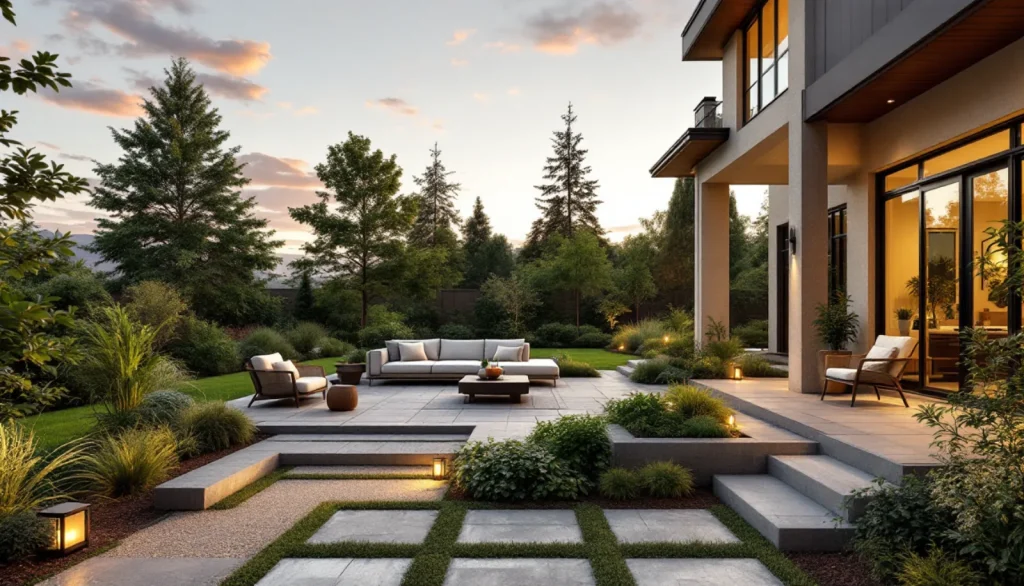
Good yard design in 2026 starts with three decisions made in this order: where the water goes, where you walk, and what grows in the leftover space. Most homeowners do it backwards. They buy plants at the big-box store in April, plant them in May, and spend the next three years watching half of them die because the soil drains poorly, the sun exposure was wrong, or the eventual mature size was triple what the tag said. This guide walks through the layout principles, plant selection by USDA zone, hardscape integration, and a realistic three-season phased install that keeps the budget from exploding.
The short version
- Drainage first: slope grade away from foundations at 6 inches over the first 10 feet (IRC R401.3).
- Plant by USDA zone (the 2023 map shifted half a zone warmer for most of the country, check yours before buying).
- Hardscape budget: $15 to $25 per sq ft for paver patios, $20 to $40 per linear ft for retaining walls under 4 ft.
- Phase 1 (year 1): grading, drainage, hardscape skeleton. Phase 2: trees and major shrubs. Phase 3: perennials and lawn finish.
- Buy plants from SiteOne or Ewing if you have a contractor account, otherwise local nurseries beat big-box on root quality.
- Budget realistic: $8,000 to $25,000 for a complete quarter-acre redesign, $40,000+ if you include a deck or pergola.
Step one is always drainage and grading
The single most expensive mistake in residential yard design is putting plants in the ground before solving the water. The 2021 International Residential Code (IRC R401.3) requires a minimum slope of 6 inches over the first 10 feet from the foundation. That sounds obvious, but a startling number of homes settle over time, downspouts dump straight into mulch beds, and the soil right against the foundation becomes a sponge that wicks water into basements and rots sill plates.
Before any plant goes in, walk the property after a heavy rain and mark the puddles with marking flags. Those are your drainage problems. Solutions in order of cost: regrade the soil ($800 to $2,500 for a small yard with a Bobcat), add French drains ($25 to $50 per linear foot installed), or build a backyard rain garden to absorb runoff (see our backyard rain garden build guide for the sizing math). For roof runoff specifically, extend downspouts at least 6 feet away from the foundation. Pop-up emitters work, buried 4-inch SDR-35 PVC is better.
Layout principles: lines of sight, focal points, transitions
Designers talk about “rooms” in a yard the same way architects talk about rooms in a house. Each outdoor room needs a floor (lawn, patio, or groundcover), walls (fence, hedge, or change of grade), and a ceiling (tree canopy, pergola, or sky). Without all three, the space feels unresolved.
| Design element | Function | Typical 2026 cost |
|---|---|---|
| Paver patio (entertainment room) | Floor of primary outdoor room | $15 to $25 per sq ft installed |
| Pergola or shade sail | Ceiling, partial shade | $3,500 to $12,000 installed |
| Privacy hedge (arborvitae, holly) | Walls, year-round screen | $45 to $120 per plant, 6 ft spacing |
| Walkway (paver or flagstone) | Transitions between rooms | $18 to $30 per sq ft installed |
| Retaining wall under 4 ft | Grade change, planting beds | $20 to $40 per linear ft (segmental block) |
| Lawn area (sod or seed) | Floor, recreation space | $0.50 per sq ft seed, $1.20 per sq ft sod |
Focal points matter more than people realize. Every outdoor room needs one terminus the eye lands on: a specimen tree, a sculpture, a fire pit, a fountain. Without it, the eye wanders and the space feels chaotic. Sight lines from the kitchen window and the primary patio seating area should each land on a focal point. If you can stand in your kitchen and see nothing but the back of the garage, you have a sight line problem and no amount of plant material fixes it.
Plant selection by USDA zone (the 2023 map changed things)
The USDA released a new Plant Hardiness Zone Map in November 2023. About half of the country shifted up a half-zone (warmer). If you are using plant lists from before 2023, double check. Chicago went from 6a to 6b, Atlanta from 7b to 8a, Denver from 5b to 6a in much of the metro. This matters because a plant rated to zone 6 will survive in your old zone 5 winters maybe four years out of five, but the increasing variance means those one bad winter still kills it.
For cool-season climates (zones 3 to 6), the backbone plants are oak, maple, serviceberry, hydrangea (panicle and smooth, not bigleaf), boxwood, and Kentucky bluegrass or tall fescue lawn. For transition zones (6b to 7b), add crepe myrtle, dogwood, southern magnolia (small cultivars), Zoysia or tall fescue lawn. For warm-season climates (8a and warmer), Bermuda or St. Augustine lawn, live oak, southern magnolia, crepe myrtle, palms in 9+, citrus in 9b+. Match the lawn species to your zone first since it is the biggest single visual element, then choose trees and shrubs that complement it.
Hardscape integration: patios, walkways, retaining walls
Hardscape is the skeleton. Once it is in, you can change plants every five years if you want, but you cannot move a patio without spending $3,000 to demo it. Get the hardscape right the first time.
Paver patios in 2026 cost $15 to $25 per sq ft installed using Belgard, Techo-Bloc, or Unilock pavers from SiteOne or Ewing distribution. The math: a 300 sq ft patio runs $4,500 to $7,500. Concrete pads are cheaper ($8 to $14 per sq ft) but crack within 10 to 15 years in freeze-thaw climates. Flagstone is more expensive ($25 to $40 per sq ft) but reads as more upscale.
Walkway widths matter more than people think. Single-file paths read as 3 feet wide. Two people walking abreast need 4 feet, ideally 5. If the primary path from the driveway to the front door is less than 4 feet wide, it feels stingy. The base prep is the difference between a walkway that lasts 25 years and one that heaves in 5: 6 inches of compacted crushed stone (3/4 inch minus), 1 inch of bedding sand, then pavers. Skip the base and the freeze-thaw cycle will eat you alive.
Retaining walls under 4 feet tall are within DIY range using segmental concrete block (Versa-Lok, Allan Block, Belgard StoneLedge). Anything over 4 feet typically requires an engineer’s stamp and a building permit in most jurisdictions, and the wall design needs geogrid reinforcement tied back into the soil mass. Do not freelance this. Failed retaining walls are how people get hurt and lawsuits get filed.
The three-season phased install (year one, year two, year three)
Doing a full yard makeover in one season is how budgets blow up and contractors disappear in August. The phased approach spreads cost and lets you live in the space before committing to the final plant palette.
Year 1 (spring through fall): the bones. Grading and drainage corrections first. Then hardscape: patio, primary walkways, any retaining walls, irrigation rough-in. Then large trees in fall (October planting beats spring planting for tree survival in most zones because roots establish during dormancy without leaf demand). Budget: $8,000 to $18,000 for a quarter-acre property. This is the year you spend the most and see the least visible result, which is psychologically brutal but structurally necessary.
Year 2: structural plants. Major shrubs along property lines, foundation plantings, hedge plantings. Plant in spring for shrubs (April to early June in cool-season zones, February to April in warm-season). Budget: $3,500 to $7,000. This is the year the yard starts looking intentional.
Year 3: finish layer. Perennials, groundcovers, lawn renovation or sod laydown, annual color beds, mulch refresh. Budget: $2,500 to $5,000. This is the year people start asking who did your yard. For lawn-specific renovation timing and costs, our 2026 lawn care cost guide breaks down service pricing by region. If the existing lawn has bare patches that need spot fixes before the full finish, the bare spot renovation walkthrough covers the 7-step process.
Irrigation: design it before you plant, not after
The most common irrigation regret is running drip lines after the mulch is already down. Plan the irrigation in Year 1 alongside the hardscape work. Mainline 1-inch poly tubing should be installed before walkways go in (run sleeves under walkways with 2-inch PVC for future access). Drip zones for planting beds, rotary zones for lawn.
For the lawn, Hunter MP Rotators or Toro Precision Series rotary nozzles deliver about 0.4 inches per hour, which matches deep watering targets without runoff. For beds, Netafim or Rain Bird Xerigation drip with pressure-compensating emitters. Smart controllers from Rain Bird (ESP-TM2) or Rachio (Gen 3) tie into a weather feed and skip cycles after rain, which cuts water usage 30% to 50%. For bed drip specifically, our drip irrigation install guide covers tubing sizing and emitter spacing. Smart controllers also qualify for utility rebates in California, Nevada, Arizona, and parts of Colorado, typically $80 to $200 back per unit.
Soil prep: the part nobody photographs
Plants don’t grow in dirt, they grow in soil. The difference is biology. Most suburban lots scraped during construction have 2 to 4 inches of degraded topsoil over compacted subsoil. New plantings need 12 to 18 inches of decent soil to root properly.
Before planting beds, till in 3 to 4 inches of compost (leaf compost, mushroom compost, or aged manure compost work) into the existing soil to a depth of 8 to 12 inches. A 1 cubic yard delivery from a local landscape supply runs $35 to $65, and 1 cubic yard covers about 100 sq ft at 3 inches deep. For a 500 sq ft planting bed, you need 5 cubic yards of compost: roughly $300 in material, plus $80 to $150 delivery. Get a soil test from your county extension office ($15 to $25) before adding amendments so you actually know what the soil needs instead of guessing. If pH is below 6.0, add pelletized lime per the soil test recommendation.
Lawn integration: how much grass is the right amount
The default American answer is “all of it” and that answer is increasingly wrong. Lawn maintenance runs $1,500 to $3,500 per year for a quarter-acre property and consumes 30 to 50 gallons of water per 1,000 sq ft per week in summer. Plus mowing, fertilization, weed control.
A good 2026 yard design uses lawn where you actually use lawn: kids, dogs, recreation, primary visual foreground. Everywhere else, planting beds and groundcovers reduce water and labor. In drought-prone regions, removing turf for native plant beds qualifies for rebates: Nevada pays up to $6 per sq ft, California $2 to $4, Arizona $0.50 to $3, Colorado $1 to $3. Our drought-tolerant lawn alternatives guide covers buffalo grass, fine fescue blends, and native groundcover options. For lawns that stay, the right species for your zone is the difference between a healthy 5-year stand and constant reseeding. If parts of the existing lawn won’t grow because of shade, slope, or compaction, see our guide on getting grass to grow in problem areas.
FAQ
Should I hire a landscape designer or do it myself?
A landscape designer charges $1,500 to $5,000 for a residential plan and is worth it for properties over a quarter acre or any project over $20,000 install budget. The plan pays for itself by preventing the wrong plant in the wrong place, which is a $300 to $800 mistake per misplaced shrub. For smaller projects, free or low-cost design help from local nurseries (with plant purchase) works fine.
When is the best time to plant trees and shrubs?
Fall (mid-September through mid-November in cool-season zones, October through December in warm-season) beats spring for tree planting because soil is still warm, air is cooler, and roots establish without supporting active leaf growth. Spring works for shrubs and perennials. Avoid summer planting unless you can hand-water daily for 8 weeks.
How do I find the right contractor for hardscape work?
Get three written quotes that itemize base prep depth, paver brand, edge restraint type, and warranty (5-year minimum on installation, 25-year on paver product). Check that the contractor pulls permits where required. Look up reviews and check the state license board. The cheapest quote almost always cuts base prep depth, which is exactly where you can’t afford to cut. The landscaper directory filters by service category.
How much should the whole project cost?
For a complete redesign of a quarter-acre suburban lot in 2026, budget $15,000 to $35,000 spread across three seasons. Higher if you add structures (pergola, outdoor kitchen, deck), lower if you DIY plant install and use seed instead of sod. Avoid the trap of spending 80% on hardscape and 20% on plants: a 60/40 split (hardscape/plants) reads better long-term.
What is the biggest design mistake homeowners make?
Planting trees and shrubs at their pot size and ignoring mature size. A boxwood tagged “compact” can hit 4 feet wide. A “dwarf” Alberta spruce hits 10 feet at maturity. A red maple hits 50 feet. Map mature size on paper before you dig. The number of foundation plantings that swallow first-floor windows by year 8 is comical.
Bottom line
Good yard design is sequenced design. Drainage and hardscape come first because they are expensive to redo. Plants come second because they are forgiving and replaceable. The right plant in the right place, in soil that drains, at the right USDA zone, with irrigation designed before mulch goes down, will outperform any amount of money thrown at the wrong plant in the wrong location.
If the budget for year one feels heavy and the visible result feels light, that means you did it right. The yards that look stunning by year three are the ones whose owners spent year one on the grading, drainage, and hardscape nobody photographs. For supplier sourcing on bulk materials, pavers, and irrigation, the supplier directory filters distributors by region. For pricing benchmarks across services, the learn hub aggregates current cost guides.