
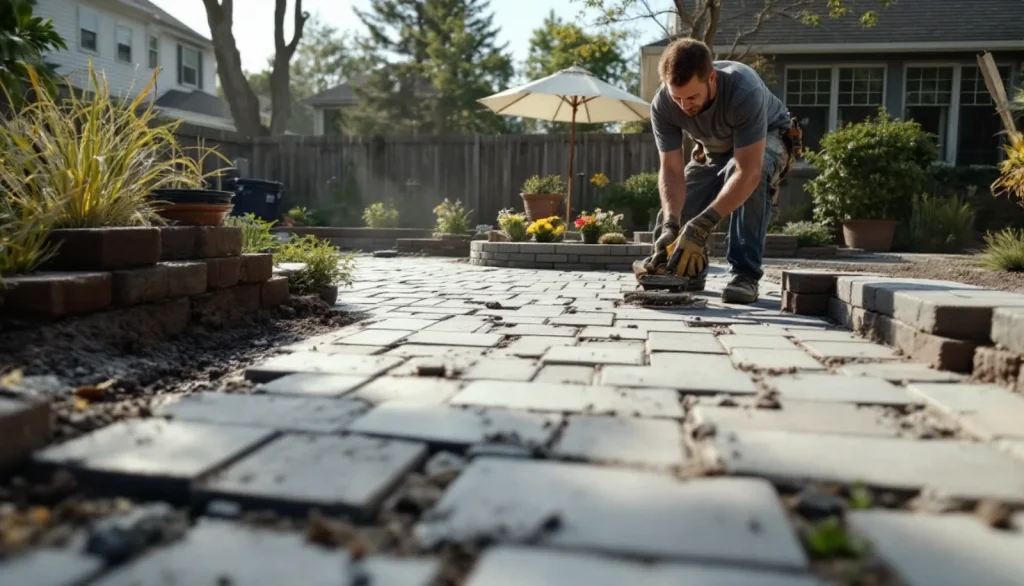
Vetting a hardscape contractor is a different exercise from vetting a lawn-care operator (our 14-step landscaper verification guide covers that side of the vetting work). The transaction sizes are larger (typically $5,000 to $50,000 on a residential patio or retaining wall job), the failure modes are physical and expensive (a settled patio or a failed wall cannot be papered over), and the verification path involves two separate credential systems: state contractor licensing and manufacturer or industry certification. The 12 questions below are the questions an institutional buyer asks when underwriting a hardscape platform, scaled down to a homeowner’s transaction. Use them in order. Verification window: June 16, 2026. Our methodology page covers the broader data discipline behind every HMNDP buyer-side guide.
The short version
- The two industry certifications that matter for hardscape are the ICPI Concrete Paver Installer certification (5 projects, 10,000 square feet minimum experience) and the NCMA/CMHA Basic SRW Installer certificate for segmental retaining walls
- Premium paver brands (Belgard, Techo-Bloc, Unilock, Versa-Lok, Pavestone, EP Henry) operate authorized-contractor programs; lifetime material warranties typically only attach with an authorized installer per the Unilock authorized contractor framework
- State contractor licensing varies by classification; California’s C-27 (CSLB) covers landscape including decorative paving, Arizona’s C-21 / CR-21 covers hardscaping and irrigation specifically per AZ ROC
- Base preparation depth (typically 6 to 12 inches of compacted aggregate base depending on soil and freeze depth) is the single highest-impact technical question
- Industry standard general liability for residential hardscape work is $1 million per occurrence per Construction Coverage’s contractor coverage guide
- ICPI certification requires recertification every 2 years with 8 continuing education hours per the ICPI certification page
Why hardscape vetting is different from lawn-care vetting
A bad lawn-care job grows out in 6 weeks. A bad hardscape job sits on your property for 15 years. The base preparation that goes under a 400 square foot paver patio determines whether the patio looks the same in 2041 or whether it has settled, heaved, and gapped to the point of needing to be torn out. The same logic applies to retaining walls: a wall that fails geotechnically is a structural problem with a five-figure repair bill and, in some cases, a downhill liability claim. The vetting effort needs to match the failure cost.
That is why this guide focuses on credential verification, materials understanding, and base-prep specification. Aesthetic taste matters but it is the easiest part to verify (look at photos of completed jobs). The technical questions are the ones the operator cannot bluff their way through. The overall budget framework for hardscape sits inside the broader 2026 pricing context in our 2026 lawn care cost guide and the project planning fundamentals in our yard design guide.
Question 1: which industry installer certifications do you hold
The two certifications that actually matter for residential hardscape are ICPI and NCMA (now operating as the Concrete Masonry and Hardscapes Association, CMHA). The ICPI Concrete Paver Installer certification requires the installer to complete an ICPI Concrete Paver Installer course, submit an application documenting at least 5 projects and 10,000 square feet of installation experience, and apply within 5 years of course completion. The certification is valid for 2 years and requires 8 continuing education hours per term to renew. ICPI certifies installation knowledge, not installation quality, but it is a baseline indicator that the installer understands the standard practice for base preparation, edge restraint, jointing sand, and bedding.
The NCMA / CMHA Basic SRW Installer certificate covers segmental retaining wall installation. Over 16,000 installers have completed the SRW Installer Course in the US and Canada per the CMHA program page, but only a smaller subgroup holds the higher CSRWI (Certified Segmental Retaining Wall Installer) credential. Recertification is required every 2 years. For any wall over 4 feet tall, you want a CSRWI-credentialed installer; many states require an engineer’s stamp on walls over 4 feet regardless of installer credential.
Question 2: which state contractor license do you hold, and is it in the right classification
State contractor licensing is separate from industry certification. In California, the C-27 Landscaping Contractor classification administered by the Contractors State License Board covers landscape including decorative paving and is required on any contract of $500 or more. Major structural retaining work over a certain height can require a separate structural classification. In Arizona, AZ ROC issues C-21 (Commercial Hardscaping and Irrigation), R-21 (Residential Hardscaping and Irrigation), and CR-21 (dual) per the AZ ROC classification documentation; the threshold for license-required work is $1,000 or more. In Florida, hardscape work does not generally require a state-level license but is subject to county and city requirements. Look up your state. Verify the license number is active in the database, not just on the operator’s truck.
Question 3: which paver manufacturer programs are you authorized under
The major US premium paver manufacturers each run an authorized-contractor program. Belgard, manufactured by Oldcastle APG (the largest producer of hardscape products in North America per industry reporting), runs the Belgard Authorized Contractor program. Unilock runs the Unilock Authorized Contractor program, which guarantees the contractor’s work per the Unilock contractor page. Techo-Bloc runs an authorized installer program. Versa-Lok, primarily a retaining wall manufacturer, runs a certified installer program (often via NCMA recognition). EP Henry, Pavestone, and Cambridge run regional authorized-contractor programs concentrated in the Northeast, central US, and Midwest respectively.
Authorized status matters for two reasons. First, the manufacturer’s lifetime product warranty often only attaches if the install is by an authorized contractor. Second, the manufacturer pulls the authorization on contractors with repeated installation failures, which means the authorization is itself a quality filter that gets stronger over time. Ask which authorizations the contractor holds, and verify the authorization on the manufacturer’s contractor-locator page.
Question 4: what insurance limits do you carry, and can you email me the COI
Industry standard general liability for residential hardscape work is $1 million per occurrence, per the Construction Coverage contractor coverage guide. State minimums for landscape contractors are typically $50,000 to $300,000 per Construction Coverage’s state requirements database, which is well below the realistic cost of a residential hardscape claim. The contractor must also carry workers’ compensation if they have any employees. Ask the contractor to have their agent or carrier email you the certificate of insurance directly, naming your property as additionally insured for the duration of the project. A COI forwarded as a PDF by the contractor is not the same as one sent by the carrier.
Question 5: what base preparation depth and aggregate spec will you use
This is the single most important technical question. The base preparation is what determines whether the patio settles. ICPI’s published guidance and the manufacturer specs typically call for 4 to 6 inches of compacted Class 5 or 21A aggregate base for pedestrian patios on stable soil, 6 to 9 inches for residential driveways, and 9 to 12 inches in freeze-thaw climates or on poor soil. The contractor’s answer should reference a specific aggregate grade (Class 5, 21A, Item 4, depending on regional naming), a specific compaction method (plate compactor minimum, vibratory roller for driveways), and a compaction lift depth (typically 2 to 3 inches per lift). An operator who quotes a flat "a few inches of base" without referencing aggregate grade or freeze-depth adjustments is either inexperienced or planning to underbuild the base.
Question 6: how will you handle the edge restraint
Edge restraint is the structural perimeter that keeps the paver field from spreading sideways. Without proper edge restraint, the perimeter pavers walk outward, the field opens up, and the patio fails. The standard solution is rigid plastic or aluminum edge restraint spiked into the base, set below the finish grade of the paver. Concrete-haunch edge restraint is also acceptable on driveways. Asking the question forces the contractor to walk you through their edge restraint plan, and the answer is a strong signal of their installation discipline.
Question 7: how will you handle bedding sand and jointing sand
Bedding sand is the 1 to 1.5 inch layer between the compacted base and the paver. ICPI guidance calls for ASTM C33 concrete sand at a uniform 1 inch depth, screeded to grade. Jointing sand is the sand that goes into the joints between the pavers after they are set. Polymeric jointing sand (a sand-and-polymer blend that hardens with water) is the industry standard for residential because it resists weed growth and water infiltration into the joints. A contractor planning to use mason sand for bedding or playground sand for joints is not following ICPI standard practice.
Question 8: what is the slope plan for drainage
A paver surface must slope away from any structure (typically 1% to 2%, or 1/8 to 1/4 inch per foot) so that surface water drains off rather than ponding or running toward the house. On a sloped lot, the slope plan is more complex and may need a French drain or surface drain to handle the runoff. Ask the contractor to walk you through where the water goes after a 1 inch rainfall. The answer should be specific: it goes to a drain at point A, runs to point B, discharges at point C. "The patio drains away from the house" is the right starting point but is not a slope plan.
Question 9: what is your retaining wall geotechnical plan
For retaining walls, the geotechnical question is structural. Walls over 4 feet tall typically require an engineer’s stamp and a permit in most states. Walls under 4 feet require proper geogrid reinforcement (rolled into the backfill at specified vertical spacing) on most soil types. The contractor’s answer should reference the manufacturer’s design tables (Versa-Lok, Belgard, and Unilock all publish geotechnical design manuals for their wall blocks), the soil classification on your lot, and the geogrid type and spacing. A contractor who quotes a 5-foot wall without mentioning an engineer or geogrid is planning a wall that will fail.
Question 10: what is the timeline and the deposit schedule
A residential paver patio of 300 to 500 square feet typically takes 3 to 7 working days from base prep to completion. A retaining wall depends on length and height but a 30-foot, 4-foot-tall wall typically takes 4 to 6 working days. The deposit schedule should be reasonable. A 10% to 30% deposit at signing is normal. Progress payments tied to milestones (base prep complete, materials delivered, install complete) are standard. The final 10% to 20% should be due only after your inspection. California Business and Professions Code 7159 caps home-improvement deposits at the lower of $1,000 or 10% of contract price; use that as a template even outside California.
Question 11: what is the installation warranty
The product warranty (the paver itself) is the manufacturer’s responsibility and typically runs lifetime for premium brands. The installation warranty is the contractor’s responsibility and typically runs 1 to 5 years. Industry standard for ICPI-certified installers is a 2 to 3 year workmanship warranty covering settlement, edge failure, and jointing failure. Get it in writing. The warranty should cover what happens if the patio settles, what counts as "normal wear", and what the contractor will do to fix a problem covered by the warranty.
Question 12: can you provide three references from completed jobs 3+ years old
The 3-year window matters because hardscape failure modes (settlement, heaving, edge walking, joint deterioration) emerge over time. A patio that looked great when finished can look terrible 3 years later if the base prep was wrong. References from completed jobs in the 3 to 7 year window are the strongest indicator of installation quality. Call all three. Ask whether the patio has settled, whether the joints have opened, whether the edges have walked, and whether they would hire the contractor again.
The 12 questions in checklist form
| # | Question | Strong answer signals |
|---|---|---|
| 1 | Industry installer certifications | ICPI for pavers, NCMA/CMHA SRWi for walls |
| 2 | State contractor license classification | Active in state database, classification matches scope |
| 3 | Manufacturer authorized contractor programs | Belgard, Unilock, Techo-Bloc, Versa-Lok, EP Henry, Pavestone, or Cambridge authorization |
| 4 | Insurance limits and COI | $1M per occurrence general liability, workers’ comp, COI from carrier |
| 5 | Base prep depth and aggregate spec | References specific aggregate grade and lift depth |
| 6 | Edge restraint plan | Rigid plastic or aluminum spiked into base |
| 7 | Bedding sand and jointing sand | ASTM C33 concrete sand, polymeric joint sand |
| 8 | Slope and drainage plan | Specific 1% to 2% slope, defined discharge point |
| 9 | Retaining wall geotechnical plan | Geogrid spec, engineer’s stamp over 4 feet |
| 10 | Timeline and deposit schedule | 10% to 30% deposit, milestone progress payments |
| 11 | Installation warranty in writing | 2 to 5 years on workmanship |
| 12 | Three references from 3+ year-old jobs | Phone calls, ask about settlement and joints |
The four common installation failures and what causes them
Most residential hardscape failures fall into four categories, and each one traces back to a specific shortcut the installer took at install time.
Settlement. The patio sinks unevenly because the base was either too shallow, undercompacted, or installed over an unstable soil layer without remediation. Settlement shows up at the perimeter first (around utility cuts, near tree roots, at the edges that did not get the same compaction effort as the center). The fix is removing the affected area, redoing the base, and resetting the pavers. Prevention is the base spec answer to question 5.
Heaving in freeze climates. Pavers lift unevenly in the spring because water infiltrated the base layer and froze. The cause is inadequate base depth in a freeze zone, missing drainage gravel, or a base aggregate that holds water rather than draining it. The fix is removing and redoing. Prevention is the freeze-depth adjustment in question 5.
Edge walking. The perimeter pavers spread outward year over year, opening up gaps near the edge. The cause is missing or undersized edge restraint. The fix is installing proper edge restraint and resetting the pavers. Prevention is question 6.
Joint deterioration. The sand between pavers washes out, allowing weed growth and accelerating movement. The cause is either non-polymeric joint sand or polymeric sand that was installed but not activated correctly (the polymer needs water activation per manufacturer spec). The fix is rejointing. Prevention is question 7.
What you do not need to ask
The questions that homeowners ask that do not predict installation quality: brand of vehicle, social media presence, design aesthetic of the salesperson, whether the contractor takes credit cards. None of these correlate with whether the patio looks the same in 10 years. Focus the vetting on credentials, base prep, and references. Aesthetic taste is a separate question; look at photos.
When the project needs a designer rather than just an installer
For projects over $25,000 or with significant landscape architecture (multiple grades, integrated drainage, integrated lighting, integrated plant beds), a landscape architect or landscape designer is the right starting point. The designer produces the plan; the hardscape contractor executes the plan. Splitting the design and the install can lift the total project cost by 10% to 20% but produces better-coordinated outcomes on complex sites. For straight paver patio projects under $15,000, a qualified contractor with an in-house designer is usually sufficient. Where the project includes plant beds and full bed renovation, our yard design guide walks through the plant-side coordination.
Frequently asked questions
What is ICPI certification?
ICPI certification is administered by the Interlocking Concrete Pavement Institute. To earn the credential, an installer must complete an ICPI Concrete Paver Installer course and document at least 5 projects and 10,000 square feet of installation experience. The credential is valid for 2 years and requires 8 continuing education hours per term to renew, per the ICPI certification page.
Do I need a permit for a paver patio?
Most jurisdictions do not require a permit for an at-grade paver patio. Elevated patios, retaining walls over a certain height (typically 4 feet), and any structure that affects drainage may require permits. Check with your local building department before the project starts. Permits are the contractor’s responsibility but you sign for them.
Are Belgard or Unilock pavers worth the premium?
The premium brands (Belgard, Unilock, Techo-Bloc) cost 20% to 50% more than commodity pavers but offer lifetime product warranties, deeper color saturation, more consistent dimensions for tighter joints, and pre-blended color batches that match across orders. The premium is usually worth it on visible patios. For utility hardscape (back walkways, equipment pads), commodity pavers from Pavestone or store-brand product are usually fine.
How long should a paver patio last?
A properly installed paver patio with adequate base prep, proper edge restraint, and polymeric joint sand should last 25 to 40 years before requiring any major work. Spot repairs (replacing damaged pavers, rejointing) may be needed every 5 to 10 years.
Methodology
Industry certification requirements verified directly from the ICPI certification page and the CMHA Basic SRW Installer page. State licensing rules from the CSLB C-27 classification page and equivalent state contractor licensing board sources for the named states. Manufacturer authorization framework from Unilock’s authorized contractor explanation. Insurance benchmarks from Construction Coverage’s contractor coverage guide. Base prep specifications consistent with ICPI Tech Spec series and manufacturer installation manuals. Data verified June 16, 2026.
Limitations
We do not name specific contractors. The vetting framework is universal; contractor-level data changes constantly. State permit thresholds for retaining wall height, permit requirements, and engineering stamp triggers vary by jurisdiction. We cite the common 4-foot threshold, but your jurisdiction may differ. Manufacturer authorization programs change naming and structure periodically; verify current authorization on the manufacturer’s contractor-locator page. Pricing benchmarks (deposit caps, warranty norms) reflect industry standard practice but specific terms are negotiable per contract.
Future updates
Industry certification requirements (ICPI, CMHA/NCMA) and state licensing rule changes trigger interim updates within 30 days. Annual refresh each spring for pricing benchmarks and manufacturer authorization programs. Next refresh: March 2027. Our methodology page documents the full data update process.
Sources & references
- ICPI. “Concrete Paver Installer Certification.” https://www.icpi.org/node/170
- CMHA (formerly NCMA). “Basic SRW Installer Certificate.” https://www.cmha.org/education-certification/certifications/basic-srw-installer-certificate/
- Versa-Lok. “NCMA Certification.” https://www.versa-lok.com/contractor/installation-seminars/ncma-certification
- Unilock. “What is the Best Brand of Pavers?” https://unilock.com/what-is-the-best-brand-of-pavers/
- California CSLB. “C-27 Landscaping Contractor Classification.” https://www.cslb.ca.gov/about_us/library/licensing_classifications/Licensing_Classifications_Detail.aspx?Class=C27
- Contractor License Requirements. (2026). “Arizona C-21 / CR-21 Landscaping License.” https://contractorlicenserequirements.com/arizona/landscaping-license-requirements/
- Florida DBPR. “Services Requiring a DBPR License.” https://www2.myfloridalicense.com/services-requiring-a-dbpr-license/
- Construction Coverage. (2026). “Contractor General Liability Insurance Coverage.” https://constructioncoverage.com/insurance/general-liability/coverage
- Construction Coverage. (2026). “Contractor General Liability Insurance Requirements.” https://constructioncoverage.com/insurance/general-liability/requirements
- IBISWorld. (2026). “Landscaping Services in the US.” https://www.ibisworld.com/united-states/industry/landscaping-services/1497/
- NCMA Segmental Retaining Wall Installation Guide PDF. https://consumersconcrete.com/wp-content/uploads/2022/09/NCMA-Segmental-Retaining-Wall-Installation-Guide.pdf
- National Association of Landscape Professionals. https://www.landscapeprofessionals.org/