
By the HMNDP Editorial Team — independent reporting on lawn care, landscaping, and the green industry.
Last reviewed: June 2026
What pine straw mulch is
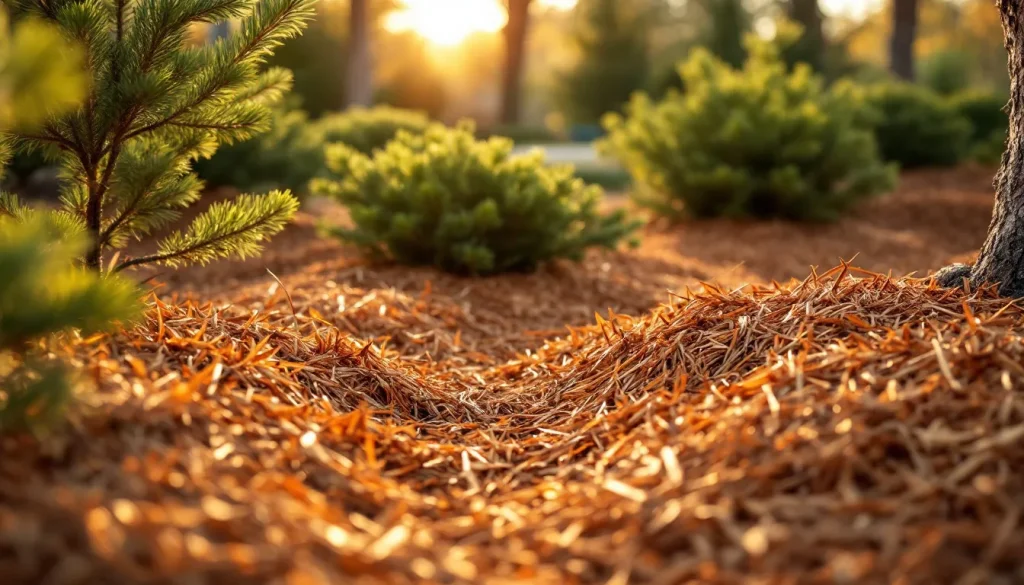
Pine straw mulch is dried, fallen pine needles baled and sold as a landscaping ground cover. It is not chopped or manufactured. It is the natural needle drop from pine trees, raked, cleaned, and compressed into bales. In the Southeast it comes mainly from longleaf, slash, and loblolly pines, which shed needles 3 to 12 inches long.
Growers harvest it without cutting the tree, so a single pine stand yields straw for years. That is why it is common and affordable across the pine belt from Virginia to Texas.
It behaves differently from bagged bark. The needles interlock, breathe, and shed water down into the soil rather than forming a crust. If you are weighing needle mulch against shredded bark, our guide to pine bark mulch covers that product in depth.
Benefits of pine straw mulch
Pine straw mulch retains soil moisture, suppresses weeds, insulates roots, and holds slopes in place. A 3-inch layer can cut surface evaporation and blocks most light-triggered weed seeds. Because needles knit together, the layer stays put on grades where bark washes off. It is lightweight, easy to spread, and breaks down into soil-building organic matter.
Retains soil moisture and reduces evaporation
A 3-inch pine straw layer shades the soil surface and slows evaporation, so beds need less frequent watering in summer heat. The needles form an open mat that lets rain and irrigation soak through, then traps that moisture underneath. University extension guidance across the Southeast recommends 2 to 3 inches of mulch for this reason.
Suppresses weeds and reduces weed growth
Pine straw suppresses weeds by blocking the sunlight most weed seeds need to sprout. A consistent 3-inch layer stops the majority of annual weeds from germinating. It will not stop established perennial weeds or seeds that blow in on top, so spot-pulling is still part of upkeep. For bed-specific strategy, see our best mulch for flower beds guide.
Insulates soil and regulates temperature
Pine straw insulates soil, buffering roots against heat spikes in summer and cold snaps in winter. The trapped air in the loose needle layer slows heat transfer in both directions. This keeps soil temperature steadier, which protects shallow roots on trees, shrubs, and perennials through seasonal swings.
Controls erosion on slopes
Pine straw controls erosion because the long needles lock and knit together into a mat that resists sliding. On banks and grades where shredded bark floats away in heavy rain, a knitted needle layer stays anchored. This is the single biggest practical edge pine straw has over loose wood mulch, and it is why highway crews and builders use it on raw slopes.
Works as mulch and as compost
Pine straw serves as surface mulch and, once broken down, as a compost and soil amendment. As it decomposes it adds organic matter and improves soil structure. You can also add spent needles to a compost pile, though they break down slowly and work best mixed with faster “green” materials like grass clippings and vegetable scraps.
Does pine straw make soil acidic?
No. Pine straw mulch does not meaningfully acidify garden soil. This is the most repeated myth about it. Fresh pine needles test slightly acidic, but as they decompose, soil microbes neutralize that acidity, and the finished effect on soil pH is negligible. Long-running studies from Washington State University Extension found no significant pH change in soil mulched with pine materials over multiple years.
The confusion comes from testing fresh needles instead of the soil beneath aged mulch. Fresh needles may read near pH 3.5 to 4.0, but that acidity is buffered and largely gone by the time needles reach the ground and break down.
Practical takeaway: you can use pine straw around vegetables, roses, hydrangeas, and lawns without worrying it will sour your soil. If you specifically want acid-loving plants like blueberries or azaleas to thrive, pine straw will not do the acidifying for you. Test your soil and amend with elemental sulfur if a low pH is the goal. Our best mulch for vegetable garden guide covers safe options for edibles.
Pine straw vs. wood (bark) mulch: which is better?
Neither is universally better. Pine straw wins on slopes, spread speed, and upfront simplicity. Wood and bark mulch win on longevity and weed suppression per application. Pine straw breaks down in about one season and often needs a refresh yearly, while shredded hardwood can last 2 to 3 years. The table below breaks down the decision.
| Factor | Pine straw mulch | Wood / bark mulch |
|---|---|---|
| Longevity | About 1 season; refresh yearly | 2 to 3 years |
| Weed control | Good at 3 in; thins as it breaks down | Very good; denser, longer-lasting barrier |
| Slope performance | Excellent; needles knit and stay put | Poor to fair; washes and floats away |
| Re-application frequency | 1 to 2 times per year | Every 2 to 3 years, plus top-ups |
| Weight and handling | Very light; easy to spread | Heavy; harder to move and spread |
| Wind resistance | Low; can blow in open, exposed sites | High; stays in place |
| Typical upfront cost | Low per bale, but more refreshes | Higher per bag/yard, fewer refreshes |
If your beds are flat and you value low maintenance, wood mulch usually costs less labor over three years. If you have slopes, tree rings, or large natural areas, pine straw is faster and stays where you put it. For a straw-only comparison, see our straw mulch guide.
How much pine straw do I need? Coverage and cost math
Plan on roughly one standard bale per 30 to 50 square feet at a proper 2 to 3 inch depth. Bale coverage claims range wildly from 100 up to 210 square feet, but those high numbers assume a thin, weed-permeable layer. For real weed suppression and moisture control, budget more straw. The math below uses a 3-inch application.
| Area to cover | Bales at 2 in (approx. 50 sq ft/bale) | Bales at 3 in (approx. 35 sq ft/bale) |
|---|---|---|
| 100 sq ft | 2 bales | 3 bales |
| 300 sq ft | 6 bales | 9 bales |
| 500 sq ft | 10 bales | 15 bales |
| 1,000 sq ft | 20 bales | 29 bales |
On cost: pine straw bales commonly run about $5 to $9 each at Lowe’s, Tractor Supply, and local suppliers, with long-needle bales at the higher end. A 500 square foot bed at 3 inches needs roughly 15 bales, so about $75 to $135 per application.
Now the part product pages skip: cost per year. Because pine straw usually needs a refresh every year, that 500 square foot bed can cost $75 to $135 annually. Shredded hardwood for the same bed might cost more upfront but hold for 2 to 3 years, so its cost per year can land lower despite the bigger single purchase. Slope, wind exposure, and how much you value the natural look often decide it more than price alone.
How to apply pine straw mulch correctly
Apply pine straw in a 3-inch layer, fluffed and spread evenly, kept a few inches back from trunks and stems. Break the bale apart by hand, shake needles loose so they interlock, and level the surface. Do not pile it against bark, which invites rot and rodents. Water lightly after spreading to settle the layer.
- Clear the bed of existing weeds and rake the surface level.
- Cut or snap the bale bands and pull sections apart into loose flakes.
- Spread by hand or with a rake to an even 3-inch depth across the bed.
- Keep needles 2 to 3 inches away from tree trunks and plant stems to avoid moisture rot.
- Tuck the outer edge under itself or against an edging so wind cannot lift it.
- Water lightly to knit the layer and top up thin spots after the first rain.
Refresh, do not remove. Each year add 1 to 2 inches on top rather than stripping the old layer, since the decomposing base feeds the soil.
Where to buy pine straw mulch
Pine straw mulch is sold at Lowe’s, Tractor Supply, The Home Depot, garden centers, and local pine straw suppliers, plus bulk pallet delivery for large jobs. Big-box stores stock bagged and baled straw seasonally, mostly spring and fall. For large areas, a local supplier delivering by the pallet is usually cheaper per bale than store pricing.
| Source | Best for | Notes |
|---|---|---|
| Lowe’s / The Home Depot | Small beds, quick pickup | Bagged and baled; convenient, higher per-bale cost |
| Tractor Supply | Rural buyers, medium jobs | Bales in season; check regional stock |
| Local pine straw supplier | Large areas, best price | Pallet delivery; ask for long-needle grade |
| Landscaper install | No-labor option | Priced per bale installed; common in the Southeast |
Search “pine straw near me” to find regional producers, who often sell fresher, cleaner, long-needle bales than seasonal big-box stock.
Long needle vs. short needle pine straw
Long-needle pine straw (from longleaf and slash pine, 8 to 12 inches) knits tighter, lasts longer, and resists wind better than short-needle straw (from loblolly, 3 to 6 inches). Long needle is the premium grade and holds slopes best. Short needle is cheaper, packs down faster, and suits flat beds where wind and erosion are not concerns.
| Type | Needle length | Strengths | Best use |
|---|---|---|---|
| Long needle (longleaf/slash) | 8 to 12 in | Knits tight, lasts longer, wind-resistant | Slopes, exposed sites, premium beds |
| Short needle (loblolly) | 3 to 6 in | Cheaper, widely available | Flat, sheltered beds |
Disadvantages of pine straw mulch and when not to use it
Pine straw has real drawbacks: it is flammable, blows away in open sites, breaks down faster than wood, and can harbor pests. Avoid placing it directly against home siding, decks, or other structures in fire-prone areas, since dry needles ignite easily. In high-wind or coastal sites, wood mulch or a heavier grade stays put better.
- Flammability: Dry pine needles catch and carry fire. Fire-safety guidance recommends keeping combustible mulch out of the first 5 feet around a home in wildfire-prone regions. Use gravel or bare soil in that zone instead.
- Blows away: In open, windy, or coastal yards, loose needles scatter. Edge the beds and tuck the perimeter, or choose long-needle grade.
- Faster breakdown: It decomposes in roughly a season, so you re-mulch more often than with hardwood.
- Pest harborage: Warm, dry needle layers can shelter fire ants and other insects in the Southeast. Keep straw pulled back from foundations and inspect nests early.
For flat, sheltered, low-maintenance beds away from structures, most of these downsides fade and pine straw is an easy, attractive choice.
Frequently Asked Questions
Is pine straw mulch better than regular (wood/bark) mulch?
Neither is universally better. Pine straw beats wood mulch on slopes, spread speed, and low weight, because the needles knit together and stay put. Wood and bark mulch beat pine straw on longevity and per-application weed control, lasting 2 to 3 years versus about one season. Choose pine straw for grades and natural areas, wood mulch for flat, low-maintenance beds.
Does pine straw make soil acidic?
No, pine straw does not meaningfully acidify soil. Fresh needles test slightly acidic, but as they decompose, soil microbes neutralize that acidity, leaving soil pH essentially unchanged. Washington State University Extension research found no significant pH shift under pine mulch over years. You can safely use it around vegetables, roses, and lawns. It will not lower pH enough to benefit acid-loving plants either.
How much pine straw do I need per square foot?
Plan on about one standard bale per 30 to 50 square feet at a 2 to 3 inch depth. At a full 3-inch layer, budget roughly one bale per 35 square feet. So 100 square feet needs about 3 bales, 500 square feet about 15 bales, and 1,000 square feet about 29 bales. High “210 sq ft per bale” claims assume a thin layer that suppresses weeds poorly.
How often do you need to replace pine straw mulch?
Refresh pine straw once or twice a year. It breaks down in roughly one season, so most homeowners top it up each spring and sometimes again in fall. Add 1 to 2 inches on top rather than removing the old layer, since the decomposing base feeds the soil. Wood mulch, by contrast, typically lasts 2 to 3 years between applications.
How do you apply pine straw mulch correctly and how deep?
Apply pine straw in an even 3-inch layer. Pull the bale apart into loose flakes, shake the needles so they interlock, and rake level across the bed. Keep straw 2 to 3 inches back from tree trunks and plant stems to prevent rot. Tuck the perimeter under an edge so wind cannot lift it, then water lightly to settle the layer.
Where can I buy pine straw mulch?
Pine straw is sold at Lowe’s, Tractor Supply, The Home Depot, garden centers, and local pine straw suppliers. Big-box stores carry bagged and baled straw seasonally in spring and fall. For large areas, a local supplier with pallet delivery usually beats store pricing per bale and offers fresher, cleaner long-needle grades. Search “pine straw near me” to find regional producers.
How much does pine straw mulch cost per bale?
Pine straw bales commonly cost about $5 to $9 each, with long-needle grades at the higher end. Local suppliers selling by the pallet often price below big-box stores. A 500 square foot bed at 3 inches needs roughly 15 bales, so about $75 to $135 per application, and because pine straw is refreshed yearly, that becomes the approximate annual cost.
What are the disadvantages of pine straw mulch?
Pine straw is flammable, blows away in open or coastal sites, breaks down faster than wood mulch, and can shelter fire ants and other pests. Keep it out of the first 5 feet around a home in wildfire-prone areas, and pull it back from foundations. For flat, sheltered beds away from structures, these drawbacks are minor.