
By the HMNDP Editorial Team | Last reviewed: June 2026
What straw mulch is and what it’s made of
Straw mulch is the dried, hollow stalks left after cereal grains (wheat, oat, or barley) are harvested for their seed heads. It is golden, lightweight, and nearly free of leaves. Because the seed has already been removed at harvest, good straw carries far fewer viable weed and grain seeds than hay, which makes it the standard mulch for gardens and grass-seed jobs.
Wheat straw is the most common type sold in the United States, followed by oat and barley. All three behave similarly as mulch. The differences that matter to a gardener are price, local availability, and how clean the bale is, not the grain species itself.
Straw breaks down over one growing season, adding a small amount of organic matter to soil. It is not a fertilizer. Pair it with a feeding plan such as an organic fertilizer for the vegetable garden rather than expecting the straw to feed plants.
Straw mulch in vegetable gardens and flower beds
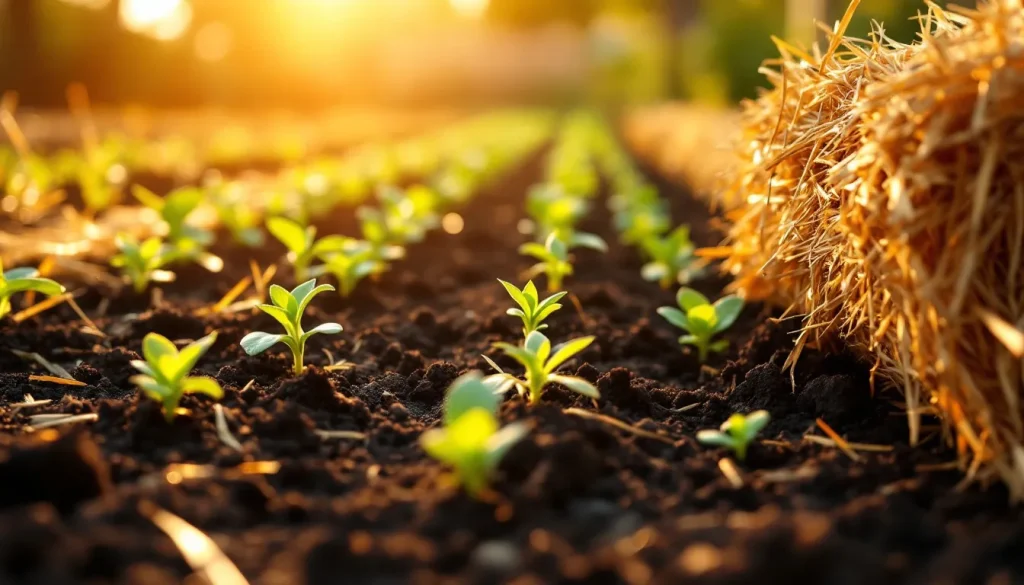
Straw mulch works well in vegetable gardens and flower beds because it holds soil moisture, keeps soil temperatures steadier, and blocks light from weed seeds. Spread it 1 to 2 inches deep around plants, keeping it 1 to 2 inches off stems to prevent rot. Pull it back from seedlings until they are 3 to 4 inches tall.
In vegetable beds, straw keeps tomatoes, peppers, squash, and beans cleaner by stopping soil from splashing onto leaves and fruit during rain. That splash is a common path for fungal disease, so the barrier has a practical payoff beyond moisture.
In flower beds, straw is usually a temporary or seasonal mulch rather than a finished look. Many gardeners use straw for overwintering perennials or protecting strawberry crowns, then switch to bark or wood mulch in spring for appearance. For ornamental coverage, compare quantities using our guide on how much mulch you need.
Using straw mulch for grass seed and new lawns
Straw mulch over grass seed holds moisture at the soil surface and shields seed from birds and wash-off, which raises germination rates. Apply a single thin layer so roughly 50 to 70 percent of the soil is still visible through it. Too much straw blocks light and smothers the new grass.
One bale (about 50 pounds) covers roughly 800 to 1,000 square feet at this light seeding rate. That is far thinner than garden mulch. If you cannot see soil between the strands, you have used too much.
Timing the seeding itself matters as much as the mulch. Cool-season lawns establish best in late summer to early fall, so align your project with the best time to plant grass seed in your region.
Do you remove straw after grass sprouts?
You usually do not remove straw used over grass seed. A light, single layer breaks down on its own within a few weeks to a couple of months. Grass typically germinates in 5 to 21 days depending on species. Once seedlings reach 2 to 3 inches and you mow once or twice, the thin straw layer disappears into the lawn.
Remove straw only if you applied it too thickly and it is matting over the seedbed. In that case, gently rake off the excess on a dry day so you do not uproot new grass. Certified weed-free straw is worth the premium here because any weed seeds you introduce will compete directly with thin new turf.
The weed-seed contamination risk in non-certified straw
The main risk with straw mulch is weed-seed and grain contamination. Cheap, uncertified bales can carry leftover grain kernels and field weed seeds that sprout in your beds. Wheat, oat, and barley seedlings appearing in rows are the telltale sign you bought a contaminated bale.
Contamination comes from sloppy harvest, weedy fields, or hay being sold as straw. The problem is real enough that gardeners on Reddit and YouTube routinely warn about importing weeds, but most buying guides never explain how to avoid it at the point of sale.
How to verify certified weed-free straw at purchase
Certified weed-free straw is straw inspected and tagged under a state or North American Weed Management Association (NAWMA) program that checks fields for noxious weeds before baling. To verify it, look for these signals before you pay:
- Ask for the certification tag or twine color. Certified bales carry a tag or colored twine tied to a state weed-free forage program.
- Confirm the label says “straw,” not “hay.” Hay is a forage crop full of seed and is not the same product.
- Inspect the bale: clean golden stalks with few seed heads is a good sign; lots of grain heads or green leafy material is not.
- Buy bagged, branded straw (for example, EZ Straw or pelletized products) when you want the lowest seed risk and are covering a small area.
How to test or treat a suspect bale
If you already have a questionable bale, test or treat it before spreading. These steps reduce the weed risk without wasting the straw entirely:
- Germination test: spread a handful on a tray of damp potting mix, keep it warm and wet for 10 to 14 days, and count sprouts. Many sprouts means heavy contamination.
- Solarize: wet the bale, seal it in clear plastic, and leave it in full sun for 4 to 6 weeks to heat-kill many seeds.
- Pre-sprout: spread the straw on a tarp, water it, let weeds germinate for two weeks, then dry and use it after most seeds have already sprouted and died.
- Spot-weed early: where you cannot pre-treat, pull grain and weed seedlings while small, before they set seed.
Straw vs. hay: the buyer’s decision rule
Straw is harvested stalks with the seed removed; hay is whole forage plants (grasses and legumes) cut and dried with the seed still in. For mulch, that single difference decides it: hay is packed with viable seed and will plant a weed crop in your beds. Straw is the correct choice for gardens and lawns in nearly every case.
The rule of thumb: use straw for any bed, seedbed, or new lawn. Accept hay only when it is free or very cheap, you are mulching a path or unplanted area, and you do not care what germinates there. Never use hay over a new lawn or vegetable rows.
| Factor | Straw | Hay |
|---|---|---|
| What it is | Grain stalks, seed removed | Whole forage plants, seed retained |
| Seed content | Low (lowest if certified weed-free) | High |
| Weed risk as mulch | Low to moderate | High |
| Typical bale price (2026) | $8 to $15 | $6 to $12 |
| Best mulch use | Gardens, flower beds, grass seed | Paths, unplanted areas only |
Coverage rates: how much straw mulch to use
Coverage depends on whether you are mulching plants or seeding a lawn. For garden beds at 2 inches deep, one standard 50-pound bale covers about 80 to 100 square feet. For grass seed at a light single layer, the same bale stretches to 800 to 1,000 square feet because the layer is much thinner.
| Use case | Depth / density | Coverage per 50 lb bale |
|---|---|---|
| Vegetable garden / flower bed | 1 to 2 in. deep | 80 to 100 sq ft |
| Pathways / heavy weed block | 3 to 4 in. deep | 40 to 50 sq ft |
| Grass seed / overseeding | Thin, soil 50 to 70% visible | 800 to 1,000 sq ft |
To estimate bales, divide your square footage by the coverage figure for your use case. A 500-square-foot vegetable garden at 2 inches needs about 5 to 6 bales; the same area reseeded as lawn needs less than one bale.
Where to buy straw mulch and what it costs
You can buy straw mulch at home improvement stores, farm supply chains, and local garden centers, with prices ranging from about $8 to $20 depending on form and certification. Bagged straw costs more per pound but stays cleaner and is easier to handle for small jobs; baled straw is cheaper for large areas.
| Source | Typical product | 2026 price |
|---|---|---|
| The Home Depot / Lowe’s | Bagged straw (e.g., EZ Straw), some bales | $10 to $20 per bag |
| Tractor Supply / farm stores | Baled wheat/oat straw | $8 to $15 per bale |
| Local farms / feed stores | Baled straw, often by the load | $5 to $12 per bale |
| Garden centers | Certified weed-free straw, pellets | $12 to $25 per unit |
For the cleanest product, ask farm and garden centers specifically for certified weed-free straw. For small flower beds or a patio garden, bagged straw from a big-box store is the simplest low-seed option.
Benefits of straw mulch
Straw mulch delivers four measurable benefits: moisture retention, temperature regulation, erosion control, and weed suppression. A 1 to 2 inch layer can cut surface evaporation noticeably, keep soil cooler in summer heat and warmer during cold snaps, hold soil in place on slopes and seedbeds, and block light that weed seeds need to sprout.
- Moisture retention: shades the soil surface so beds dry out more slowly and need less frequent watering.
- Temperature regulation: buffers roots and seed from heat spikes and frost, steadying germination conditions.
- Erosion control: the standard choice on graded seedbeds and gentle slopes to stop rain wash and seed runoff.
- Weed suppression: a proper layer starves most weed seeds of light, as long as the straw itself is clean.
Alternatives to straw for grass seed
If straw’s mess or weed risk concerns you, three alternatives cover grass seed: straw erosion mats, mulch pellets, and hydromulch. Each trades cost for convenience or coverage quality, and all avoid loose straw blowing around the yard.
| Alternative | What it is | Best for |
|---|---|---|
| Straw mats / blankets | Stitched straw netting rolled over the seedbed | Slopes, erosion-prone areas; stays put |
| Mulch pellets | Compressed paper or straw that expands when watered | Small patches, spot repair; no blowing |
| Hydromulch | Sprayed wood/paper slurry with green dye | Large lawns done by a pro; even coverage |
For deeper how-to guidance across lawn and garden projects, browse the HMNDP Learn library.
Frequently Asked Questions
Is straw mulch good for vegetable gardens?
Yes. Straw mulch is well suited to vegetable gardens because it retains soil moisture, steadies soil temperature, and stops rain from splashing soil onto leaves and fruit, which reduces fungal disease. Spread it 1 to 2 inches deep, keeping it off stems. Use certified weed-free straw to avoid introducing weed and grain seeds among your rows.
What’s the difference between straw and hay mulch?
Straw is the dried stalk left after grain is harvested, with the seed removed. Hay is whole forage plants cut and dried with their seed intact. For mulch, straw is preferred because hay carries abundant viable seed that will sprout weeds in your beds. Use hay only on paths or unplanted areas where germinating seeds do not matter.
Can you put straw mulch over grass seed, and do you remove it after it sprouts?
Yes, apply a thin single layer so 50 to 70 percent of soil stays visible. You usually do not remove it. Grass germinates in 5 to 21 days, and a light layer breaks down within weeks. Remove straw only if it was applied too thickly and is matting; rake the excess gently on a dry day to avoid pulling seedlings.
How thick should you spread straw mulch?
Spread straw 1 to 2 inches deep in vegetable gardens and flower beds, and up to 3 to 4 inches on paths or for heavy weed blocking. Over grass seed, use only a thin single layer that still shows soil between the strands. Keep straw 1 to 2 inches away from plant stems and crowns to prevent rot.
Where can I buy weed-free straw mulch?
Buy certified weed-free straw at garden centers, farm supply stores, and from local farms that participate in a state or NAWMA weed-free forage program. Look for a certification tag or colored twine. Big-box stores like The Home Depot sell bagged straw products that are low in seed and convenient for small beds, typically $10 to $20 per bag.
Will straw mulch introduce weeds into my garden?
It can if the straw is uncertified and contaminated with weed or leftover grain seed. To minimize risk, buy certified weed-free straw, inspect bales for clean golden stalks with few seed heads, and avoid anything labeled hay. If a bale is suspect, run a germination test, solarize it, or pre-sprout it on a tarp before spreading.
How much does straw mulch cost (bagged vs. bale)?
In 2026, baled straw runs about $5 to $15 per 50-pound bale from farm stores and local farms, while bagged straw such as EZ Straw costs $10 to $20 per bag at home improvement stores. Bales are cheaper per square foot for large areas; bags are cleaner and easier for small flower beds. Certified weed-free straw sits at the higher end.
What kind of straw is best, wheat, oat, or barley?
All three perform similarly as mulch, so the grain species is less important than cleanliness. Wheat straw is the most widely available in the United States and a safe default. Oat and barley straw work just as well. Prioritize certified weed-free straw with clean stalks and few seed heads over any specific grain type.