
By the HMNDP Editorial Team, independent reporting on lawn care, landscaping, fertilizer, water, and the green-industry business.
Last reviewed: June 2026
The best mulch for a vegetable garden, in one line
The best mulch for a vegetable garden is clean straw applied 2 to 3 inches deep, because it suppresses weeds, holds soil moisture, protects seeds, and breaks down into organic matter. Shredded leaves and finished compost are the best free alternatives. Whatever you choose, confirm it is free of aminopyralid and clopyralid herbicides, the contaminants that ruin more vegetable beds than any pest.
This guide ranks 9 mulches, gives exact depths and coverage per 100 square feet, tells you when to apply relative to transplant date and soil temperature, and settles the wood-mulch and killer-compost questions that most articles skip.
Quick-pick decision matrix: 9 mulches scored
Here is every common vegetable-garden mulch scored 1 (poor) to 5 (excellent) on the factors that decide a season. Straw and shredded leaves lead for annual vegetable beds; wood chips score high only for perennials and pathways. Cost reflects typical US 2026 retail or free sourcing. Use this table to pick fast, then read the section for your material.
| Mulch | Typical cost (100 sq ft) | Weed control | Moisture retention | Nitrogen tie-up risk | Best use case |
|---|---|---|---|---|---|
| Clean straw | $8-$15 (1 bale) | 5 | 5 | Low (2) | Whole annual beds, seed protection |
| Shredded leaves / leaf mold | $0 (free) | 4 | 5 | Low (2) | Whole beds, soil building |
| Grass clippings (herbicide-free) | $0 (free) | 4 | 4 | Very low (1) | Thin layers between rows |
| Finished compost | $0-$40 | 2 | 4 | None (1) | Feeding layer, top-dress |
| Pine straw / pine needles | $0-$12 | 4 | 4 | Low (2) | Pathways, acid-loving crops |
| Salt hay | $15-$30 (regional) | 5 | 4 | Low (2) | Coastal beds, weed-free choice |
| Rice hulls | $20-$35 | 3 | 4 | Low (2) | Seedbeds, no weed seeds |
| Wood chips / bark | $5-$30 | 4 | 4 | High at soil line (4) | Pathways and perennials only |
| Hay (grass or legume) | $6-$12 (1 bale) | 3 | 4 | Low (2) | Avoid: carries weed seeds |
1. Straw: the top all-around vegetable mulch
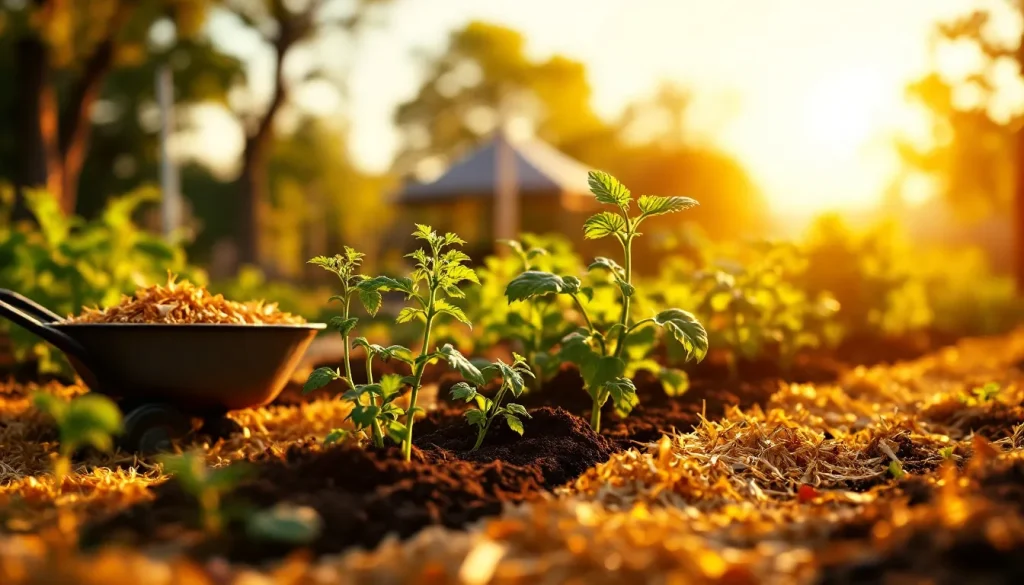
Straw is the best mulch for most vegetable gardens because it suppresses weeds, keeps soil moist, shelters germinating seeds from crusting and splash, and rots into humus within a season. Apply clean straw 2 to 3 inches deep. One standard bale (about 40 pounds) covers roughly 80 to 100 square feet at that depth. Buy oat, wheat, or barley straw, not hay.
Straw is the stalk left after grain is harvested, so a properly threshed bale carries few viable seeds. Pull it back 1 to 2 inches from stems to limit slug shelter and rot. Learn more in our guide to using straw mulch.
One caution decides everything: some straw is grown with aminopyralid or clopyralid herbicides that survive baling and stunt tomatoes, beans, and potatoes. Ask the supplier whether the field was sprayed, or run the jar bioassay described later before you spread a full bed.
2. Shredded leaves and leaf mold: the best free mulch
Shredded leaves are the best no-cost vegetable mulch. Run a mower over dry fall leaves, then spread them 2 to 3 inches deep. Shredding matters: whole leaves mat into a water-shedding crust, while chopped leaves let rain through and break down into leaf mold, a crumbly soil conditioner rich in fungal life. Ten bags of leaves mulch a large bed and cost nothing.
Leaf mold holds up to several times its weight in water and feeds earthworms without tying up much nitrogen. Avoid black walnut leaves, which contain juglone that can harm tomatoes and peppers. Aged leaf mold applied 1 to 2 inches deep doubles as a seedbed cover that will not crust.
3. Grass clippings: free, but only herbicide-free
Grass clippings make excellent thin mulch when they come from an untreated lawn. Apply them just 1 to 2 inches deep and let each layer dry before adding more; piled thick and green, they heat, slime, and stink. Clippings are nitrogen-rich, so they rarely rob soil of nitrogen and feed crops as they rot.
The catch is lawn herbicide. Clippings from a lawn treated with weed-and-feed or a broadleaf product (including clopyralid) can carry residue that damages vegetables. Do not use clippings from any lawn sprayed in the past 3 mowings, and never use clippings that went to seed. Clippings work best tucked between rows of established tomatoes, squash, and beans.
4. Compost as a mulch and feeding layer
Finished compost works as a dual-purpose mulch: a 1 to 2 inch top-dress feeds the soil and moderates moisture while a coarser mulch above it handles weeds. On its own, compost suppresses weeds poorly because it is a perfect seedbed for anything blown in. Use it under straw or leaves for the best of both.
Compost adds no nitrogen tie-up and buffers soil temperature. Confirm the source: composted manure or municipal compost made from herbicide-sprayed hay or grass can carry aminopyralid. Pair compost with the right feeding plan using our notes on organic fertilizer for vegetable gardens.
5. Pine straw and pine needles
Pine straw (fallen pine needles) is a light, airy mulch that knits together and resists blowing away. Apply 2 to 3 inches deep. It breaks down slowly, so it is ideal for pathways, strawberries, and perennial herbs rather than beds you replant often. Contrary to a common myth, pine needles do not meaningfully acidify soil once they decompose.
Pine straw sheds water off the surface while letting it percolate at the edges, which suits blueberries and other acid-tolerant crops planted alongside. It carries no weed seeds, a real advantage over hay.
6. Salt hay: the weed-free coastal option
Salt hay is harvested from tidal marsh grasses (Spartina) and prized because its seeds will not germinate in garden soil, so it adds no weeds. Rutgers and other coastal extension programs have long recommended it in the Northeast and mid-Atlantic. Apply 2 to 3 inches deep. It is loose, reusable across seasons, and slow to rot.
Availability is regional and cost runs higher than field straw, roughly $15 to $30 per equivalent bale near the coast. Where you can source it, salt hay is one of the cleanest mulches for seedbeds and low-growing crops.
7. Rice hulls and other regional byproducts
Rice hulls are a lightweight, seed-free byproduct that gardeners in rice-growing regions and online communities like Reddit’s r/vegetablegardening recommend for seedbeds. Apply 1 to 2 inches deep. They resist compaction, do not blow away as easily as expected once wetted, and break down over a season or two.
Other regional byproducts follow the same logic: availability and cost drive the choice. Sugar cane mulch (bagasse) is common in the South and Australia; cocoa hulls appear near processors but are toxic to dogs. Pick the cheapest clean, seed-free, herbicide-free material near you.
Is wood mulch safe in a vegetable garden? The straight verdict
Undyed wood chips and bark are safe around vegetables, but keep them on pathways and perennial beds, not tilled into annual rows. Fresh wood at the soil surface pulls nitrogen from the top inch as it decomposes, which stunts shallow-rooted seedlings. On top of paths or around established fruit and perennial herbs, that tie-up is harmless.
Dyed mulch colored with carbon or iron oxide is generally considered low risk, but avoid any mulch that may contain CCA-treated (chromated copper arsenate) lumber, sometimes found in cheap recycled or “ground pallet” products. Arsenic near food crops is not worth the savings. See our wood chip mulch guide for sourcing clean, undyed chips.
Bottom line: wood chips for the walkways between beds, straw or leaves inside the beds. If you must mulch an annual bed with wood, lay it only on the surface and add a nitrogen source such as blood meal or feather meal to offset tie-up.
Organic vs inorganic mulch, and why weed control comes first
Organic mulches (straw, leaves, compost, pine straw) feed the soil as they rot and are the right default for vegetables. Inorganic mulches (black plastic, landscape fabric, gravel) warm soil and block weeds but add nothing to it and can trap heat. For most home vegetable growers, weed suppression is the single biggest payoff, and a 2 to 3 inch organic layer blocks most weed germination by cutting off light.
Black plastic has one clear use: warming soil for heat-loving crops like melons and peppers in short-season climates. Otherwise, organic mulch that suppresses weeds and holds moisture wins, cutting watering frequency by roughly 25 to 50 percent in summer heat.
Hay vs straw: the difference that matters
Straw is the seed-free stalk left after grain harvest; hay is dried whole grass or legume plants cut for animal feed, and it is loaded with viable weed and grass seeds. Mulch a vegetable bed with hay and you often seed it with the very weeds you were trying to stop. Choose straw for beds. Reserve hay for deep sheet-mulching under cardboard where seeds cannot reach light.
Both hay and straw share the herbicide risk covered next, so the seed distinction is only half the decision.
The gap no one warns you about: killer compost and herbicide-contaminated mulch
The fastest way to destroy a vegetable garden is herbicide-contaminated mulch, compost, or manure. Aminopyralid and clopyralid are persistent broadleaf herbicides sprayed on hay, straw, and pasture. They survive the animal gut, composting, and months of storage, then twist and stunt tomatoes, potatoes, beans, peas, and lettuce at parts-per-billion levels. This is the number-one cause of mystery garden failure, and most mulch articles never mention it.
At-risk inputs: hay and straw from sprayed fields, grass clippings from treated lawns, manure from animals fed sprayed hay, and bagged compost or “composted manure” made from any of these. Symptoms are cupped, fern-like, twisted new growth within 2 to 3 weeks of transplanting.
Run this jar bioassay before spreading any hay, straw, manure, or unknown compost across a bed:
- Mix the suspect material 1 part to 1 part with clean potting soil in two pots; fill two more pots with clean potting soil only as controls.
- Plant 3 pea or bean seeds in each pot and grow on a windowsill.
- Compare after 2 to 3 weeks. Cupped, curled, or fern-like new leaves versus the controls mean contamination.
- If damaged, do not use the material anywhere near vegetables; it can persist for 1 to 3 years or longer.
Buy from suppliers who confirm their fields were not sprayed, and when in doubt, default to shredded leaves or your own compost from known-clean inputs.
How thick to apply and how much you need
Apply most vegetable mulches 2 to 3 inches deep after the soil has warmed and plants are established; use 1 to 2 inches for nitrogen-rich grass clippings and for compost. Depth is what suppresses weeds by blocking light, so thinner layers leak weeds and thicker layers can trap dampness against stems. Keep mulch 1 to 2 inches clear of plant stems and crowns.
Coverage math per 100 square feet, using cubic feet needed (100 sq ft times depth in feet):
| Depth | Cubic feet per 100 sq ft | Rough real-world amount |
|---|---|---|
| 1 inch | 8.3 cu ft | ~3-4 bags leaf mulch, or thin grass layer |
| 2 inches | 16.7 cu ft | ~1 straw bale, or ~4-6 bags |
| 3 inches | 25 cu ft | ~1.5 straw bales, ~1 cu yd covers ~110 sq ft |
Application timing: when to mulch relative to planting and soil temperature
Mulch after the soil has warmed and seedlings are up, not before. Organic mulch insulates, so laying it on cold spring soil keeps roots cold and slows heat-loving crops. Wait until soil reaches about 60 to 65 degrees Fahrenheit for tomatoes, peppers, and squash, usually 2 to 3 weeks after transplanting, before applying the full 2 to 3 inch layer.
For direct-sown seeds, keep the soil bare or lightly covered with 0.5 inch of fine mulch until seedlings are 2 to 3 inches tall, then thicken the layer around them. Cool-season crops like lettuce, peas, and brassicas can be mulched earlier because they tolerate cool roots.
Best mulch over winter for a vegetable garden
The best over-winter mulch is a thick 4 to 6 inch layer of shredded leaves or clean straw over cleared or cover-cropped beds. Its job is different from summer mulch: it protects soil structure, feeds soil life, prevents erosion, and shields overwintering crops like garlic, carrots, and kale from freeze-thaw heaving. Apply after the first hard frost, once the ground starts to cool.
For garlic planted in fall, lay 4 inches of straw right after planting to insulate the cloves. In spring, pull winter mulch back 2 weeks before sowing to let the soil warm and dry. A leaf or straw blanket over bare beds also smothers cool-season weeds before they establish.
Frequently Asked Questions
What is the best mulch for a vegetable garden?
Clean straw applied 2 to 3 inches deep is the best all-around vegetable mulch because it suppresses weeds, retains moisture, protects seeds, and decomposes into organic matter within a season. Shredded leaves and finished compost are the best free alternatives. Whichever you pick, verify it is free of aminopyralid and clopyralid herbicides, which damage vegetables at trace levels.
Is wood mulch or wood chips safe to use in a vegetable garden?
Undyed wood chips and bark are safe on pathways and around perennials but should not be mixed into annual vegetable rows, because decomposing wood ties up nitrogen at the soil surface and stunts seedlings. Keep chips on top of the soil, never tilled in. Avoid any mulch possibly containing CCA-treated (arsenic) lumber near food crops. Standard dyed mulch is generally low risk.
Straw vs leaf mulch for vegetables, which is better?
Both are excellent. Straw suppresses weeds slightly better and protects seeds well, applied 2 to 3 inches deep, but must be bought and checked for herbicides. Shredded leaves are free, build soil into leaf mold faster, and hold moisture strongly. Use straw for tidy whole-bed coverage and leaves when you want no-cost soil building. Many gardeners layer both.
What is the best mulch to prevent weeds in a vegetable garden?
A 2 to 3 inch layer of clean straw or salt hay gives the strongest weed suppression by blocking light to germinating seeds. Shredded leaves at the same depth work nearly as well. Avoid hay, which carries weed seeds, and avoid thin layers under 2 inches, which let weeds break through. Depth matters more than material for weed control.
How thick should I apply mulch in a vegetable garden?
Apply most organic mulches 2 to 3 inches deep, using 1 to 2 inches for grass clippings and compost. That depth blocks enough light to stop weed germination while letting water through. Keep mulch 1 to 2 inches away from plant stems to prevent rot. For over-winter protection, increase to 4 to 6 inches of straw or shredded leaves.
What is the difference between hay and straw for mulching?
Straw is the seed-free stalk left after grain (wheat, oat, barley) is harvested, making it a clean bed mulch. Hay is dried whole grass or legumes cut for animal feed and is full of viable weed and grass seeds that will sprout in your garden. Use straw for vegetable beds. Both can carry persistent herbicides, so verify the source.
Can grass clippings be used as mulch on vegetables, and are they safe?
Yes, if the lawn was not treated with herbicide. Apply clippings only 1 to 2 inches deep and let them dry between layers so they do not mat or heat. They are nitrogen-rich and feed crops as they rot. Never use clippings from a lawn sprayed with weed-and-feed or clopyralid in the last few mowings, and skip clippings that went to seed.
What is the best mulch to protect a vegetable garden over winter?
A 4 to 6 inch layer of shredded leaves or clean straw is the best over-winter mulch. Applied after the first hard frost, it protects soil structure, feeds soil organisms, prevents erosion, and shields overwintering garlic, carrots, and kale from freeze-thaw heaving. Pull it back about 2 weeks before spring sowing so the soil can warm and dry.
More growing guides at the HMNDP Learn hub.