
By the HMNDP Editorial Team. Last reviewed: June 2026.
What pine bark mulch is and who it suits
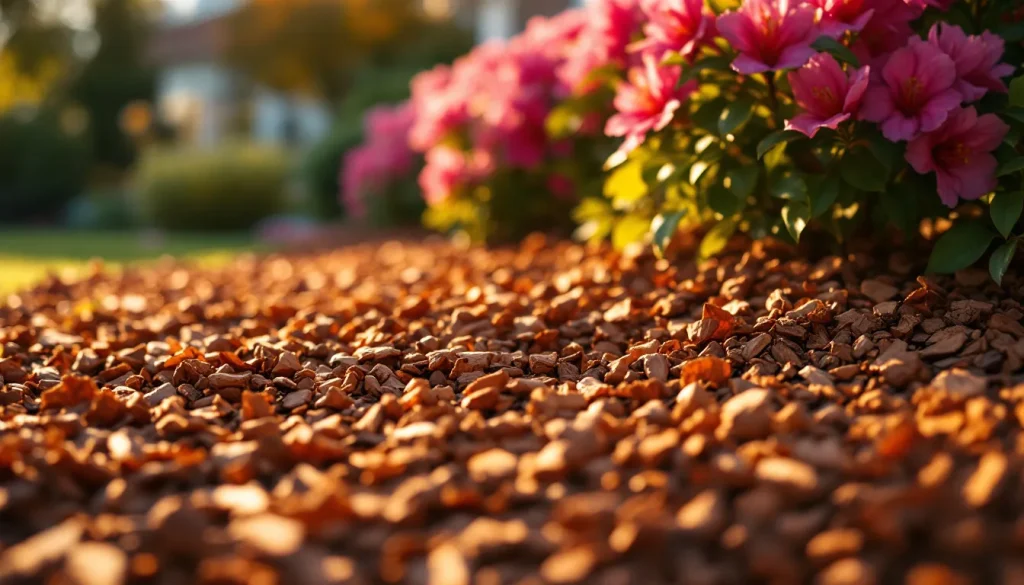
Pine bark mulch is shredded or chipped bark stripped from pine logs during lumber and paper milling, sold as a long-lasting, slightly acidic ground cover for garden beds. It is a renewable byproduct, not whole trees harvested for mulch. It works best around acid-loving plants and in well-drained beds, and less well on steep slopes where it floats away in heavy rain.
Mills such as those supplying brands like Scotts and Vigoro separate the bark from pine timber, then grind and screen it into different sizes. Because bark is the part of the tree built to resist rot, pine bark mulch breaks down slower than most wood or leaf mulches.
This guide covers the forms, how long each lasts, the honest pros and cons, the real pH and coverage numbers, and a buying framework so you know which product to put in your cart. For broader pricing context across materials, see our breakdown of how much mulch costs.
Pine bark mulch forms: nuggets vs shredded vs fines
Pine bark mulch comes in three main grades: large nuggets (1 to 3 inches), mini-nuggets or shredded bark (0.5 to 1.5 inches), and fines or soil conditioner (under 0.5 inch). Larger pieces resist compaction and last longer but blow and float more easily. Smaller pieces knit together, stay put better, and break down into the soil faster.
| Form | Piece size | Best use | Trade-off |
|---|---|---|---|
| Large nuggets | 1 to 3 in | Flat beds, trees, shrubs, drainage | Floats and washes on slopes |
| Mini-nuggets / shredded | 0.5 to 1.5 in | General beds, foundation plantings | Decomposes faster than nuggets |
| Fines / soil conditioner | under 0.5 in | Soil amendment, seed beds, containers | Can tie up nitrogen, breaks down fastest |
Most bagged retail product (for example at Lowe’s and Home Depot) is mini-nuggets or shredded, sold in 2 cubic foot bags. Large nuggets and bulk fines are more common from landscape supply yards.
How long does pine bark mulch last?
Pine bark mulch typically lasts 4 to 7 years for large nuggets, 3 to 5 years for mini-nuggets and shredded bark, and 1 to 2 years for fines, before it needs topping up. That is roughly double the lifespan of shredded hardwood (2 to 3 years) and far longer than straw or leaf mulch (under 1 year), because bark contains lignin and waxes that resist decomposition.
| Mulch type | Typical lifespan before refresh |
|---|---|
| Pine bark nuggets (large) | 4 to 7 years |
| Pine bark mini-nuggets / shredded | 3 to 5 years |
| Pine bark fines | 1 to 2 years |
| Shredded hardwood | 2 to 3 years |
| Cedar / cypress | 4 to 7 years |
| Straw or leaf mulch | under 1 year |
Lifespan varies with climate. In hot, wet zones (USDA 8 to 10) decomposition runs faster, so expect the lower end of each range. In cooler, drier zones expect the higher end. For comparable longevity in other materials, see our guides to cedar mulch and cypress mulch.
Pine bark mulch pros and cons (the honest version)
Pine bark mulch wins on durability, drainage, appearance, and gentle soil acidification, and it is a sustainable milling byproduct. The real downsides, often left out of sales-driven guides, are that nuggets float and wash away on slopes and in heavy rain, fines can temporarily tie up soil nitrogen as they decompose, lightweight pieces blow in wind, and it usually costs more than hardwood mulch.
Pros
- Long-lasting: resists decomposition for 3 to 7 years depending on form.
- Resists compaction: chunky nuggets stay loose, so air and water reach roots.
- Improves drainage: coarse texture sheds excess water rather than holding a soggy mat.
- Slightly acidifies soil: a small benefit for acid-loving plants over time.
- Attractive: natural reddish-brown to dark color that holds well without dye.
- Sustainable: a renewable byproduct of pine timber and paper production, not trees cut for mulch.
Cons
- Floats and washes: nuggets ride downhill in heavy rain, so they are poor on slopes.
- Nitrogen tie-up: fine grades can pull nitrogen from soil as microbes break them down, which may temporarily yellow nearby plants.
- Blows away: dry, lightweight pieces scatter in wind and from mowers.
- Costs more: often 20 to 50 percent more per cubic foot than shredded hardwood.
Does pine bark mulch make soil acidic or lower soil pH?
Pine bark mulch lowers soil pH slightly, usually by about 0.1 to 0.3 of a pH unit in the top few inches over several seasons, not the dramatic acidification many people expect. The change is gradual because mulch sits on the surface and only the decomposing layer in contact with soil contributes. To meaningfully acidify soil for blueberries, use elemental sulfur, not mulch alone.
If you need a faster or larger pH drop, pine bark fines worked into the top 6 inches act faster than surface nuggets because more surface area contacts the soil. Always confirm with a soil test before assuming your beds are acidic enough.
Is pine bark mulch good for acid-loving plants like azaleas and blueberries?
Yes. Pine bark mulch is a strong match for acid-loving plants including azaleas, rhododendrons, camellias, blueberries, hydrangeas, and hollies. Its slow, mild acidification suits their preferred pH of about 4.5 to 5.5, and the coarse texture protects shallow feeder roots while keeping the root zone cool and evenly moist. Apply 2 to 3 inches and keep it off the stems.
For blueberries specifically, combine 2 to 3 inches of pine bark mulch with a soil test and elemental sulfur if your starting pH is above 5.5. The mulch maintains acidity; the sulfur establishes it.
Pine bark mulch vs hardwood mulch: which is better?
Pine bark mulch is better for drainage, acid-loving plants, and longevity, while shredded hardwood is better for slopes, windy sites, and tight budgets. Hardwood knits into a mat that resists washing and blowing and costs less, but it compacts, decomposes in 2 to 3 years, and can raise pH slightly. Pine bark stays loose, lasts longer, and gently lowers pH, but floats on slopes.
| Factor | Pine bark mulch | Shredded hardwood |
|---|---|---|
| Lifespan | 3 to 7 years | 2 to 3 years |
| Slope performance | Poor (floats) | Good (knits) |
| Drainage | Excellent | Moderate |
| Effect on pH | Slightly lowers | Slightly raises |
| Compaction | Resists | Compacts over time |
| Cost per cu ft | Higher | Lower |
| Best for | Acid-lovers, flat beds, drainage | Slopes, large areas, budget |
If you want a dyed look instead of natural bark color, compare with our guide to black mulch, which is usually dyed hardwood.
Pine bark nuggets vs shredded pine bark: which form to buy
Choose large pine bark nuggets for flat beds, around trees and shrubs, and where drainage matters, because they resist compaction and last 4 to 7 years. Choose shredded or mini-nugget pine bark for general beds and slight slopes, because the smaller pieces knit together, blow and float less, and still last 3 to 5 years. Avoid nuggets on any noticeable slope.
Quick decision framework by use case
- Slopes or heavy-rain areas: shredded pine bark or hardwood, not nuggets.
- Flat foundation beds and shrubs: large nuggets for longevity.
- Azaleas, blueberries, acid-lovers: mini-nuggets or fines, 2 to 3 inches.
- Kids and pets play areas: larger nuggets are a softer, low-dust surface but can be a choking hazard for toddlers; supervise.
- Windy sites: shredded, which scatters less than nuggets.
How deep to apply pine bark mulch and how many bags you need
Apply pine bark mulch 2 to 3 inches deep for beds and around shrubs, and keep it 2 to 3 inches away from trunks and stems. For coverage, one 2 cubic foot bag covers about 12 square feet at 2 inches deep or 8 square feet at 3 inches. So 100 square feet needs roughly 8 to 9 bags at 2 inches, or 12 to 13 bags at 3 inches.
| Area | Bags (2 cu ft) at 2 in | Bags (2 cu ft) at 3 in | Bulk (cubic yards) |
|---|---|---|---|
| 100 sq ft | 8 to 9 | 12 to 13 | 0.6 to 0.9 |
| 250 sq ft | 21 | 31 | 1.5 to 2.3 |
| 500 sq ft | 42 | 62 | 3.1 to 4.6 |
The math: square footage times depth in feet equals cubic feet needed (one cubic yard equals 27 cubic feet). For larger jobs, buying in bulk cubic yards almost always beats bagged. Run your own numbers with our mulch cost and coverage guide.
Where to buy pine bark mulch
Pine bark mulch is widely available bagged at Lowe’s, Home Depot, and Walmart under brands like Scotts, Vigoro, and store labels, usually in 2 cubic foot bags. For large projects, local landscape supply yards sell it bulk by the cubic yard, often at a lower per-unit price plus a delivery fee. Bulk is the better value above roughly 3 cubic yards.
Bagged product is easier for small beds, cleaner to handle, and lets you buy exactly what you need. Bulk suits whole-yard refreshes where you want nuggets specifically, since stores stock mostly mini-nuggets.
Frequently Asked Questions
What is pine bark mulch made of?
Pine bark mulch is made from the bark of pine trees, stripped off logs during lumber and paper milling and then ground and screened into nuggets, mini-nuggets, or fines. It is a byproduct, so the trees are harvested for timber first and the bark would otherwise be waste. Because bark naturally resists rot, the mulch lasts longer than most wood or leaf mulches.
What are the pros and cons of pine bark mulch?
Pros: it lasts 3 to 7 years, resists compaction, improves drainage, gently lowers soil pH for acid-lovers, looks natural, and is a renewable byproduct. Cons: nuggets float and wash away on slopes and in heavy rain, fine grades can temporarily tie up soil nitrogen, lightweight pieces blow in wind, and it typically costs 20 to 50 percent more per cubic foot than shredded hardwood mulch.
How long does pine bark mulch last?
Pine bark mulch lasts about 4 to 7 years as large nuggets, 3 to 5 years as mini-nuggets or shredded bark, and 1 to 2 years as fines, before needing a refresh. That is roughly double shredded hardwood (2 to 3 years). Hot, wet climates push lifespan to the lower end of each range; cool, dry climates push it toward the higher end.
Pine bark mulch vs hardwood mulch, which is better?
Pine bark is better for drainage, acid-loving plants, and longevity, lasting 3 to 7 years and gently lowering pH. Hardwood is better for slopes, windy sites, and budget, since it knits into a mat that resists washing and costs less. Choose pine bark for flat beds and acid-lovers; choose hardwood for slopes and large, cost-sensitive areas.
What is the difference between pine bark nuggets and shredded pine bark?
Pine bark nuggets are large chunks (1 to 3 inches) that resist compaction, drain well, and last 4 to 7 years, but they float on slopes and blow in wind. Shredded pine bark or mini-nuggets are smaller pieces (0.5 to 1.5 inches) that knit together, stay put better on slight slopes, and last 3 to 5 years while decomposing somewhat faster.
Does pine bark mulch lower soil pH?
Pine bark mulch lowers soil pH slightly, usually about 0.1 to 0.3 of a unit in the top few inches over several seasons, not a dramatic change. The effect is gradual because only the decomposing layer touching the soil contributes. For a meaningful acidity drop, such as for blueberries, use elemental sulfur and confirm levels with a soil test rather than relying on mulch.
Is pine bark mulch good for azaleas and blueberries?
Yes. Pine bark mulch suits acid-loving plants like azaleas, rhododendrons, camellias, and blueberries because its slow, mild acidification matches their preferred pH of about 4.5 to 5.5 and the coarse texture protects shallow roots. Apply 2 to 3 inches, keep it off stems, and for blueberries pair it with a soil test and elemental sulfur if pH is above 5.5.
How deep should I apply pine bark mulch and how many bags do I need?
Apply 2 to 3 inches deep and keep mulch 2 to 3 inches off trunks. One 2 cubic foot bag covers about 12 square feet at 2 inches or 8 square feet at 3 inches. So 100 square feet needs about 8 to 9 bags at 2 inches or 12 to 13 bags at 3 inches. Above roughly 3 cubic yards, buying bulk is cheaper.