
By the HMNDP Editorial Team, independent reporting on lawn care, landscaping, and green-industry sourcing.
Last reviewed: June 2026
What “rubber mulch bulk” actually means (pallets, tons, cubic yards, truckloads)
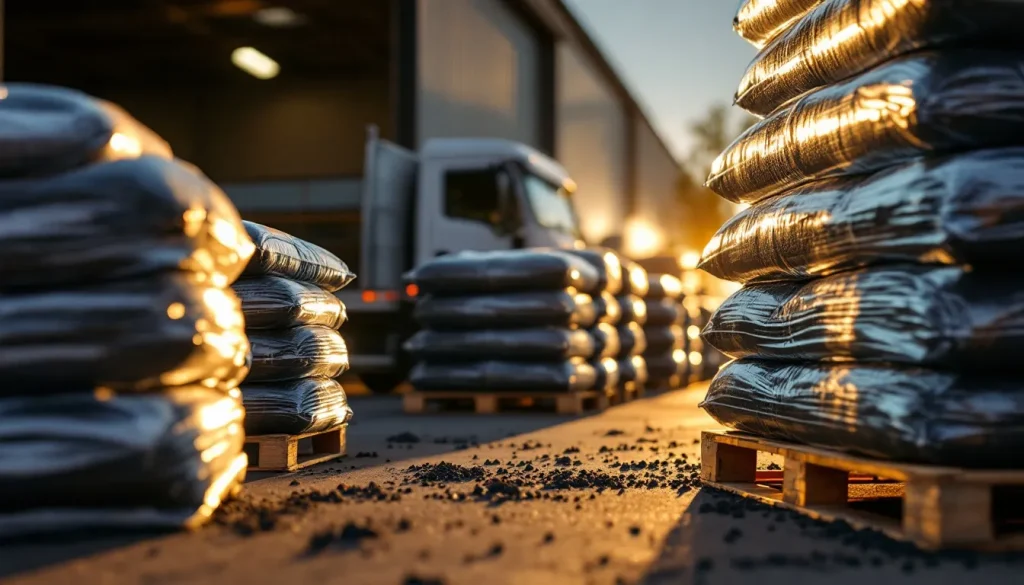
Rubber mulch in bulk is recycled-tire mulch sold in large volume units rather than single retail bags: shrink-wrapped pallets of bags, loose tonnage, cubic yards, or full truckloads. One pallet typically holds 50 bags of 0.8 cubic feet each (about 40 cubic feet, or roughly 2,000 lb). A full truckload runs about 20 to 24 pallets.
The unit you buy in changes the math and the price. Pallets ship on standard freight and are the most common bulk format. “Tons” and “cubic yards” show up with loose bulk suppliers who load into your trailer or dump-deliver. One cubic yard of rubber mulch weighs roughly 800 to 1,200 lb depending on nugget vs. shredded form.
| Bulk unit | Typical size | Approx. weight | Rough coverage at 3 in deep |
|---|---|---|---|
| Bag (retail) | 0.8 cu ft | ~40 lb | ~3.2 sq ft |
| Pallet | 50 bags / ~40 cu ft | ~2,000 lb | ~160 sq ft |
| Cubic yard (loose) | 27 cu ft | ~800-1,200 lb | ~108 sq ft |
| Truckload | 20-24 pallets | ~40,000 lb (a “full 40k”) | ~3,200-3,840 sq ft |
Bulk rubber mulch pricing: real per-pallet, per-ton, and per-yard benchmarks
Bulk rubber mulch typically runs $250 to $450 per pallet, $280 to $500 per ton, and $80 to $160 per cubic yard before freight, based on 2025-2026 landscape-supplier and playground-vendor quotes. Color-coated playground grades and IPEMA-certified product sit at the top of each range. Loose recycled shred sits at the bottom.
Prices move on four levers: color coating (coated black, brown, red, and green cost more than uncoated), certification (IPEMA-verified playground mulch commands a premium), form (virgin nuggets over recycled shred), and order size (each added pallet lowers the per-pallet rate). When a listing says “need more pallets than listed, call for pricing,” that call is the volume-discount conversation, not a barrier.
| Order size | Typical rate driver | Indicative $/pallet |
|---|---|---|
| 1-3 pallets | Retail-adjacent, freight-heavy | $380-$450 |
| 4-9 pallets | First volume tier | $320-$400 |
| 10-19 pallets (LTL max) | Deeper discount | $290-$360 |
| 20-24 pallets (full truckload) | Best per-unit rate | $250-$320 |
Treat these as planning benchmarks, not quotes. Actual pricing depends on supplier, region, tire-feedstock costs, and delivery distance, and can shift with scrap-rubber markets. Get two or three written quotes before committing.
How much rubber mulch do I need? Coverage per pallet and the depth math
To size an order, multiply your area in square feet by depth in feet, which gives cubic feet, then divide by 40 to get pallets (each pallet covers about 40 cubic feet). At 3 inches (0.25 ft) deep, one pallet covers roughly 160 sq ft. A 1,000 sq ft area at 3 inches needs about 6.25 pallets.
The formula in order:
- Area (sq ft) = length x width.
- Depth in feet = target inches / 12.
- Cubic feet needed = area x depth in feet.
- Pallets = cubic feet / 40. Bags = cubic feet / 0.8. Cubic yards = cubic feet / 27.
| Depth | Coverage per pallet (40 cu ft) | Pallets for 1,000 sq ft |
|---|---|---|
| 2 in | ~240 sq ft | ~4.2 |
| 3 in | ~160 sq ft | ~6.25 |
| 4 in | ~120 sq ft | ~8.3 |
| 6 in | ~80 sq ft | ~12.5 |
Buy about 5 to 10 percent extra for settling, edging, and uneven grade. If you also order wood mulch elsewhere on the property, our guide to how many cubic feet are in a yard of mulch keeps your yard-to-bag conversions consistent across both materials.
Playground safety: fall-height, depth, and IPEMA / ASTM ratings
For playground use, rubber mulch depth is a safety spec, not a cosmetic choice. Rubber mulch is rated for critical fall height well above wood: it absorbs impact at more than double the fall-height protection of wood chips and roughly three times that of many other loose surfaces at equal depth. A 6 inch depth commonly rates for fall heights around 10 to 12 feet.
Two standards govern this. ASTM F1292 sets the impact-attenuation test for the critical fall height under playground equipment. IPEMA is the third-party certification body that verifies a product meets it. School, park, and municipal buyers should confirm the specific product carries current IPEMA validation for the fall height matching their tallest equipment, because uncertified mulch may not satisfy inspection or liability requirements. Requirements can vary by state and by facility insurer.
Colors, form, and grade: what to specify when you order
Bulk rubber mulch comes in uncoated black plus color-coated black, brown, red, and green, and in two main forms: shredded and nuggets. Playground buyers usually specify IPEMA-certified color-coated product; landscape buyers often accept uncoated recycled shred to cut cost. Coating adds durability to the color but raises price.
- Color: uncoated black is cheapest; coated black, brown, red, and green cost more and hold their look longer.
- Form: nuggets read like traditional mulch; shredded packs tighter for playground surfacing.
- Source: virgin vs. recycled affects consistency and metal-free processing; ask about wire-free certification.
For a color-specific buying rundown, see our breakdown of black rubber mulch options and where it fits. Rubber mulch also will not host the damp conditions that let moss take over shaded ground cover the way decomposing wood can.
Freight economics: LTL vs. full truckload, and what delivery really costs
Freight is the hidden line item that decides whether bulk saves money. Palletized rubber mulch ships two ways: LTL (less-than-truckload) for roughly 1 to 10 pallets, and full truckload (FTL) for about 20 to 24 pallets. LTL often adds $150 to $400+ per shipment and can equal 15 to 40 percent of a small order’s total. FTL spreads one flat freight cost across the most pallets, giving the lowest delivered per-pallet price.
The awkward middle is 11 to 19 pallets: too many for cheap LTL, not enough to fill a truck, so per-pallet freight stays high. Buyers near that line often round up to a full load if storage allows. Ask each vendor whether the quote is delivered or freight-collect, whether it includes a liftgate and residential surcharge, and the minimum order quantity, which is frequently one pallet for LTL and a full truckload for the best rate.
| Freight mode | Typical pallet count | Freight as share of total | Best for |
|---|---|---|---|
| LTL | 1-10 | 15-40%+ | Small residential / single playground |
| Partial / volume LTL | 11-19 | 10-20% | Mid-size, if FTL will not fill |
| Full truckload (FTL) | 20-24 | 5-12% | Municipal, multi-site, contractors |
Original analysis: is bulk cheaper than bagged from Home Depot or Costco?
Bulk beats bagged retail only after you clear the freight hurdle. Big-box bags (Home Depot, Lowe’s, Costco) run roughly $6 to $10 per 0.8 cu ft bag, or about $7.50 to $12.50 per cubic foot, with no freight because you cart it home. Bulk pallets land near $6.25 to $11.25 per cubic foot delivered once LTL freight is added, so the break-even is real, not automatic.
Where bulk wins: full-truckload orders. At FTL rates the delivered cost can drop toward $6 to $8 per cubic foot, comfortably under bagged retail, and you skip dozens of trips and manual loading. Where bagged wins: small jobs under a few hundred square feet, where LTL freight on one or two pallets erases the per-unit savings.
A working rule from the quote spread above: below about 3 to 4 pallets, price bagged retail seriously; from roughly 4 pallets up, bulk pulls ahead; at a full truckload, bulk is almost always cheapest per covered square foot. Contractors sourcing other volume materials, like professional-grade lawn fertilizer in bulk, tend to hit these truckload thresholds naturally and should price rubber mulch the same way.
Durability, longevity, and where to buy in bulk near you
Rubber mulch does not decompose, so it outlasts wood mulch by roughly 10 years or more versus wood’s one-to-two-season breakdown. That single trait reframes bulk buying: you are buying a decade of surface, not an annual refill, which is why the per-square-foot cost over time often undercuts repeatedly rebuying wood.
For sourcing, named bulk and playground suppliers include Best Rubber Mulch, Rainbow Midwest, and PlaygroundEquipment.com, and Michigan-region buyers see heavy local availability. Search “rubber mulch bulk near me” to surface regional yards that dump-deliver loose tonnage, which can beat palletized freight on short hauls. Confirm IPEMA certification for playgrounds, get the delivered (not pickup) price in writing, and compare at least two vendors before ordering.
Frequently Asked Questions
How much does rubber mulch cost in bulk per pallet or per ton?
Bulk rubber mulch typically runs $250 to $450 per pallet and $280 to $500 per ton before freight, per 2025-2026 supplier quotes. Coated colors (brown, red, green) and IPEMA-certified playground grades sit at the high end; uncoated recycled shred at the low end. Each added pallet lowers the per-pallet rate, so a full truckload of 20-24 pallets earns the best unit price.
How much rubber mulch do I need per pallet by depth and square footage?
Multiply area (sq ft) by depth in feet, then divide by 40 (cubic feet per pallet). One pallet covers about 240 sq ft at 2 inches, 160 sq ft at 3 inches, 120 sq ft at 4 inches, and 80 sq ft at 6 inches. A 1,000 sq ft space at 3 inches needs about 6.25 pallets. Add 5 to 10 percent for settling and edging.
Where can I buy rubber mulch in bulk near me?
Named bulk and playground suppliers include Best Rubber Mulch, Rainbow Midwest, and PlaygroundEquipment.com, with heavy availability across Michigan and the Midwest. Search “rubber mulch bulk near me” for regional landscape yards that dump-deliver loose tonnage, which can beat palletized freight on short hauls. For playgrounds, confirm the local product carries current IPEMA certification before ordering.
Is buying rubber mulch in bulk cheaper than bagged from Home Depot or Costco?
It depends on order size and freight. Big-box bags run about $7.50 to $12.50 per cubic foot with no delivery. Bulk pallets land near $6.25 to $11.25 per cubic foot delivered, so small LTL orders often are not cheaper. Above roughly 4 pallets bulk pulls ahead, and at full truckload it is almost always cheapest per covered square foot.
How is bulk rubber mulch delivered and how much is freight?
Palletized mulch ships LTL (less-than-truckload) for about 1 to 10 pallets or full truckload (FTL) for 20 to 24 pallets. LTL freight often adds $150 to $400+ and can be 15 to 40 percent of a small order. FTL spreads one flat cost across the most pallets, dropping freight to roughly 5 to 12 percent. Loose bulk may dump-deliver locally instead.
What is the minimum order quantity for bulk rubber mulch?
Minimum order quantity is frequently one pallet (about 50 bags or 40 cubic feet) for LTL-shipped bulk, and a full truckload of 20 to 24 pallets to unlock the best per-pallet rate. Some loose-bulk yards set minimums by the cubic yard or ton for local delivery. Minimums vary by vendor and region, so confirm before pricing.
How deep should rubber mulch be for a playground to meet fall-height safety ratings?
Depth depends on your tallest equipment. Rubber mulch is commonly installed 3 to 6 inches deep for playgrounds, with 6 inches often rating for critical fall heights around 10 to 12 feet under ASTM F1292. Rubber outperforms wood by more than 2x at equal depth. Confirm the specific product carries current IPEMA certification for your equipment’s fall height.
How long does rubber mulch last compared to wood mulch?
Rubber mulch does not decompose and commonly lasts 10 years or more, while wood mulch typically breaks down and needs replacing every one to two seasons. Over a decade that means one rubber install versus five to ten wood refills, which is why bulk rubber often wins on cost per square foot over time despite the higher upfront price.