
By HMNDP Editorial Team, independent reporting on lawn care, landscaping, and the green-industry business.
Last reviewed: June 2026
How to aerate a lawn (the short version)
To aerate a lawn, pull thousands of small soil plugs out of the ground with a core aerator so air, water, and nutrients reach the grass roots. Water the lawn one to two days before, run overlapping passes the way you mow, leave the plugs to break down, then overseed and fertilize within 48 hours. Fall suits cool-season grass; late spring suits warm-season grass.
That is the whole job in one breath. The rest of this guide tells you whether your lawn even needs it, which tool to use, what each route costs in 2026, and the exact order of steps so you do not waste a Saturday.
What lawn aeration actually is
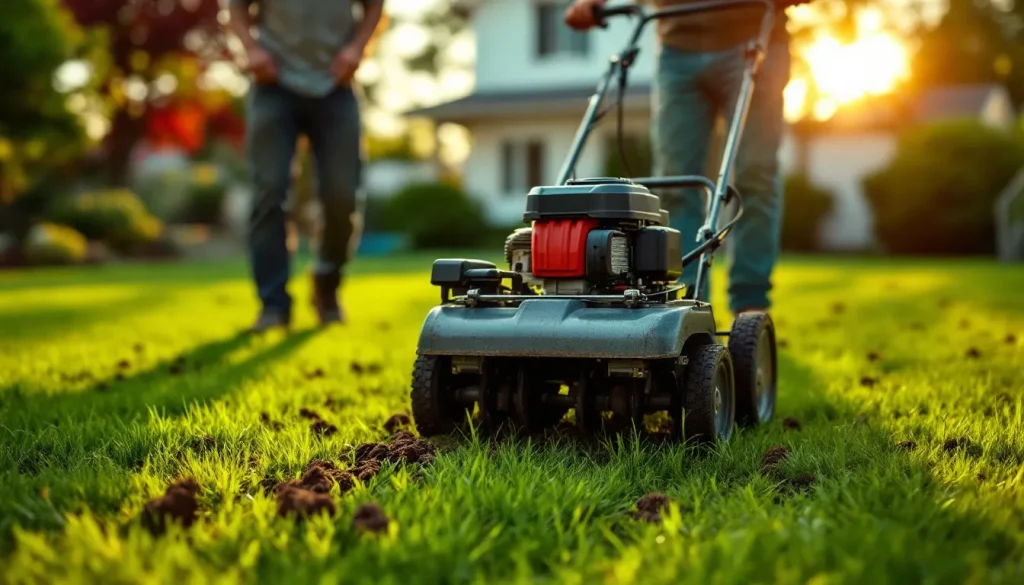
Lawn aeration is the process of perforating soil with holes so that air, water, and nutrients can move down to the grass roots. Core (plug) aeration removes small cylinders of soil and thatch, usually 2 to 3 inches deep and about 0.5 to 0.75 inch wide. The open channels relieve pressure in packed soil and give roots room to spread.
Think of compacted soil like a packed parking lot. Rain runs off instead of soaking in, and roots cannot push through. Aeration drills the parking lot full of holes so the lawn can breathe and drink again.
Why aerate: the benefits that matter
Aerating relieves soil compaction, breaks up thatch, improves root growth, and helps water and fertilizer absorb instead of running off. For most home lawns the single biggest payoff is fixing compaction caused by clay soil, foot traffic, and years of mowing over the same ground.
- Relieves compaction: opens packed soil so roots get oxygen and grow deeper.
- Reduces thatch: the soil cores carry microbes that help decompose the spongy thatch layer.
- Improves water absorption: water reaches roots instead of pooling or running off.
- Boosts fertilizer uptake: nutrients travel down the open channels rather than sitting on top.
- Sets up overseeding: seed drops into the holes, making soil contact for better germination.
Signs your lawn needs aeration (and a 5-minute test)
Your lawn likely needs aeration if the soil is hard, water pools after rain, or the grass thins in high-traffic spots. Other tells are a thatch layer thicker than half an inch and soil so packed that a screwdriver will not push in easily. If two or more apply, put aeration on the calendar.
Run the two quick checks below before you spend a dollar. They keep you from aerating a lawn that does not need it, which is wasted effort and stresses healthy grass.
- Screwdriver test: push a 6-inch screwdriver into moist soil. If it stops short or fights you the whole way, the soil is compacted.
- Soil-core test: dig a square of turf about 4 inches deep. If the thatch layer above the soil is thicker than 0.5 inch, or roots only reach 1 to 2 inches down, aeration will help.
Other red flags: water that pools or runs off, bare worn paths where people and pets walk, and a lawn that dries out fast in summer despite watering. For a deeper walk-through of diagnosing compaction, see our companion piece on aerating a lawn.
Core (plug) aeration vs spike aeration
Core aeration removes plugs of soil and is the recommended method for most lawns. Spike aeration only pokes holes by pushing soil aside, which can compress the soil walls and make compaction worse over time. If you have heavy or clay soil, choose core aeration. Spike tools are fine only for very light, occasional touch-ups on already-loose soil.
| Factor | Core (plug) aeration | Spike aeration |
|---|---|---|
| How it works | Pulls out soil cores | Pokes holes, pushes soil aside |
| Effect on compaction | Relieves it | Can worsen it around each hole |
| Best for | Most lawns, clay, high traffic | Light touch-ups on loose soil |
| Recommended? | Yes, for most homeowners | Only in limited cases |
Manufacturer and retailer pages often blur this distinction. The practical rule is simple: if your goal is to fix compacted soil, a core aerator is the tool, and a spike roller is not.
When to aerate: a grass-type and region calendar
Aerate during the peak growing season for your grass so it recovers fast. Cool-season grasses recover best in early fall (September to October), with early spring as a backup. Warm-season grasses recover best in late spring through early summer (May to June), once they are actively greening up. Aerating during dormancy or peak heat stress sets the lawn back.
First, identify which grass you have. Cool-season grasses (Kentucky bluegrass, tall fescue, perennial ryegrass) dominate the northern and transition US and green up in spring and fall. Warm-season grasses (Bermuda, zoysia, St. Augustine, centipede) dominate the South and green up in late spring and summer.
| Grass type | Common grasses | Typical region | Best aeration window |
|---|---|---|---|
| Cool-season | Kentucky bluegrass, tall fescue, ryegrass | Northern US, transition zone | Early fall (Sept to Oct) |
| Warm-season | Bermuda, zoysia, St. Augustine, centipede | Southern US | Late spring to early summer (May to June) |
Most home lawns need aeration once a year. Lawns on heavy clay or with constant foot traffic may benefit twice a year; sandy or low-use lawns may only need it every 2 to 3 years.
How to aerate a lawn step by step
Aerate a lawn in seven steps: mark hazards, water the soil, make overlapping passes in a mowing pattern, hit compacted areas twice, leave the plugs to break down, then overseed and fertilize. The whole job takes one to three hours for an average yard once the machine or tool is in hand.
- Mark hazards. Flag sprinkler heads, shallow utility lines, and irrigation valves so the tines do not strike them.
- Water one to two days before. Moist soil lets the tines pull deeper, cleaner plugs. Aim for soil that is damp, not muddy. Watering before aerating is the single biggest factor in how easily the tool penetrates.
- Make the first pass. Run the aerator across the lawn in straight rows, the same way you mow, with slight overlap so you do not leave gaps.
- Cross-hatch high-traffic zones. Make a second pass at a right angle over the most compacted areas for denser hole coverage.
- Aim for the right hole density. A good result is roughly 20 to 40 holes per square foot, spaced 2 to 3 inches apart.
- Leave the plugs. Do not rake them up. They break down in 2 to 4 weeks, returning soil and microbes that help digest thatch. Mow over them after a week to speed it up.
- Follow with seed, water, and fertilizer. See the aftercare sequence below.
Tools and equipment: rent, buy, or hire
You have three routes to aerate a lawn: rent a powered core aerator, buy a manual tool, or hire a pro. Renting suits medium to large lawns done in one day. Buying a manual tool suits small lawns and spot fixes. Hiring makes sense for big lawns, bad backs, or anyone who wants it done right without the equipment hassle.
| Route | Typical 2026 cost | Best for | Watch out for |
|---|---|---|---|
| Rent a powered core aerator | $15 to $25 per hour, or roughly $60 to $90 per half day | Lawns over 2,000 sq ft done in one session | Machines are heavy (100+ lbs); plan transport and help loading |
| Buy a manual tool | $25 to $50 for a handheld core aerator; $50 to $80 for a rolling plug aerator | Small lawns under 2,000 sq ft, spot fixes | Slow and tiring on large or clay-heavy yards |
| Hire a pro | $75 to $250 for a typical residential lawn | Large lawns, clay soil, no desire to wrangle equipment | Confirm they do core (not spike) aeration |
The decision is mostly about lawn size and effort. Under 2,000 square feet, a $50 to $80 manual plug aerator pays for itself in two seasons. Between 2,000 and 8,000 square feet, a rental machine at $15 to $25 per hour usually wins. Above that, or on hard clay, a pro at $75 to $250 is often cheaper than the rental plus your weekend. When you call a pro, ask one question: do you pull cores or use spikes. Choose the one who pulls cores.
Aftercare: the overseed, water, and fertilize sequence
Right after aerating is the best time to overseed and fertilize, because seed and nutrients fall straight into the open holes for strong soil contact. Overseed first, then apply a starter fertilizer, then water lightly every day for the first 10 to 14 days. Expect visible recovery in 2 to 4 weeks and full fill-in over one to two months.
- Day 0, overseed. Spread grass seed immediately after aerating so it settles into the holes. Our guide on how to overseed a lawn covers seed rates by grass type.
- Day 0, fertilize. Apply a starter or seasonal fertilizer. For fall cool-season work, a fall lawn fertilizer feeds roots heading into winter.
- Days 1 to 14, water lightly and often. Keep the top inch of soil moist with short daily waterings so new seed does not dry out.
- Weeks 2 to 4, taper watering. Shift to deeper, less frequent watering as seed germinates and plugs break down.
- Hold off on weed killer. Skip pre-emergent and weed-and-feed products for 4 to 6 weeks, since they can stop new seed from sprouting.
For more step-by-step lawn projects and seasonal calendars, browse the HMNDP learn hub.
Should you dethatch or aerate first?
If your thatch layer is thicker than three-quarters of an inch, dethatch first, then aerate. Dethatching removes the dead spongy layer on the surface, while aeration relieves compaction below it. For most lawns with thatch under half an inch, core aeration alone is enough because the soil cores help break thatch down naturally.
Doing both in one season is fine on neglected lawns. Dethatch, then aerate, then overseed the same day so the bare soil does not sit exposed to weeds.
Frequently Asked Questions
What is lawn aeration and how does it work?
Lawn aeration is perforating the soil with holes so air, water, and nutrients reach grass roots. The most effective method, core aeration, uses hollow tines to pull out small soil plugs 2 to 3 inches deep. The open channels relieve compaction, let roots grow deeper, and help water and fertilizer soak in instead of running off the hard surface.
When is the best time to aerate a lawn?
Aerate during your grass’s peak growing season so it recovers fast. Cool-season grasses like Kentucky bluegrass and tall fescue do best in early fall, around September to October. Warm-season grasses like Bermuda and zoysia do best in late spring to early summer, around May to June. Avoid aerating during dormancy or peak summer heat stress.
How do I know if my lawn needs aerating?
Push a 6-inch screwdriver into moist soil. If it will not slide in easily, the soil is compacted and needs aeration. Other signs include water pooling after rain, thin grass in high-traffic areas, a thatch layer thicker than half an inch, and soil that dries out quickly. If two or more apply, aerate that season.
Should I aerate or dethatch first?
If thatch is thicker than three-quarters of an inch, dethatch first, then aerate. Dethatching strips the dead surface layer, while aeration relieves compaction in the soil below. For lawns with thatch under half an inch, core aeration alone is usually enough, since the soil plugs it pulls up carry microbes that help break thatch down naturally.
What is the difference between core aeration and spike aeration?
Core aeration removes small plugs of soil and is recommended for most lawns. Spike aeration only pokes holes by pushing soil aside, which can compress the surrounding soil and worsen compaction over time. For clay or compacted lawns, choose core (plug) aeration. Spike tools are acceptable only for light touch-ups on already-loose, healthy soil.
How much does it cost to aerate a lawn, DIY versus hiring a pro?
In 2026, renting a powered core aerator runs about $15 to $25 per hour. A manual plug tool costs roughly $50 to $80 to buy, and a handheld version $25 to $50. Hiring a professional typically costs $75 to $250 for a residential lawn. Renting suits mid-size lawns, buying suits small ones, and hiring suits large or clay-heavy yards.
Should I overseed and fertilize after aerating?
Yes. Right after aerating is the ideal time to overseed and fertilize, because seed and nutrients drop into the open holes for strong soil contact and better germination. Overseed first, apply a starter or seasonal fertilizer, then water lightly every day for 10 to 14 days. Avoid weed killers and pre-emergents for 4 to 6 weeks so new seed can sprout.
Can you aerate a lawn yourself, and what tools do you need?
Yes, most homeowners can aerate their own lawn. For small lawns under 2,000 square feet, a manual core aerator ($25 to $80) works. For larger lawns, rent a powered core aerator for about $15 to $25 per hour. Choose a core (plug) tool over a spike tool, water the soil a day before, and make overlapping passes like mowing.