
By the HMNDP Editorial Team. Independent reporting on lawn care, landscaping, and the green industry.
Last reviewed: June 2026
What Is Yard Design (and How It Differs From Gardening)
Yard design is the planning of how the outdoor space around a home is laid out: where paths, patios, planting beds, lawn, and focal points go, and how they connect. It is the same discipline professionals call landscape design. Gardening is what happens after: choosing, planting, and maintaining the plants inside that layout. Design is the map; gardening is the driving.
The distinction matters for budget. A design mistake (a patio in the wrong spot, a path too narrow) costs hundreds of dollars to redo. A gardening mistake (the wrong perennial) costs a few dollars.
Good yard design solves three problems at once: how the space works (circulation and use), how it looks (color, texture, form), and what survives your climate. Skip any one and the yard fails within two seasons. For the wider market context, see our 2026 US lawn care and landscape industry report.
How to Design Your Yard Step by Step
Designing a yard follows a repeatable eight-step process: measure, map sun and soil, list your needs, sketch zones, place hardscape, layer plants, cost it out, then phase the build. Work in that order. Most DIY failures come from choosing plants first (step 6) before understanding the site (steps 1 to 3). Expect 6 to 12 hours of planning for an average quarter-acre lot.
- Measure the space. Pace or tape the boundaries and mark the house, driveway, existing trees, downspouts, and utility lines. Call 811 before any digging in the US to locate buried utilities (free, required by law in most states).
- Map sun and soil. Note which areas get full sun (6+ hours), part sun (3 to 6), or shade (under 3). Do a $12 to $20 soil test through your county extension office to learn pH and drainage.
- List needs and wants. Separate “must have” (parking, a dry path to the door) from “nice to have” (fire pit, veg garden). This list drives every later decision.
- Sketch zones. Block the yard into use areas: entry, dining, play, utility, planting. Do not place a single plant yet.
- Place hardscape. Draw patios, paths, borders, and beds. Hardscape is permanent and expensive, so lock it before plants.
- Layer plants. Add trees, then shrubs, then perennials and groundcover, matched to each zone’s sun and soil.
- Cost it out. Price materials and plants against real ranges (see the budget table below).
- Phase the build. Split the plan into 2 or 3 seasons if the full cost exceeds your budget. Hardscape first, plants later.
Front Yard Design Ideas and Layout Principles
Front yard design centers on curb appeal and a clear route to the door. The layout principle that matters most is the “public face” rule: keep it simpler and more symmetrical than the back. Three to five plant types, one clear focal point (a specimen tree or the front door itself), and a path wide enough for two people (at least 48 inches) read as intentional. Clutter reads as neglect.
Anchor the front with foundation planting that stays below window height at maturity. A common beginner error is buying shrubs by their nursery size, not their 10-year size, which buries the windows within four seasons.
Layer the front yard in three depths: low border plants along the path, mid-height shrubs against the house, and one taller anchor tree offset from center. Repeat one plant or one color at least three times to create rhythm rather than a random collection.
Back Yard Design Ideas and Zones
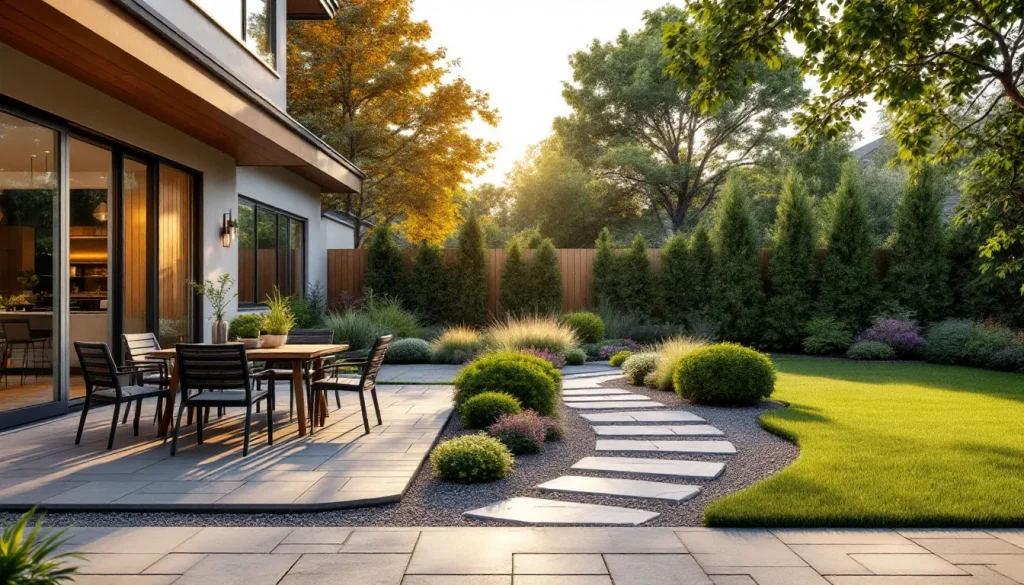
Back yard design is organized by zones because the back is private and multi-use. A workable backyard usually holds three to five zones: a dining or patio zone near the house, an open lawn or play zone, a planting or privacy zone at the edges, and often a utility zone (bins, compost, tools) hidden from view. Assign every square foot to a zone before choosing materials.
Place the patio zone within 15 feet of the kitchen door. Distance kills use; a fire pit at the far fence gets visited far less than one 20 feet from the back door.
Use planting to screen, not just decorate. A staggered row of upright evergreens or a mixed hedge along a fence line creates privacy faster and cheaper than a taller fence in most jurisdictions where fence height is capped at 6 feet.
Combining Color, Texture, Shape, and Plant Layering
Strong yard design combines four visual tools: color (limit to two or three families, plus green), texture (mix fine, medium, and bold leaf sizes), shape (contrast rounded mounds against upright spikes), and layering (tall in back, short in front). The single highest-impact move for beginners is repetition: repeat one plant, color, or material at least three times across the yard so the eye reads a pattern instead of chaos.
Texture does more heavy lifting than flower color because leaves are present all season while blooms last weeks. Pair a fine-textured grass against a bold-leaved hosta or hydrangea for instant contrast that holds from spring to frost.
Layer in tiers by mature height: canopy trees, understory shrubs, then perennials and groundcover. This mirrors how plant communities grow naturally and shades out weeds as the layers fill in.
Choosing Plants for Your Climate, Sun, and Soil
Choosing plants starts with three site facts, not a wish list: your USDA hardiness zone (updated 2023), each area’s daily sun hours, and your soil type. A plant tag that says “full sun, zones 5 to 9, well-drained soil” is a pass or fail test for your specific spot. Match all three and the plant thrives with little care. Miss one and you replace it, on average, within two seasons.
Find your zone by ZIP code on the USDA Plant Hardiness Zone Map, then treat the zone as the outer limit, not a guarantee. Microclimates (a south wall, a low frost pocket) shift a spot up or down half a zone.
Favor plants native or well-adapted to your region. Native plants typically need less water and no soil amendment once established, and regional programs often list them free. The table below shows how climate steers plant choice.
| Region / condition | USDA zone range | Design consideration | Reliable plant categories |
|---|---|---|---|
| Arid Southwest | 7 to 10 | Water restrictions, intense sun | Agave, native grasses, gravel xeriscape |
| Humid Southeast | 7 to 9 | Heat plus humidity, fungal pressure | Wax myrtle, muhly grass, native azalea |
| Upper Midwest / Northeast | 3 to 6 | Hard freezes, short season | Coneflower, serviceberry, cold-hardy conifers |
| Pacific Northwest | 7 to 9 | Wet winters, dry summers | Ferns, sword fern, drought-tolerant natives |
Hardscape Elements: Patios, Paths, Borders, and Beds
Hardscape is the non-living structure of a yard: patios, walkways, retaining walls, borders, and defined beds. It sets the skeleton and consumes the largest share of most budgets, often 60 to 70 percent. Design and install hardscape first because it is permanent and the most expensive item to redo. Plants are cheap and movable by comparison.
Size a patio to the furniture plus 3 feet of clearance on each side. A four-seat dining set needs roughly 12 by 12 feet (144 square feet) to feel usable rather than cramped.
Give beds a clean, defined edge. A cut trench edge or a steel or stone border does more for a finished look than any single plant, and it stops lawn grass from creeping into beds. Curved bed lines read softer and more natural than straight ones in most residential yards.
Yard Design Tools and Software: Free, Paid, and AI (2026 Comparison)
The best yard design tool depends on whether you want a hand-drawn plan, a paid pro render, or an instant AI redesign from a photo. As of 2026, no single free tool does everything well, so most DIY designers use two: one to lay out the plan to scale and one to visualize the finished look. The comparison below is honest about what each does and does not deliver.
| Tool | Type | Cost (2026) | Best for | Honest limitation |
|---|---|---|---|---|
| iScape | App, 2D/AR | Free tier; Pro ~$30/mo | Placing plants over a photo of your yard | Plant library and realism limited on free tier |
| Canva | Web design | Free; Pro ~$15/mo | Mood boards and simple to-scale layouts | Not a true landscape tool; no plant data |
| SketchUp Free | Web 3D | Free (web version) | Accurate 3D layout and hardscape | Steep learning curve; hours to learn |
| Yardzen | Pro design service | ~$700 to $2,500+ per package | A designer-made plan and plant list by mail | Paid service, not a free tool; remote only |
| AI photo redesign tools | AI render | Free trials; ~$10 to $20/mo | Instant style inspiration from one photo | Renders are aspirational, not buildable plans |
| Pen and graph paper | Manual | Free | Fast, reliable to-scale plans | No 3D preview; harder to share |
For a deeper feature breakdown of paid platforms, see our 2026 landscape software report. For the full walkthrough, our complete 2026 yard design guide expands each step.
Can AI Design Your Yard From a Photo?
AI yard design tools can generate a styled render of your yard from a single photo in seconds, and in 2026 several (iScape AI, and generative render tools) do it convincingly. What they cannot do is produce a buildable plan. AI renders ignore your sun exposure, soil, hardiness zone, drainage, and mature plant sizes. Treat them as inspiration for a mood board, then translate the look into real, climate-matched plants using the process above.
The practical workflow: run one photo through an AI tool to test a style (modern, cottage, xeriscape), screenshot the versions you like, then hand-build the actual plan with plants that survive your zone. The AI sets the direction; you supply the horticulture.
Design Inspiration and Idea Boards
Idea boards turn scattered inspiration into a coherent style before you spend money. Collect 15 to 25 images of yards you like on Pinterest, Houzz, or Instagram, then look for the pattern: the repeated colors, materials, and plant shapes are your style. Delete the outliers. A tight board of 8 to 10 images beats a sprawling one because it forces a decision.
Pin real yards in your climate, not staged magazine shots from other regions. A lush tropical courtyard is useless inspiration in USDA zone 4. Filter every saved image through one question: could this survive my winter?
DIY vs Hiring a Landscape Designer: A Decision Framework
Whether to DIY or hire a designer comes down to four factors: budget size, site complexity, your time, and grading or drainage risk. As a rule, DIY the design when the yard is flat, the budget is under about $10,000, and no drainage or retaining walls are involved. Hire a professional when slopes, water problems, or five-figure budgets raise the cost of a mistake above the designer’s fee. Use the framework below.
| Factor | Lean DIY | Lean hire a pro |
|---|---|---|
| Budget | Under $10,000 | $15,000+ where mistakes are costly |
| Grade / slope | Flat, no retaining walls | Slopes, terracing, drainage issues |
| Complexity | Beds, path, planting | Structures, lighting, irrigation design |
| Your time | Have 10+ hours to plan | Little time, want it done once |
A middle path exists: hire a landscape designer for the plan only (a one-time design fee, often $1,500 to $4,000, or a flat package from a remote service like Yardzen), then install it yourself. This buys professional judgment on layout and drainage while keeping labor costs, which run the largest share of any project, in your own hands. Labor economics are covered in our 2026 landscape labor report.
Budget and Cost: What Yard Design and Redesign Actually Cost
Yard design and installation typically costs $5 to $40 per square foot in 2026, depending on how much hardscape is involved. A design plan alone runs $0 (DIY) to about $4,000 (custom professional). A full backyard redesign for an average lot commonly lands between $8,000 and $30,000 installed, with hardscape (patios, walls, paths) driving most of that. Plants are usually the smallest line item.
| Item | Typical 2026 cost range | Notes |
|---|---|---|
| DIY design plan | $0 to $50 | Free tools plus a soil test |
| Professional design plan | $1,500 to $4,000 | Or ~$700+ for a remote package |
| Planting (per sq ft) | $5 to $12 | Perennials and shrubs, installed |
| Paver patio (per sq ft) | $15 to $30 | Materials plus labor |
| Gravel path (per sq ft) | $5 to $12 | DIY-friendly hardscape |
| Retaining wall (per sq ft of face) | $25 to $60 | Get a pro for walls over 3 ft |
| Full backyard redesign (avg lot) | $8,000 to $30,000 | Phasing spreads this over seasons |
Cut cost without cutting quality by phasing: install hardscape and trees in year one, fill in perennials and groundcover in year two. Buying plants in smaller sizes (1-gallon instead of 5-gallon) saves 40 to 60 percent and they catch up within two to three seasons.
Frequently Asked Questions
What is yard design and how is it different from landscaping?
Yard design is the planning stage: deciding where paths, patios, beds, lawn, and focal points go and how they connect. Landscaping is the broader term that includes both that design and the physical installation and upkeep. In short, design is the plan and landscaping is executing plus maintaining it. Getting the design right first prevents expensive rework during installation.
How do I design my yard step by step?
Follow eight steps in order: measure the space, map sun and soil, list needs versus wants, sketch use zones, place hardscape (patios and paths), then layer plants, cost it out, and phase the build. The key rule is to choose plants last, only after you understand the site and lock the hardscape. Expect 6 to 12 hours of planning for an average lot.
What is the best free yard design tool or app?
No single free tool does everything in 2026. SketchUp Free handles accurate 3D layouts, iScape’s free tier places plants over a photo of your yard, and Canva builds quick mood boards. Many DIY designers pair a free layout tool with a free AI render tool for visualization. Pen and graph paper remain the fastest reliable way to draw a to-scale plan at no cost.
Can AI design my yard from a photo?
AI tools can generate a styled render of your yard from one photo in seconds, and several do it well in 2026. However, AI renders ignore your sun exposure, soil, hardiness zone, and mature plant sizes, so they are inspiration, not buildable plans. Use AI to test a style, then translate the look into real, climate-matched plants using a proper site-based design process.
How much does it cost to design and redesign a yard?
Yard design plus installation typically runs $5 to $40 per square foot in 2026. A DIY design plan costs $0 to $50; a professional plan runs $1,500 to $4,000, or about $700 for a remote package. A full backyard redesign on an average lot commonly lands between $8,000 and $30,000 installed, with hardscape driving most of the total and plants the smallest share.
Should I hire a landscape designer or do it myself?
DIY the design when the yard is flat, the budget is under about $10,000, and there are no drainage or retaining wall issues. Hire a professional when slopes, water problems, or five-figure budgets make a design mistake costlier than the fee. A middle path is paying a designer for the plan only, then installing it yourself to save on labor.
How do I design a front yard vs a back yard?
Design the front for curb appeal: keep it simpler and more symmetrical, use three to five plant types, one focal point, and a path at least 48 inches wide. Design the back by zones for private, multi-use living: a patio zone near the kitchen door, an open lawn or play zone, planting for privacy at the edges, and a hidden utility zone.
How do I choose plants for my yard design?
Start with three site facts, not a wish list: your USDA hardiness zone, each area’s daily sun hours (full, part, or shade), and your soil type from a $12 to $20 test. Treat a plant tag as a pass or fail test against those three facts. Favor native or well-adapted plants, which need less water and rarely need soil amendment once established.