
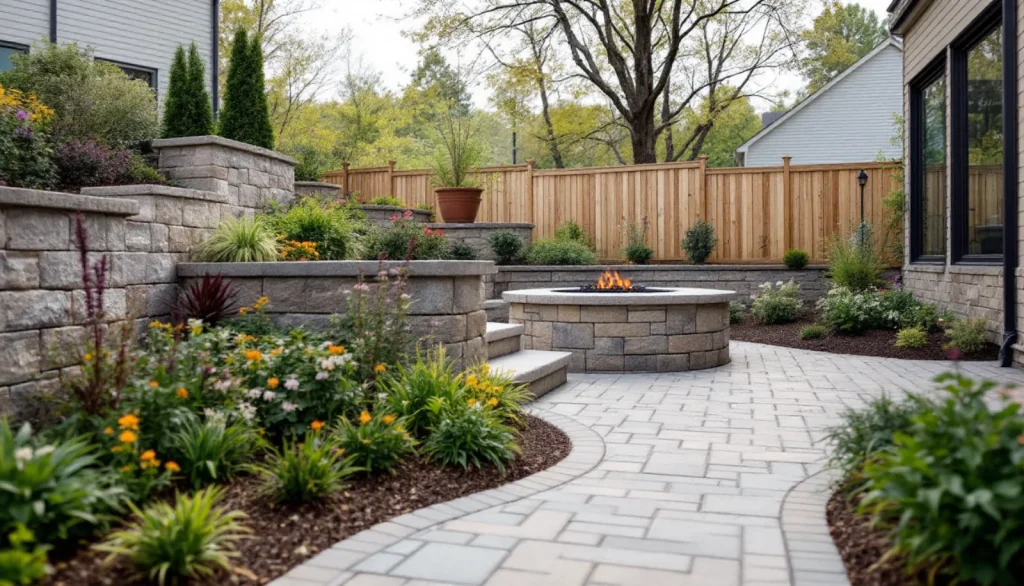
Hardscaping: Elements, Cost, and Hardscape vs Softscape
Hardscaping is the non-living side of a landscape: the patios, walkways, retaining walls, driveways, and fire pits built from stone, concrete, pavers, brick, gravel, and timber. It gives a yard its structure and usable floor space, and it usually eats the largest slice of an outdoor budget because the materials are heavy and the labor is skilled. This guide covers what hardscaping includes, how it differs from softscape, what each element costs in 2026, and which projects are realistic to do yourself versus when to hire a pro.
The short version
- Hardscaping covers every built, non-living feature: patios, walkways, driveways, retaining walls, fire pits, steps, pergolas, outdoor kitchens, and lighting.
- Softscape is the living half (grass, plants, trees, mulch). A common planning rule allocates 10 to 20 percent of the total landscape budget to hardscape, though structure-heavy yards run higher.
- Most basic backyard hardscape projects land between $3,000 and $15,000; designs with retaining walls, outdoor kitchens, or large patios reach $10,000 to $30,000 and up (Angi, HomeGuide 2026 data).
- Whole-project hardscaping averages roughly $15 to $50 per square foot installed depending on material and site prep.
- The hidden cost driver is the base: excavation, compacted gravel sub-base, and drainage. Skipping it is why DIY patios heave and pavers sink.
- Gravel paths, simple paver walkways, and prefab fire pit kits are realistic DIY. Driveways, structural retaining walls (often over 4 feet), and gas fire features usually need a licensed pro and a permit.
What is hardscaping?
Hardscaping is the practice of installing the hard, non-living elements of a landscape: anything built from stone, concrete, pavers, brick, gravel, wood, or metal rather than grown. The term covers ground surfaces you walk and park on, vertical structures that hold soil or define space, and built features like fire pits and outdoor kitchens. If it does not need water or sunlight to stay alive, it is hardscape.
The word pairs with softscape, the living half of the same design. Together they make up landscaping. Hardscape provides the framework (the floor, the walls, the paths), and softscape fills that framework with plants. A well-planned yard balances both so the built features have a job and the planting has a place to sit.
What are the main hardscaping elements?
The core hardscape elements are patios, walkways, driveways, retaining walls, and fire pits, with steps, pergolas, outdoor kitchens, water features, and lighting added as the budget grows. Each one serves a specific function: a surface to stand on, a path to move along, a wall to hold a slope, or a feature to gather around. Below is what each element does and how it is typically built.
- Patio: a flat outdoor floor in pavers, poured or stamped concrete, flagstone, or brick. The most common hardscape project and usually the largest single line item.
- Walkway or path: a route between spaces, from loose gravel to mortared flagstone. Width and material set the cost.
- Driveway: a load-bearing surface for vehicles, built in gravel, concrete, asphalt, or pavers. Needs a deeper, stronger base than a patio.
- Retaining wall: a structural wall that holds back soil on a slope. Short decorative walls are simple; tall walls are engineered.
- Fire pit: a built-in or kit gathering feature, wood-burning or gas. Gas versions add fuel lines and clearance rules.
- Steps and edging: grade changes and clean borders between hardscape and planting beds.
- Pergolas, outdoor kitchens, water features, lighting: higher-end additions that raise both function and cost.
Hardscape vs softscape: what is the difference?
Hardscape is the built, non-living material in a yard; softscape is the living material. Hardscape is durable, costs more upfront, and is hard to change once set. Softscape is cheaper per square foot to install, easier to move or replace, but carries ongoing maintenance like mowing, pruning, and watering. Most projects use both because each covers the other’s weakness.
| Factor | Hardscape | Softscape |
|---|---|---|
| What it is | Patios, walls, walkways, driveways, fire pits (stone, concrete, pavers, gravel, wood) | Grass, plants, trees, shrubs, flowers, mulch, soil |
| Upfront cost | Higher; heavy materials plus skilled labor and excavation | Lower per square foot for basic planting |
| Ongoing maintenance | Low; occasional cleaning, resanding, sealing | Higher; mowing, watering, pruning, replacing |
| Flexibility | Low; expensive to tear out and redo | High; plants can be moved or swapped seasonally |
| Role in design | Structure and usable floor space | Color, texture, shade, softening |
| Typical budget share | Often the larger share; structure-heavy yards run well above the 10 to 20 percent planning rule | The remainder, plus recurring care costs |
A practical planning rule cited across landscape design sources is to allocate 10 to 20 percent of the total landscape budget to hardscape, but that figure assumes a planting-heavy yard. A design built around a large paver patio, a retaining wall, and an outdoor kitchen will flip that ratio, with hardscape taking the majority. Decide the function first, then let the budget follow the structure you actually need.
How much does hardscaping cost in 2026?
Hardscaping costs roughly $15 to $50 per square foot installed across the whole project, and most basic backyard builds run $3,000 to $15,000, per Angi and HomeGuide 2026 cost data. Designs that add retaining walls, outdoor kitchens, or large patios push into the $10,000 to $30,000 range, and extensive projects with water features or custom masonry exceed $50,000. The element you build and the material you pick set the per-square-foot number.
| Element | Typical installed cost | Typical project total | Notes |
|---|---|---|---|
| Paver patio | $18 to $45 per sq ft | $4,000 to $12,000 | Concrete pavers cheapest; natural bluestone and flagstone higher |
| Concrete patio (poured) | $4 to $12 per sq ft | $2,000 to $6,000 | Stamped concrete $10 to $20 per sq ft |
| Flagstone patio | $15 to $30 per sq ft | $3,000 to $12,000+ | Dry-laid cheaper than mortar-set |
| Walkway | About $15 per sq ft | Varies by length | Gravel paths far cheaper; mortared stone higher |
| Retaining wall | $35 to $65 per sq ft of face, or $60 to $120 per linear ft (modular) | $3,200 to $9,200 | Tall or engineered walls cost well above this |
| Gravel driveway | $1 to $10 per sq ft | $500 to $3,500 | Basic install often $2 to $4 per sq ft |
| Fire pit | Average about $850 installed | $240 to $2,400 (custom $5,000+) | Gas and in-ground cost more than above-ground kits |
Three things move these numbers more than anything else. Material is the first: poured concrete and gravel sit at the bottom, concrete pavers in the middle, and natural stone like flagstone or bluestone at the top. Site prep is the second: a sloped lot, poor drainage, or a deep frost line all add excavation and base material. Region is the third: Pacific Coast and Northeast markets commonly run 25 to 35 percent above national averages, partly from labor and partly from freeze-thaw base requirements.
For the recurring side of a landscape budget, our breakdown of 2026 lawn care cost by service and region covers what the softscape half costs to maintain year after year, which is the number hardscape-heavy designs are often built to reduce.
Why the base costs more than the surface
The visible material is not what makes hardscape last; the base under it is. A durable patio or walkway sits on excavated, graded soil topped with a compacted gravel sub-base and a leveling layer, with drainage planned so water moves away rather than pooling. That hidden work is the difference between a patio that stays flat for decades and one that heaves, cracks, or sinks within a few seasons.
Base depth scales with the load and the climate. A foot patio needs a few inches of compacted base; a vehicle driveway needs far more. In freeze-thaw regions, the base has to extend deep enough that seasonal frost heave does not lift the surface, which is the main reason Northeast and upper-Midwest installs cost more than the Sun Belt. When a DIY hardscape fails, skipped or shallow base prep is almost always the cause, and correcting a failed install costs more than building it right the first time.
Should you DIY hardscaping or hire a pro?
Small, non-structural, non-permit projects are realistic DIY: a gravel path, a simple sand-set paver walkway, a prefab fire pit kit, or a short decorative border wall. Anything load-bearing, tall, or tied to utilities should go to a licensed pro: driveways, retaining walls (often anything over 4 feet, which typically needs engineering and a permit), gas fire features, and large patios with drainage and grading demands. The dividing line is whether failure is cosmetic or structural.
| Project | Realistic DIY? | Why |
|---|---|---|
| Gravel path or garden border | Yes | Low load, no permit, mistakes are cheap to fix |
| Small sand-set paver walkway or patio | Maybe | Doable with base prep know-how; expect several weekends and rented compaction gear |
| Prefab or kit fire pit (wood-burning) | Yes | Stackable block kits with adhesive; follow clearance rules |
| Short decorative retaining wall (under ~3 ft) | Maybe | Non-structural height; still needs proper base and backfill drainage |
| Large patio with drainage and grading | No | Base, slope, and compaction errors are expensive to undo |
| Tall or load-bearing retaining wall (over ~4 ft) | No | Usually requires engineering, a permit, and a licensed contractor |
| Driveway (concrete, paver, asphalt) | No | Heavy load, deep base, and equipment beyond most DIY reach |
| Gas fire pit or outdoor kitchen | No | Fuel lines, clearances, and permits demand a licensed trade |
If you do hire out, the build quality lives in the base prep you cannot see after it is finished, which is exactly where corners get cut. Before you sign anything, walk through our 12 questions that separate real hardscape contractors from patio failures, and use our broader checklist on how to find a reputable landscaper to verify licensing, insurance, and references.
How hardscaping fits the rest of the yard
Plan hardscape and softscape together, not in sequence. The built features set the floor plan: where you sit, walk, park, and gather. Planting then frames and softens that structure, adds shade, and manages the parts of the yard the hardscape does not cover. Drainage ties the two halves together, since every paved surface sends water somewhere that the softscape has to absorb.
Boundary structures sit on the line between hardscape and the rest of the property. A run of fencing reads as both a privacy and a design element, so coordinate it with your patio and wall materials early. Our guides to fence and gate options and choosing a privacy fence cover the styles, materials, and cost ranges that pair with a hardscape build. For the runoff side, a backyard rain garden is a common softscape answer to the extra water that patios and driveways shed.
Get the structure right and the planting becomes the easy, changeable part. Hardscape is the decision you live with for decades; softscape is the one you can revise every season. Spend the planning time, and the money, where mistakes are permanent.
Last reviewed: June 2026
HMNDP Editorial Team, reviewed by HMNDP turf and horticulture editors.
Frequently asked questions
What is hardscaping?
Hardscaping is the practice of installing the non-living, built elements of a landscape: patios, walkways, driveways, retaining walls, fire pits, steps, and structures made from stone, concrete, pavers, brick, gravel, wood, or metal. If a feature does not need water or sunlight to stay alive, it is hardscape. It pairs with softscape, the living plant half, to form a complete landscape.
What is the difference between hardscaping and landscaping?
Landscaping is the whole yard design. Hardscaping is only the non-living, built portion of it: patios, walls, walkways, driveways, and fire pits. Softscape is the living portion: grass, plants, trees, and mulch. So hardscape and softscape are the two halves that together make up landscaping. Hardscape sets the structure; softscape fills it in.
What is an example of a hardscape?
Common hardscape examples are a paver or concrete patio, a flagstone or gravel walkway, a driveway, a retaining wall that holds back a slope, and a fire pit. Steps, pergolas, outdoor kitchens, water features, and landscape lighting also count. Anything built from stone, concrete, brick, gravel, wood, or metal rather than grown is hardscape.
How much does hardscaping cost?
Whole-project hardscaping runs roughly $15 to $50 per square foot installed, per Angi and HomeGuide 2026 data. Most basic backyard builds land between $3,000 and $15,000. Adding retaining walls, outdoor kitchens, or large patios pushes the total to $10,000 to $30,000, and extensive custom projects exceed $50,000. Material, site prep, and region drive the final number.
How much should you spend on a hardscape?
A common planning rule allocates 10 to 20 percent of the total landscape budget to hardscape, but that assumes a planting-heavy yard. Designs built around a large patio, a retaining wall, or an outdoor kitchen flip that ratio, with hardscape taking the majority. Decide the function you need first, then size the budget to the structure rather than to a fixed percentage.
What is the cheapest hardscape option?
Gravel and poured concrete are the cheapest hardscape materials. A gravel path or driveway can run $1 to $10 per square foot, and a poured concrete patio runs $4 to $12 per square foot. Concrete pavers sit in the middle, while natural stone like flagstone or bluestone is the most expensive surface per square foot installed.
Can you DIY hardscaping?
Small, non-structural projects are realistic DIY: a gravel path, a simple sand-set paver walkway, a prefab wood-burning fire pit kit, or a short decorative wall. Driveways, tall retaining walls (often over 4 feet, which usually need a permit and engineering), gas fire features, and large drained patios should go to a licensed pro. The line is whether failure is cosmetic or structural.
What makes hardscaping fail?
Most hardscape failures trace to the base, not the surface. A lasting patio or walkway needs excavated soil, a compacted gravel sub-base, and planned drainage. Skipped or shallow base prep is why DIY pavers sink, patios heave, and walls lean, especially in freeze-thaw regions where frost lifts an undersized base. Correcting a failed install costs more than building it right once.