
By the HMNDP Editorial Team, independent reporting on gardening, landscaping, and the green industry.
Last reviewed: June 2026
What are baby breath flowers?
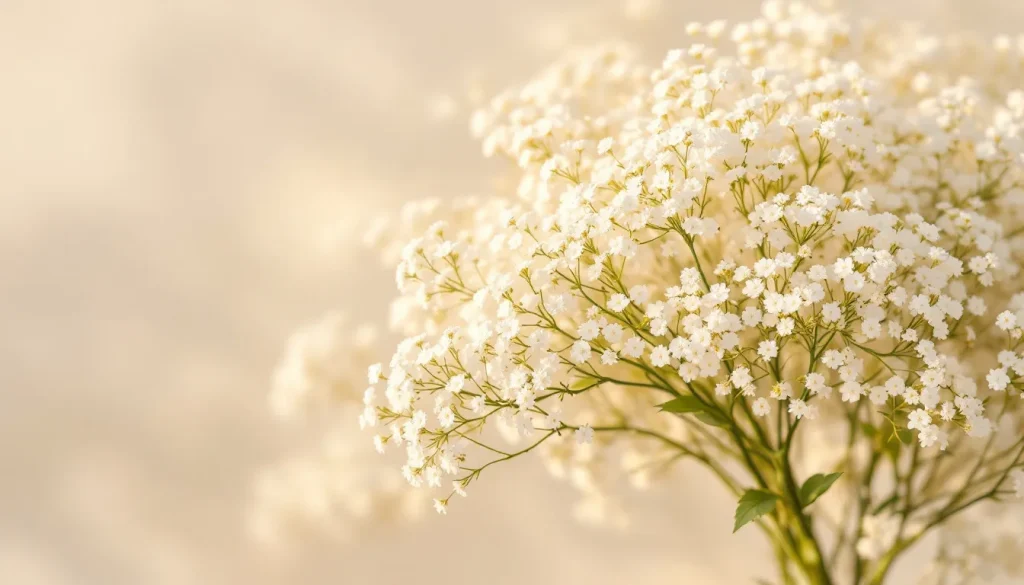
Baby breath flowers are the tiny white blooms of the plant genus Gypsophila, most often the species Gypsophila paniculata. Each stem carries clusters of small five-petaled flowers on thin, branching stalks, creating a soft, snow-like cloud. Florists rank it among the most popular filler flowers in the world, used to fill space between focal blooms in bouquets and arrangements.
The name “baby’s breath” describes the flower’s delicate, airy look, as if a light exhale could scatter the petals. It has been a florist staple for well over a century, valued because a single armful can visually double the volume of an arrangement at low cost.
Common names include baby’s breath, common gypsophila, panicled baby’s-breath, and simply gypsophila. Retailers and wedding planners frequently drop the possessive and search for “baby breath flowers,” which is why you may see both spellings used interchangeably.
Botanical identity at a glance
Gypsophila is a genus of roughly 150 species in the carnation family, Caryophyllaceae. The name comes from the Greek for “gypsum-loving,” a reference to the chalky, lime-rich soils many species prefer. The florist trade centers on one perennial species, Gypsophila paniculata, though a pink annual, Gypsophila elegans, also reaches gardens.
| Attribute | Detail |
|---|---|
| Genus | Gypsophila (family Caryophyllaceae) |
| Primary florist species | Gypsophila paniculata |
| Common names | Baby’s breath, common gypsophila, panicled baby’s-breath, gypsophila |
| Native range | Central and eastern Europe, Asia |
| Flower color (wild) | White, occasionally soft pink |
| Bloom size | Roughly 3 to 6 mm across |
| Primary use | Filler flower in bouquets and floral arrangements |
Is baby’s breath toxic to cats, dogs, or humans?
Yes, baby’s breath is mildly toxic. The ASPCA lists Gypsophila paniculata as toxic to cats, dogs, and horses. The plant contains gyposenin, a type of saponin, which can cause vomiting, diarrhea, drooling, and loss of appetite if pets chew or swallow the stems or flowers. For humans it is not considered edible and can irritate skin and airways with repeated handling.
This is the single biggest gap in most online guides. Bulk-flower sellers and encyclopedia entries rarely mention toxicity at all, yet “is baby’s breath toxic” is a common related search. If you keep pets or plan a home arrangement around children, treat baby’s breath as a look-but-do-not-eat flower.
Who is at risk and what to watch for
Saponins irritate the digestive tract rather than causing organ failure, so most exposures are unpleasant but not fatal. Symptoms usually appear within a few hours and resolve once the plant is removed. Call a veterinarian if a pet shows repeated vomiting, weakness, or refuses food.
| Who | Toxicity level | Typical symptoms |
|---|---|---|
| Cats | Mildly toxic (ASPCA-listed) | Vomiting, diarrhea, drooling, low appetite |
| Dogs | Mildly toxic (ASPCA-listed) | Vomiting, diarrhea, lethargy |
| Horses | Mildly toxic (ASPCA-listed) | Digestive upset, reduced appetite |
| Humans | Not edible; contact irritant | Skin rash, respiratory irritation in florists |
Florists who handle large volumes daily sometimes report a mild skin reaction called “gypsophila dermatitis” or respiratory irritation from the pollen and dust. Wearing gloves and working in ventilated space reduces the risk. Keep fresh or dried stems out of reach of curious pets.
What do baby’s breath flowers symbolize or mean?
Baby’s breath symbolizes everlasting love, purity, and innocence, which is why it appears in so many weddings and christenings. Its association with new life and sincerity also makes it a common gift for births and fresh starts. The delicate white blooms have long carried meanings of a pure heart and a lasting, undying bond between two people.
These meanings explain the flower’s near-universal presence at weddings beyond its low price. Couples reach for it because the symbolism reinforces the occasion: a commitment meant to endure. Paired with red roses, baby’s breath is said to signal love that lasts forever.
Symbolism by context
Flower meaning shifts with setting and color. White baby’s breath leans toward purity and innocence, while tinted or dyed versions borrow the general symbolism of their color. If you build arrangements around meaning, the table below maps common associations.
| Context | Common meaning |
|---|---|
| Weddings | Everlasting love, lasting commitment |
| Births and christenings | Innocence, purity, new life |
| Sympathy arrangements | Sincerity, remembrance, a pure heart |
| Paired with roses | Undying, eternal love |
Readers who plan gifts around bloom symbolism can go deeper in our guides to annual flower meanings and birth flowers by month, which cover how florists match blooms to occasions and birthdays.
How much baby’s breath do I need for a wedding or bouquet?
Plan on roughly 1 to 2 bunches of baby’s breath per medium arrangement, where a wholesale bunch holds about 8 to 10 stems. A single hand-tied bridal bouquet made only of baby’s breath typically needs 3 to 5 bunches, and a 5-foot table garland can consume 10 or more. Because each stem branches heavily, one bunch fills far more space than the stem count suggests.
DIY brides consistently underestimate quantity because photos make baby’s breath look sparse when it is actually packed tight. Buy about 20 percent more than your math suggests to cover breakage, cleanup of dead florets, and last-minute fullness.
Quantity planning table
Use these ballpark figures as a starting point, then adjust for how dense or airy you want each piece. Prices vary by season, with peak wedding months (May through October) running higher than winter.
| Project | Approx. bunches | Notes |
|---|---|---|
| Boutonniere | Small piece of 1 bunch | A few sprigs per piece |
| Bridesmaid bouquet | 2 to 3 bunches | Fuller than a boutonniere |
| All-baby’s-breath bridal bouquet | 3 to 5 bunches | Dense, cloud-like look |
| Centerpiece (medium) | 1 to 2 bunches | As filler or standalone |
| 5-foot table garland | 10+ bunches | Very stem-hungry |
| Ceremony arch accent | 15 to 25 bunches | Depends on coverage |
Where can I buy baby’s breath flowers in bulk or near me?
You can buy baby’s breath fresh in bulk from online wholesale florists, grocery-store floral counters, farmers markets, and local flower shops. Wholesale sites such as Bloomsbythebox, FiftyFlowers, Sam’s Club, and Costco ship fresh stems by the box, often 10 to 30 bunches, directly to your door with delivery timed to your event date. Local florists offer smaller quantities and same-week pickup.
For weddings and events, order fresh stems to arrive 2 to 4 days before the date so the blooms have time to open and hydrate. Buying bulk online usually costs less per stem than a retail florist, but you handle processing and arranging yourself.
Buying channels compared
| Channel | Best for | Typical lead time |
|---|---|---|
| Online wholesale (bulk boxes) | Weddings, large events, lowest per-stem cost | Ships to a chosen delivery date |
| Warehouse clubs (Sam’s, Costco) | Mid-size DIY projects | Days; some pickup, some ship |
| Local florist | Small orders, expert arranging | Same day to a few days |
| Grocery floral counter | Last-minute single bunches | Immediate |
| Farmers market | Seasonal, local, sometimes dried | Immediate, seasonal |
Flower-delivery availability is broad because baby’s breath ships and stores well. When comparing sellers, check whether the price is per stem or per bunch, and confirm the guaranteed delivery window before a fixed event date.
What colors and varieties of baby’s breath are available?
Baby’s breath is naturally white, but growers offer dyed and tinted stems in pink, blue, lavender, red, and even rainbow, plus several named cultivars. The main fresh-cut varieties are Million Stars, Overtime, New Love, and Xlence, which differ in bloom size, fullness, and vase life. Dyed color is added after harvest, so any hue is possible for events with a strict palette.
Most guides stop at “white,” missing that dyed and cultivar choices materially change the look and price. Larger-flowered cultivars read as fuller from a distance, while small-flowered types give the classic misty texture.
Popular cultivars compared
| Variety | Bloom character | Best use |
|---|---|---|
| Million Stars | Small, dense, very full sprays | Bouquets, garlands, classic misty look |
| Overtime | Long vase life, sturdy stems | Events needing extended freshness |
| New Love | Larger individual blooms | Fuller, showier arrangements |
| Xlence | Uniform, well-branched | Consistent commercial-grade filler |
For dyed stems, note that absorbed dye can transfer to hands and light fabrics when wet, so handle blue and red varieties with care. Curious about non-standard flower colors for a themed palette? Our features on blue flowers and black flowers explain which hues occur naturally versus dyed.
How long does fresh baby’s breath last in a vase?
Fresh baby’s breath lasts about 5 to 14 days in a vase, longer than many focal flowers because the small blooms hold water well. Cutting the stems at an angle, changing the water every 2 to 3 days, and keeping the arrangement out of direct sun and away from ripening fruit all extend its life. Sturdy cultivars like Overtime sit at the top of that range.
Vase life is a top practical concern for DIY brides who buy days ahead, yet few competitor pages address it. Baby’s breath is forgiving: even as the water clouds, the flowers often dry in place rather than wilting dramatically.
Steps to keep cut baby’s breath fresh
- Unwrap stems on arrival and recut about 1 inch off each base at a 45-degree angle.
- Strip any foliage that would sit below the waterline to slow bacterial growth.
- Use clean, room-temperature water with the flower food packet included in the box.
- Place the vase away from direct sunlight, heat vents, and bowls of ripening fruit, which release ethylene gas.
- Refresh the water every 2 to 3 days and recut stems if you want maximum longevity.
How do you dry and preserve baby’s breath?
Baby’s breath is one of the easiest flowers to dry because it holds its shape and color as it dehydrates. The simplest method is air-drying: bundle 8 to 10 stems, tie the bases, and hang them upside down in a dark, dry, well-ventilated room for 1 to 2 weeks. Dried baby’s breath can last for months to years and keeps its soft white cloud almost unchanged.
This drying quality is a major reason baby’s breath dominates DIY weddings and home decor. You can prepare it weeks in advance, avoiding the stress of same-week fresh delivery, and reuse it long after the event.
Drying methods compared
| Method | Time | Result |
|---|---|---|
| Air-dry (hang upside down) | 1 to 2 weeks | Best shape retention; classic choice |
| Upright in an empty or shallow-water vase | 1 to 2 weeks | Convenient; slightly looser form |
| Silica gel | 3 to 7 days | Fastest, most color retention, more effort |
| Glycerin solution | 1 to 2 weeks | Softer, more pliable stems |
- Buy fresh stems and let them open fully before drying for the best final look.
- Remove excess lower foliage and gather stems into loose bundles of 8 to 10.
- Secure the bases with twine or a rubber band that tightens as the stems shrink.
- Hang upside down in a dark, dry room with good airflow to preserve color.
- Wait 1 to 2 weeks, then store or arrange; a light hairspray mist reduces shedding.
Growing baby’s breath in the garden
Home gardeners can grow perennial baby’s breath (Gypsophila paniculata) in USDA zones 3 to 9 in full sun and well-drained, slightly alkaline soil. Plants reach 2 to 3 feet tall and wide, blooming in early to mid summer. Because it prefers the lime-rich soil its name implies, gardeners on acidic ground often add garden lime before planting.
One caution matters: Gypsophila paniculata is listed as an invasive or noxious weed in parts of the northern United States and Canada, including Michigan and Washington, where it escapes cultivation and spreads on sandy shorelines. Check your local list before planting, and choose sterile cultivars or the annual Gypsophila elegans where the perennial is restricted.
Quick growing reference
| Condition | Preference |
|---|---|
| Hardiness | USDA zones 3 to 9 (perennial species) |
| Light | Full sun (6+ hours) |
| Soil | Well-drained, neutral to alkaline |
| Mature size | 2 to 3 feet tall and wide |
| Bloom season | Early to mid summer |
| Watch out for | Invasive status in some northern regions |
Frequently Asked Questions
Is baby’s breath toxic to cats, dogs, or humans?
Yes, mildly. The ASPCA lists Gypsophila paniculata as toxic to cats, dogs, and horses because it contains gyposenin, a saponin that irritates the digestive tract. Pets that chew the stems may vomit, drool, or have diarrhea, usually within hours. For humans the flower is not edible and can cause skin or respiratory irritation with heavy handling. Keep stems away from pets.
What do baby’s breath flowers symbolize or mean?
Baby’s breath symbolizes everlasting love, purity, and innocence, which is why it appears in weddings, christenings, and new-baby gifts. The tiny white blooms also carry meanings of a pure heart, sincerity, and new life. Paired with red roses, baby’s breath is often read as a sign of undying, eternal love, reinforcing its long-standing role in ceremonies of lasting commitment.
What is baby’s breath (Gypsophila) and what is it used for?
Baby’s breath is the common name for Gypsophila, a genus in the carnation family whose main florist species is Gypsophila paniculata. It produces clouds of tiny white five-petaled flowers on branching stems. Florists use it as a filler flower to add volume and softness between focal blooms in bouquets, centerpieces, and wedding arrangements, and it is one of the most popular fillers worldwide.
How much baby’s breath do I need for a wedding or bouquet?
Plan on 3 to 5 wholesale bunches for an all-baby’s-breath bridal bouquet, 1 to 2 bunches per medium centerpiece, and 10 or more for a 5-foot garland, where each bunch holds roughly 8 to 10 stems. Because the stems branch heavily, one bunch fills more space than expected. Buy about 20 percent extra to cover breakage and last-minute fullness.
How do you dry and preserve baby’s breath?
Air-drying is easiest: bundle 8 to 10 stems, tie the bases, and hang them upside down in a dark, dry, ventilated room for 1 to 2 weeks. Baby’s breath holds its shape and white color well, so dried stems last months to years. Silica gel dries it faster with strong color retention, and a light hairspray mist afterward reduces petal shedding.
How long does fresh baby’s breath last in a vase?
Fresh baby’s breath usually lasts 5 to 14 days in a vase, outlasting many focal flowers. To extend it, recut stems at an angle, use the included flower food, change the water every 2 to 3 days, and keep the arrangement out of direct sun and away from ripening fruit. Sturdy cultivars like Overtime reach the longer end of that range.
Where can I buy baby’s breath flowers in bulk or near me?
Buy baby’s breath in bulk from online wholesale florists like Bloomsbythebox and FiftyFlowers, warehouse clubs such as Sam’s Club and Costco, or locally at florists, grocery floral counters, and farmers markets. Online bulk boxes ship fresh stems to a chosen delivery date and cost the least per stem. For events, schedule delivery 2 to 4 days ahead so blooms can open and hydrate.
What colors and varieties of baby’s breath are available?
Naturally white, baby’s breath is also sold dyed in pink, blue, lavender, red, and rainbow, with color added after harvest. Main fresh-cut cultivars include Million Stars (small, dense), Overtime (long vase life), New Love (larger blooms), and Xlence (uniform, well-branched). Small-flowered types give the classic misty texture, while larger-bloom cultivars read as fuller from a distance.