
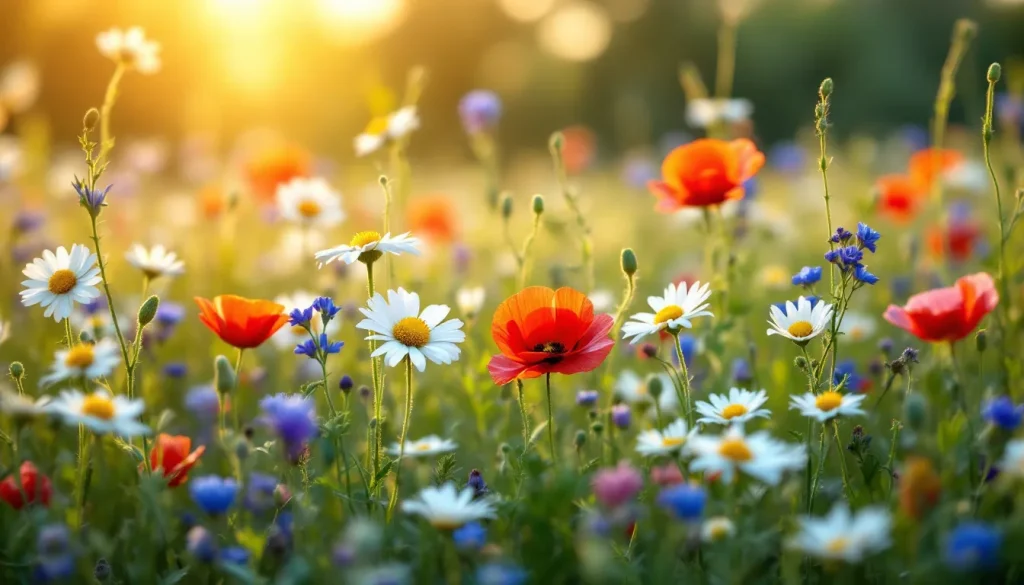
By the HMNDP Editorial Team, independent reporting on lawn care, landscaping, and the green industry.
Last reviewed: June 2026
What Is a Wild Flower? The Short Answer
A wild flower is a flowering plant that grows on its own in the wild, without being intentionally seeded, planted, or cultivated by people. The term covers native species that evolved in a region and long-naturalized arrivals that now reproduce unaided. The defining trait is self-sowing: no gardener put it there. This separates wild flowers from garden cultivars, which depend on human planting and care.
Botanists use “wildflower” (one word) and “wild flower” (two words) interchangeably. Both describe herbaceous flowering plants, and sometimes flowering shrubs, that appear in meadows, woodlands, roadsides, coasts, and mountains without cultivation.
The category is loose on purpose. A poppy in a hedgerow is a wild flower. The same poppy species grown from a seed packet in a border is a cultivated flower. Context, not the plant itself, often decides the label.
Wild Flower vs Weed vs Cultivated Flower: Where the Lines Sit
A wild flower grows unplanted and is usually valued; a weed is any plant growing where a person does not want it; a cultivated flower is deliberately planted and tended. These categories overlap. The dandelion (Taraxacum officinale) is a wild flower to a forager, a weed to a lawn owner, and, rarely, a cultivated crop for greens. The label reflects human judgment, not biology.
| Type | How it arrived | Valued or unwanted | Example |
|---|---|---|---|
| Wild flower | Self-sown, uncultivated | Usually valued | Common poppy (Papaver rhoeas) |
| Weed | Self-sown, often aggressive | Unwanted in that spot | Creeping thistle (Cirsium arvense) |
| Cultivated flower | Deliberately planted | Valued and tended | Garden tulip (Tulipa gesneriana) |
The weed boundary is the fuzziest. Many prized wild flowers, including oxeye daisy and yarrow, are treated as weeds in tidy lawns. If you are deciding what to remove or keep on your own turf, our guide to types of grass explains how lawn species compete with self-seeding flowers.
Are Wild Flowers the Same as Native Plants?
Not exactly. A native plant is one that evolved in a specific region over thousands of years. A wild flower is any flower growing uncultivated there, which can include natives and naturalized non-natives. Oxeye daisy is a wild flower across North America but is native to Europe and Asia, introduced to the US in the 1800s. So every native wild flower is a wild flower, but not every wild flower is native.
The distinction matters for gardeners and pollinators. Native wild flowers support local bees, butterflies, and birds that evolved alongside them. Non-native wild flowers can be neutral, useful, or, in some cases, invasive. Checking a species against a regional native-plant list before planting is the safest step.
How to Identify a Wild Flower by Color, Shape and Habitat
To identify a wild flower, work through five observable keys in order: flower color, petal count and shape, plant height, habitat, and bloom season. Recording these five before you reach for a name narrows thousands of species to a short list fast. Most field guides and apps sort by exactly these traits, so training your eye to note them turns a vague sighting into a confident identification.
This is the single most useful skill the typical “list of names” page never teaches. Use the checklist below every time.
- Color: Note the dominant petal color (yellow, blue, purple, white, pink, red). Color alone can eliminate 70 percent of candidates.
- Petal count and shape: Count petals and note symmetry. Buttercups have 5 rounded petals; poppies have 4; daisies have many strap-like ray florets around a central disc.
- Height: Ankle-high (under 15 cm), knee-high (15 to 60 cm), or waist-high and above (over 60 cm). Foxglove reaching 1.5 m rules out low creepers.
- Habitat: Woodland shade, open meadow, wetland, coast, chalk grassland, or roadside. Bluebells mean woodland; sea thrift means coast.
- Bloom season: The month you saw it. A blue flower in March (likely bluebell or forget-me-not) differs from a blue flower in August (likely harebell or cornflower).
Quick color-to-candidate shortcuts for temperate regions:
| Petal color | Common wild flower candidates | Fast tell |
|---|---|---|
| Yellow | Buttercup, dandelion, cowslip, common ragwort, birdsfoot trefoil | Count petals; glossy 5 = buttercup |
| Blue / purple | Bluebell, cornflower, harebell, self-heal, viper’s bugloss | Bell shape vs flat vs spike |
| White | Oxeye daisy, wild garlic, cow parsley, wood anemone, yarrow | Single bloom vs flat umbel cluster |
| Pink / red | Common poppy, red campion, foxglove, herb Robert, ragged robin | 4 papery petals = poppy |
A-Z Index of Wild Flower Names (With Latin Names)
This alphabetical index pairs common wild flower names to their botanical Latin names, plus color, region, and bloom season so each entry is identifiable, not just listed. It spans both US and UK species. Use the region column to filter: many names travel across the Atlantic while the plant behind them differs, so the Latin name is the reliable anchor.
| Common name | Latin name | Color | Region | Blooms |
|---|---|---|---|---|
| Arrowhead | Sagittaria sagittifolia | White | UK / US | Jul to Aug |
| Autumn gentian | Gentianella amarella | Purple | UK | Aug to Sep |
| Bee orchid | Ophrys apifera | Pink / brown | UK / Europe | Jun to Jul |
| Bell heather | Erica cinerea | Purple | UK | Jul to Sep |
| Betony | Betonica officinalis | Purple | UK / Europe | Jun to Sep |
| Bird’s-nest orchid | Neottia nidus-avis | Brown | UK / Europe | May to Jul |
| Black-eyed Susan | Rudbeckia hirta | Yellow | US | Jun to Sep |
| Bluebell | Hyacinthoides non-scripta | Blue | UK | Apr to May |
| Butterfly weed | Asclepias tuberosa | Orange | US | Jun to Aug |
| Common poppy | Papaver rhoeas | Red | UK / US | Jun to Aug |
| Cornflower | Centaurea cyanus | Blue | UK / US | Jun to Aug |
| Cowslip | Primula veris | Yellow | UK | Apr to May |
| Foxglove | Digitalis purpurea | Pink / purple | UK / US | Jun to Jul |
| Harebell | Campanula rotundifolia | Blue | UK / US | Jul to Sep |
| Oxeye daisy | Leucanthemum vulgare | White | UK / US | May to Sep |
| Purple coneflower | Echinacea purpurea | Pink | US | Jun to Aug |
| Ragged robin | Silene flos-cuculi | Pink | UK | May to Jun |
| Red campion | Silene dioica | Pink | UK | Apr to Sep |
| Wild bergamot | Monarda fistulosa | Lavender | US | Jul to Sep |
| Yarrow | Achillea millefolium | White | UK / US | Jun to Sep |
For a deeper color-first sort of red-blooming species on both sides of the Atlantic, see our companion piece on types of red flowers.
Top 12 Most Common Wild Flowers, Ranked by How Often You Will See Them
These twelve are the wild flowers a walker in the US or UK is most likely to meet, ranked by ubiquity across roadsides, meadows, and waste ground. Each entry gives the Latin name and a one-line identification tell so you can confirm it in the field, not just recognize the name on a page.
- Dandelion (Taraxacum officinale): Yellow composite, hollow stem with milky sap, seed clock. Everywhere.
- Common poppy (Papaver rhoeas): 4 papery scarlet petals, black center, arable field margins.
- Oxeye daisy (Leucanthemum vulgare): White rays, yellow disc, knee-high, meadows and verges.
- Buttercup (Ranunculus acris): 5 glossy yellow petals, damp grassland.
- Red clover (Trifolium pratense): Pink-purple globe, three-part leaves, pasture.
- Cow parsley (Anthriscus sylvestris): White flat umbels, ferny leaves, hedgerows in May.
- Bluebell (Hyacinthoides non-scripta): Nodding blue bells, woodland carpets, spring.
- Black-eyed Susan (Rudbeckia hirta): Golden rays, dark cone center, US prairies and roadsides.
- Yarrow (Achillea millefolium): Flat white heads, feathery leaves, dry grassland.
- Forget-me-not (Myosotis species): Tiny 5-petal sky-blue flowers, yellow eye, damp ground.
- Common knapweed (Centaurea nigra): Purple thistle-like head, no spines, summer meadow.
- Ragwort (Jacobaea vulgaris): Dense yellow daisy clusters, waste ground, toxic to livestock.
Types of Wild Flowers: The Main Categories
Wild flowers group into a few practical categories based on life cycle and habitat rather than a single taxonomy. The most useful splits are by life cycle (annual, biennial, perennial) and by habitat (meadow, woodland, wetland, coastal, upland). Knowing the category tells you when a species appears and where to look, which speeds both identification and garden planning.
| Category basis | Types | What it means |
|---|---|---|
| Life cycle | Annual, biennial, perennial | Poppies are annual; foxgloves biennial; oxeye daisy perennial |
| Habitat | Meadow, woodland, wetland, coastal, upland | Bluebell = woodland; sea thrift = coastal; harebell = upland |
| Origin | Native vs naturalized | Harebell native to UK; oxeye daisy naturalized in US |
| Growth form | Herbaceous, climbing, shrubby | Most are herbaceous; honeysuckle climbs; heather is shrubby |
US vs UK Wild Flowers: Why Region Splits Matter
US and UK wild flowers differ enough that a single shared list misleads readers on both sides. Some names, such as bluebell, refer to entirely different plants: the UK bluebell is Hyacinthoides non-scripta, while a US “bluebell” is often Mertensia virginica (Virginia bluebells). Iconic species also diverge, so American and British readers should filter by region before trusting an identification.
Signature US natives include butterfly weed (Asclepias tuberosa), black-eyed Susan (Rudbeckia hirta), purple coneflower (Echinacea purpurea), and California poppy (Eschscholzia californica). These anchor American prairie and roadside plantings.
Signature UK natives include bluebell, cowslip (Primula veris), red campion (Silene dioica), and common knapweed (Centaurea nigra). Many UK meadow species are also naturalized in North America, which is exactly why the Latin name in the index above is the reliable anchor, not the common name.
Which Wild Flowers Bloom in Spring and Summer?
Spring wild flowers (March to May) tend to be woodland species racing to bloom before tree canopies close, while summer wild flowers (June to August) are meadow and grassland species that need full sun. A bloom calendar turns “when will I see it” into a plan, and it doubles as an identification aid: timing narrows candidates as sharply as color does.
| Season | Months | Typical wild flowers in bloom |
|---|---|---|
| Early spring | Mar to Apr | Primrose, lesser celandine, wood anemone, coltsfoot |
| Late spring | Apr to May | Bluebell, cowslip, cow parsley, red campion |
| Early summer | Jun to Jul | Common poppy, oxeye daisy, foxglove, bird’s-foot trefoil |
| High summer | Jul to Aug | Harebell, knapweed, yarrow, butterfly weed, coneflower |
| Late summer to autumn | Aug to Oct | Autumn gentian, devil’s-bit scabious, ivy, sneezeweed |
Foraging Wild Flowers: Edibility and Toxicity
Some wild flowers are edible and long used in food, while others are seriously toxic, and the two can grow side by side, so positive identification is essential before eating anything. Edible examples include dandelion, wild garlic, elderflower, and red clover. Dangerous examples include foxglove, ragwort, and hemlock. Never eat a wild flower you cannot name with certainty, and treat lookalikes as the main risk.
| Wild flower | Status | Note |
|---|---|---|
| Dandelion (Taraxacum officinale) | Edible | Leaves, flowers, and roots all used |
| Wild garlic / ramsons (Allium ursinum) | Edible | Smells of garlic; confusable with toxic lily-of-the-valley leaves |
| Elderflower (Sambucus nigra) | Edible cooked | Flowers used in cordials; raw berries and stems are toxic |
| Foxglove (Digitalis purpurea) | Highly toxic | Contains cardiac glycosides; can be fatal |
| Hemlock (Conium maculatum) | Highly toxic | Resembles edible cow parsley; purple-blotched stem |
| Ragwort (Jacobaea vulgaris) | Toxic | Liver-damaging alkaloids; hazardous to horses |
This is general information, not medical or safety advice. Foraging carries real risk, and misidentification can be fatal, so confirm any find with an expert or a trusted regional guide before consuming it.
Is It Illegal to Pick Wild Flowers?
Picking wild flowers may be legal or illegal depending on where you are, who owns the land, and the species. In the UK, the Wildlife and Countryside Act 1981 makes it an offence to uproot any wild plant without the landowner’s permission, and picking listed rare species is prohibited outright. In the US, rules vary by state and are strict in national and state parks, where picking is generally banned.
General principles that often apply, though you should always check local rules:
- Uprooting a wild plant is more restricted than picking a flower or leaf, and is an offence in the UK without permission.
- Protected species may not be picked at all. UK Schedule 8 species and US federally listed plants are examples.
- Protected land such as national parks, nature reserves, and SSSIs typically bans picking entirely.
- Private land requires the owner’s permission regardless of species.
When in doubt, photograph rather than pick. A phone image identifies the flower without harming a population or breaking a local rule.
Which Wild Flowers Can You Grow in Your Own Garden?
Most meadow wild flowers grow well in gardens if you match them to your soil, sun, and region, and starting with regional natives gives the best results for pollinators. Reliable, widely available choices include oxeye daisy, cornflower, red clover, yarrow, and, in the US, black-eyed Susan and purple coneflower. Sow into cleared, low-fertility ground in autumn or early spring for the strongest germination.
One counterintuitive rule drives success: wild flowers prefer poor soil. Rich, fertilized ground favors vigorous grasses that outcompete them. Skip feeding a wild-flower patch, and read our guide to types of fertilizers to understand why lower nutrients help flowers win against grass.
On sloped or bare ground, wild flowers also stabilize soil once established, since their roots bind loose surfaces. Our overview of types of erosion explains where a deep-rooted native mix does the most good.
| Wild flower | Best for | Region |
|---|---|---|
| Oxeye daisy | Sunny meadow patch | UK / US |
| Cornflower | Annual color, poor soil | UK / US |
| Yarrow | Dry, tough ground | UK / US |
| Black-eyed Susan | Prairie beds, pollinators | US |
| Purple coneflower | Long-blooming borders | US |
| Red campion | Partial shade, hedges | UK |
Frequently Asked Questions
What is considered a wild flower?
A wild flower is a flowering plant that grows in the wild without being intentionally seeded, planted, or cultivated. It self-sows in meadows, woods, roadsides, and coasts. The category includes native species and long-naturalized non-natives. The key test is that no gardener planted it. The same species grown deliberately from seed in a border counts as a cultivated flower, not a wild one.
What are the most common types of wild flowers?
The most common wild flowers a US or UK walker meets include dandelion (Taraxacum officinale), common poppy (Papaver rhoeas), oxeye daisy (Leucanthemum vulgare), buttercup, red clover, cow parsley, and bluebell. In the US, black-eyed Susan and purple coneflower are also widespread. They spread across roadsides, meadows, and waste ground, and most bloom between May and September.
How do I identify a wild flower by its color and shape?
Record five traits before naming it: petal color, petal count and symmetry, plant height, habitat, and the month it bloomed. Color eliminates most candidates, then petal count refines further. Five glossy yellow petals suggest buttercup; four papery red petals suggest poppy; many white rays around a yellow disc suggest oxeye daisy. Feed these traits into a field guide or app for a confident match.
What is the difference between a wild flower and a weed?
A wild flower grows unplanted and is usually valued, while a weed is any plant growing where a person does not want it. The distinction is human judgment, not biology. The same dandelion is a cherished wild flower in a meadow and an unwanted weed in a manicured lawn. Many prized wild flowers, including yarrow and oxeye daisy, are treated as weeds on tidy turf.
Are wild flowers the same as native plants?
No. A native plant evolved in a specific region over millennia, while a wild flower is any flower growing uncultivated there. Wild flowers include both natives and naturalized non-natives. Oxeye daisy grows wild across North America but is native to Europe, introduced in the 1800s. So every native wild flower is a wild flower, but many wild flowers are not native to where they now grow.
Is it illegal to pick wild flowers?
It depends on location, land ownership, and species. In the UK, the Wildlife and Countryside Act 1981 makes uprooting any wild plant without the landowner’s permission an offence, and picking rare listed species is banned. In the US, rules vary by state, and national and state parks generally prohibit picking. Protected land and private land carry the strictest limits. When unsure, photograph the flower instead of picking it.
Which wild flowers bloom in spring and summer?
Spring wild flowers (March to May) are mostly woodland species blooming before canopies close, including primrose, wood anemone, bluebell, and cowslip. Summer wild flowers (June to August) are sun-loving meadow species such as common poppy, oxeye daisy, foxglove, harebell, and, in the US, butterfly weed and purple coneflower. Timing is a strong identification clue, since a blue flower in March differs from a blue flower in August.
Which wild flowers can I grow in my own garden?
Beginner-friendly wild flowers include oxeye daisy, cornflower, red clover, and yarrow, plus black-eyed Susan and purple coneflower in the US. Match species to your soil, sun, and region, and favor regional natives for pollinators. Sow into cleared, low-fertility ground in autumn or early spring. Wild flowers prefer poor soil, so avoid feeding the patch, which would let vigorous grasses crowd them out.