
By the HMNDP Editorial Team — independent reporting on lawn care, landscaping, and the green industry.
Last reviewed: June 2026
The 30 best blue flowers, ranked by how truly blue they actually are
Blue flowers are one of the rarest colors in the plant kingdom because fewer than 10 percent of the world’s roughly 280,000 flowering species produce blue pigment, and many “blue” garden plants are really violet. Below are 30 blue flowers by common and botanical name, sorted into genuinely blue, borderline blue-violet, and marketed-as-blue. Use the data table further down to filter by zone, height, and season.
Genuinely blue flowers (the real thing)
These species reliably produce a blue a camera reads as blue, not violet. The color comes from delphinidin-based anthocyanin pigments held at a near-neutral to slightly alkaline cell pH, sometimes stabilized by metal ions. They are the closest most gardeners get to sky-blue in a bed or bouquet.
- Cornflower / Bachelor’s Button (Centaurea cyanus) — the benchmark true blue; the word “cornflower blue” comes from this annual. Grows 1 to 3 ft, blooms early summer to fall.
- Forget-me-not (Myosotis sylvatica) — tiny sky-blue flowers with yellow eyes, 6 to 12 in tall, spring bloom, self-seeds freely.
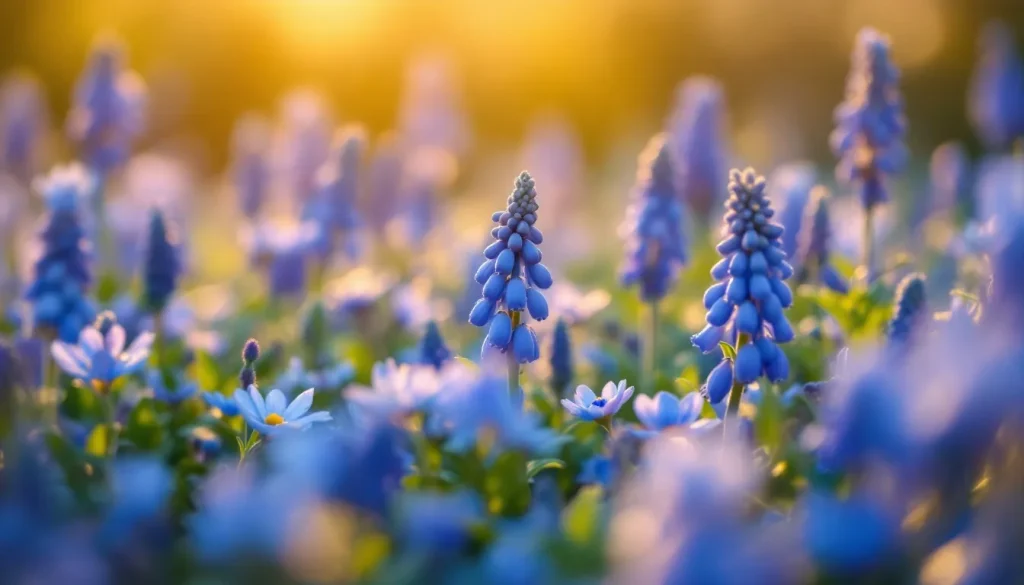
- Grape Hyacinth (Muscari armeniacum) — cobalt-blue spikes of little urn-shaped florets, 6 to 8 in, early spring bulb.
- Himalayan Blue Poppy (Meconopsis betonicifolia) — often called the truest blue in horticulture; demands cool, moist, acidic conditions and USDA zones 3 to 8.
- Gentian (Gentiana spp.) — trumpet gentians deliver intense royal blue, 4 to 12 in, alpine and rock-garden favorites.
- Blue Star (Amsonia tabernaemontana) — powder-blue star flowers on a 2 to 3 ft perennial, native to the eastern United States.
- Bluebell (Hyacinthoides non-scripta) — nodding blue-to-violet bells, 12 in, but see the invasiveness note below.
- Blue-eyed Grass (Sisyrinchium spp.) — small six-petaled blue stars on grass-like foliage, 6 to 20 in, a North American native.
- Brunnera / Siberian Bugloss (Brunnera macrophylla) — forget-me-not-like sprays of true blue over heart-shaped leaves, shade tolerant, 12 to 18 in.
- Plumbago / Leadwort (Ceratostigma plumbaginoides) — gentian-blue late-season groundcover, 6 to 10 in, zones 5 to 9.
Blue-violet flowers (they lean purple, and that is honest)
These are the plants most often mislabeled as blue. Under natural light most cultivars photograph as violet, periwinkle, or lavender, though a few named varieties get close to blue. Buy them for the color you actually see, and check the specific cultivar rather than the plant name.
- Iris (Iris spp.) — sold as blue, but most bearded and Siberian irises are violet or blue-violet; ‘Blue Magic’ and some Iris sibirica get closest. 2 to 2.5 ft tall.
- Delphinium / Larkspur (Delphinium elatum, Consolida) — the tall border classic; many spires read blue but drift into indigo and violet. Grows 3 to 6 ft.
- Globe Thistle (Echinops ritro) — steel-blue spheres, genuinely metallic blue-gray, 2 to 4 ft, drought tough.
- Morning Glory (Ipomoea) — ‘Heavenly Blue’ is one of the truest garden blues, but the genus is aggressive; see invasiveness below.
- Sweet Pea (Lathyrus odoratus ‘Mammoth Navy Blue’) — navy to blue-violet, fragrant climber, annual, 4 to 6 ft.
- Lobelia (Lobelia erinus) — trailing true-blue-to-violet edging annual, 4 to 9 in.
- Salvia (Salvia farinacea ‘Victoria Blue’) — blue-violet spikes, 18 to 24 in, long bloom.
- Anchusa / Italian Bugloss (Anchusa azurea) — one of the more genuinely blue in this tier, 3 to 5 ft.
- Balloon Flower (Platycodon grandiflorus) — blue-violet balloon buds, 1 to 2.5 ft, zones 3 to 8.
- Columbine (Aquilegia ‘Blue Star’) — blue-and-white spurred flowers leaning violet, 1 to 3 ft.
Marketed as blue (usually another color)
These plants carry “blue” in their marketing but most cultivars are pink, mauve, or violet unless you intervene or pick a specific variety. Read the tag, and for hydrangeas, read the soil section below.
- Hydrangea (Hydrangea macrophylla) — only turns blue in acidic soil that frees aluminum; in neutral or alkaline soil the same plant is pink or mauve. 3 to 6 ft.
- Blue Rose — no true-blue rose exists in nature; commercial “blue” roses are dyed or genetically modified (Suntory’s ‘Applause’ is lavender).
- Hyacinth (Hyacinthus ‘Blue Jacket’) — deep blue-violet, fragrant spring bulb, 8 to 12 in.
- Aster (Symphyotrichum) — “blue” asters are mostly blue-violet to lavender, 1 to 4 ft, fall bloom.
- Periwinkle / Vinca (Vinca minor) — periwinkle-blue groundcover, 3 to 6 in, but invasive in much of the United States.
- Bluebeard (Caryopteris x clandonensis) — genuinely blue-flowered shrub, 2 to 3 ft, late summer.
- Blue Daze (Evolvulus glomeratus) — small true-blue morning-glory relative, 6 to 12 in, tender.
- Love-in-a-Mist (Nigella damascena) — sky-blue flowers in feathery foliage, 12 to 18 in, easy from seed.
- Chicory (Cichorium intybus) — clear pale-blue roadside wildflower, 1 to 4 ft, blooms only in morning.
- Borage (Borago officinalis) — star-shaped true-blue edible flowers, 1 to 3 ft, bee magnet.
Blue flower comparison table: zone, height, sun, season, and native vs invasive
This is the sortable reference no other blue-flower listicle provides. Scan it to match a plant to your bed by USDA hardiness zone, mature height, sun needs, bloom season, life cycle, and whether the species is a native, well-behaved, or invasive choice in North America. Cultivars vary, so confirm the tag.
| Flower (botanical) | USDA zones | Height | Sun | Bloom season | Life cycle | Native / invasive note |
|---|---|---|---|---|---|---|
| Cornflower (Centaurea cyanus) | 2-11 (annual) | 1-3 ft | Full sun | Summer-fall | Annual | Non-native, can self-seed |
| Forget-me-not (Myosotis sylvatica) | 3-8 | 6-12 in | Part shade | Spring | Biennial/short perennial | Self-seeds aggressively |
| Grape Hyacinth (Muscari armeniacum) | 4-8 | 6-8 in | Full-part sun | Early spring | Perennial bulb | Naturalizes readily |
| Himalayan Blue Poppy (Meconopsis) | 3-8 | 2-4 ft | Part shade | Late spring | Perennial | Non-native, fussy |
| Blue Star (Amsonia tabernaemontana) | 3-9 | 2-3 ft | Full-part sun | Late spring | Perennial | US native |
| Iris (Iris sibirica) | 3-9 | 2-2.5 ft | Full sun | Late spring | Perennial | Mostly violet, not true blue |
| Delphinium (Delphinium elatum) | 3-7 | 3-6 ft | Full sun | Early-mid summer | Perennial | Often drifts violet |
| Globe Thistle (Echinops ritro) | 3-9 | 2-4 ft | Full sun | Mid-late summer | Perennial | Drought tolerant |
| Morning Glory (Ipomoea ‘Heavenly Blue’) | 2-11 (annual) | 6-10 ft vine | Full sun | Summer-fall | Annual | Invasive in warm zones |
| Bluebell (Hyacinthoides non-scripta) | 4-9 | 12 in | Part shade | Spring | Perennial bulb | Can be invasive; Spanish hybrid worse |
| Sweet Pea (Lathyrus ‘Mammoth Navy Blue’) | 2-11 (annual) | 4-6 ft vine | Full sun | Spring-summer | Annual | Seeds toxic if eaten |
| Hydrangea (H. macrophylla) | 5-9 | 3-6 ft | Part shade | Summer | Perennial shrub | Blue only in acidic soil |
| Gentian (Gentiana) | 3-8 | 4-12 in | Full-part sun | Summer-fall | Perennial | Rock-garden native/alpine |
| Bluebeard (Caryopteris) | 5-9 | 2-3 ft | Full sun | Late summer | Perennial shrub | Non-native, well-behaved |
| Periwinkle (Vinca minor) | 4-9 | 3-6 in | Shade | Spring | Perennial | Invasive groundcover |
| Borage (Borago officinalis) | 2-11 (annual) | 1-3 ft | Full sun | Summer | Annual | Edible, self-seeds |
For bed planning around these perennials, our guide to perennial flowers that bloom all summer pairs blue anchors with longer-season color.
Why true-blue flowers are so rare (the delphinidin and pH story)
Naturally blue flowers are rare because no plant makes a true blue pigment; blue is a chemical trick. Flowers build it by taking a red-to-purple pigment called delphinidin (an anthocyanin) and shifting its color with a higher, more alkaline cell pH plus metal ions like aluminum or iron and co-pigments. Break any part of that recipe and the flower slides back toward violet, pink, or red.
Only about 10 percent of flowering plants carry the genetics for delphinidin at all, and holding the cell sap alkaline enough to turn it blue is metabolically expensive. That is why a plant labeled “blue” so often photographs as violet: it has the delphinidin but not the pH or co-pigment stack to finish the job.
The hydrangea is the clearest proof. The same shrub swings from pink to blue based on soil chemistry, because acidic soil frees aluminum ions the flower needs to stabilize blue. Soil chemistry drives the color, which is why understanding your soil type matters as much as the plant tag when you want blue.
How to tell if a flower is truly blue
Test a candidate three ways. First, photograph it in shade with a neutral white balance; violet reads as violet on a screen. Second, compare it to a cornflower, the reference true blue. Third, check whether the cultivar name promises blue while the species runs violet, a common tag trick with iris, aster, and delphinium.
Blue flowers you can grow from seed
Several of the truest blues are cheap, fast annuals you sow directly, which makes seed the smart entry point for a blue bed or cutting garden. Buy from named-cultivar suppliers such as Johnny’s Selected Seeds, Eden Brothers, or Botanical Interests, since the cultivar (not just the species) determines how blue you get.
- Cornflower (Centaurea cyanus) — direct sow in early spring, blooms in 10 to 12 weeks.
- Love-in-a-Mist (Nigella damascena) — cold-tolerant, self-seeds, sky-blue in 12 weeks.
- Morning Glory ‘Heavenly Blue’ (Ipomoea) — nick and soak seeds; treat as annual to avoid spread.
- Forget-me-not (Myosotis) — surface sow in fall or spring for spring bloom.
- Borage (Borago officinalis) — germinates in 5 to 10 days, edible flowers.
- Sweet Pea ‘Mammoth Navy Blue’ (Lathyrus odoratus) — soak seed, sow early, provide a trellis.
Annual vs perennial blue flowers
Annual blue flowers finish their life in one season and often give the truest, most saturated blues (cornflower, morning glory, love-in-a-mist), while perennial blue flowers return each year and anchor a bed but skew more violet. Mixing both gives you reliable structure plus a hit of genuine blue.
| Type | Best true-blue picks | Trade-off |
|---|---|---|
| Annual | Cornflower, Morning Glory ‘Heavenly Blue’, Love-in-a-Mist, Borage | Truest blue, but replant yearly |
| Perennial | Blue Star (Amsonia), Gentian, Brunnera, Bluebeard, Plumbago | Returns yearly, often leans blue-violet |
| Bulb (perennial) | Grape Hyacinth, Bluebell, Blue Hyacinth | Reliable spring blue, short window |
Blue wildflowers and native species (including the Pacific Northwest)
Native blue wildflowers give pollinator value and low maintenance that garden hybrids often lack, and North America has strong true-blue natives. In the Pacific Northwest, look for Common Camas (Camassia quamash), a 1 to 2 ft blue-flowered bulb historically harvested for food, and Great Camas (Camassia leichtlinii).
- Common Camas (Camassia quamash) — Pacific Northwest, blue star spikes, moist meadows.
- Blue Flax (Linum lewisii) — western US native, sky-blue, 1 to 2 ft, drought tolerant.
- Blue-eyed Grass (Sisyrinchium) — widespread native, small blue stars.
- Wild Lupine (Lupinus perennis) — blue-violet spikes, host plant for the Karner blue butterfly.
- Virginia Bluebells (Mertensia virginica) — eastern woodland native, buds pink then open sky-blue.
Native blue wildflowers also help hold soil on slopes and meadows; if a planting site sheds water, review the common types of erosion before you plant.
Invasive blue flowers to plant with caution
Some of the prettiest blues spread aggressively and displace natives, so treat them as annuals or skip them. The worst offenders across US regions are periwinkle, morning glory in warm zones, and Spanish bluebell, all of which can escape a bed and colonize wild ground.
- Periwinkle (Vinca minor and V. major) — smothers native groundcover, invasive across the US.
- Morning Glory (Ipomoea) — reseeds and climbs aggressively in zones 8 to 11.
- Spanish Bluebell (Hyacinthoides hispanica) — hybridizes with and crowds out native bluebells.
- Chicory (Cichorium intybus) — naturalized weed of roadsides, though rarely harmful in a bed.
Blue flower meaning, symbolism, and use in bouquets
Blue flowers symbolize trust, calm, longing, and the unattainable, which is why they carry weight in weddings and remembrance. In the language of flowers, forget-me-nots mean true love and memory, cornflowers signal devotion, and blue as a color reads as serenity, making blue blooms a default for the “something blue” wedding tradition.
- Weddings / “something blue” — delphinium, cornflower, and blue hydrangea are the standard cut-flower choices.
- Remembrance — forget-me-nots are the classic memory flower and a symbol used by several Alzheimer’s charities.
- Birth flowers — larkspur (delphinium) is a July birth flower and often appears in blue.
- Bouquets — because true blue is rare, florists frequently dye white flowers or lean on hydrangea and delphinium.
How to make hydrangeas turn blue
To turn a bigleaf hydrangea (Hydrangea macrophylla) blue, lower the soil pH below 6.0 so aluminum becomes available to the plant; in soil at pH 6.0 or above, the same flowers stay pink or mauve. Only pink and mauve mophead and lacecap types respond. White hydrangeas will not turn blue.
- Test the soil pH — aim for 5.2 to 5.5 for the strongest blue.
- Acidify — apply aluminum sulfate per label rate, or use elemental sulfur and an acidic mulch like pine bark over a full season.
- Feed low-phosphorus — high phosphorus locks up aluminum, so use a fertilizer low in the middle number.
- Water and wait — color shifts over weeks to a full season; retest pH each spring.
Soil pH and mineral availability behave much like they do under turf, so the same acidity thinking in our types of grass guide applies to keeping hydrangeas blue.
Frequently Asked Questions
What flowers are truly blue, and which just look blue but are really purple?
Genuinely blue flowers include cornflower, forget-me-not, grape hyacinth, gentian, Himalayan blue poppy, borage, and blue flax. Plants often mislabeled as blue but usually violet or lavender include most iris, delphinium, aster, hyacinth, and “blue” roses (which do not exist naturally). Hydrangeas are blue only in acidic soil; otherwise they are pink.
What are the names of common blue flowers?
The most common blue garden flowers are cornflower (Centaurea cyanus), delphinium, iris, hydrangea, forget-me-not (Myosotis), morning glory, bluebell, grape hyacinth (Muscari), globe thistle (Echinops ritro), and sweet pea. Cornflower, forget-me-not, and grape hyacinth are the truest blues; iris and delphinium usually read as blue-violet in natural light.
What are small or little blue flowers called?
Small blue flowers include forget-me-not (Myosotis, 6 to 12 in), grape hyacinth (Muscari, 6 to 8 in), lobelia, blue-eyed grass (Sisyrinchium), periwinkle (Vinca minor), blue daze, and gentian. Most stay under 12 inches and work as edging, groundcover, or rock-garden plants, with grape hyacinth and forget-me-not being the classic spring options.
What is the rarest or most true-blue flower?
The Himalayan blue poppy (Meconopsis betonicifolia) is widely considered the truest natural blue, prized because it produces a clear sky-blue that most plants cannot. It is also hard to grow, needing cool, moist, acidic conditions. Gentians and cornflowers are more attainable true blues. A naturally true-blue rose has never existed.
Why are naturally blue flowers so rare?
No plant makes a blue pigment directly. Blue requires a red-to-purple pigment called delphinidin, shifted by a higher cell pH plus metal ions such as aluminum and co-pigments. Only about 10 percent of flowering species carry delphinidin, and holding the cell sap alkaline enough to turn it blue is metabolically costly, so most “blue” flowers end up violet instead.
Which blue flowers can I grow from seed?
Easy blue flowers from seed include cornflower, love-in-a-mist (Nigella), morning glory ‘Heavenly Blue’, forget-me-not, borage, and sweet pea ‘Mammoth Navy Blue’. Direct sow cornflower and borage in early spring for bloom in 10 to 12 weeks. Choose a named blue cultivar, since the variety, not just the species, determines how blue the flowers come out.
What blue flowers are perennials that come back every year?
Blue perennials that return yearly include blue star (Amsonia tabernaemontana), gentian, brunnera, bluebeard (Caryopteris), plumbago, balloon flower, and blue flax. Bulb perennials like grape hyacinth and bluebell also come back each spring. Perennials tend to lean blue-violet, so pair them with true-blue annuals like cornflower for the most saturated color.
How do I make my hydrangeas turn blue?
Lower the soil pH of a bigleaf hydrangea below 6.0, ideally 5.2 to 5.5, so aluminum becomes available to the plant. Apply aluminum sulfate at the label rate or elemental sulfur over a season, use a low-phosphorus fertilizer, and retest pH each spring. Only pink and mauve mophead or lacecap types respond; white hydrangeas will not turn blue.