
By the HMNDP Editorial Team | Last reviewed: June 2026
What kills weeds: the short answer
What kills weeds depends on whether you want to burn the top growth fast or kill the root permanently. Contact methods (vinegar, boiling water, dish soap sprays) scorch leaves in hours but leave perennial roots alive, so weeds regrow. Systemic herbicides (glyphosate, triclopyr) and full manual removal of the root are the only ways to kill most weeds for good.
That single distinction, contact kill versus root kill, explains why your driveway weeds keep coming back after a vinegar spray. Below is a method for every situation, plus the two questions most guides dodge: what actually kills the root, and what kills weeds but not grass.
| Method | Kills the root? | Speed | Safe near edibles/pets? | Best location |
|---|---|---|---|---|
| Pulling / digging | Yes (if whole root) | Immediate | Yes | Beds, lawns, small patches |
| Boiling water | Small annuals only | Minutes | Yes (once cooled) | Patio cracks, driveways |
| Vinegar + soap spray | No (top growth) | Hours | Yes | Gravel, cracks |
| Salt | Yes, but sterilizes soil | Days | No | Cracks only, never beds |
| Mulch / barrier | Prevents, not kills | Weeks | Yes | Beds, paths |
| Glyphosate (non-selective) | Yes | 7-14 days | No, wait per label | Gravel, driveways, clearing beds |
| Selective broadleaf herbicide (2,4-D) | Yes | 7-14 days | Follow label | Lawns (kills weeds, spares grass) |
Contact kill vs killing the root: why weeds grow back
Contact methods destroy only the plant tissue they touch. Vinegar, boiling water, salt sprays, and dish soap all burn or dehydrate leaves and stems on contact. Systemic herbicides move through the plant into the root. For annual weeds a contact kill often ends the plant, but for perennials with deep roots (dandelion, bindweed, thistle), the root survives and pushes new growth in one to three weeks.
Annual weeds like crabgrass complete their life in a single season and have shallow roots, so burning the top can be enough. Perennials store energy in taproots or rhizomes. A dandelion taproot can reach 10 inches deep. Cut or burn the top and it regrows from the crown.
This is the honest gap most guides skip: vinegar and boiling water are real tools, but treat them as top-growth burners, not root killers. For genuine root death you need to physically remove the whole root or use a herbicide that translocates down. Our fuller walkthrough on how to get rid of weeds covers the perennial regrowth cycle in more detail.
What kills weeds permanently down to the root
Permanently killing weeds means killing the root, not just the leaves. Three approaches do this: (1) dig out the entire root, including any taproot or runner, (2) apply a systemic herbicide that translocates into the root over 7 to 14 days, or (3) smother the area for a full season under a barrier so no light reaches regrowth. Anything that only burns leaves is temporary.
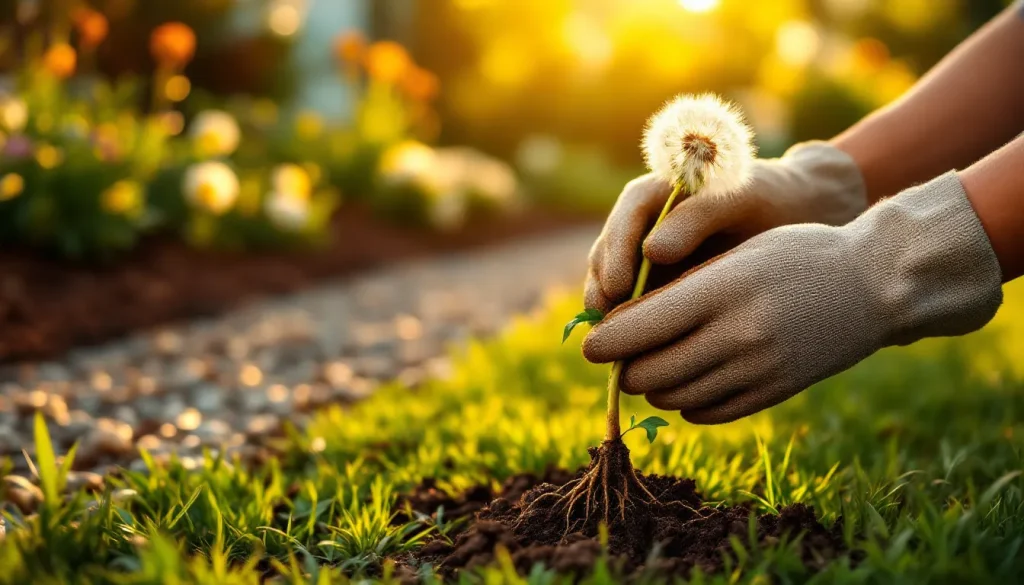
- Full root removal. Loosen soil when damp, grip at the base, and pull slowly so the taproot comes with the crown. A dandelion weeder or hori-hori knife helps. Any root fragment left behind can resprout.
- Systemic herbicide. Glyphosate (the active ingredient in Roundup) and triclopyr move from leaf to root. Expect yellowing in 3 to 7 days and full die-off in about 2 weeks. Apply on a dry, wind-free day.
- Season-long smothering. Cover with cardboard plus 3 to 4 inches of mulch, or landscape fabric, for a full growing season. Starved of light, even perennial roots exhaust their stored energy and die.
“Permanently” also depends on new weed seeds. No method stops fresh seeds from blowing in next spring, so permanence means killing the existing plant to the root, not sterilizing the future.
What kills weeds but not grass
Selective broadleaf herbicides kill weeds but not grass. Products with 2,4-D, dicamba, or MCPA target broadleaf plants (dandelion, clover, plantain) while leaving narrow-leaf turf grasses unharmed. The chemistry exploits how broadleaf plants absorb and process the herbicide differently than grasses. Non-selective killers like glyphosate kill everything green, so never use them across a lawn.
The mechanism matters because it is the single most searched sub-question here and most guides ignore it. Grasses (fescue, ryegrass, Kentucky bluegrass) and broadleaf weeds are built differently. Selective herbicides are designed so the grass metabolizes the chemical safely while the weed cannot.
| Goal | Use | Do not use |
|---|---|---|
| Kill weeds in a lawn, keep the grass | Selective broadleaf herbicide (2,4-D / dicamba / MCPA) | Vinegar, salt, glyphosate |
| Kill everything on gravel or a driveway | Non-selective (glyphosate) or vinegar | Selective herbicides (wasteful) |
| Spot-kill grassy weeds like crabgrass in turf | Targeted grassy-weed product per label | Broadleaf-only herbicide (will not work) |
Spot-treat rather than blanket-spray a whole lawn, and always match the product to your grass species on the label. Some warm-season grasses (St. Augustine, centipede) can be damaged by dicamba.
Natural and homemade weed killers (vinegar, salt, dish soap)
Homemade weed killers burn top growth using acid, salt, or heat. The classic recipe is 1 gallon of vinegar, 1 cup of salt, and 1 tablespoon of dish soap. Vinegar (acetic acid) dehydrates leaves, salt draws out water, and soap helps the mix stick. It works on young annual weeds in sun but rarely kills perennial roots, so expect some regrowth.
Household vinegar is 5% acetic acid and only scorches tender growth. Horticultural vinegar at 20% to 30% is far stronger but is a hazardous skin and eye irritant that requires gloves and eye protection. Both work best on hot, sunny days when leaves dry out fastest.
Use these mixes on driveways, gravel, and cracks, not garden beds you care about, because the acid and salt do not distinguish weeds from your vegetables. Our detailed test of vinegar limits sits inside our weed-removal guide. For the harsher shortcut some people try, see whether bleach kills weeds (it burns foliage but harms soil and is not a recommended garden method).
Does salt kill weeds, and is it safe for your garden?
Salt kills weeds by pulling water out of plant cells, and heavy applications reach the root. The serious catch: salt sterilizes soil for months or even years, stopping anything from growing there. That makes it useful only in permanent hardscape like driveway cracks, and dangerous anywhere near lawns, beds, or edible plants. Rain can also wash salt into nearby soil.
Most casual guides recommend salt without this warning. Sodium accumulates, damages soil structure, and can leach sideways to kill plants you never targeted. Once soil is salted heavily, replanting may require removing and replacing the top layer.
Reserve salt for cracks in concrete or a gravel area you never intend to plant. Keep it away from bed edges and slopes where runoff carries it downhill. Our standalone breakdown of whether salt kills weeds covers safe concentrations and cleanup.
Boiling water for cracks and small weeds
Boiling water kills weeds by cooking plant cells instantly. Pour a full kettle directly over young weeds in patio cracks, driveway seams, or walkway edges. It is free, chemical-free, and safe around pets and kids once the water cools. It works best on small annuals; deep-rooted perennials often need two or three repeat pourings over successive weeks.
The heat denatures proteins in leaves and shallow roots within seconds. Because water spreads and cools fast, effectiveness drops on large taproots. Reheat and repeat as new growth appears.
Aim carefully: boiling water will also kill grass and garden plants it splashes, and it can crack cold ceramic tile. It is ideal for hardscape gaps, not lawns. See our field notes on whether boiling water kills weeds for repeat-treatment timing.
Killing weeds without poison: mulch, barriers, and manual removal
You can kill and block weeds with no chemicals at all. The two pillars are physical removal (pulling and digging the whole root) and smothering (mulch, cardboard, or landscape fabric that blocks light). These methods are safe around kids, pets, and edible gardens, and they improve soil over time instead of harming it. They take more effort but need no protective gear.
- Hand-pulling and digging: best after rain when soil is soft. Remove the entire root. A dandelion fork or hori-hori knife reaches taproots.
- Mulch (3 to 4 inches): wood chips, bark, or straw block light so seeds cannot sprout. Refresh yearly as it breaks down.
- Cardboard / newspaper sheet mulch: lay under mulch to smother existing weeds over a season.
- Landscape fabric: a semi-permanent barrier under gravel or bark for paths and beds.
- Flame or thermal weeders: a propane torch wilts weeds in cracks (keep away from dry brush and mulch).
For lawns, a thick, well-fed turf is itself a weed blocker: dense grass shades out most weed seedlings before they establish.
Chemical herbicides as an alternative
When manual and natural methods cannot keep up, chemical herbicides offer root-level kill. Non-selective glyphosate clears everything green and is common for driveways and clearing beds before planting. Selective herbicides (2,4-D) kill lawn weeds without harming grass. Pre-emergents like pendimethalin stop seeds from sprouting rather than killing existing weeds. Always read and follow the product label, which is legally binding.
| Herbicide type | Example active ingredient | What it does | Where it fits |
|---|---|---|---|
| Non-selective, systemic | Glyphosate | Kills all green plants to the root | Gravel, driveways, bed prep |
| Selective, broadleaf | 2,4-D, dicamba | Kills broadleaf weeds, spares grass | Lawns |
| Pre-emergent | Pendimethalin | Stops seeds from germinating | Lawns, beds, early season |
| Contact, natural | Acetic acid (20-30%) | Burns top growth only | Cracks, gravel |
Herbicide rules vary by state and municipality, and some products may be restricted depending on your location. Check your state extension office and the label before applying near water, edibles, or in windy conditions.
Decision framework: match the method to the location
The right weed killer depends less on the weed and more on where it grows. Use non-selective or natural burners on hardscape you never plant, selective herbicides only in lawns, and manual or mulch methods in beds with edibles. Speed versus permanence is the second axis: contact methods are fast but temporary, root methods are slower but lasting.
| Location | Fast fix (temporary) | Permanent fix (root) | Avoid |
|---|---|---|---|
| Lawn | Hand-pull visible weeds | Selective broadleaf herbicide, dig taproots | Salt, vinegar, glyphosate |
| Driveway / gravel | Boiling water, vinegar spray | Glyphosate, landscape fabric under gravel | Nothing off-limits |
| Vegetable / flower bed | Hand-pull | Dig roots, mulch 3-4 in, cardboard | Salt, non-selective herbicide |
| Patio / paver cracks | Boiling water, flame weeder | Remove root, seal joints with sand | Salt if near beds |
Two rules cover most mistakes: never put salt or non-selective herbicide anywhere you will plant, and never expect a leaf-burning method to kill a perennial root in one pass.
Frequently Asked Questions
What kills weeds permanently down to the root?
Permanently killing weeds means killing the root. Digging out the entire root (including taproots and runners), applying a systemic herbicide like glyphosate or triclopyr that travels leaf-to-root over 7 to 14 days, or smothering the area under cardboard and mulch for a full season all kill the root. Leaf-burning methods like vinegar only remove top growth, so perennials regrow.
What kills weeds but not grass?
Selective broadleaf herbicides kill weeds but not grass. Products containing 2,4-D, dicamba, or MCPA target broadleaf weeds such as dandelion and clover while leaving turf grasses unharmed, because grasses metabolize the chemical safely and broadleaf plants cannot. Never use non-selective killers like glyphosate, vinegar, or salt on a lawn, since they kill grass too.
What is the best homemade weed killer that actually works?
The most effective homemade mix is 1 gallon of vinegar, 1 cup of salt, and 1 tablespoon of dish soap, sprayed on young weeds on a hot, sunny day. It reliably burns top growth of annual weeds. It does not usually kill perennial roots, and the salt harms soil, so use it only on driveways, gravel, and cracks, never in garden beds.
Does vinegar kill weeds permanently or do they grow back?
Vinegar burns weed leaves on contact but rarely kills the root, so perennial weeds grow back within one to three weeks. Household 5% vinegar scorches only tender annuals. Horticultural vinegar at 20% to 30% is stronger but still a contact killer and a hazardous irritant. For lasting results, remove the root or use a systemic herbicide instead.
Does salt kill weeds, and is it safe for my garden?
Salt kills weeds by dehydrating them, and heavy doses reach the root. It is not safe for gardens: salt sterilizes soil for months or years, stopping anything from growing, and rain can wash it into nearby beds. Reserve salt for driveway or concrete cracks you never intend to plant, and keep it far from lawns, beds, and edible plants.
What kills weeds instantly or the fastest?
Boiling water and flame weeders kill weeds fastest, wilting small weeds within minutes. High-strength horticultural vinegar (20% to 30%) browns leaves within hours. These are all contact methods, so they act quickly on top growth but do not kill perennial roots in one pass. For instant results that also last, pull the whole root by hand.
How do I kill weeds in gravel, driveways, and patio cracks?
For gravel and driveways, use boiling water or a vinegar-and-soap spray for a fast burn, or glyphosate for root-level kill on stubborn perennials. In patio and paver cracks, boiling water or a flame weeder works well; sealing the joints with polymeric sand afterward stops regrowth. Salt works here too, but only where nothing nearby will be planted.
What kills weeds naturally without harming pets or kids?
Boiling water, hand-pulling, digging, and smothering with mulch or cardboard kill weeds with no chemicals, making them safe around pets, kids, and edible gardens once any water cools. A 3 to 4 inch mulch layer blocks light so seeds cannot sprout. Dense, healthy lawn turf also shades out weed seedlings naturally without any spray at all.