
By the HMNDP Editorial Team, independent reporting on lawn care and landscaping.
Last reviewed: June 2026
The honest answer on how to get rid of weeds
To get rid of weeds, match the method to the root. Pull or dig the whole root system for perennials, scald or cut top growth for shallow annuals, and then block regrowth with mulch or dense turf. Vinegar, salt, and boiling water burn only the leaves and stem, so deep-rooted weeds return within one to three weeks unless you remove the root or repeat the treatment.
That last sentence is the part most guides skip. A method that makes a weed look dead is not the same as a method that kills it. The difference is whether the root survives.
This guide separates the two. It leans on natural, low-cost, non-toxic methods first, then explains the few cases where a targeted product is the honest recommendation.
Which weed-removal method actually works (kill-depth, regrowth, cost)
The fastest way to choose a method is to know how deep it kills and how fast the weed comes back. Natural surface treatments (vinegar, boiling water, flame, salt) destroy only what they touch above ground. Mechanical removal (pulling, digging) is the only natural method that removes the root in one pass. The table below ranks the common options.
| Method | Kill depth | Regrowth rate | Rough cost | Best for |
|---|---|---|---|---|
| Hand-pulling / digging (full root) | Entire root if removed | Low if root is complete | $0 (tool $10-$30) | Beds, lawns, taproot weeds when soil is moist |
| Hoeing / cutting below crown | 1-2 in below soil | Low for annuals, high for perennials | $0 (hoe $15-$40) | Annual seedlings in beds and rows |
| Boiling water (~212F / 100C) | Top growth, shallow roots only | High for perennials | $0 | Patio cracks, driveway joints, gravel |
| Horticultural vinegar (20-30% acetic acid) | Top growth, partial on young roots | Moderate to high, often regrows | $20-$35/gal | Young annuals on hardscape, hot sunny days |
| Household vinegar (5%) + soap | Leaf surface only | Very high, almost always regrows | $3-$5/gal | Tiny seedlings, cosmetic knockdown only |
| Flame / heat weeding | Top growth, shallow roots | High for perennials | Torch $20-$50 | Gravel, pavers, away from mulch and dry brush |
| Smothering (mulch, cardboard, fabric) | Whole plant over weeks | Low while cover stays intact | $0.50-$3/sq ft | Beds and bare ground, prevention |
| Salt (sodium chloride) | Whole plant plus the soil | Low, but sterilizes soil | $1-$5 | Almost nowhere you ever want to plant again |
Read the regrowth column closely. Boiling water and vinegar score “high” against perennials because the root reserves push new shoots once the burned leaves fall away. They are knockdown tools, not kill tools, on anything with a taproot or running roots.
Annual vs. perennial weeds: why the difference decides your method
Annual weeds (crabgrass, chickweed, common purslane) live one season and die after setting seed, so cutting or scalding the top before they seed often ends them. Perennial weeds (dandelion, bindweed, white clover, quackgrass) regrow every year from roots, rhizomes, or taproots, so any method that leaves the root alive simply resets the clock. Identify which you have before you treat.
A quick field test: tug gently. If the plant lifts with a thin fibrous root and dies when uprooted, treat it as an annual. If it has a thick taproot, white running roots, or snaps off and leaves white root in the soil, it is a perennial and surface burning will not finish it.
For annuals, timing beats effort. Removing them on a hot, dry day, before they flower and seed, kills the plant and prevents next year’s crop in one move.
Hand-pulling and hoeing: the only natural method that removes the root
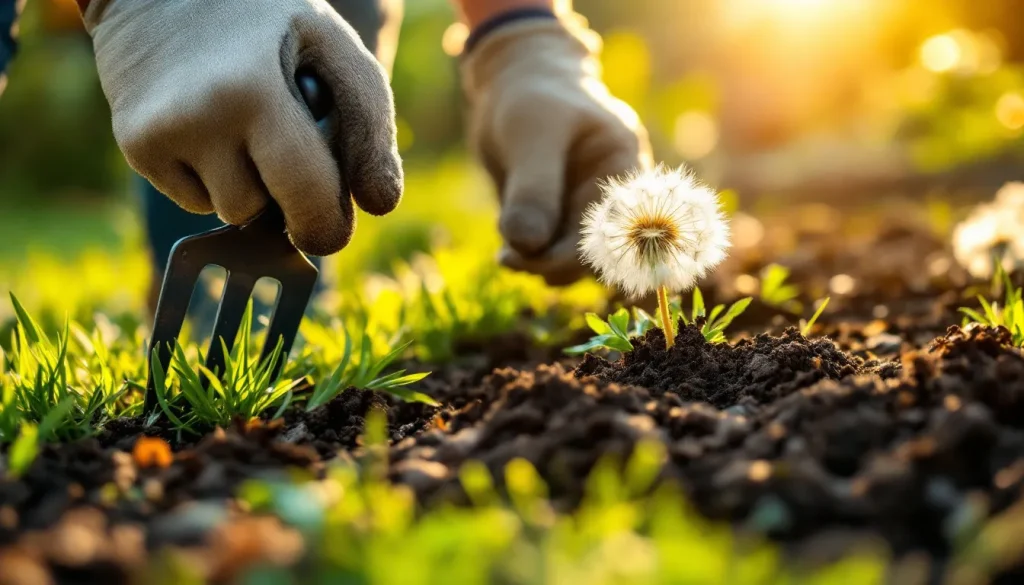
Hand-pulling and hoeing physically remove the weed, including the root if you do it right, which is why they are the most reliable natural option. Pull when soil is moist (the day after rain or watering) so the full root slides out. Cut annuals just below the crown, about 1 to 2 inches under the surface, with a hoe so the growing point is gone. Dig taproot weeds with a forked weeder.
- Water the area or wait until the day after rain so roots release cleanly.
- Grip the weed low at the base, not the leaves, to avoid snapping it.
- Pull slowly and straight up so the taproot follows.
- For dandelions and docks, push a forked dandelion weeder or hori-hori knife down beside the taproot and lever it out whole.
- For annual seedlings in a row, slice a sharp hoe 1 to 2 inches below the surface to sever the crown, then leave the tops to dry on a hot day.
- Bag any weed already in flower or seed so you do not spread it.
Cutting below the soil surface matters because the crown (where root meets shoot) holds the regrowth buds. Snip a dandelion at ground level and it returns in days. Sever it 2 inches down and an annual will not, though a perennial taproot may still rally and need a second pass.
Vinegar weed killer: the recipe, and the truth about how long it lasts
Vinegar kills weeds by drying out leaf tissue on contact, so it works fast in sun but only burns what it touches. Household 5% vinegar barely dents anything past the seedling stage. Horticultural vinegar at 20 to 30% acetic acid burns top growth of young weeds within hours, but roots of perennials survive and push new leaves within one to three weeks. Vinegar is a knockdown, not a permanent kill.
The widely shared recipe is 1 gallon vinegar, 1 cup salt, and 1 tablespoon dish soap. It works visually. The soap helps the liquid stick, the vinegar burns, and the salt draws water out of the plant. Spray on a hot, dry, sunny day for the harshest effect, and only on a dead-calm day so drift does not hit your grass or garden plants.
Important safety notes for vinegar:
- It is non-selective. It kills or scorches any plant it lands on, including grass and prized perennials. Shield nearby plants with cardboard while you spray.
- Horticultural-strength vinegar (20%+) can burn skin and eyes. Wear gloves and eye protection, and keep it away from kids and pets until dry.
- It does not move into roots, so plan to repeat it or remove the root afterward.
If you want a product engineered to spare turf, see our breakdown of the best weed killer that won’t kill grass, which covers selective options for lawns.
Why salt is the trap in the vinegar recipe
Salt kills weeds, but it does not stop at the weed. Sodium chloride dissolves into the soil, binds to soil particles, and stays there, drawing water away from any root that tries to grow in that spot for months to years. In garden beds and lawns, salt does long-term damage: it can leave bare, plant-hostile patches and leach sideways into areas you never sprayed.
This is the gap in nearly every vinegar-plus-salt post online. They print the recipe and skip the consequence. Salt is only defensible in spots you intend to keep permanently bare, such as a gravel pad far from beds, and even there it can move with rain runoff.
Practical rule: never use salt where you might plant grass, vegetables, flowers, or shrubs in the future, and never near the edge of beds or lawns. If you want the vinegar to behave, leave the salt out and accept that you will likely repeat the treatment or pull the root.
Boiling water: does it actually kill weed roots?
Boiling water kills weeds by cooking plant cells on contact at roughly 212F (100C), and it does kill shallow roots in the top inch or so of soil. It does not reach the deep roots of established perennials, so dandelions, bindweed, and quackgrass usually regrow. It works best on annual weeds and seedlings in hard surfaces where the heat is trapped.
Pour a full kettle slowly and directly onto the weed crown and surrounding base. The narrow gaps of patio cracks and driveway joints hold heat against the roots, which is why boiling water shines there and underperforms in open soil. It is free, leaves no residue, and is safe around edible gardens once cooled, but it can scald you and any plant or grass it splashes.
How to kill weeds by surface: lawn, beds, gravel, driveway, patio cracks
The right method depends as much on where the weed grows as on what it is. A treatment that is fine on a driveway will scorch a lawn. Match the surface to the approach using the matrix below, then confirm the weed type before acting.
| Surface | Best natural method | Avoid here | Prevention |
|---|---|---|---|
| Lawn / turf | Hand-dig taproots; selective removal; overseed bare spots | Vinegar, salt, boiling water (kills grass too) | Mow high, dense turf, feed grass |
| Flower / shrub beds | Hand-pull moist; shielded spot treatment; 2-3 in mulch | Salt; broadcast vinegar spray | 3-4 in mulch, drip irrigation only at plants |
| Vegetable / edible beds | Hand-pull, hoe seedlings, mulch | Any synthetic herbicide; salt | Mulch, dense planting, hoe weekly |
| Gravel paths / driveways | Boiling water, flame, horticultural vinegar | Salt near bed edges or runoff paths | Landscape fabric under fresh gravel |
| Patio pavers / cracks | Boiling water, flame, hand tool in joints | Salt (corrodes, kills nearby plants) | Polymeric sand in joints |
For lawns, protecting the grass is the whole game. Non-selective methods (vinegar, salt, boiling water, flame) cannot tell a weed from your turf, so on a lawn you either dig weeds out individually or use a selective product designed to spare grass. If moss is your real problem rather than broadleaf weeds, our guide on how to get rid of moss in lawn covers the different fix that situation needs.
Beating four stubborn weeds: dandelion, crabgrass, bindweed, clover
Stubborn weeds win because their root structure defeats surface treatments. The fix is method matched to anatomy: dig the taproot of dandelions, deny crabgrass its germination window, exhaust bindweed’s deep roots, and crowd out clover with strong turf. Identify the weed first, then apply the matched method below.
| Weed | Type | What beats it | What fails |
|---|---|---|---|
| Dandelion | Perennial taproot | Fork out the full taproot when soil is moist; repeat if it snaps | Cutting at ground level, single vinegar spray |
| Crabgrass | Annual | Pull before it seeds; pre-emergent in spring; thick turf | Pulling after seed set (next year’s crop is already sown) |
| Bindweed | Perennial, deep running roots | Repeated cutting to starve roots; persistent smothering for a full season | One-time pulling (root fragments resprout), vinegar |
| White clover | Perennial, spreads by stolons | Dense, well-fed turf; hand-pull patches; raise mowing height | Scalping the lawn (clover loves thin turf) |
Bindweed is the clearest proof that natural quick fixes fail on tough perennials. Its roots can run several feet deep and any fragment left behind grows a new plant, so the only reliable organic route is starving it through repeated cutting or smothering across an entire growing season.
How to stop weeds from coming back: the prevention system
Removing weeds is temporary. Preventing them is what makes a yard low-weed for good. Three layers do the work: smother bare soil with mulch, block germination with timing or pre-emergent, and grow turf dense enough to leave weeds no room. Set up the system once and you spend far less time pulling.
Mulch depth. Apply 2 to 4 inches of organic mulch (bark, wood chips, straw) on beds. Less than 2 inches lets light reach weed seeds, more than 4 inches can suffocate plant roots. Refresh it as it breaks down each year.
Pre-emergent timing. Pre-emergent products and corn gluten meal stop seeds from establishing, but only if applied before germination. For crabgrass, that is early spring when soil reaches about 55F (13C), often when local forsythia blooms. Applied after weeds sprout, pre-emergent does nothing.
Dense turf and mowing height. A thick lawn shades out weed seeds. Mow most cool-season grasses at 3 to 4 inches rather than scalping them, since tall grass blocks light at the soil surface. Knowing your grass helps you set this correctly, so use our guide to figure out what kind of grass you have before choosing a mowing height.
Landscape fabric tradeoffs. Fabric blocks weeds under gravel or fresh beds for a few years, but it clogs, soil and debris collect on top, and weeds eventually root in that layer while desirable plants struggle to spread. Use it under gravel and hardscape, not in active planting beds where it becomes a long-term headache.
Reseeding the lawn after you remove weeds
Removing lawn weeds leaves bare patches, and bare soil is where the next weeds land. Overseed those gaps with grass seed so turf fills the space first. Wait until any herbicide or vinegar residue clears (check the product label, often 2 to 4 weeks), loosen the surface, spread seed, and keep it consistently moist until it establishes.
New grass needs patience. Germination and fill-in vary by species and season, and our guide on how long grass seed takes to grow walks through realistic timelines. Until that new turf thickens up, keep it watered and avoid harsh weed treatments that would set back the seedlings.
If you want to mix your own spot treatment for the stubborn patches that keep coming back, our guide to DIY grass killer recipes you can make at home walks through the ingredients and ratios that actually knock plants down.
Frequently Asked Questions
What kills weeds permanently and naturally?
Removing the entire root is the only natural method that kills weeds permanently. Hand-dig taproot weeds like dandelions when soil is moist, and starve running-root perennials like bindweed through repeated cutting or season-long smothering. Vinegar, salt, and boiling water are not permanent because they burn top growth while roots survive. After removal, mulch and dense turf prevent return.
How do I get rid of weeds without killing my grass?
On a lawn, avoid non-selective methods (vinegar, salt, boiling water, flame) because they kill grass on contact. Instead, hand-dig individual weeds with a taproot weeder, then overseed the bare spot so grass fills in first. For widespread lawn weeds, use a selective herbicide labeled safe for your grass type, applied per label directions only.
Does vinegar kill weeds permanently, or do they grow back?
Vinegar usually does not kill weeds permanently. Even horticultural-strength vinegar (20-30% acetic acid) burns only the leaves and stem on contact and does not travel to the roots, so perennials and established weeds regrow within one to three weeks. Vinegar works best as a fast knockdown on young annual seedlings on hot, sunny days, ideally paired with later root removal.
Is it safe to use salt to kill weeds in my garden?
No, salt is not safe in or near a garden. Sodium chloride sterilizes soil, drawing water away from roots and leaving ground hostile to plants for months to years, and it can leach sideways into beds and lawns you never treated. Reserve salt only for areas you intend to keep permanently bare, and never use it where you may plant again.
How do I get rid of weeds quickly or overnight?
For an overnight cosmetic knockdown, spray horticultural vinegar with a little dish soap on a hot, sunny day, or pour boiling water directly on the weed. The leaves brown within hours. Understand the tradeoff: this kills only top growth, so deep-rooted weeds regrow within weeks. For a fast and lasting result, pull the whole root instead.
What is the best way to kill weeds in gravel, driveways, and between patio pavers?
Boiling water, flame weeding, and horticultural vinegar work best in gravel, driveways, and paver cracks because the narrow, hard surfaces trap heat against roots and there is no desirable grass to protect. Pour boiling water on the crown, or pass a flame torch briefly over each weed. Then prevent regrowth with polymeric sand in joints or landscape fabric under gravel.
How do I stop weeds from coming back after I remove them?
Stop weeds returning with a three-layer system: apply 2 to 4 inches of mulch on bare beds, use a pre-emergent or corn gluten before seeds germinate (around 55F soil for crabgrass), and grow dense turf mowed at 3 to 4 inches to shade out seeds. Overseed bare patches so grass, not weeds, claims the open ground first.
Does boiling water actually kill weed roots?
Boiling water kills shallow roots in roughly the top inch of soil and reliably kills annual weeds and seedlings. It does not reach the deep roots of established perennials like dandelion or bindweed, which regrow afterward. It performs best in patio cracks and driveway joints where the narrow space holds heat against the root zone longer than in open soil.