
By the HMNDP Editorial Team. Independent reporting on lawn care, weeds, and turf management.
Last reviewed: June 2026
What counts as a creeping lawn weed
Creeping lawn weeds are low-growing plants that spread sideways across turf by horizontal stems or underground runners rather than growing tall from a single crown. They form dense mats that root as they go, which is why hand-pulling one plant often leaves a network behind. The flagship example is creeping charlie (ground ivy), joined by clover, speedwell, creeping buttercup, and prostrate spurge.
The word “creeping” is doing real work here. A weed can spread fast without creeping. Crabgrass spreads fast but grows in tufts. True creeping weeds hug the soil and travel horizontally, which changes both how you identify them and how you kill them.
Most weed lists ignore that distinction and mix tall spreaders in with prostrate mat-formers. This guide keeps them separate and, further down, sorts every weed by how it spreads, because the spreading mechanism decides your control strategy.
Creeping charlie (ground ivy): the flagship creeping weed
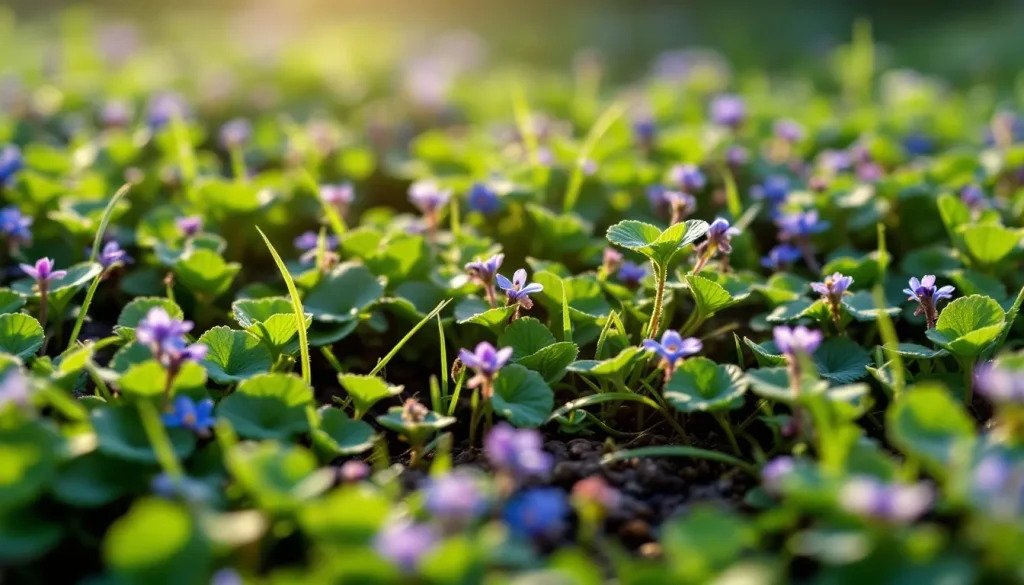
Creeping charlie (Glechoma hederacea) is the most common creeping lawn weed in North America and the UK. It has round-to-kidney-shaped leaves with scalloped edges, square stems (it is in the mint family), and small funnel-shaped blue-violet flowers in spring. Crushed leaves smell minty. It thrives in shade and damp soil where turf is thin.
Creeping charlie spreads by stolons, which are above-ground stems that root at each node where they touch soil. One plant can send runners across several feet in a season. Because every rooted node is a new plant, pulling a single strand rarely clears it.
Creeping charlie vs ground ivy: they are the same plant. “Creeping charlie” is the common US name and “ground ivy” is the common UK name for Glechoma hederacea. There is no botanical difference. If two sources seem to disagree, they are almost always describing identical turf using different regional labels. This is the single biggest point of confusion in the topic, so we cover it in full in the FAQ below.
Control: a broadleaf selective herbicide containing triclopyr is the most reliable option, applied in fall when the plant moves resources to its roots. Improving drainage and reducing shade removes the conditions it needs. See our roundup of a weed killer that won’t kill grass for selective product options.
The creeping weed roundup: 12 low-growing invaders to identify
Below are the creeping and fast-spreading weeds homeowners most often find taking over turf. Each entry gives the visual ID cues (leaf, habit, flower) and a one-line control note. The table separates the truly prostrate, mat-forming creepers from the fast spreaders that grow more upright, so you can match what you actually see in your lawn.
| Weed | Habit | Leaf and flower cue | Spreads by | Control note |
|---|---|---|---|---|
| Creeping charlie / ground ivy (Glechoma hederacea) | Prostrate mat | Round scalloped leaves, blue-violet flowers, minty smell | Stolons | Triclopyr in fall |
| White clover (Trifolium repens) | Prostrate mat | Three-part leaves, white puffball flowers | Stolons | Selective broadleaf herbicide; or tolerate (fixes nitrogen) |
| Creeping buttercup (Ranunculus repens) | Prostrate mat | Three-lobed toothed leaves, glossy yellow flowers | Stolons and runners | Dig out crowns; common UK/RHS problem |
| Prostrate spurge (Euphorbia maculata) | Flat mat | Small oval leaves, milky sap, red stem | Seed, low branching stems | Pre-emergent; pull before it seeds |
| Common speedwell (Veronica spp.) | Prostrate mat | Small scalloped leaves, tiny blue-white flowers | Creeping stems that root at nodes | Hard to kill; hand-pull small patches |
| Ground ivy see creeping charlie | Prostrate mat | Same plant as creeping charlie | Stolons | See above |
| Common chickweed (Stellaria media) | Low sprawling | Small pointed leaves, tiny white star flowers | Creeping stems, seed | Pull when young; pre-emergent |
| Crabgrass (Digitaria spp.) | Low tufted, fast | Coarse light-green blades fanning from center | Seed, prostrate tillers | Pre-emergent in early spring |
| Yellow nutsedge (Cyperus esculentus) | Upright, fast | Triangular stem, waxy yellow-green V-shaped blades | Rhizomes and tubers (nutlets) | Sedge-specific herbicide; not a normal weed killer |
| Japanese stiltgrass (Microstegium vimineum) | Sprawling grass | Pale silver midrib stripe, thin lance leaves | Seed, stems root at nodes | Pre-emergent; pull before September seed set |
| Quackgrass (Elymus repens) | Upright, fast | Coarse blades, clasping auricles at leaf base | Aggressive rhizomes | Spot-treat with glyphosate; digging spreads it |
| Bermudagrass (as a weed) (Cynodon dactylon) | Prostrate mat | Gray-green fine blades, seed heads like fingers | Stolons and rhizomes | Very hard to remove; repeated spot treatment |
Notice the pattern in the “spreads by” column. That column, not the leaf shape, is what determines whether you can pull, spray, or need a specialty product. The next section explains why.
The part every other guide skips: how creeping weeds actually spread
Creeping and spreading lawn weeds travel by one of three mechanisms: stolons (above-ground runners), rhizomes (underground runners), or creeping stems that root at each node. This taxonomy matters because the mechanism decides which control works. Hand-pulling clears stolon weeds but leaves rhizome weeds behind, so misreading the mechanism wastes a whole season.
Stolons (above-ground runners): horizontal stems that crawl across the soil surface and root wherever a node touches down. Creeping charlie, white clover, and creeping buttercup all use stolons. Because the runners are visible, you can physically remove much of the plant, but every rooted node left behind restarts the mat. Fall-applied selective herbicide moves down into the connected root system better than pulling.
Rhizomes (underground runners): horizontal stems that travel below the surface. Quackgrass, yellow nutsedge, and bermudagrass spread this way. This is the hardest group to control, because tilling or digging chops the rhizome into pieces and each piece grows a new plant. Nutsedge adds underground tubers (nutlets) that can sit dormant, which is why it needs a sedge-specific herbicide rather than a broadleaf spray.
Creeping stems that root at nodes: weaker, thread-like stems that sprawl and root opportunistically without the vigor of true stolons or rhizomes. Speedwell, chickweed, and Japanese stiltgrass fit here. These respond to early hand-pulling and pre-emergent herbicide before they set seed.
| Mechanism | Where it spreads | Example weeds | What works | What backfires |
|---|---|---|---|---|
| Stolons | Above ground | Creeping charlie, clover, creeping buttercup | Fall triclopyr; remove rooted nodes | Pulling one strand and leaving nodes |
| Rhizomes | Below ground | Quackgrass, nutsedge, bermudagrass | Systemic or sedge-specific herbicide | Tilling or digging (fragments spread) |
| Rooting stems | At the surface | Speedwell, chickweed, stiltgrass | Early pull; spring pre-emergent | Waiting until they seed |
This is the analysis missing from every ranking listicle. If you can name your weed’s mechanism, you already know whether pulling, a broadleaf selective, a systemic, or a pre-emergent is the right move.
Crabgrass and stiltgrass: the fast-spreading grasses
Crabgrass and Japanese stiltgrass spread fast but are grassy weeds, not broadleaf creepers, so broadleaf herbicides do not touch them. Crabgrass (Digitaria) forms low, coarse, light-green fans of blades from a central point and produces thousands of seeds per plant. Stiltgrass is thinner with a distinctive silvery stripe down the middle of each leaf.
Both are annuals that germinate from seed each year, which makes timing everything. A pre-emergent herbicide applied in early spring, before soil temperatures reach the mid-50s Fahrenheit (around 13C), stops crabgrass germination. Miss that window and you are left spot-treating with a grassy-weed product.
Stiltgrass sets seed in late summer to early fall, so pulling or mowing it before September prevents next year’s crop. A thick, competitive lawn is the strongest defense against both, since bare or thin turf is where their seeds establish.
Nutsedge: the weed that looks like grass but is not
Yellow nutsedge (Cyperus esculentus) is not a grass and not a broadleaf; it is a sedge, which is why standard weed killers fail on it. Identify it by its triangular stem (roll it between your fingers, sedges have edges), waxy yellow-green blades in sets of three, and faster growth than surrounding turf, so it stands taller a few days after mowing.
Nutsedge spreads by rhizomes and by underground tubers called nutlets that can survive for years. Pulling it snaps the stem and leaves the nutlets, which resprout. Control requires a sedge-specific herbicide (halosulfuron or sulfentrazone are common actives) applied while the plant is actively growing in early summer, not a general broadleaf spray.
Creeping buttercup: the UK and RHS lawn problem
Creeping buttercup (Ranunculus repens) is one of the most reported creeping lawn weeds in the UK, flagged repeatedly by the RHS in damp gardens. It has hairy, three-lobed toothed leaves and glossy bright-yellow five-petaled flowers on upright stalks in early summer. It favors heavy, wet, compacted soil.
Like creeping charlie, it spreads by stolons that root at the nodes, forming spreading rosettes. On lawns, mowing removes flowers but not the rooting runners. Digging out the crowns works for small patches, while improving drainage and aeration removes the wet conditions it depends on. A selective lawn herbicide is the option for larger infestations. Buttercups are also toxic to grazing animals, though rarely a concern in a mowed home lawn.
How to choose the right control method
Match the control to the weed’s mechanism and habit, not to a generic “kill weeds” product. There are three tools: hand-pulling and cultural fixes, selective herbicides, and pre-emergents. Each fits a different weed type and a different season, and using the wrong one is why creeping weeds come back.
- Identify the mechanism first. Stolons and rooting stems can be physically removed; rhizome and tuber weeds cannot, and disturbing them spreads them.
- Hand-pull and fix conditions for small, stolon-based patches. Remove every rooted node, then reduce shade and improve drainage so turf outcompetes the gap. This suits early creeping charlie, clover, and chickweed.
- Use a selective broadleaf herbicide for established broadleaf creepers. Products with triclopyr or a 2,4-D blend target creeping charlie, clover, speedwell, and buttercup without killing grass. Our guide to common lawn weeds covers how selectives read leaf chemistry.
- Use a specialty product for grasses and sedges. Nutsedge needs a sedge-specific active; grassy weeds like crabgrass need a grassy-weed or pre-emergent product, since broadleaf sprays do nothing to them.
- Apply pre-emergents on the calendar, not on sight. They stop seeds from germinating, so early spring (crabgrass) and correct seasonal timing beat reacting once the weed is visible.
For weeds identified by their bloom, our reference on a weed with purple flowers helps confirm creeping charlie, henbit, and speedwell before you spray.
When to treat: seasonal timing that decides success
Timing matters as much as the product. Fall is the best season to kill perennial creeping broadleaf weeds like creeping charlie and clover, because the plant is moving sugars down to its roots and carries systemic herbicide with them. Early spring is for pre-emergents against annual grasses.
| Season | Best action | Targets |
|---|---|---|
| Early spring (soil below mid-50s F) | Apply pre-emergent | Crabgrass, stiltgrass, spurge |
| Late spring / early summer | Spot-treat actively growing weeds | Nutsedge, young buttercup |
| Fall (before first frost) | Systemic selective herbicide | Creeping charlie, clover, speedwell |
For more on turf health that crowds weeds out before they start, see the HMNDP learn hub.
Frequently Asked Questions
What is the difference between creeping charlie and ground ivy?
There is no difference: they are the same plant, Glechoma hederacea. “Creeping charlie” is the common name used in the United States and “ground ivy” is the common name used in the UK. Both describe a mint-family perennial with round scalloped leaves, square stems, blue-violet flowers, and stolons that root at the nodes. Any control advice for one applies to the other.
How do I identify a creeping or low-growing lawn weed?
Look at growth habit first: creeping weeds hug the soil and spread sideways in a mat rather than growing tall from one crown. Then check the leaf shape, whether stems root where they touch soil, and flower color. Round scalloped leaves with blue flowers signal creeping charlie; three-part leaves with white puffballs signal clover; triangular stems signal nutsedge.
What are the most common creeping weeds in lawns?
The most common are creeping charlie (ground ivy), white clover, creeping buttercup, common speedwell, prostrate spurge, and common chickweed among broadleaf creepers. Among grassy and sedge invaders that spread fast and low, crabgrass, yellow nutsedge, quackgrass, bermudagrass, and Japanese stiltgrass dominate. Creeping charlie is the single most frequently reported creeping lawn weed in North America and the UK.
How do creeping lawn weeds spread (stolons vs rhizomes)?
They spread three ways. Stolons are above-ground runners that root at each node (creeping charlie, clover, buttercup). Rhizomes are underground runners (quackgrass, nutsedge, bermudagrass). Some use weaker creeping stems that root opportunistically (speedwell, chickweed). The mechanism decides control: stolon weeds can be pulled, but tilling rhizome weeds fragments them and makes the problem worse.
How do I get rid of creeping charlie in my lawn?
Apply a selective broadleaf herbicide containing triclopyr in fall, when the plant carries the herbicide down to its roots. For small patches, pull the runners and remove every rooted node. Then fix the conditions it needs by reducing shade and improving drainage, so healthy turf fills the gap. Repeat treatment is usually needed over one to two seasons.
What is the fastest-spreading weed that takes over lawns?
Among grasses, crabgrass spreads fastest by seed, with a single plant producing thousands of seeds in one season. Among perennial creepers, bermudagrass and quackgrass spread most aggressively because they use both stolons and rhizomes. Creeping charlie is the fastest-spreading broadleaf creeper, sending stolons several feet across thin, shaded turf in a single growing season.
Are creeping lawn weeds harmful to grass or pets?
Most creeping weeds harm lawns mainly by crowding out grass and thinning turf, not by poisoning it. A few carry pet or livestock concerns: creeping buttercup is toxic to grazing animals, and creeping charlie can be mildly toxic to horses in quantity. For dogs and cats on a mowed home lawn, these weeds are generally low risk, though herbicide products should be applied per label directions.
When is the best time to kill creeping lawn weeds?
Fall is best for perennial broadleaf creepers like creeping charlie, clover, and speedwell, because systemic herbicide follows the plant’s sugars down to the roots before winter. Early spring, before soil warms past the mid-50s Fahrenheit, is best for pre-emergents against annual grasses like crabgrass. Early summer suits actively growing nutsedge and young buttercup.