
By the HMNDP Editorial Team, independent reporting on lawn care, landscaping, and the green-industry business.
Last reviewed: June 2026
Does boiling water kill weeds? The direct answer
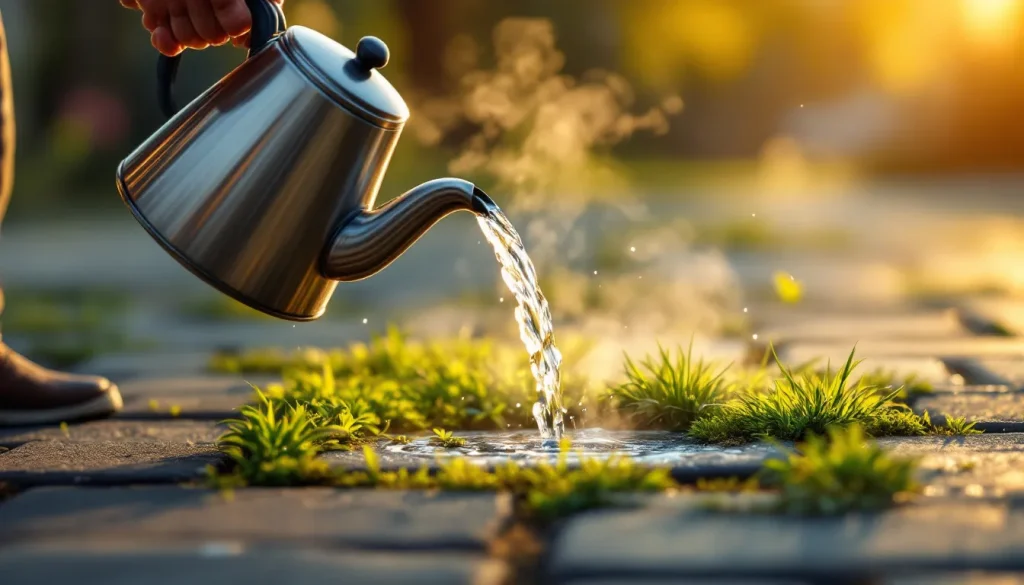
Yes, boiling water kills weeds. Water at a rolling boil (100 C / 212 F at sea level) scalds plant tissue on contact, destroying the foliage within hours and killing shallow roots in the top 2 to 5 cm of soil. It works best on young weeds in pavement cracks, driveways, patios, and paths. Deep-rooted perennials usually need 2 to 4 repeat pourings.
It is free, chemical-free, and already in your kitchen. The catch is that it is a contact treatment, not a systemic one, so it punishes the part of the weed it touches and little else.
How boiling water kills weeds: the science in plain terms
Boiling water kills weeds by denaturing the proteins inside plant cells. Heat above roughly 60 C (140 F) breaks the bonds that hold enzymes and cell-wall proteins in shape. The cells rupture, water-transport tissue collapses, and the leaf can no longer photosynthesize. Damage is immediate; the visible wilt follows within minutes to hours.
Think of it like blanching a vegetable. The same heat that turns spinach limp in seconds does identical structural damage to a chickweed seedling. There is no chemistry to absorb and no waiting for translocation, which is why dieback is so fast compared with sprays.
It is a non-selective contact herbicide
Boiling water is non-selective, meaning it kills whatever green tissue it touches. It does not tell a dandelion from your lettuce. Anything in the splash zone, including grass blades, flower seedlings, and the crowns of ornamentals, takes the same scald. That makes it excellent in hardscape and risky in planted beds.
Because it acts only where it lands, precision matters more than volume. A narrow, controlled pour onto the weed crown does the job; a wide splash wastes heat and endangers neighbors. For a broader rundown of removal methods, see our guide on how to get rid of weeds.
What it kills well, and what survives
Boiling water reliably kills weed tops and shallow roots. Annual weeds and young seedlings, which store little energy underground, often die from a single application. Established perennials with deep taproots or running rhizomes survive because the heat never reaches their energy reserves.
- Dies from one pour: chickweed, annual bluegrass, young crabgrass, oxalis seedlings, moss in cracks, most weeds under 10 cm tall.
- Needs repeat pours (2 to 4): plantain, clover, young dock, shallow grass clumps.
- Often regrows, resists boiling water: dandelion (taproot 25 cm or deeper), bindweed (roots to 1.5 m or more), Japanese knotweed, established bramble, horsetail.
The pattern is simple. The deeper and more energy-rich the root, the more times you pour.
How to apply boiling water to weeds (step by step)
Pour boiling water directly onto the weed crown, the point where stem meets soil, using 250 to 500 ml (about 1 to 2 cups) per weed. Soak the base, not just the leaves, so heat reaches the upper root zone. Apply on a dry, still day for best penetration into cracks.
- Boil a full kettle (1.5 to 2 L). A kettle with a narrow spout gives the most control.
- Carry it in a vessel with a lid and a pouring spout. Wear closed shoes and long sleeves.
- Pour slowly onto the crown and base of each weed, using about 250 ml for small weeds and up to 500 ml for clumps or taproots.
- Pour into the crack, not across it, to drive heat down toward the roots.
- Mark stubborn weeds and recheck in 7 days. Re-pour any that show green regrowth.
One full kettle treats roughly 4 to 8 weeds depending on size. The whole job for a typical driveway seam costs nothing beyond the energy to boil water.
The dieback timeline: what to expect day by day
Boiling water shows results within hours, with full visible death in 2 to 4 days for susceptible weeds. The leaves do not vanish; they scald, wilt, brown, and dry out in a predictable sequence. Knowing the timeline tells you when a weed is truly dead versus just shocked.
| Time after pouring | What you see | What it means |
|---|---|---|
| 0 to 2 hours | Leaves darken and go limp | Cell walls have ruptured |
| Day 1 | Foliage wilts flat, looks water-soaked | Top growth is dead |
| Days 2 to 4 | Leaves brown and crisp | Annuals and seedlings are dead |
| Days 5 to 10 | Weed stays brown, or new green appears at center | Brown = success; green = taproot survived, re-pour |
If you see fresh green shoots at the crown after day 7, the root lived. That is your signal to apply a second pour, not to assume the method failed.
Boiling water vs vinegar vs salt: the numbers
Boiling water, household vinegar, and salt are the three popular no-herbicide options, and they perform very differently. Boiling water is the fastest and leaves zero soil residue. Vinegar (acetic acid) burns foliage chemically. Salt kills by dehydration but poisons the soil for months. Here is the head-to-head most pages never give you.
| Factor | Boiling water | Vinegar (5 to 20%) | Salt (rock or table) |
|---|---|---|---|
| Top-kill on young weeds | ~90% in one pass | ~80% (household 5%), higher at 20% horticultural | ~70%, slower |
| Kills the root | Shallow roots only | No, contact only | Yes, but sterilizes soil |
| Speed to visible death | 2 to 4 days | 1 to 2 days (foliage) | 3 to 10 days |
| Cost per treatment | Near $0 (energy only) | ~$0.10 to $0.40 | ~$0.05 to $0.20 |
| Soil residue | None | Minimal, breaks down fast | Persists weeks to months |
| Safe near desired plants | Only with precise pouring | No, drift damages | No, leaches sideways |
Boiling water wins on cost and soil safety. Vinegar acts slightly faster on leaves. Salt is the one to avoid in any spot you ever want to grow something again. For the full breakdown on each, see our reports on whether salt kills weeds and whether bleach kills weeds.
Safety and soil warnings competitors skip
Boiling water is chemical-free but not risk-free. The biggest hazard is to you: carrying 2 L of 100 C water causes serious scald burns if it splashes. The second risk is collateral damage to plants, soil life, and lawn you did not mean to hit. Treat it as a tool with a sharp edge.
- Scald burns: use a lidded vessel, closed footwear, and pour at ground level. Never pass an open pot over bare skin.
- Runoff kills neighbors: heat travels through soil. A pour next to a lawn edge can brown grass 5 to 10 cm beyond the target.
- Soil life: boiling water kills earthworms and microbes in the top few centimeters it soaks. In hardscape cracks this is irrelevant; in garden beds, repeated dousing degrades soil biology.
- Do not add salt in beds: salting boiling water makes it more lethal but sterilizes soil for months and leaches to nearby roots. Reserve salt only for permanent hardscape you will never plant.
The method is genuinely pet- and kid-safe once the water cools, with no residue to track indoors. That is its real advantage over sprays, and the reason it is worth the careful handling.
The follow-up strategy to actually kill the root
To kill a deep-rooted weed with boiling water, combine heat with depletion. A single pour kills the top; the root then spends stored energy pushing out new shoots. Pour again as soon as those shoots appear, before they rebuild reserves. Repeated 2 to 4 times over 3 to 6 weeks, this starves the root.
For the toughest taproots like dandelion, pair the pour with manual removal. Boiling water softens the surrounding soil, so a dandelion fork or narrow trowel lifts more of the root intact within an hour of treatment. That combination beats either method alone. Browse more techniques in the HMNDP learn hub.
Frequently Asked Questions
Does boiling water kill weed roots or just the leaves?
Boiling water kills the leaves and the shallow roots it soaks, typically the top 2 to 5 cm of soil. It does not reach deep taproots or running rhizomes, so weeds like dandelion and bindweed regrow from below. For shallow-rooted annuals and seedlings, one pour often kills the whole plant. For perennials, you need repeat applications.
How fast does boiling water kill weeds and how long until they die?
Foliage wilts within hours of pouring. Susceptible annual weeds and seedlings turn brown and die within 2 to 4 days. Stubborn perennials may look dead at day 4 but push new green shoots from the root by days 5 to 10. If you see regrowth after a week, the root survived and the weed needs another pour.
How much boiling water do I need to pour on each weed?
Use 250 to 500 ml (about 1 to 2 cups) per weed, poured directly onto the crown where stem meets soil. Small seedlings need around 250 ml; larger clumps and taprooted weeds need closer to 500 ml. One full kettle of 1.5 to 2 L treats roughly 4 to 8 weeds. Pour into cracks, not across them.
Is boiling water or vinegar better for killing weeds?
Boiling water is cheaper (near $0), leaves no soil residue, and kills shallow roots, while vinegar acts slightly faster on foliage but is contact-only and can drift onto desired plants. Boiling water gets about 90% top-kill in one pass on young weeds; household 5% vinegar gets about 80%. For hardscape weeds with no plants nearby, boiling water is the better default.
Should I add salt to boiling water to kill weeds?
Only on permanent hardscape you never intend to plant. Salt makes boiling water more lethal but sterilizes the soil for weeks to months and leaches sideways into the roots of nearby plants and lawn. In garden beds or near borders, skip the salt entirely. Plain boiling water plus repeat pours kills weeds without poisoning the ground.
Will boiling water permanently kill weeds or do they grow back?
Boiling water permanently kills shallow-rooted annuals and seedlings with one or two pours. Deep perennials grow back from surviving roots unless you pour repeatedly. Apply each time new shoots appear, 2 to 4 times over 3 to 6 weeks, to deplete the root energy. New weed seeds can still germinate later, so cracks may need seasonal re-treatment.
Is boiling water safe for the soil, grass, and nearby plants?
Boiling water leaves no chemical residue, so it is safe for pets and children once cooled. However, it kills earthworms and microbes in the top few centimeters it soaks and browns any grass or plant in the splash and runoff zone, often 5 to 10 cm beyond the target. Use it freely in hardscape cracks and very cautiously in planted beds.
What weeds does boiling water NOT kill?
Boiling water often fails on deep-rooted and rhizomatous perennials. Dandelion (taproot 25 cm or deeper), bindweed (roots over 1.5 m), Japanese knotweed, established brambles, and horsetail regrow because the heat never reaches their energy stores. These need repeat pourings combined with manual root removal, or a systemic approach, to control rather than just top-kill.