
By the HMNDP Editorial Team. Last reviewed: June 2026.
What is a tumbleweed?
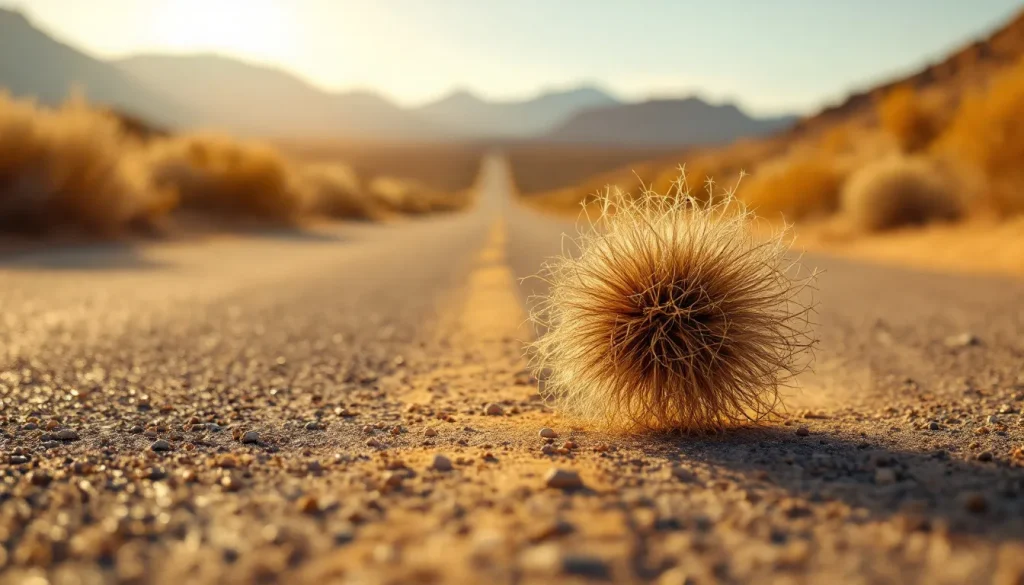
A tumbleweed is the dried, detached above-ground part of a plant that breaks off at the stem base and rolls across open ground in the wind. It is not a single species. It is a life stage. Several plants do this, but the most common tumble weed in the United States is Russian thistle (Salsola tragus, also classified as Salsola kali). The tumbling spreads seeds.
The plant lives, dries, snaps off near the soil line, and then travels. Each rolling skeleton scatters tens of thousands of seeds as it goes. That is the whole point of the behavior, biologically speaking.
Why do tumbleweeds tumble and roll in the wind?
Tumbleweeds tumble to disperse seeds. When a Russian thistle plant dries out at the end of its season, an abscission layer forms at the stem base and the plant snaps free. The wind then rolls the dead, rounded skeleton across the ground, and it drops seeds the entire distance it travels. A single plant can scatter 200,000 or more seeds across many miles.
This is wind dispersal taken to an extreme. Most plants release seed from a fixed position. The tumbleweed turns the whole parent plant into a moving seed shaker. One windy afternoon can plant a field that was clean the day before.
Are tumbleweeds the same as Russian thistle?
Russian thistle is the most common tumbleweed, but the two terms are not identical. “Tumbleweed” describes any plant that detaches and rolls to spread seed. Russian thistle (Salsola tragus) is one specific species that does this. So every Russian thistle skeleton is a tumbleweed, but not every tumbleweed is Russian thistle.
Other plants become tumbleweeds too. Kochia (Bassia scoparia), several pigweeds and amaranths (Amaranthus species), and tumble mustard can all dry, break off, and roll. When people in California, Nevada, or New Mexico picture a tumbleweed, they are almost always picturing Russian thistle, because it dominates the arid West.
| Common name | Scientific name | Where it shows up |
|---|---|---|
| Russian thistle | Salsola tragus / Salsola kali | Roadsides, fallow farmland, deserts across the West |
| Kochia | Bassia scoparia | Croplands, feedlots, the Great Plains |
| Tumble pigweed | Amaranthus albus | Gardens, disturbed lots, fields |
| Tumble mustard | Sisymbrium altissimum | Rangeland, dry open ground |
The tumbleweed life cycle, stage by stage
A tumbleweed goes through five stages: seed germination, bushy green growth, drying, breaking off at the stem base, and tumbling to scatter seed. Russian thistle germinates in spring, grows into a rounded bush through summer, dies and dries by fall, then snaps free and rolls. The cycle resets when those scattered seeds germinate the next spring.
- Germination. Seeds sprout in early spring, often after the first warm rains, in bare or disturbed soil.
- Green growth. The plant grows into a soft, bushy, rounded form through summer. At this young stage it is green and not yet thorny.
- Maturity and drying. By late summer and fall the plant flowers, sets seed, stiffens, and dries to a hard, spiny skeleton.
- Detachment. An abscission layer forms at the base and the dead plant breaks free of its own root.
- Tumbling. Wind rolls the skeleton across open ground, dropping seed the whole way. Then the cycle repeats.
The takeaway for control: the easiest time to kill a tumbleweed is stage two, when it is small and green, long before it can roll or seed.
Are tumbleweeds native to North America?
No. Tumbleweeds are not native to North America. Russian thistle was introduced to the United States in the 1870s, most likely as a contaminant in flax seed imported from southwestern Russia and Ukraine. The first documented arrival was in Bonhomme County, South Dakota. From there it spread west fast.
The spread ranks among the fastest plant invasions in United States history. The Natural History Museum and multiple weed-science programs document that Russian thistle reached the California coast by 1895, roughly two decades after it landed in the Dakotas. Railroads, livestock, and the plant’s own rolling seed dispersal carried it across the West.
The cowboy-movie image of a tumbleweed rolling through a frontier town is, ironically, a picture of an invasive species. The plant Americans treat as a symbol of the Old West is a Eurasian newcomer that arrived during the homesteading era.
Where tumbleweeds thrive: disturbed soil
Tumbleweeds thrive in disturbed, bare, dry soil. Russian thistle is a pioneer plant that colonizes ground where competition has been removed: roadsides, fallow or overgrazed land, construction sites, vacant lots, fence lines, and drought-stressed fields. It does poorly in dense, healthy turf or established native cover.
This is why tumbleweeds explode after disturbance. A graded building pad, a road shoulder, a field left fallow during drought, or an overgrazed pasture all give the seed open ground with little competition. Healthy, dense vegetation is the plant’s main natural enemy, which is why prevention and good ground cover matter as much as removal. Our guides on identifying common lawn weeds and managing broadleaf weeds cover the same logic of crowding weeds out with healthy cover.
How do I get rid of tumbleweeds on my property?
To get rid of tumbleweeds, kill the plants while they are young and green in spring, remove and bag any dried skeletons before they roll, and keep bare soil covered so new seed cannot establish. Timing matters more than any single product. A young Russian thistle pulls easily and dies fast. A dried, seed-laden skeleton just spreads the problem when you move it.
- Hit them young (spring). Pull, hoe, or mow seedlings while they are small and green, before they flower. Hand-pulling works well after rain when soil is soft. This is the single most effective step.
- Use herbicide at the seedling stage if needed. Post-emergent broadleaf herbicides (for example, products containing glyphosate or 2,4-D) work best on young, actively growing plants. Pre-emergent products can stop germination in problem areas. Always follow the label, and note that timing on small plants beats any late-season spray. See our overview of how to get rid of weeds for application basics.
- Collect dried skeletons carefully. If plants already dried and detached, gather them on a calm day. Wear gloves and long sleeves, because mature Russian thistle is sharp and spiny.
- Bag the seeds, do not scatter them. Place collected tumbleweeds in contractor bags. Do not shred, burn near structures, or pile them where wind can move them again.
- Dispose of them per local rules. Many arid-West municipalities run green-waste or special tumbleweed collection. Check local guidance before dumping or burning, because open burning is restricted or banned in many fire-prone counties.
- Close the bare ground. Reseed, mulch, or establish dense cover so the next seed crop has nowhere to take hold. This is what stops the cycle long term.
One disposal warning: never rake dried tumbleweeds into a loose pile against a fence, shed, or house. That pile is both a seed bank and, as the next section explains, a fire load.
Are tumbleweeds a fire hazard?
Yes. Dried tumbleweeds are extremely flammable and are a documented fire and property hazard. A dead Russian thistle is essentially a ball of dry, woody tinder. Wind packs them by the thousands against fences, walls, and parked equipment, creating continuous fuel that can carry flame straight to a structure in dry, windy conditions.
The pile-up risk is not theoretical. In 2018, strong desert winds buried a neighborhood in Victorville, California, where tumbleweeds reached the second stories of homes and trapped residents indoors. Cleanup required city public works crews, code enforcement, contractors, and the county fire department. Similar burials have hit towns across the desert Southwest in high-wind events.
Two hazards stack here. First, the sheer volume blocks doors, driveways, and roads. Second, that same volume is dry fuel. In wildfire-prone parts of California, Nevada, Arizona, and New Mexico, clearing dried tumbleweeds away from structures is a basic defensible-space measure, the same logic fire agencies apply to dry brush and pine needles.
Are tumbleweeds invasive or a noxious weed?
Yes. Russian thistle is widely treated as an invasive and, in several states, a regulated noxious weed. It is non-native, it displaces native vegetation on disturbed land, and it carries real agricultural and health costs. Exact legal status depends on the state and county, so check your local agriculture department or weed-control district for designations and any control requirements that may apply.
The damage goes beyond looks. Russian thistle competes with crops and rangeland forage, pulls scarce water and nitrogen from soil, and can host pests and crop viruses. Its pollen is also a significant late-summer allergen across the West, so the plant is a documented hay-fever trigger, not just a nuisance.
Conditional point worth repeating: noxious-weed lists, mandatory-control rules, and burn restrictions vary by jurisdiction. What is merely discouraged in one county may be a regulated weed you are required to control in another. Verify locally before assuming either way.
Are tumbleweeds dangerous or bad for the environment?
Tumbleweeds can be dangerous and are generally harmful where they invade. The direct risks are fire fuel, road and property obstruction, sharp spines that cut skin and puncture tires, and allergenic pollen. Ecologically, Russian thistle degrades disturbed land by outcompeting native and forage plants and by drawing down soil moisture in already dry regions.
There is a narrow upside. Young, green Russian thistle is edible to livestock and even to people before it turns spiny, and the plant can briefly stabilize raw bare soil. Those benefits are minor next to the fire load, the water loss, the allergy burden, and the speed at which it spreads. For most property owners in the arid West, the honest verdict is that tumbleweeds are a problem to manage, not a plant to keep.
For deeper how-to material on weed identification, prevention, and control timing, the HMNDP Learn library collects the practical guides referenced throughout this article.
Frequently Asked Questions
What is a tumbleweed and what plant is it?
A tumbleweed is the dried, detached above-ground part of a plant that breaks off at the stem base and rolls in the wind to scatter seed. It is a life stage, not one species. In the United States the most common tumbleweed by far is Russian thistle (Salsola tragus), though kochia, pigweeds, and tumble mustard also tumble.
Are tumbleweeds the same as Russian thistle?
Not exactly. Russian thistle (Salsola tragus) is the most common tumbleweed in North America, so the names get used interchangeably. But “tumbleweed” describes any plant that detaches and rolls to spread seed. Every dried Russian thistle is a tumbleweed, yet other species like kochia and tumble pigweed become tumbleweeds too. Russian thistle simply dominates the arid West.
Are tumbleweeds native to North America?
No. Russian thistle was introduced to the United States in the 1870s, most likely as a contaminant in flax seed from southwestern Russia and Ukraine, first documented in Bonhomme County, South Dakota. It spread to the California coast by 1895, one of the fastest plant invasions in US history. The cowboy-film tumbleweed is actually an invasive Eurasian plant.
How do I get rid of tumbleweeds on my property?
Kill young plants in spring by pulling, hoeing, or mowing while they are green, before they flower or dry out. Use post-emergent herbicide on seedlings if needed, per the label. Collect any dried skeletons on a calm day with gloves, bag them so seeds do not scatter, dispose of them per local rules, and cover bare soil to stop new growth.
Are tumbleweeds a fire hazard?
Yes. Dried tumbleweeds are extremely flammable, essentially balls of dry tinder. Wind packs them in huge numbers against fences, walls, and homes, creating continuous fuel that can carry fire to structures. In 2018, tumbleweeds buried a Victorville, California neighborhood to second-story height. Clearing dried tumbleweeds from around buildings is a basic defensible-space step in fire-prone regions.
Are tumbleweeds invasive or a noxious weed?
Yes. Russian thistle is widely considered invasive and is listed as a regulated noxious weed in several states, though exact status varies by state and county. It displaces native plants on disturbed land, competes with crops for water and nitrogen, and produces allergenic pollen. Check your local agriculture department or weed-control district for designations and any control requirements that may apply.
Why do tumbleweeds tumble and roll in the wind?
Tumbleweeds tumble to disperse seed. When a Russian thistle dries out, an abscission layer forms at the stem base and the dead plant snaps free of its root. Wind then rolls the rounded skeleton across the ground, and it drops seed the entire distance it travels. A single plant can scatter 200,000 or more seeds across many miles this way.
Are tumbleweeds dangerous or bad for the environment?
Generally yes. Tumbleweeds are fire fuel, block roads and driveways, carry sharp spines that cut skin and puncture tires, and release allergenic pollen. Ecologically, Russian thistle outcompetes native and forage plants and draws down scarce soil moisture in dry regions. Young green plants are briefly edible to livestock, but that minor benefit is far outweighed by the harm where the plant invades.