
By the HMNDP Editorial Team, independent reporting on lawn care, landscaping, and the green-industry business.
Last reviewed: June 2026
Wooden fences at a glance: cost, best wood, and lifespan
Wooden fences typically cost $15 to $55 per linear foot installed, last 15 to 30 years depending on the wood, and split into three practical species: pressure-treated pine (cheapest), cedar (the popular middle), and redwood (premium). A 150-foot privacy fence runs roughly $2,250 to $8,250 installed. DIY installation can cut that by 40 to 60 percent, since labor is often half the bill.
The choice comes down to three levers: which wood you buy, which style you build, and whether you hire out the digging. Get those three right and a wood fence delivers privacy and curb appeal for two decades or more.
The sections below give the numbers, then cover the planning steps most buyers skip until it costs them a permit fine or a cut gas line.
Wood species used for fencing: pine, cedar, redwood, and cypress
The four common fencing woods are pressure-treated southern yellow pine, western red cedar, redwood, and cypress. Pine is the budget default. Cedar and redwood contain natural oils (thujaplicin in cedar, tannins in redwood) that resist rot and insects without chemical treatment. Cypress offers cedar-like decay resistance at a regional price advantage in the US Southeast.
Grade matters as much as species. Within cedar, “select” or “clear” boards have few knots and cost 20 to 40 percent more than knotty “#2 and better” grade. Knots are weak points where water enters and rot starts, so grade directly affects lifespan, not just looks.
| Wood | Natural rot resistance | Relative cost | Best for |
|---|---|---|---|
| Pressure-treated pine | Chemically treated (not natural) | $ (lowest) | Budget builds, posts |
| Western red cedar | High | $$ | Most homeowners, privacy fences |
| Redwood | Very high | $$$ (highest) | Premium curb appeal, West Coast |
| Cypress | High | $$ | US Southeast, humid climates |
A common hybrid saves money without sacrificing much life: pressure-treated pine posts set in the ground (where rot pressure is highest) with cedar pickets and rails above grade.
How much a wooden fence costs per linear foot
Installed wooden fences run about $15 to $55 per linear foot, driven mostly by species and height. Pressure-treated pine sits at the low end near $15 to $30, cedar in the middle at $20 to $45, and redwood at the top from $30 to $55. Materials alone are roughly half that range; labor is the rest.
The table below separates materials from installed price so you can see exactly what your labor is buying. Figures reflect typical US pricing for a standard 6-foot privacy style in 2025 and 2026.
| Wood (6 ft privacy) | Materials only / lf | Installed / lf | 150 ft installed |
|---|---|---|---|
| Pressure-treated pine | $7 – $12 | $15 – $30 | $2,250 – $4,500 |
| Western red cedar | $12 – $22 | $20 – $45 | $3,000 – $6,750 |
| Redwood | $20 – $35 | $30 – $55 | $4,500 – $8,250 |
| Cypress | $10 – $20 | $20 – $40 | $3,000 – $6,000 |
DIY versus installed: the labor split
Labor is usually 40 to 60 percent of an installed wood fence, so doing it yourself can nearly halve the cost. A crew charges roughly $8 to $18 per linear foot in labor, or $30 to $70 per hour. On a $4,500 installed cedar job, expect $1,800 to $2,700 of that to be labor you could keep.
DIY trades cash for time and tools. Budget a weekend or two, a post-hole digger or rented power auger ($60 to $100 per day), a level, and concrete at about $5 to $7 per 60-pound bag (one to two bags per post). The physically hard part is digging and setting posts plumb, not attaching pickets.
Affordable wood fence options
The cheapest durable wood fence is a pressure-treated pine stockade or dog-ear picket, often $15 to $22 per linear foot installed and available as pre-built 6×8 panels. To cut cost further, choose a 4-foot picket instead of 6-foot privacy (less material), space posts at the full 8 feet, and buy knotty grade. Avoid untreated pine, which can rot in 5 to 7 years and erases the savings.
How long wooden fences last and how to protect them
A wooden fence lasts 15 to 30 years depending on species, grade, moisture, and maintenance. Redwood and cedar reach the top of that range; pressure-treated pine holds 15 to 20 years; untreated pine may fail in 5 to 7. Posts fail first because ground contact keeps them wet, so post material and setting depth often decide the whole fence’s life.
Maintenance extends every number below. The single biggest lifespan factor you control is keeping water out of the wood with stain or sealer on a schedule.
| Wood | Typical lifespan | Re-stain / re-seal interval |
|---|---|---|
| Untreated pine | 5 – 7 years | Not recommended for fencing |
| Pressure-treated pine | 15 – 20 years | Seal every 2 – 3 years |
| Cypress | 20 – 25 years | Stain every 2 – 4 years |
| Western red cedar | 15 – 30 years | Stain every 3 – 5 years |
| Redwood | 20 – 30+ years | Stain every 3 – 5 years |
Timing the first coat matters. Pressure-treated lumber ships wet and must dry for 2 to 6 months before it will hold stain (sprinkle water on it; if it beads, wait). Cedar and redwood can be sealed within weeks once surface-dry. A semi-transparent oil-based stain both waterproofs and blocks the UV that turns bare wood silver-gray.
Grading the fence line so water drains away from posts adds years. If your yard slopes or pools, our guide on how to level a yard covers the drainage prep that keeps post bases from sitting in standing water.
Wood fence styles: privacy, picket, classic, and modern
Wood fence styles fall into two buckets: solid styles built for privacy and open styles built for curb appeal. Privacy options include solid board, board-on-board, shadowbox, and stockade. Open options include the classic picket, split rail, and lattice-top. The modern look uses horizontal boards instead of vertical pickets. Height and board spacing define the style more than anything else.
Privacy fences: the 6-foot solid cedar standard
A privacy fence is a solid wood barrier, most commonly 6 feet tall in cedar or pressure-treated pine, built to block sightlines and reduce noise. Board-on-board (overlapping pickets) looks identical from both sides and stays private even after the wood shrinks. Shadowbox alternates boards front and back, giving privacy plus airflow that helps the fence survive high winds.
Six feet is the residential default and often the maximum a permit allows without special approval. Note that solid fences catch wind like a sail, so windy sites benefit from shadowbox spacing or heavier 4×4 or 6×6 posts.
Picket, classic, and modern horizontal
The classic picket fence is a 3 to 4-foot open fence with spaced vertical boards, built for curb appeal rather than privacy, and the timeless choice for front yards and cottage gardens. For a modern look, horizontal cedar boards with a thin reveal between them read as contemporary and pair well with flat-roofed or mid-century homes. Split-rail and post-and-rail styles suit rural and large properties at the lowest material cost.
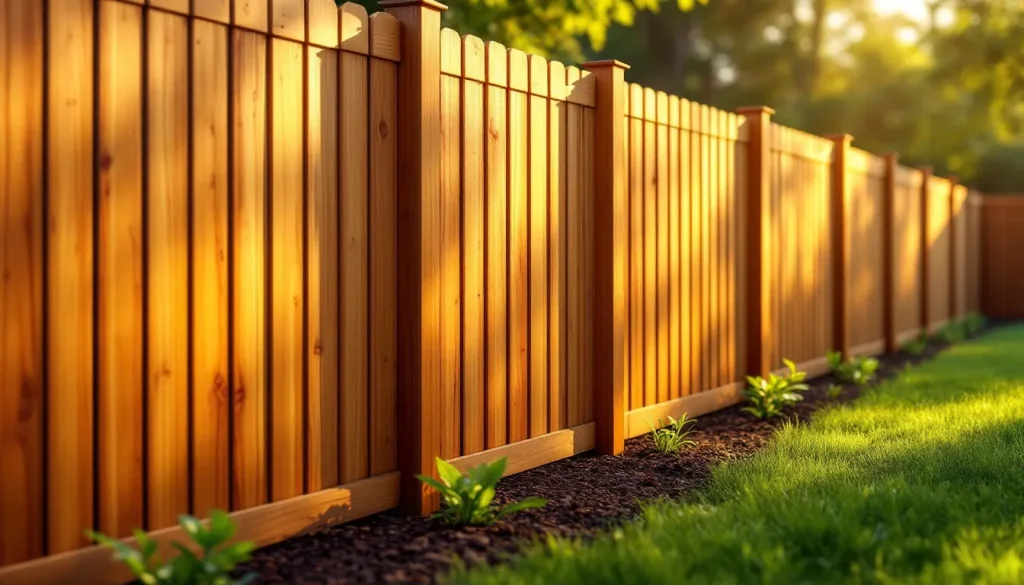
The natural grain and warm tone of real wood is the reason many homeowners pick it over vinyl for design. Unlike a printed vinyl panel, each cedar or redwood board weathers into its own character, and you can re-stain to any color later.
Wood fence panels, sizes, and components
Wood fences are sold either as pre-built panels or as loose pickets, rails, and posts. The standard panel is 6×8, meaning 6 feet tall by 8 feet wide, matching the typical 8-foot post spacing. Panels install faster; loose components let you follow uneven ground and custom heights. Both use the same core parts.
| Component | Standard spec | Notes |
|---|---|---|
| Panel | 6 ft x 8 ft (also 4×8, 6×6) | Pre-assembled section between posts |
| Picket / board | 3.5 – 5.5 in wide, 6 ft tall | Dog-ear or flat-top |
| Rail (stringer) | 2×4, 8 ft | 2 rails for 4 ft, 3 for 6 ft |
| Post | 4×4, 8 ft, set 24 – 36 in deep | Spaced 8 ft on center |
| Gate | 3 – 4 ft wide walk gate | Add $150 – $400 built |
Estimating material is straightforward. Measure the perimeter in linear feet, divide by 8 for the number of posts and panels, and add one post (posts always outnumber panels by one). Add gates separately. Most retailers and fence “packages” price by linear feet, then bundle posts, panels, gates, and concrete into a per-foot number, which is why the cost tables above use linear feet as the unit.
Plan before you dig: permits, HOA, property lines, and 811
Before buying a single board, complete four checks: pull a permit if required, clear the design with your HOA, confirm your property lines and setback, and call 811 to locate buried utilities. Skipping any one can force you to tear the fence down or, in the case of utilities, cause injury and liability. These steps are free or cheap and take days, not weeks.
- Permits. Many US municipalities require a permit for fences over 6 feet (sometimes over 3 or 4 feet in front yards). Fees often run $20 to $100. Building without one can mean fines or a forced rebuild, depending on your local code.
- HOA rules. Homeowners associations frequently dictate allowed materials, heights, styles, and which side of the fence faces out. Get written approval first; associations can compel removal of a non-compliant fence.
- Property line and setback. Do not assume the old fence or a hedge marks the line. A boundary survey (roughly $350 to $700) prevents a neighbor dispute and encroachment. Many codes also require the fence to sit a few inches inside your line.
- Call 811 before digging. In the US, dialing 811 or filing online triggers a free utility locate, typically within 2 to 3 business days, before you auger post holes. It is required by law in most states, and hitting a gas or electric line is both dangerous and expensive.
Timing note: order your utility locate after you have staked the exact post positions, since the marks (paint and flags) are placed relative to where you plan to dig.
Wood versus vinyl, composite, and chain-link: total cost of ownership
Over 25 years, wood is cheaper to install but costs more to maintain, while vinyl and composite cost more up front and almost nothing after. Wood’s sticker price wins; its lifetime price is a closer call once you count stain, seals, and board replacement. Chain-link is the cheapest overall but offers no privacy or curb appeal. The table models a 150-foot, 6-foot fence.
| Material | Installed / lf | Lifespan | Upkeep | 25-yr TCO (150 ft) |
|---|---|---|---|---|
| Wood (cedar) | $20 – $45 | 15 – 30 yr | Stain every 3 – 5 yr | ~$6,000 – $10,000 |
| Vinyl | $25 – $60 | 20 – 30 yr | Rinse only | ~$5,000 – $9,500 |
| Composite | $30 – $70 | 25 – 30+ yr | Rinse only | ~$5,500 – $11,000 |
| Chain-link | $10 – $25 | 15 – 20 yr | Minimal | ~$2,500 – $4,500 |
The honest takeaway: if you never restain wood, it loses to vinyl on both looks and lifetime cost, because a neglected wood fence grays and rots early. If you enjoy the natural material and will maintain it, wood is competitive and often cheaper to install. Vinyl and composite buy you the least maintenance for the most cash up front.
Climate tilts the decision. In regions with long dry spells and intense sun, bare wood fades and checks faster, so factor UV-blocking stain into your plan. Our notes on preparing your yard for drought cover the same heat and moisture stress that ages fence boards.
Where to buy wood fencing
Homeowners buy wood fencing from big-box retailers (Home Depot, Lowe’s), local lumberyards, and dedicated fence suppliers. Big-box stores stock pre-built 6×8 panels, pickets, and posts with the lowest picket prices and easy pickup. Local lumberyards often carry higher-grade cedar and redwood and can order clear grades. Fence-specialty suppliers sell full packages by linear foot, including gates and hardware.
For grade and species selection, a lumberyard usually beats a big-box aisle. For price and same-day availability on standard pine or cedar panels, the big-box stores are hard to match. If you are hiring out, many installers include materials at a markup, so compare their bundled number against buying materials yourself and paying labor only. Our directory of landscaping and fencing suppliers can help you compare local sources.
Finishing touch: once the fence is up, a clean mulch strip along the base keeps the mower and string trimmer away from posts, which prevents the nicks that let rot start. If you are estimating that, see how we calculate cubic feet in a yard of mulch to size the order.
Frequently Asked Questions
How much does a wooden fence cost per linear foot?
A wooden fence costs about $15 to $55 per linear foot installed. Pressure-treated pine runs $15 to $30, cedar $20 to $45, and redwood $30 to $55 for a standard 6-foot privacy style in 2025 and 2026. Materials alone are roughly half that. A 150-foot fence therefore lands between $2,250 and $8,250 installed, with labor making up 40 to 60 percent of the total.
What is the best type of wood for a fence?
Western red cedar is the best all-around fence wood for most homeowners, balancing strong natural rot resistance, good looks, and moderate cost. Redwood lasts longer and looks premium but costs more, while pressure-treated pine is cheapest and best for posts. Cypress is an excellent value in the humid US Southeast. Wood grade matters too: fewer knots means fewer rot entry points and longer life.
How long does a wooden fence last?
A wooden fence lasts 15 to 30 years depending on species and maintenance. Redwood and cedar reach 20 to 30 years or more, pressure-treated pine holds 15 to 20, and untreated pine may fail in 5 to 7. Posts usually rot first because of ground contact. Re-staining every 3 to 5 years and grading water away from posts can add years to any wood fence.
Is cedar or pressure-treated pine better for a fence?
Cedar looks better and resists rot naturally without chemicals, while pressure-treated pine costs less and handles ground contact well. A popular compromise uses pressure-treated pine posts (set in the soil, where rot pressure is highest) with cedar pickets and rails above grade. Choose cedar for curb appeal and a longer above-ground life; choose pine to minimize up-front cost.
What are the most common wood fence styles?
The most common wood fence styles are the 6-foot solid privacy fence, board-on-board, shadowbox, stockade, and the classic 3 to 4-foot picket. Split-rail suits rural lots, and horizontal-board fences give a modern look. Solid styles block sightlines for privacy; open styles like picket and split-rail prioritize curb appeal. Board spacing and height define the style more than the wood species does.
Do wooden fences need to be stained or sealed, and how often?
Yes. Staining or sealing keeps water out and blocks UV, and it is the biggest lifespan factor you control. Stain cedar and redwood every 3 to 5 years, and seal pressure-treated pine every 2 to 3 years. Let new pressure-treated lumber dry 2 to 6 months before the first coat; cedar and redwood can be sealed within weeks once surface-dry. A semi-transparent oil-based stain works well.
Are wood fences cheaper than vinyl or composite?
Wood is cheaper to install than vinyl or composite, but the lifetime gap narrows once you count maintenance. Cedar installs at $20 to $45 per linear foot versus $25 to $70 for vinyl and composite. Over 25 years, wood’s staining costs bring its total cost of ownership close to vinyl’s. If you skip maintenance, wood ages faster and loses the value comparison.
What are the standard wood fence panel sizes (like 6×8)?
The standard wood fence panel is 6×8, meaning 6 feet tall by 8 feet wide, matching the typical 8-foot post spacing. Other common sizes are 4×8 (4-foot picket height) and 6×6. Individual pickets are usually 3.5 to 5.5 inches wide and 6 feet tall. Posts are 4×4 lumber set 24 to 36 inches deep, spaced 8 feet on center, with one more post than panels.