
Weed types, explained in one place
Weed types fall into three lawn-and-garden categories (broadleaf, grassy, and sedge) crossed with two life cycles (annual and perennial). Naming a weed by these traits tells you exactly how to kill it. If you searched “weed types” looking for cannabis strains (sativa, indica, hybrid), that is a different topic and this guide does not cover it.
This is the disambiguation most search results skip. The word “weed” collides between unwanted plants and marijuana. Sources like WebMD answer the cannabis question; sources like Rutgers and Lawn Love answer the lawn question. Almost none separate the two up front.
Below is the lawn and garden answer, built for the New Jersey and Northeast US homeowner trying to identify a plant, name it, and remove it.
By the HMNDP Editorial Team. Last reviewed: June 2026.
The three main weed types (broadleaf, grassy, sedge)
The three main weed types are broadleaf, grassy (grass-like), and sedge. Broadleaf weeds have wide leaves with net-like veins, such as dandelion. Grassy weeds look like turf blades with parallel veins, such as crabgrass. Sedges resemble grass but have solid triangular stems, such as yellow nutsedge. Each category responds to different herbicides, so identifying the category comes first.
This grouping (used by Lawn Love, AggieTurf, and Rutgers Cooperative Extension) matters because a herbicide that kills a broadleaf weed often ignores a grassy weed entirely. Get the category wrong and you spray the wrong product.
| Category | Leaf / stem shape | Veins | Stem cross-section | Examples |
|---|---|---|---|---|
| Broadleaf | Wide, often lobed or rounded | Net-like (branching) | Round or square, hollow or solid | Dandelion, clover, henbit, thistle, plantain |
| Grassy | Narrow blades, like turf | Parallel | Round, hollow | Crabgrass, goosegrass, foxtail, annual bluegrass |
| Sedge | Grass-like but stiff, glossy | Parallel | Solid triangle (“sedges have edges”) | Yellow nutsedge, purple nutsedge, kyllinga |
A quick field test: roll the stem between your fingers. If it feels triangular and will not roll flat, it is a sedge. If it rolls round and the plant blends into your turf, it is grassy. If the leaves are wide with spreading veins, it is broadleaf.
Why sedges are a separate weed type
Sedges are a distinct third category, not a kind of grass. Rutgers, Lawn Love, and AggieTurf all treat nutsedge separately because it has a solid triangular stem, grows faster than turf in heat, and survives most crabgrass and broadleaf products. Sedges reproduce from underground tubers (nutlets), so pulling one plant leaves the tubers behind to resprout.
Yellow nutsedge is the sedge most Northeast homeowners meet. It shoots up light-green, waxy blades that outpace mowed grass within days of cutting, creating a patchy, uneven look. Because it is neither broadleaf nor grassy, a sedge-specific herbicide (with an active ingredient like halosulfuron or sulfentrazone) is usually the effective route.
Annual vs perennial weeds (the life-cycle test)
Annual weeds live one season, sprout from seed, and die after setting seed, so timing prevention matters most. Perennial weeds live multiple years, often returning from roots or tubers, so killing the whole root system matters most. This annual-vs-perennial split (from AggieTurf and Rutgers) determines whether you use a pre-emergent barrier or a systemic post-emergent spray.
| Life cycle | How it survives | Best control timing | Examples |
|---|---|---|---|
| Summer annual | Seed germinates in spring, dies at frost | Pre-emergent before germination | Crabgrass, goosegrass, foxtail, spurge |
| Winter annual | Seed germinates in fall, dies in late spring | Pre-emergent in early fall | Henbit, chickweed, annual bluegrass |
| Perennial | Returns from roots, rhizomes, or tubers | Post-emergent systemic on actively growing plants | Dandelion, clover, thistle, nutsedge, ground ivy |
The practical rule: pre-emergent herbicides only stop seeds and do nothing to an established perennial like dandelion. Post-emergent systemic herbicides travel into roots and are what you need for a plant already up and growing.
The most common weeds in grass and lawns
The most common lawn weeds in the US Northeast are dandelion, crabgrass, white clover, yellow nutsedge, henbit, broadleaf plantain, and Canada thistle. Each belongs to one of the three categories and each has a preferred control method. The identification-to-treatment table below is the piece most weed lists leave out.
| Weed | Category | Life cycle | Key visual ID | Season of emergence | Control method |
|---|---|---|---|---|---|
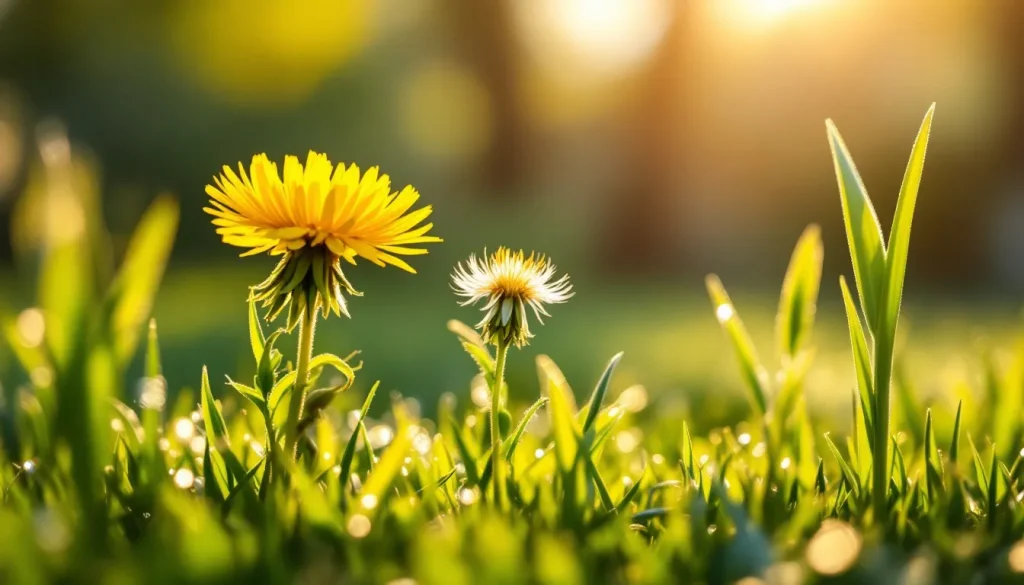
| Dandelion | Broadleaf | Perennial | Yellow flower, puffball seed head, deep taproot, toothed leaves | Spring and fall bloom | Post-emergent selective (2,4-D / dicamba blend) or dig the full taproot |
| Crabgrass | Grassy | Summer annual | Low, spreading star-shaped clump, wide light-green blades | Late spring into summer | Pre-emergent in early spring; post-emergent quinclorac if already up |
| White clover | Broadleaf | Perennial | Three round leaflets, small white flower, low mat | Late spring to fall | Selective broadleaf herbicide; often a sign of low nitrogen |
| Yellow nutsedge | Sedge | Perennial | Waxy light-green blade, triangular stem, faster than turf | Early to mid summer | Sedge-specific (halosulfuron or sulfentrazone); pulling fails |
| Henbit | Broadleaf | Winter annual | Square stem, scalloped leaves, purple tubular flowers | Fall through early spring | Fall pre-emergent; post-emergent broadleaf in early spring |
| Broadleaf plantain | Broadleaf | Perennial | Flat rosette, oval ribbed leaves, seed spikes | Spring through fall | Selective broadleaf herbicide; hand-pull in moist soil |
| Canada thistle | Broadleaf | Perennial | Spiny leaves, purple flower, spreads by root | Late spring to summer | Systemic post-emergent; repeat, roots resprout |
Notice the pattern: perennial broadleaf weeds want a selective post-emergent, summer annual grassy weeds want a pre-emergent barrier, and sedges want their own product. For a deeper look at turf invaders, see our guide to weeds in grass.
The most common weeds in New Jersey and the Northeast
Common weeds in New Jersey lawns include crabgrass, yellow nutsedge, white clover, dandelion, ground ivy (creeping Charlie), broadleaf plantain, and annual bluegrass (Poa annua). Rutgers Cooperative Extension, based at the New Brunswick, NJ campus, tracks these as recurring turf problems across the state’s cool-season lawns. The Northeast’s cold winters and humid summers favor this specific mix.
New Jersey sits in a cool-season turf zone, so lawns are usually fescue, ryegrass, or Kentucky bluegrass. That climate sets a reliable weed calendar. Crabgrass germinates once soil hits roughly 55 degrees Fahrenheit (often mid-April to early May in central NJ). Nutsedge appears in June. Winter annuals like henbit and chickweed sprout in fall and hold through spring.
Ground ivy is a Northeast standout worth naming: a low, creeping perennial with round scalloped leaves and a minty smell, it thrives in the damp, shaded yards common in older NJ neighborhoods. It spreads sideways by stems that root as they go, so it resists hand-pulling. Our guide to creeping lawn weeds covers this spreading habit in detail.
How to identify a weed in your lawn (step by step)
To identify a lawn weed, work through four traits in order: stem shape, leaf shape and veins, flower or seed head, and growth habit. These four narrow almost any weed to a category and often a name within a minute, without a photo gallery. Match the traits to the ID table above, then choose the control method listed for that weed.
- Feel the stem. Triangular and solid means sedge. Round and hollow means grassy or broadleaf.
- Look at the leaf. Narrow with parallel veins points to grassy. Wide with net-like veins points to broadleaf.
- Check the flower or seed head. A yellow flower then a puffball is dandelion. Purple tubular flowers on a square stem is henbit. A white clover head is clover.
- Watch the growth habit. A single taprooted plant differs from a mat that spreads sideways and roots at each node (creeping perennial).
Photo galleries (the “weed types with pictures” many searchers want) help confirm a guess, but the trait sequence gets you there faster and works even when a weed is not flowering. If your lawn also shows dying turf, read our diagnosis of brown patches in lawn, since bare spots invite weeds.
How to get rid of each weed type
Match the control method to the weed type. Broadleaf weeds respond to selective broadleaf herbicides or hand-pulling. Grassy annual weeds respond to pre-emergent barriers applied before germination. Sedges need sedge-specific herbicides. Perennials need systemic post-emergents that reach the root. Using the wrong tool wastes money and can damage your lawn.
| Weed type | Primary method | How it works | Timing |
|---|---|---|---|
| Broadleaf (perennial) | Selective post-emergent (2,4-D, dicamba, MCPP blends) | Kills broadleaf plants, spares grass blades | Actively growing, spring or fall |
| Grassy (summer annual) | Pre-emergent (prodiamine, pendimethalin) | Forms a soil barrier that stops seeds | Before soil hits ~55°F |
| Sedge | Sedge-specific (halosulfuron, sulfentrazone) | Targets tubers most products miss | Early summer, when actively growing |
| Any type, small patch | Hand-pulling or digging | Physical removal, no chemicals | Moist soil, before seed set |
Two cautions. First, a “selective” herbicide is what protects your turf; a non-selective product like glyphosate kills grass too, so reserve it for beds, cracks, or full renovations. Our roundup of the best weed killer that won’t kill grass walks through selective options. Second, herbicide rules and restricted products vary by state, so read the label and check your local regulations before applying, especially near water or in shared spaces.
The most durable weed control is a thick lawn. Dense, well-fed turf shades the soil and crowds out germinating seeds, which reduces how often you reach for any herbicide at all.
Frequently Asked Questions
What are the main types of weeds?
In lawns and gardens, the main weed types are broadleaf, grassy (grass-like), and sedge, crossed with two life cycles, annual and perennial. Broadleaf weeds have wide veined leaves, grassy weeds look like turf, and sedges have triangular stems. This plant classification is separate from cannabis strain “types” like sativa and indica, a different meaning of the word weed.
What is the difference between broadleaf, grassy, and sedge weeds?
Broadleaf weeds have wide leaves with net-like veins (dandelion, clover). Grassy weeds have narrow blades with parallel veins and look like turf (crabgrass, foxtail). Sedges look grass-like but have solid triangular stems and reproduce from tubers (yellow nutsedge). The difference matters because each category responds to a different herbicide, so identifying the category comes before choosing a product.
What are the most common weeds in grass and lawns?
The most common lawn weeds in the US Northeast are dandelion, crabgrass, white clover, yellow nutsedge, henbit, broadleaf plantain, and Canada thistle. Dandelion and clover are perennial broadleaf weeds, crabgrass is a summer annual grassy weed, and nutsedge is a sedge. Each has a distinct control method, from selective broadleaf sprays to spring pre-emergents.
What are the most common weeds in New Jersey?
Common New Jersey lawn weeds include crabgrass, yellow nutsedge, white clover, dandelion, ground ivy (creeping Charlie), broadleaf plantain, and annual bluegrass (Poa annua). Rutgers Cooperative Extension tracks these across the state’s cool-season fescue and bluegrass lawns. New Jersey’s cold winters and humid summers create a reliable weed calendar, with crabgrass germinating around mid-April and nutsedge appearing in June.
How do I identify a weed in my lawn?
Identify a lawn weed by checking four traits in order: stem shape (triangular means sedge), leaf shape and veins (parallel means grassy, net-like means broadleaf), flower or seed head, and growth habit (single taproot versus creeping mat). This sequence narrows almost any weed to a category and often a name within a minute, even when the plant is not flowering.
What is the difference between annual and perennial weeds?
Annual weeds complete their life in one season, sprouting from seed and dying after they set seed, so prevention with a pre-emergent barrier works best. Perennial weeds live multiple years and return from roots, rhizomes, or tubers, so a systemic post-emergent that reaches the root works best. Summer annuals like crabgrass and perennials like dandelion need opposite strategies.
How do I get rid of different types of weeds?
Match the method to the type. Broadleaf perennials need selective post-emergent herbicides or digging. Grassy summer annuals need pre-emergent applied before soil reaches about 55°F. Sedges need sedge-specific products with halosulfuron or sulfentrazone. Small patches of any type can be hand-pulled in moist soil before they seed. Herbicide rules vary by state, so read the label.
Are there weed types with pictures to help me identify mine?
Yes. University extension services like Rutgers publish photo galleries of common lawn and garden weeds, and many lawn-care sites show pictures organized by category. Pictures help confirm a guess, but the fastest identification uses the four-trait test (stem, leaf, flower, growth habit) because it works even when a weed is not flowering and photos look similar.