
By the HMNDP Editorial Team, independent reporting on lawn care, landscaping, and the green-industry business.
Last reviewed: June 2026
The 3 categories every weed in grass falls into (and why it decides your herbicide)
Weeds in grass sort into three groups: broadleaf weeds, grassy weeds, and sedges. This is not trivia. It decides which herbicide works, because the wrong product does nothing. Broadleaf weeds need a selective broadleaf herbicide. Grassy weeds need a pre-emergent or grass-specific post-emergent. Sedges need sulfentrazone or halosulfuron. Match the category first, then buy.
| Category | Leaf clue | Examples | What actually kills it |
|---|---|---|---|
| Broadleaf | Wide leaves, branching veins, often flowers | Dandelion, clover, plantain, chickweed | Selective broadleaf herbicide (2,4-D, dicamba, MCPP blends) |
| Grassy | Narrow blades, parallel veins, looks like turf | Crabgrass, foxtail, quackgrass, Poa annua | Pre-emergent (before germination) or quinclorac/fenoxaprop post |
| Sedge | Triangular stem, three-ranked leaves, waxy | Yellow nutsedge, purple nutsedge | Sulfentrazone (Dismiss) or halosulfuron (Sedgehammer) |
The fastest field test: roll the stem between your fingers. A round or flat stem with parallel veins is a grass. A triangular stem you can feel three edges on is a sedge. The old rule holds: sedges have edges. Anything with wide leaves and a flower is broadleaf. Our lawn weeds hub carries the full profiles.
Broadleaf weeds in grass: 5 you can name from a photo
Broadleaf weeds have wide leaves, netted or branching veins, and usually a visible flower, so they stand out against fine turf. The five below cover most US suburban lawns. All respond to a selective broadleaf herbicide (2,4-D, dicamba, or MCPP blends) that kills the weed and leaves the grass. Our broadleaf weed guide has more.
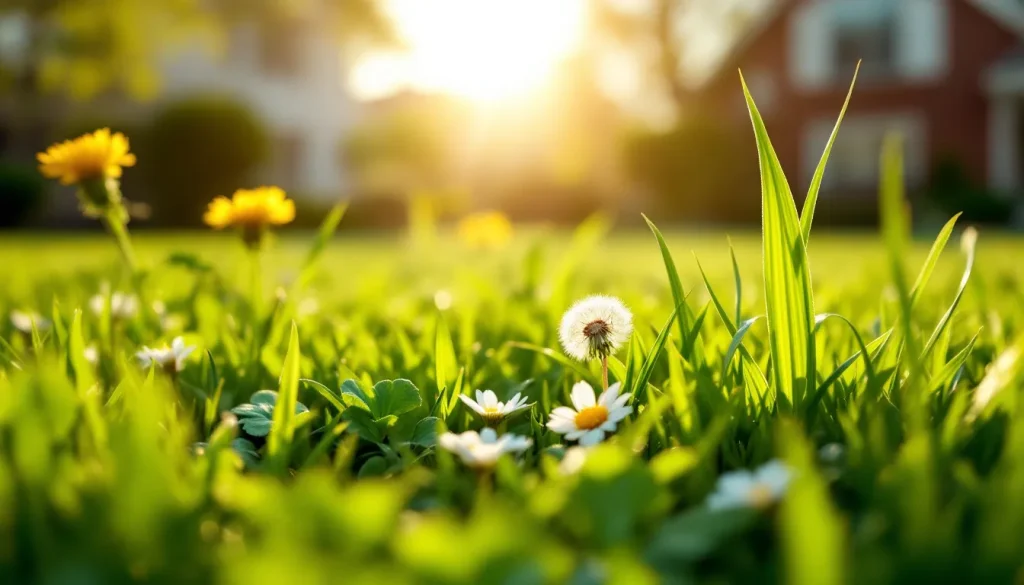
- Dandelion (perennial): yellow flower, jagged leaves in a rosette, deep taproot. Spot-treat with a broadleaf selective, or dig the whole taproot.
- White clover (perennial): three round leaflets, white puffball flowers, spreads by stolons. It signals low soil nitrogen.
- Broadleaf plantain (perennial): oval ribbed leaves flat to the ground, seed spikes. Loves compacted soil.
- Common chickweed (winter annual): tiny star-shaped white flowers, low mats, thrives in cool, moist, shady spots.
- Creeping Charlie / ground ivy (perennial): scalloped leaves, square stem, minty smell. Dicamba blends work better than 2,4-D alone.
Grassy weeds in grass: 4 that hide inside your turf
Grassy weeds look like your lawn, which is why they get missed. They have narrow blades, parallel veins, and hollow or flat round stems. Because they are grasses, a broadleaf selective will not touch them. Stop annual grassy weeds with a pre-emergent before germination, or use a labeled post-emergent like quinclorac on young plants.
- Crabgrass (summer annual): low, star-shaped spread from a center, wide light-green blades. Germinates when soil hits about 55F. Prevent with pre-emergent, never cure it after seed set.
- Yellow foxtail (summer annual): bristly seedhead like a fox tail, coarse blades. Same pre-emergent timing as crabgrass.
- Quackgrass (perennial): blue-green blades, clasping auricles, aggressive white rhizomes. No selective kills it cleanly in lawns; spot-treat with glyphosate and reseed.
- Annual bluegrass (Poa annua): bright green, boat-shaped leaf tip, seedheads even at low mowing. A cool-season winter annual; pre-emergent goes down in late summer/fall.
Sedges: nutsedge is the third category people misdiagnose
Sedges are neither broadleaf nor grass. Yellow nutsedge (nutgrass) has a solid triangular stem, three-ranked V-shaped leaves at 120-degree angles, and a waxy yellow-green shine. It grows faster than turf, so it sticks up days after you mow. It stores energy in underground tubers, which is why pulling it fails.
Nutsedge shrugs off broadleaf and grass herbicides. It needs a sedge-specific active ingredient: sulfentrazone (Dismiss) or halosulfuron-methyl (Sedgehammer). Purdue and Penn State Extension list both among effective homeowner options. Treat at the 3-to-8-leaf stage; the systemic product moves down to the tubers over about three weeks.
How to match the weed to the exact weed killer (the step competitors skip)
Identification is only useful if it changes what you buy. Most guides name the weed and stop, so readers grab a generic bottle that does nothing. Use this map: the herbicide chemistry must match the weed category, because each class targets a different plant type.
| Weed type | Right active ingredient | Timing | Wrong move |
|---|---|---|---|
| Broadleaf (dandelion, clover, plantain) | 2,4-D, dicamba, MCPP (selective blend) | Actively growing, spring or fall | A grass pre-emergent (no effect) |
| Grassy annual (crabgrass, foxtail) | Prodiamine, pendimethalin, dithiopyr (pre); quinclorac (post) | Before soil hits 55F | A broadleaf selective (no effect) |
| Sedge (nutsedge) | Sulfentrazone or halosulfuron | 3-to-8-leaf stage, warm soil | Any all-in-one lawn weed killer |
A “kills all lawn weeds” label usually means broadleaf weeds only. It will not stop crabgrass and will not kill nutsedge. Read the active ingredient, not the front of the jug. For products that spare turf, see our guide to the best weed killer that won’t kill grass.
Why the weeds keep coming back (fix the cause, not just the symptom)
Weeds in grass are a symptom of thin or stressed turf. Kill the weed and leave the opening, and a new weed fills it within weeks. Each weed points to a specific lawn problem. Fix the condition and dense grass crowds weeds out on its own.
- Clover and low-nitrogen turf: clover fixes its own nitrogen, so it wins in underfed lawns. Feed the grass.
- Plantain, prostrate knotweed, goosegrass: these thrive in compacted soil. Core-aerate to relieve it.
- Crabgrass and foxtail: they invade thin, sun-exposed edges. Mow taller (3 to 4 inches) to shade the soil and block germination.
- Nutsedge and moss: both flag poor drainage or overwatering. Fix low, soggy spots.
- Chickweed and ground ivy: both prefer shade and moisture. Thin overhead branches and cut watering.
When to apply pre-emergent and weed killer (soil-temp and month triggers)
Timing decides whether a pre-emergent works. It must be down and watered in before annual grassy weeds germinate. The trigger is soil temperature, not the calendar: apply when the 2-inch soil temperature reaches 50 to 55F for three consecutive days, roughly 1 to 2 weeks before germination begins.
| Region | Spring pre-emergent window (crabgrass) |
|---|---|
| Southeast / Gulf Coast | Late February to early March |
| Mid-Atlantic / transition zone | Mid-March to mid-April |
| Northeast | Late March to April |
| Great Lakes / Upper Midwest | April to mid-May |
Once soil passes about 65F, the pre-emergent window has closed; switch to a post-emergent like quinclorac on young, visible crabgrass. For Poa annua, a winter annual, apply the pre-emergent in late summer to early fall instead. Treat broadleaf weeds when they are actively growing, spring or fall.
Spot-treat, blanket-treat, dig, or tolerate: a decision framework
Not every weed needs herbicide. Choose your response by weed type, how much of the lawn is affected, and turf health. This four-way framework keeps you from nuking a whole lawn over a few dandelions or hand-pulling a nutsedge tuber that regrows.
| Situation | Best move |
|---|---|
| A few scattered broadleaf weeds (under ~5% cover) | Spot-treat or dig by hand (taproot and all) |
| Grassy weeds over large areas, healthy turf | Blanket pre-emergent next season; post-emergent now |
| Nutsedge clumps | Spot-treat with sulfentrazone/halosulfuron; do not pull |
| Weeds over 50% of a thin, weak lawn | Renovate: treat, then overseed to rebuild density |
| Clover or a few dandelions, otherwise dense lawn | Tolerate; clover feeds nitrogen and pollinators |
Hand-digging works for taprooted broadleaf weeds like dandelion. It fails for rhizome and tuber spreaders (quackgrass, nutsedge), where breaking the plant multiplies it. Learn the fundamentals in our lawn-care learning hub.
Frequently Asked Questions
What are the most common weeds found in grass?
The most common weeds in grass are dandelion, white clover, broadleaf plantain, and chickweed (broadleaf weeds); crabgrass, foxtail, quackgrass, and annual bluegrass (grassy weeds); and yellow nutsedge (a sedge). Most US suburban lawns see a mix from all three categories. Identifying which category a weed belongs to matters more than its exact name, because it determines the herbicide.
How do I tell the difference between grassy weeds and broadleaf weeds?
Broadleaf weeds have wide leaves with branching (netted) veins and usually a flower, so they stand out against turf. Grassy weeds have narrow blades with parallel veins and blend in with your lawn. The distinction is practical: broadleaf weeds die to a selective broadleaf herbicide, while grassy weeds need a pre-emergent or a grass-specific post-emergent instead.
How do I identify a weed in my lawn from a picture?
Match three features from your photo: leaf width (wide equals broadleaf, narrow equals grassy), vein pattern (branching versus parallel), and stem shape (triangular equals sedge). Then compare against university Extension weed profiles from the University of Maryland, Penn State, or Purdue, which show verified photos. Getting the category right, not the exact species, is what tells you which herbicide to buy.
How do I get rid of weeds in grass without killing the grass?
Use a selective herbicide matched to the weed category. Selective broadleaf products (2,4-D, dicamba, MCPP) kill dandelion and clover while sparing turf. Quinclorac targets crabgrass without harming most lawns. Sulfentrazone or halosulfuron kill nutsedge selectively. Avoid non-selective glyphosate on lawns except for spot-killing perennial grassy weeds like quackgrass, then reseed the bare spot.
What is the difference between crabgrass, nutsedge, and regular grass?
Regular turfgrass and crabgrass are both true grasses with round or flat stems and parallel-veined blades; crabgrass spreads low in a star pattern with lighter, wider blades. Nutsedge is not a grass at all: it has a solid triangular stem, three-ranked V-shaped leaves, and grows faster than turf. That triangular stem is the fastest way to tell nutsedge from grass.
Why do weeds keep coming back in my lawn?
Weeds return because the underlying condition is unchanged. Weeds colonize thin, stressed, or bare turf, so killing them without fixing the cause just reopens the door. Common causes: compaction (plantain), low nitrogen (clover), low mowing and thin edges (crabgrass), and poor drainage (nutsedge). Aerate, feed, mow taller (3 to 4 inches), and overseed to build density that crowds weeds out.
When should I apply weed killer or pre-emergent to my lawn?
Apply crabgrass pre-emergent when 2-inch soil temperature reaches 50 to 55F for three consecutive days, roughly late February in the Gulf Coast to mid-May in the Upper Midwest. For annual bluegrass, apply in late summer to early fall. Treat broadleaf weeds when they are actively growing in spring or fall. Once soil exceeds about 65F, switch to a post-emergent.
Are dandelions and clover bad for my lawn or should I leave them?
Neither harms healthy turf, and both offer benefits. Clover fixes nitrogen and feeds pollinators, and its presence signals your lawn is underfed. Dandelions have deep taproots that break up compaction. Many homeowners now tolerate both in low densities. Treat them only if you want a uniform monoculture or if coverage climbs high enough to crowd the grass.