
By the HMNDP Editorial Team, independent reporting on lawn care, landscaping, water, and the green industry.
Last reviewed: June 2026
What is water erosion?
Water erosion is the detachment and transport of topsoil, sediment, and rock by moving water. Raindrops dislodge soil particles, then runoff, snowmelt, or stream flow carries them downhill. It is one of the main surface (geomorphic) processes that reshape land over time. On a managed yard or farm it strips the fertile top layer, the most valuable few inches of soil.
The water doing the work comes from three agents: rainfall hitting bare ground, surface runoff that gathers as it moves, and snowmelt that saturates and loosens soil in spring.
Erosion happens everywhere water flows, but humans speed it up. Bare slopes, compacted lawns, construction sites, and tilled fields can lose soil 10 to 100 times faster than land under natural vegetation, according to USDA Natural Resources Conservation Service (NRCS) field data.
The four types of water erosion (splash, sheet, rill, gully)
The four main types of water erosion are splash, sheet, rill, and gully, listed in the order they usually develop. Splash detaches soil where raindrops land. Sheet erosion removes a thin even layer across a slope. Rill erosion cuts small channels you could erase with a rake. Gully erosion carves deep channels too large for normal tillage or mowing to fix.
- Splash erosion: Raindrops hit bare soil at up to 20 mph and blast particles up to 2 feet sideways. This is the first step, and the reason mulch and ground cover matter.
- Sheet erosion: A thin, uniform layer of soil washes off a slope. It is easy to miss because there is no obvious channel, only gradually paler, less fertile soil and exposed plant roots.
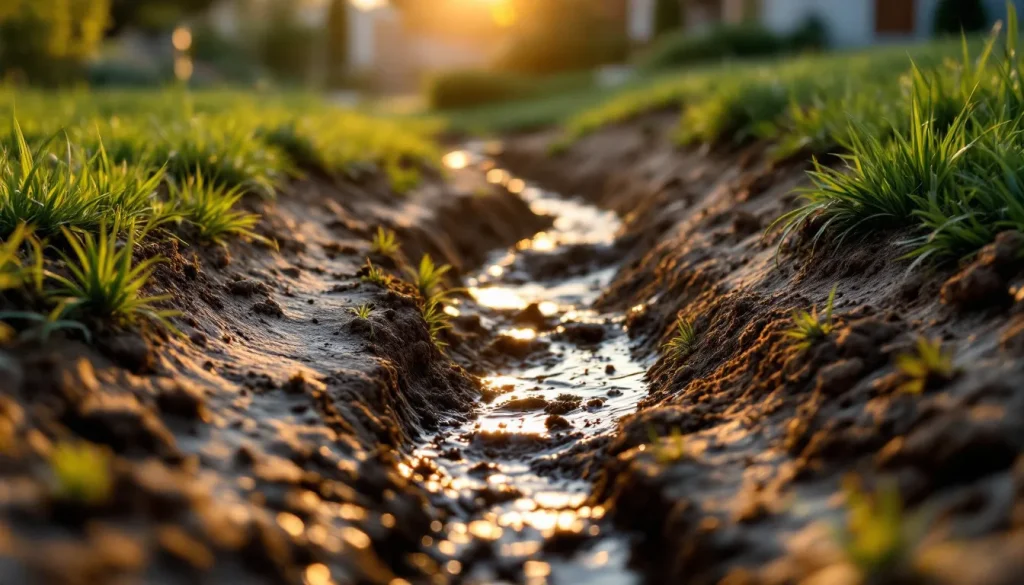
- Rill erosion: Runoff concentrates into small parallel channels, usually under 4 inches deep. You can still smooth them out with grading or a rake.
- Gully erosion: Rills deepen into channels often more than a foot deep and a foot wide. Ordinary mowing or tilling cannot repair them, and they keep growing headward up the slope.
Stream, channel, and bank erosion
Stream and bank erosion is the wearing away of channel beds and banks by flowing water in creeks, rivers, and drainage ditches. It differs from slope erosion because the water flows year-round or seasonally in a defined channel, undercutting banks until they slump. A single storm can move a streambank back several feet.
For waterfront and ditch-adjacent property, bank erosion threatens fences, trees, and foundations. Controls differ from slope fixes: riprap (loose stone), bioengineered live stakes, and anchored erosion-control blankets stabilize the toe of the bank where flow is strongest.
What causes water erosion?
Water erosion is caused mainly by four factors: rainfall intensity, slope steepness and length, soil type, and lack of vegetation cover. The Universal Soil Loss Equation (USLE), used by the USDA since 1965, multiplies these same variables to predict annual soil loss. Change any one and erosion rises or falls sharply.
| Factor | Why it drives erosion | What raises the risk |
|---|---|---|
| Rainfall intensity | Hard, fast rain detaches more soil and produces more runoff than slow rain | Intense summer storms, more than 1 inch per hour |
| Slope steepness and length | Steeper, longer slopes let water gain speed and energy | Grades over 10 percent; long unbroken runs |
| Soil type | Fine silts and bare sands wash away faster than clay or organic soils | Silty, low-organic, compacted soil |
| Vegetation cover | Roots bind soil; leaves and mulch absorb raindrop impact | Bare ground, thin lawn, recent construction or tilling |
Effects of water erosion on soil and waterways
Water erosion damages land in two places at once: where soil leaves and where it lands. On site, it strips topsoil and the nutrients and organic matter held there, cutting fertility and crop or lawn productivity. Off site, the eroded sediment fills streams, ponds, and storm drains, raising flood risk and degrading water quality.
- Topsoil and fertility loss: The top 6 to 8 inches hold most of a soil’s nutrients. Losing it can cut yields and force more fertilizer.
- Sedimentation: The EPA lists sediment as one of the most common pollutants in US rivers and streams, clouding water and smothering aquatic habitat.
- Reduced productivity: Studies summarized by the NRCS link severe erosion to long-term declines in crop yield as the root zone thins.
- Downstream cost: Sediment clogs drainage, fills reservoirs, and damages neighbors’ property, which can create liability depending on your state and local stormwater rules.
How to identify which type of water erosion you have
You can identify the type of water erosion in your yard by reading three cues: depth, width, and whether you can fix it by hand. The deeper and wider the cut, the more advanced the problem and the heavier the fix. Use the chart below before choosing a control method, because matching the fix to the stage saves money.
| Type | Visual cue | Depth / width | Reversible by hand? |
|---|---|---|---|
| Splash | Soil specks on plants, walls, mulch displaced | Surface only | Yes, add mulch or cover |
| Sheet | Uniform pale patches, exposed roots, no channel | Thin, even layer | Yes, reseed and cover |
| Rill | Small parallel finger channels after rain | Under ~4 in deep | Yes, rake or regrade |
| Gully | One or few deep channels, growing uphill | Over ~1 ft deep and wide | No, needs structures |
If a rake fixes it, you caught it early. If you need a shovel and stone, the erosion has reached gully stage and ignoring it will only widen the channel. See our broader explainer on what erosion is for the full geomorphic picture.
How to prevent water erosion in your yard
To prevent water erosion in your yard, slow the water, cover the soil, and hold the slope. The cheapest fixes (ground cover and mulch) stop splash and sheet erosion. Mid-cost fixes (regrading, drainage) redirect runoff. Structural fixes (riprap, retaining walls) hold steep or gullied ground. Start at the top of the slope and work down.
- Plant ground cover and reseed bare spots: Dense turf, creeping plants, or a cover crop give roots that bind soil. This is the single most effective low-cost control.
- Mulch bare soil: 2 to 3 inches of bark, straw, or wood chips absorbs raindrop impact and cuts splash erosion immediately.
- Lay an erosion-control blanket on slopes: Biodegradable mats hold seed and soil while grass establishes. See our guide to the erosion-control blanket for material choices.
- Regrade and add swales: Reshape steep grades and cut shallow vegetated channels (swales) to spread and slow runoff.
- Install a French drain: A gravel-filled trench with perforated pipe intercepts and reroutes subsurface water away from the eroding area.
- Add riprap or rock check dams: Loose stone in ditches and gully bottoms dissipates the water’s energy and traps sediment.
- Build retaining walls or terraces on steep ground: Terracing breaks one long slope into shorter level steps, the same principle farmers use on hillsides.
| Control method | Best for | Typical cost | Effectiveness |
|---|---|---|---|
| Ground cover / reseeding | Splash, sheet | $ | High once established |
| Mulch | Splash, sheet | $ | High, immediate |
| Erosion-control blanket | New slopes, rills | $$ | High during establishment |
| French drain / swale | Concentrated runoff | $$ | High for water rerouting |
| Riprap / check dam | Gully, channel | $$$ | High for energy control |
| Retaining wall / terrace | Steep slopes, gully | $$$$ | Highest, permanent |
For a deeper menu of techniques and when to call a contractor, see our main erosion control guide.
Water erosion vs wind erosion
Water erosion and wind erosion both move soil, but the carrier and the pattern differ. Water erosion needs rainfall, runoff, or flowing water and follows slopes downhill in sheets, rills, and gullies. Wind erosion needs dry, loose, bare soil and a strong breeze, and it moves particles across flat open land regardless of slope.
| Feature | Water erosion | Wind erosion |
|---|---|---|
| Carrier | Rain, runoff, snowmelt, streams | Moving air |
| Where it dominates | Slopes, humid and high-rainfall regions | Flat, dry, arid and semi-arid regions |
| Visible signs | Channels, rills, gullies, muddy runoff | Dust, drifts, blown topsoil |
| Key trigger | Rainfall intensity and slope | Dryness and wind speed |
| Shared fix | Keep soil covered with vegetation, mulch, or residue | |
How fast does water erosion happen, and how much soil loss is too much?
Water erosion can be slow and invisible or fast and dramatic, depending on cover and slope. The USDA sets a tolerable soil loss limit, called the T-value, of 1 to 5 tons per acre per year, the rate at which soil can still rebuild naturally. Bare or steep land routinely loses far more in a single storm season.
A single intense storm on bare slope can carve rills in minutes and a gully in one season. By contrast, well-vegetated ground may lose less than the T-value for decades. The takeaway: catch erosion at the splash, sheet, or rill stage, because gully repair costs many times more.
On an active slope, stabilize fast. Seed and blanket the surface before the next heavy rain, divert the water above the slope, and add stone at the bottom where flow concentrates. For step-by-step methods and product comparisons, visit the HMNDP learn hub.
Frequently Asked Questions
What is water erosion?
Water erosion is the detachment and transport of topsoil and rock by moving water. Raindrops loosen soil particles, then surface runoff, snowmelt, or stream flow carries them downhill. It is a natural surface process, but bare slopes, tilling, and construction can speed it 10 to 100 times faster than vegetated land, stripping the fertile top few inches of soil.
What are the four types of water erosion (splash, sheet, rill, gully)?
The four types are splash, sheet, rill, and gully, in the order they develop. Splash detaches soil where raindrops hit. Sheet removes a thin even layer across a slope. Rill cuts small channels under about 4 inches deep that a rake can fix. Gully carves channels over a foot deep that need structures, not mowing or tilling, to repair.
What causes water erosion?
Water erosion is caused mainly by four factors: rainfall intensity, slope steepness and length, soil type, and lack of vegetation cover. Hard rain on bare, steep, silty ground erodes fastest. The USDA Universal Soil Loss Equation multiplies these same variables to predict annual loss. Roots and mulch reduce risk the most, which is why bare or recently tilled land erodes quickly.
What are the effects of water erosion on soil and waterways?
Water erosion strips topsoil, nutrients, and organic matter, cutting soil fertility and crop or lawn productivity. The eroded sediment then fills streams, ponds, and storm drains, raising flood risk and degrading water quality. The US EPA lists sediment among the most common pollutants in rivers. Downstream damage can also create liability depending on your state and local stormwater rules.
How do you prevent water erosion in your yard?
Slow the water, cover the soil, and hold the slope. Reseed bare spots and add 2 to 3 inches of mulch to stop splash and sheet erosion cheaply. Lay erosion-control blankets on slopes, regrade and add swales, and install French drains to reroute runoff. For steep or gullied ground, add riprap, check dams, or retaining walls and terraces.
How is water erosion different from wind erosion?
Water erosion uses moving water (rain, runoff, snowmelt, streams) and follows slopes downhill as sheets, rills, and gullies, dominating humid, high-rainfall regions. Wind erosion uses moving air, needs dry loose bare soil, and spreads particles across flat open land regardless of slope, dominating arid regions. Both are reduced by the same fix: keeping soil covered with vegetation, mulch, or crop residue.
What is the difference between sheet, rill, and gully erosion?
The difference is depth, channeling, and how hard each is to fix. Sheet erosion removes a thin uniform layer with no visible channel. Rill erosion cuts small parallel channels under about 4 inches deep that you can rake or regrade away. Gully erosion forms deep channels over a foot deep and wide that ordinary mowing or tilling cannot repair and that require structural controls.
How fast does water erosion happen, and how do you stop it on a slope?
A single intense storm can cut rills in minutes and a gully in one season on bare slope, while vegetated ground may stay below the USDA tolerable limit of 1 to 5 tons per acre per year for decades. To stop it on a slope, seed and lay an erosion-control blanket, divert water above the slope, and place stone where flow concentrates at the bottom.