
By the HMNDP Editorial Team, independent reporting on lawn care, landscaping, water, and the green-industry business.
Last reviewed: June 2026
What erosion control actually means
Erosion control is the practice of preventing or slowing the loss of soil to wind and water. It works by holding soil in place (with roots, fabric, or mulch), reducing the force that moves it (slowing runoff and wind), and capturing sediment before it leaves the site. The goal is simple: keep bare or sloped soil where it belongs.
Soil moves when something disturbs the surface and nothing holds it. Rain hits exposed dirt, water sheets downhill picking up particles, and wind lifts dry grains off flat fields. A single 1-inch rainstorm on an acre of bare slope can move several tons of topsoil, the same topsoil that took centuries to form.
Effective erosion control is layered. You attack the cause, cover the surface, and divert the water, rather than relying on one product to fix everything. The right combination depends entirely on what is driving the loss on your specific site. For background on the underlying process, see our explainer on what erosion is and how it happens.
What causes erosion: diagnose before you buy
Erosion has four common drivers: concentrated water runoff, wind across dry exposed ground, slope steepness that speeds water, and bare soil with no root system or cover. Most failing sites have two or three at once. Identifying which ones apply to your property is the single most important step, because each driver calls for a different fix.
Water runoff is the leading cause on most properties. Roofs, driveways, and compacted ground send sheets and channels of water across soil, cutting rills and gullies. Wind dominates on flat, dry agricultural land and coastal dunes where loose, fine soil has no cover. Slope multiplies water’s energy: erosion risk roughly doubles for every doubling of slope length and rises sharply past a 3:1 grade. Bare soil is the common denominator. Vegetation roots bind soil and the canopy absorbs raindrop impact, so exposed dirt is always the most vulnerable.
Walk your site after a heavy rain. Visible channels mean concentrated water flow. A fan of deposited silt at the bottom of a slope means sheet erosion. Dust and rippled surfaces on dry days mean wind. Match the symptom to the cause, then choose from the methods below.
Vegetation: the primary and cheapest control
Replanting is the most effective long-term erosion control and the lowest cost per square foot. Living roots physically hold soil, the canopy breaks raindrop force, and ground cover slows runoff. On any site that can support plants, vegetation is the foundation, and products like blankets or mats exist mainly to protect seed until that vegetation establishes.
Seed bare areas with a fast-establishing mix suited to your region and the season. Grasses and deep-rooted natives work on most slopes; native shrubs and ground covers stabilize steeper or shadier ground. Seeding costs roughly $0.05 to $0.25 per square foot for materials, far below any manufactured product. Hydroseeding (seed, mulch, and tackifier sprayed as a slurry) runs about $0.06 to $0.20 per square foot and covers large or steep areas fast.
Timing decides success. The best seeding windows are early spring and early fall, when soil is warm and rain is reliable. Seed sown into summer heat or before a hard freeze often fails, leaving soil bare through the next storm. If you are estimating fill or topsoil for a regrade before seeding, our guide on how much soil you need helps you size the order.
Erosion control products: blankets, wattles, logs, and mats compared
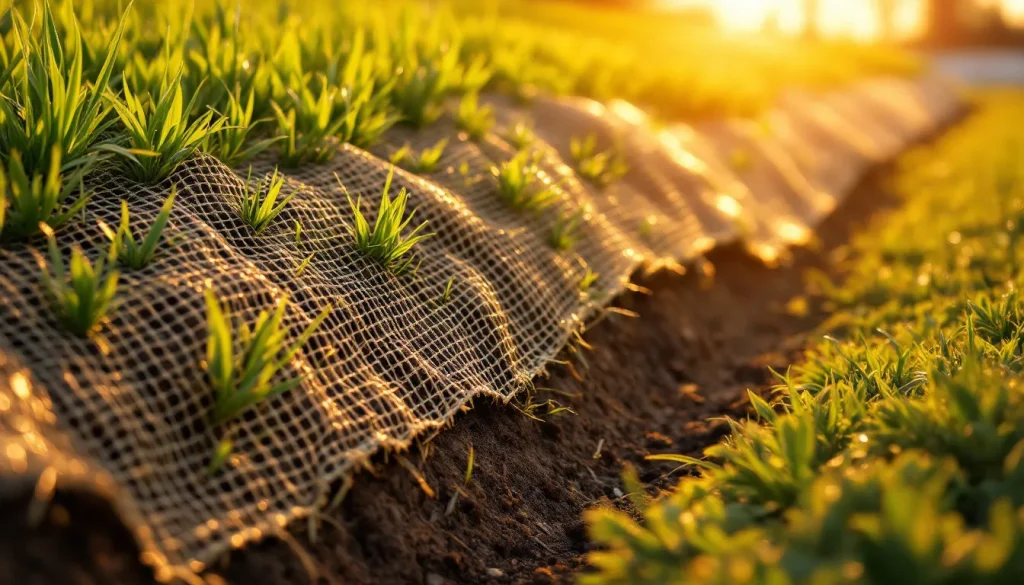
Erosion control products buy time. They protect soil and hold seed in place until vegetation takes over, or they trap sediment and slow water at specific points. The main categories are rolled blankets and mats (surface protection), wattles and coir logs (linear sediment and flow control), geotextiles (separation and reinforcement under soil), and turf reinforcement mats (permanent armoring for high-flow areas).
The biggest buying decision is biodegradable versus synthetic. Biodegradable blankets (straw, coconut coir, jute) break down in months to a few years and are ideal where vegetation will take over. Synthetic turf reinforcement mats (TRMs) are permanent and rated for channels and steep slopes where grass alone cannot survive the water velocity.
| Product | Best use | Slope / flow rating | Longevity | Typical cost | Coverage per unit |
|---|---|---|---|---|---|
| Straw erosion blanket | Gentle to moderate slopes, seed protection | Up to 3:1 | ~12 months (biodegradable) | $0.20–$0.60 / sq ft | ~8 ft x 112.5 ft (~900 sq ft) per roll |
| Coconut coir blanket | Steeper slopes, longer establishment | 2:1 to 1:1 | 2–3 years (biodegradable) | $0.40–$1.20 / sq ft | ~900 sq ft per roll |
| Straw wattle | Slope interruption, slowing sheet flow | Slopes; not channels | 1–2 years | $1.50–$4.00 / linear ft | 9 in or 12 in diameter, ~25 ft |
| Coir log | Streambanks, shorelines, wetland edges | Moderate flowing water | 3–6 years | $5–$15 / linear ft | 12 in or 20 in diameter, ~10 ft |
| Geotextile fabric | Under riprap, gravel, or fill; separation | Subsurface reinforcement | Decades (synthetic) | $0.30–$1.00 / sq ft | Rolls up to 15 ft x 300 ft |
| Turf reinforcement mat (TRM) | Channels, spillways, steep high-flow slopes | Steeper than 1:1; high velocity | Permanent (synthetic) | $1.00–$3.50 / sq ft | ~900 sq ft per roll |
Costs above are material-only ranges and exclude labor; professional installation often adds $0.50 to $2.00 per square foot. Always confirm the manufacturer’s slope and flow rating against your site, because installing a 3:1 straw blanket on a 1:1 slope is a common and expensive failure.
Managing and diverting surface runoff
Diverting runoff stops erosion at the source by moving water away from bare soil or slowing it before it concentrates. The core tactics are interceptor swales and berms across slopes, diversion drains that route water to a stable outlet, and capture features like rain gardens or sediment basins that hold water and drop its sediment load.
On a slope, a swale or berm running across the grade (on contour) catches sheet flow and spreads it out so it never gains erosive speed. At the bottom, direct flow to a vegetated channel, a rock-lined outlet, or a holding feature rather than letting it dump onto bare ground.
Capturing water also recharges it into the soil instead of carrying it off-site. A backyard rain garden is a practical residential way to absorb roof and driveway runoff that would otherwise scour a yard. On larger or construction sites, engineered sediment basins do the same job at scale and are often required by permit.
Covering exposed soil: mulch and ground cover
Covering bare soil is the fastest, cheapest immediate protection, because it absorbs raindrop impact and slows surface flow the day you apply it. Organic mulch (straw, wood chips, compost) and living ground cover both work; mulch is the stopgap while ground cover is the permanent solution. Any cover beats bare dirt during the gap before vegetation establishes.
Apply straw mulch at roughly 2 tons per acre (about a 70 to 75 percent ground cover) over freshly seeded areas. Wood chips at a 2 to 3 inch depth suit beds and paths but should not be used on steep slopes where they wash off. Compost blankets add organic matter and hold moisture, improving seed germination at the same time.
On slopes steep enough that loose mulch slides, switch to a tacked mulch (sprayed with a binder) or a rolled blanket that anchors the cover in place. The principle stays the same: never leave soil exposed to the next storm.
Erosion control by context: which approach fits where
The right method depends on the setting as much as the cause. Agriculture, land development, construction sites, and coastal areas each face different forces and rules. The framework below matches the dominant problem in each context to the methods that actually hold, so you can self-select instead of guessing.
| Context | Dominant cause | Primary methods | Key rule or note |
|---|---|---|---|
| Agriculture / farm fields | Wind and sheet water on bare flat soil | Cover crops, no-till, windbreaks, contour planting, grassed waterways | NRCS conservation programs may cost-share practices |
| Land development | Cleared, regraded bare ground | Phased clearing, perimeter silt fence, swales, fast revegetation | Local stormwater ordinance usually applies |
| Construction sites | Concentrated runoff from disturbed soil | Silt fence, wattles, sediment basins, blankets, stabilized entrances | EPA NPDES permit and SWPPP required if over 1 acre |
| Coastal / shoreline | Wave action and wind on loose sediment | Dune grass, coir logs, living shorelines, geotextile-backed structures | State coastal permits common; check before any work |
| Residential slope | Roof and yard runoff, slope speed | Terracing, blankets plus seed, ground cover, rain gardens | DIY-friendly under most local thresholds |
Erosion control on slopes: matching grade to method
On slopes, the grade decides the method. Slope is written as a ratio of horizontal run to vertical rise, so 3:1 is gentler than 1:1. As the slope steepens, water moves faster and gains erosive force, so gentle slopes accept seed and straw while steep slopes need anchored mats or hard armoring. Picking the product to match the grade is the difference between a fix and a washout.
- Gentler than 4:1: Seed plus straw mulch or a straw blanket is usually enough.
- 3:1 to 2:1: Use a coir blanket over seed, or add straw wattles across the slope to break up flow length.
- 2:1 to 1:1: Use a coconut coir blanket or a turf reinforcement mat, often with wattles and a terrace.
- Steeper than 1:1: Engineered solutions: TRMs, retaining structures, terracing, or riprap over geotextile, usually with professional design.
Anchor every blanket or mat per the manufacturer’s stapling pattern, typically more staples per square yard as the slope steepens, and trench the top edge so water cannot run underneath and peel it off.
Permits, regulation, and timing
Erosion control on disturbed land is often regulated, and ignoring it can mean stop-work orders or fines. The most common trigger in the United States is the EPA’s NPDES Construction General Permit, which generally applies to construction that disturbs 1 acre or more (or smaller sites within a larger common plan of development). Rules vary by state and locality, so confirm requirements before you start.
Sites that meet the threshold typically must prepare a Stormwater Pollution Prevention Plan (SWPPP) documenting the erosion and sediment controls in place, inspect them on a schedule (often weekly and after significant rain), and keep records. Many states delegate the program and add their own permits; coastal work frequently needs a separate state coastal permit.
Timing matters legally and practically. Disturbed soil should be stabilized within a set window after work stops (commonly 14 days in many state programs), and seeding only succeeds in the right season. Plan grading so bare soil is exposed for the shortest time and so final seeding lands in spring or fall. These are general descriptions and not legal advice; check your state environmental agency and local building department for the rules that apply to your project.
Maintaining and evaluating erosion control over time
Erosion control is not install-and-forget; it has to be inspected and maintained until vegetation takes over permanently. Check the site after every significant storm and on a regular schedule, looking for new channels, undermined blankets, sediment buildup behind wattles, and bare patches where seed failed. Fix small failures fast, before one storm turns them into a gully.
Use a simple checklist. Is vegetation reaching at least 70 percent ground cover (the common benchmark for stabilized soil)? Are blankets still anchored and intact, or are edges lifting? Are wattles and silt fences holding sediment, or are they full and bypassed? Is water still going where you diverted it, or has it cut a new path? Each “no” is a repair, not a wait.
Biodegradable products are designed to disappear as plants establish, which is success, not failure, provided the vegetation has filled in underneath. Replace synthetic mats only if they tear or detach. The endpoint of good erosion control is self-sustaining ground cover that no longer needs the products that protected it. For more landscaping fundamentals, browse the HMNDP learning library.
Frequently Asked Questions
What is erosion control and why is it important?
Erosion control is the practice of preventing soil loss to wind and water by holding soil in place, slowing runoff, and capturing sediment. It matters because eroded topsoil takes centuries to form, and its loss damages crops, clogs waterways with sediment, undermines structures, and can violate stormwater law. A single heavy storm can strip tons of soil from one bare acre.
How do you prevent or stop soil erosion?
Stop soil erosion by diagnosing the cause, then layering fixes. Cover bare soil with mulch or a blanket immediately, establish deep-rooted vegetation as the permanent hold, and divert concentrated runoff with swales, berms, or rain gardens. On slopes, add wattles or anchored mats. Bare soil is the common denominator, so getting plants established is the most durable fix.
What are the most effective erosion control methods?
Vegetation is the most effective and cheapest long-term method, because living roots bind soil permanently at roughly $0.05 to $0.25 per square foot. For the gap before plants establish, blankets and mulch protect the surface, wattles and coir logs slow water, and runoff diversion removes the force. The best results come from combining these, not relying on one.
What is the best erosion control for a slope?
The best slope method depends on grade. Slopes gentler than 4:1 usually need only seed and straw. From 3:1 to 2:1, use a coir blanket plus wattles. From 2:1 to 1:1, use a coconut coir blanket or turf reinforcement mat with terracing. Steeper than 1:1 needs engineered solutions like TRMs, riprap over geotextile, or retaining structures.
What are erosion control blankets and how do they work?
Erosion control blankets are rolled mats of straw, coconut coir, or synthetic fiber laid over seeded soil. They absorb raindrop impact, slow surface flow, hold seed and soil in place, and retain moisture so grass germinates faster. Biodegradable blankets last roughly 12 months to 3 years and break down as vegetation takes over. They are anchored with staples and a trenched top edge.
How much does erosion control cost?
Erosion control costs vary widely by method. Seeding runs about $0.05 to $0.25 per square foot, hydroseeding $0.06 to $0.20, straw blankets $0.20 to $0.60, coir blankets $0.40 to $1.20, and turf reinforcement mats $1.00 to $3.50. Wattles cost $1.50 to $4.00 per linear foot. Professional installation often adds $0.50 to $2.00 per square foot on top of materials.
What is the difference between coir logs, straw wattles, and erosion control blankets?
Blankets are flat rolled mats that protect a whole surface and shelter seed. Straw wattles are tube-shaped rolls placed across a slope to slow sheet flow and trap sediment, lasting 1 to 2 years. Coir logs are denser coconut-fiber tubes built for flowing water at streambanks and shorelines, lasting 3 to 6 years. Use blankets for area cover, wattles and logs for linear flow control.
Do I need a permit for erosion control on a construction site?
Often yes. In the United States, the EPA’s NPDES Construction General Permit generally applies to sites disturbing 1 acre or more, requiring a Stormwater Pollution Prevention Plan (SWPPP) and scheduled inspections. Smaller sites within a larger development can also qualify, and many states and localities add their own stormwater rules. Requirements vary, so confirm with your state environmental agency and local building department before starting.