
By the HMNDP Editorial Team. Last reviewed: June 2026.
The main types of erosion at a glance
The main types of erosion are grouped two ways: by the agent that moves material (water, wind, ice, and gravity) and by the process that does the work (hydraulic action, abrasion, attrition, and solution). Water erosion is the most widespread on land, and within it soil erosion runs from sheet to rill to gully as severity increases.
Erosion is the transport of soil, rock, and sediment from one place to another by a natural agent. It differs from weathering, which only breaks material apart in place. Hold that distinction, because conflating the two is the single most common mistake students make.
This guide organizes every erosion type under one taxonomy so the categories stop overlapping in your head. For the broader background on the process, see our explainer on what erosion is and how it works.
Erosion vs weathering: the distinction to fix first
Weathering breaks rock and soil into smaller pieces without moving them. Erosion picks up those loosened pieces and carries them away. Weathering is the demolition; erosion is the removal truck. A cracked boulder sitting in place has been weathered. The same boulder rolled downhill by a flood has been eroded.
The two work together. Weathering usually has to soften or fracture material before erosion can transport it efficiently. Deposition is the third step, when the moving agent loses energy and drops its load, building features like deltas, dunes, and floodplains.
| Process | What happens | Material moves? | Example |
|---|---|---|---|
| Weathering | Rock breaks down in place | No | Frost cracking a sidewalk |
| Erosion | Loosened material is transported | Yes | Rain washing topsoil downslope |
| Deposition | Transported material is dropped | Stops | Sand building a beach |
The two ways to classify types of erosion
Every type of erosion fits into one of two classification systems, and they describe the same events from different angles. Agent-based classification asks what is doing the moving (water, wind, ice, gravity). Process-based classification asks how the material is detached and worn down (hydraulic action, abrasion, attrition, solution). One event can be tagged under both.
| Axis | Categories | Question it answers |
|---|---|---|
| By agent | Water, wind, ice (glacial), gravity | What force is moving the material? |
| By process | Hydraulic action, abrasion, attrition, solution | How is the material detached or worn? |
For instance, a river carving a bank uses water (the agent) through hydraulic action and abrasion (the processes). A glacier uses ice (the agent) through abrasion and plucking. Naming both axes is how you describe any erosion event precisely.
Erosion by agent: water, wind, ice, and gravity
The four agents of erosion are water, wind, ice, and gravity. Water moves the most material globally and shapes soil, rivers, and coasts. Wind dominates dry, bare landscapes. Ice (glacial erosion) reshapes mountains and valleys over millennia. Gravity drives mass movement like landslides and slumps, often working alongside the other three.
Water erosion
Water erosion is the detachment and transport of soil and rock by rainfall, runoff, rivers, and waves. It is the leading agent on most land surfaces. Raindrops dislodge soil particles on impact, and flowing water carries them downhill. It splits into surface soil forms (sheet, rill, gully) and channel forms (stream bank, coastal). See our deeper coverage of how water erosion works.
Wind erosion
Wind erosion lifts and carries loose, dry soil particles across exposed land, then drops them elsewhere. It is worst on flat, bare, sandy ground with little vegetation, such as plowed fields and deserts. The 1930s American Dust Bowl, which stripped topsoil across roughly 100 million acres of the Great Plains, is the textbook case. Our guide to wind erosion and how to stop it covers control methods.
Glacial (ice) erosion
Glacial erosion happens when moving ice scrapes and gouges the land beneath and beside it. Glaciers carry embedded rock that grinds bedrock (abrasion) and pull away loosened blocks (plucking). The result is U-shaped valleys, fjords, and cirques. It works slowly, but over thousands of years it carves entire mountain ranges, including features across the Alps and the Rockies.
Gravity erosion (mass movement)
Gravity erosion, also called mass wasting, is the downslope movement of soil and rock under their own weight. It ranges from slow soil creep to sudden landslides, slumps, and rockfalls. Water often triggers it by adding weight and reducing friction. A hillside collapsing after heavy rain is gravity erosion in action.
Water erosion by river: the four key processes
Rivers erode through four processes: hydraulic action, abrasion (corrasion), attrition, and solution (corrosion). Hydraulic action is the force of moving water alone. Abrasion is sediment scraping the channel. Attrition is rocks colliding and wearing each other smooth. Solution is water chemically dissolving soluble rock like limestone and chalk.
- Hydraulic action: the sheer force of water pushing into cracks in the bank and bed, compressing trapped air and breaking rock apart. No sediment needed.
- Abrasion (corrasion): sand, pebbles, and boulders carried by the river scrape and sandpaper the channel sides and bottom.
- Attrition: transported rocks knock into each other, chipping and rounding into smaller, smoother stones over distance.
- Solution (corrosion): mildly acidic water dissolves minerals from soluble rock such as limestone, carrying them away invisibly in solution.
These same four processes drive coastal erosion too, with waves supplying the energy instead of river current.
Stream bank and river erosion
Stream bank erosion is the wearing away of the sides and bed of a river channel by flowing water. It speeds up on the outer bend of meanders, where water flows fastest, and undercuts banks until they collapse. Removing streamside vegetation, cattle access, and channel straightening all accelerate it, widening channels and dumping sediment downstream.
Coastal (sea) erosion
Coastal erosion is the breakdown and removal of rock and sediment along shorelines by waves, tides, and currents. Waves attack cliffs through hydraulic action and abrasion, carving caves, arches, stacks, and wave-cut platforms. England’s Holderness coast, retreating about 1.5 to 2 meters per year, is among the fastest-eroding shorelines in Europe.
Chemical vs physical (mechanical) erosion
Physical (mechanical) erosion physically wears and moves material without changing its chemistry: think abrasion, attrition, and hydraulic action. Chemical erosion (solution) dissolves minerals into water, changing them chemically and carrying them away unseen. Limestone caves and sinkholes form this way as slightly acidic rainwater dissolves the rock over time.
| Type | How it works | Visible debris? | Example |
|---|---|---|---|
| Physical / mechanical | Grinding, impact, and force move material | Yes (sediment, rounded stones) | Pebbles smoothed in a stream |
| Chemical (solution) | Minerals dissolve into water | No (carried in solution) | Limestone cave forming |
Soil erosion subtypes: sheet, rill, gully, tunnel, and scalding
Soil erosion progresses through recognizable stages, each more severe than the last. Sheet erosion removes a thin, even layer across a slope. Rill erosion cuts small channels. Gully erosion carves deep, vehicle-swallowing trenches. Tunnel erosion hollows out subsurface pipes. Scalding strips topsoil down to bare, often salty subsoil.
| Subtype | What you see | Typical scale | Severity |
|---|---|---|---|
| Sheet | Uniform thinning, exposed roots, lighter soil patches | Whole slope, no channels | Early |
| Rill | Many small parallel grooves | A few cm deep | Moderate |
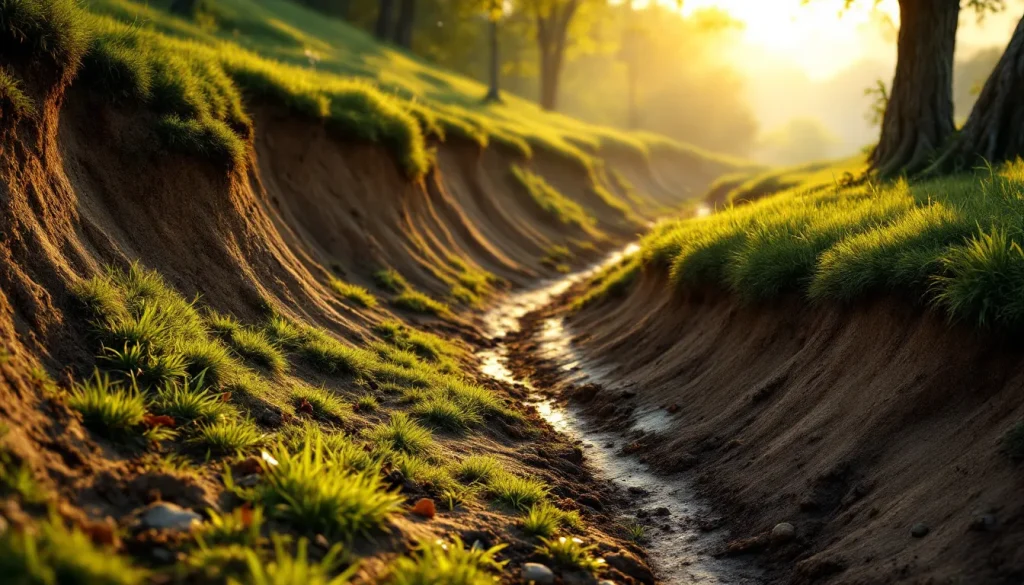
| Gully | Deep channels, steep walls | Tens of cm to meters deep | Severe |
| Tunnel | Surface collapses, sinkholes appear | Underground pipes | Severe, hidden |
| Scalding | Bare, hard, often salty patches | Patchy, no growth | Severe |
How to identify erosion in your own yard or field
You can diagnose erosion type by the marks left on the ground. Sheet erosion shows as uniform soil thinning, exposed grass roots, and pale patches where dark topsoil is gone. Rill erosion shows finger-width grooves running downslope after rain. Gully erosion is unmistakable: channels deep enough to trip in or swallow a mower wheel.
Walk a slope after a heavy rain. If silty water sheets off evenly with no channels, that is sheet erosion starting. If you find a fan of small parallel grooves you can erase with a rake, those are rills, the warning stage. Rills left untreated concentrate flow and deepen into gullies, which are far harder and costlier to fix.
Other field clues: a fan of deposited soil at the bottom of a driveway or against a fence means upslope erosion is feeding it. Exposed tree roots, soil pedestals capped by pebbles, and a receding garden bed edge all signal active loss. Catch it at the sheet or rill stage. Once gullies form, repair usually needs regrading and structural fixes covered in our erosion control methods guide.
Causes and agents of erosion
The agents of erosion are water, wind, ice, and gravity, the four forces that physically move material. The causes are what set those agents loose: heavy rainfall, river and stream flow, strong wind over bare ground, gravity on steep slopes, and human triggers like clearing vegetation, overgrazing, tilling, and construction that leaves soil exposed.
- Rainfall and runoff: raindrop impact loosens soil; runoff carries it off, driving sheet, rill, and gully erosion.
- Rivers and streams: flowing water erodes banks and beds through hydraulic action, abrasion, attrition, and solution.
- Wind: lifts dry, loose particles from bare flat land, the main agent in deserts and exposed fields.
- Gravity: pulls soil and rock downslope as creep, slumps, and landslides.
- Human activity: deforestation, overgrazing, and exposed construction sites accelerate all of the above.
Frequently Asked Questions
What are the main types of erosion?
The main types of erosion fall into two classifications. By agent: water, wind, ice (glacial), and gravity erosion. By process: hydraulic action, abrasion, attrition, and solution (chemical). Water erosion is the most widespread on land, and its soil subtypes progress from sheet to rill to gully as severity rises. Coastal, river bank, and glacial erosion are major large-scale forms.
What is the difference between erosion and weathering?
Weathering breaks rock and soil into smaller pieces in place without moving them. Erosion picks up that loosened material and transports it elsewhere by water, wind, ice, or gravity. Weathering is the breakdown; erosion is the removal. A frost-cracked boulder has been weathered. The same boulder rolled downhill by a flood has been eroded. They often work together in sequence.
What is the difference between sheet, rill, and gully erosion?
These are three stages of soil erosion by water, increasing in severity. Sheet erosion removes a thin, even layer across an entire slope with no visible channels. Rill erosion cuts many small grooves a few centimeters deep. Gully erosion carves deep, steep-walled channels tens of centimeters to meters deep. Rills are the warning stage before gullies form and become costly to repair.
What is the difference between water erosion and wind erosion?
Water erosion uses rainfall, runoff, rivers, and waves to detach and carry soil and rock, and it dominates most land surfaces. Wind erosion lifts and moves dry, loose particles and dominates flat, bare, sandy areas like deserts and plowed fields. Water can move heavier material and cut channels; wind chiefly transports fine, light particles and needs dry, unvegetated ground to work.
What are the four types of erosion by rivers?
Rivers erode through four processes. Hydraulic action is the force of moving water forcing into cracks and breaking rock apart. Abrasion (corrasion) is carried sediment scraping the channel. Attrition is transported rocks colliding and wearing each other smooth and round. Solution (corrosion) is water chemically dissolving soluble rock such as limestone and chalk and carrying it away in solution.
What are the agents of erosion?
The four agents of erosion are water, wind, ice, and gravity. Water (rainfall, runoff, rivers, waves) moves the most material on land. Wind carries dry, loose particles across bare ground. Ice, as glaciers, scrapes and gouges valleys over millennia. Gravity pulls soil and rock downslope as creep, slumps, and landslides. They frequently act together, with water often triggering gravity-driven movement.
What are examples of erosion in a yard or garden?
Common yard examples include pale, thinning patches of lawn where topsoil has washed away (sheet erosion), finger-width grooves running downslope after rain (rill erosion), and deep channels near downspouts or driveways (gully erosion). Exposed tree roots, soil pedestals capped by pebbles, a fan of deposited soil against a fence, and a receding garden bed edge all signal active erosion.
What is the most destructive or fastest type of erosion?
Gully erosion is often the most destructive everyday type because it removes large volumes of soil fast and is expensive to repair once formed. For sheer speed, coastal erosion and flood-driven river bank erosion can remove meters of land quickly; England’s Holderness coast retreats about 1.5 to 2 meters yearly. Glacial erosion reshapes the most land overall, but very slowly.