
By the HMNDP Editorial Team, independent reporting on lawn care, landscaping, water, and the green-industry business.
Last reviewed: June 2026
What tree watering bags are and how slow-release drip irrigation works
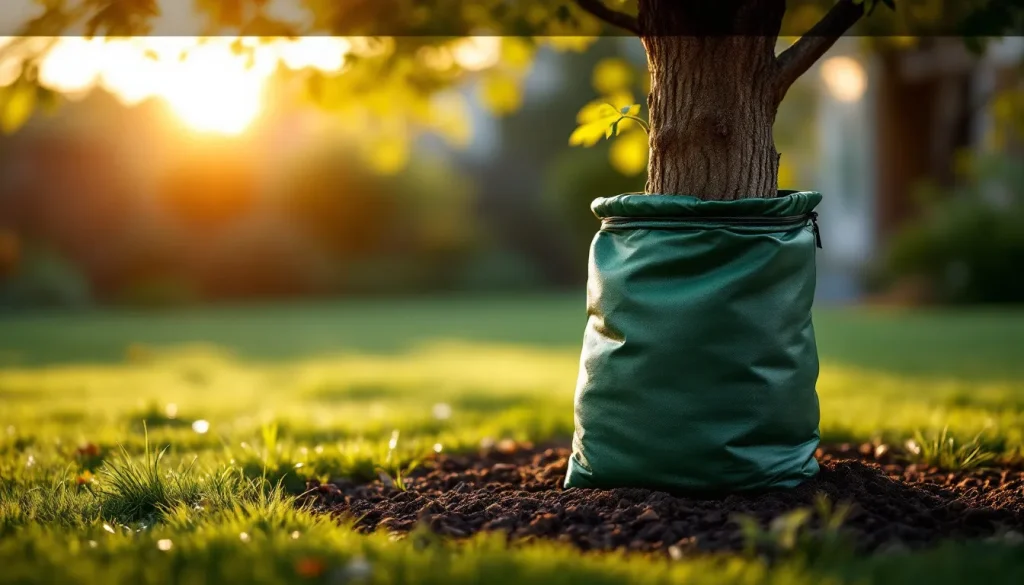
Tree watering bags are zippered or donut-shaped reservoirs that wrap a young tree’s trunk or base, hold 15 to 20 gallons, and release that water slowly through tiny holes over 5 to 9 hours. Instead of a hose blasting the surface, the bag drips water directly onto the root zone, so it soaks deep with almost no runoff.
The physics is simple. Small perforations in the seam meter the flow to roughly 2 to 4 gallons per hour. That slow rate lets the soil absorb each drop before the next arrives, pushing moisture down to 8 to 12 inches where new feeder roots grow.
Fast surface watering does the opposite. On clay or compacted lawn soil, a hose loses 30 percent or more to runoff and wets only the top inch or two. Slow deep watering is the established-tree standard most extension services recommend, and the bag automates it.
Treegator: the brand that defined tree watering bags
Treegator (often spelled Tree Gator), made by Spectrum Products in North Carolina since 1989, is the category-defining tree watering bag. The Original zip-up model holds about 20 gallons, fits trunks 1 to 4 inches in diameter, and drains in 5 to 9 hours. Most homeowners and municipal crews use “Treegator” the way they say “Kleenex.”
The lineup splits into two shapes. The upright zip-up bag wraps a single trunk. The Treegator Junior Pro is a donut/ring that lies flat and suits shrubs, multi-stem trees, and trunks too small to zip a bag around.
Competitors include TreeBuddy, Gator-style generics on Amazon, and Ooze Tube. They function the same way. Treegator earns the brand recognition because it has the longest track record with landscapers and HOA grounds crews.
Trunk-fit and tree size: which bag matches your tree
Single zip-up bags fit trunks 1 to 4 inches in diameter and zip into a tall teardrop holding 15 to 20 gallons. For trunks above roughly 4 inches, you join two or more bags side by side to circle the trunk, reaching 50-plus gallons. Donut/ring bags work on small trunks, shrubs, and multi-stem plants where a zip-up cannot close.
| Tree size | Trunk caliper | Bag type | Total capacity |
|---|---|---|---|
| Shrub / small whip | Under 1 inch | Donut/ring | 15-20 gal |
| Young single-trunk tree | 1-4 inches | Single zip-up | 15-20 gal |
| Established sapling | 4-8 inches | 2 zip-up bags joined | 30-40 gal |
| Large transplant | 8+ inches | 3+ bags or multiple donuts | 50+ gal |
Best use: newly planted trees in their first 1 to 2 years
Tree watering bags exist for one job: keeping newly planted or transplanted trees alive through the 1 to 2 year establishment window. A balled-and-burlapped or container tree loses most of its root mass at planting and cannot pull enough water from surrounding soil yet. Consistent moisture during this period decides whether the tree survives.
After establishment, a tree’s roots spread well beyond the original planting hole and a bag wrapped at the trunk no longer reaches them. At that point the bag is not just useless, it becomes a risk. See the removal protocol below.
For deeper guidance on tree health and when to call a pro, our arborist resource page covers diagnosis and care decisions a watering bag cannot solve.
How to fill and set up a tree watering bag
Setup takes about five minutes, and the appeal is the “fill and walk away” convenience: no standing with a hose, no timer to babysit. Wrap the bag, zip or position it, drop a hose in the fill spout, and let it run while you do other yard work.
- Slip the bag around the trunk and zip it closed, or lay the donut flat with the trunk centered.
- Pull the bag snug but not tight against the bark. Leave a finger-width gap.
- Insert the hose into the fill opening and fill to the marked line (15-20 gallons).
- Confirm the drip holes at the base are clear and water is seeping, not pouring.
- Walk away. The bag drains over the next 5 to 9 hours.
How long a tree watering bag takes to drain
A full 15 to 20 gallon tree watering bag drains in 5 to 9 hours. The exact window depends on hole condition and soil. Loose, sandy soil accepts water fast and may empty closer to 5 hours. Heavy clay backs up and slows the drip toward 9 hours, which is fine because the goal is slow absorption with zero runoff.
If a bag empties in under 3 hours, the holes have stretched or torn and water is escaping too fast to soak in. If it stalls past 12 hours, the holes are clogged with debris. Either case calls for a quick inspection.
Watering frequency and refill cadence by climate
Most newly planted trees need refilling every 5 to 7 days in mild weather, dropping to every 2 to 3 days in summer heat above 85 F. Skip refills after soaking rain. The bag delivers one deep watering per fill, so refill cadence is just how often you repeat that deep soak.
| Condition | Refill interval | Notes |
|---|---|---|
| Spring / fall, mild | Every 5-7 days | Standard establishment cadence |
| Summer, 85 F+ | Every 2-3 days | Check soil 4 inches down first |
| Hot, dry, windy (arid West) | Every 2 days | May need a second bag |
| After 1+ inch rain | Skip 1 cycle | Overwatering rots roots |
Tree watering follows the same deep-and-infrequent logic as lawns. Our guide to the best time to water grass explains why early-morning deep watering beats frequent shallow watering for roots.
The dosing math: gallons per week by trunk caliper
A common rule from nursery and extension sources is 10 to 15 gallons of water per week per inch of trunk caliper during establishment. That number tells you how many bag fills a tree actually needs, which no commercial page spells out. Measure caliper 6 inches above the soil line.
| Trunk caliper | Weekly water need | 20-gal bag fills per week |
|---|---|---|
| 1 inch | 10-15 gal | 1 fill |
| 2 inches | 20-30 gal | 1-2 fills |
| 3 inches | 30-45 gal | 2 fills |
| 4+ inches | 40-60 gal | 2-3 fills or join 2 bags |
This is the math that turns a vague “fill it weekly” into a plan. A 3-inch caliper maple needs roughly 30 to 45 gallons a week, so a single 20-gallon bag must be refilled at least twice, or you join two bags and fill once. In peak summer, add a fill.
The removal protocol: exactly when to take the bag off
Remove a tree watering bag at the end of each growing season, take it off entirely after the 1 to 2 year establishment period, and never leave a bag on through winter. Leaving bags on too long traps moisture against the bark and causes the documented downsides: trunk rot, girdling, bark decay, and insect or rodent harborage. No competing guide gives these specific dates, so here is the schedule.
- During the growing season: A constantly wet trunk invites fungal cankers. If your climate is humid, unzip and air-dry the trunk between fills, or use a donut style that sits away from the bark.
- End of each season (first frost): Remove the bag completely. Drain, dry, fold, and store it. A bag left on through fall holds water against bark heading into freeze cycles.
- Winter (never): A wet bag freezes against the trunk, splits bark, and creates a dark, moist hideout for voles and boring insects that chew the cambium. There is no winter watering benefit because dormant trees barely drink.
- After year 1 to 2: Once the tree is established, retire the bag permanently. Roots now extend past the trunk where the bag drips, so it no longer helps and only risks girdling as the trunk thickens against the wrap.
The principle: the bag is a tool for a fixed window, not permanent yard furniture. Treat it like a cast on a broken bone, useful while healing, harmful if never removed.
Donut/ring style vs zip-up upright bag: which to choose
Zip-up upright bags hold more water (15-20 gal) in a small footprint and suit single young trunks. Donut/ring bags lie flat, fit shrubs and multi-stem plants, sit farther from the bark (lower rot risk), and stack for higher capacity, but they take more ground space. Choose by trunk shape and how humid your climate is.
| Factor | Zip-up upright | Donut/ring |
|---|---|---|
| Best for | Single trunks 1-4 in | Shrubs, multi-stem, small whips |
| Capacity each | 15-20 gal | 15-20 gal |
| Bark contact | High (wraps trunk) | Low (sits on ground) |
| Rot risk | Higher in humid climates | Lower |
| Footprint | Narrow | Wide ring |
Are tree watering bags worth it? Pros, cons, and the honest verdict
Tree watering bags are worth it for most homeowners establishing new trees, because consistent deep watering during years 1 to 2 is the single biggest survival factor and a $25 bag is cheaper than replacing a dead $200 tree. The catch, raised repeatedly on extension sites and Reddit gardening threads, is that misuse (leaving them on too long) causes real harm.
| Pros | Cons |
|---|---|
| Slow deep soak, almost zero runoff | Trunk rot if left on wet too long |
| Fill and walk away, saves time | Girdling and bark damage over years |
| Cheaper than a dead tree | Hides voles, borers, fungal cankers |
| Great for crews managing many trees | Useless once roots spread past trunk |
| Reusable for years if stored dry | UV degrades cheap bags in 2-3 seasons |
For crews and grounds teams, the labor math favors bags strongly: one fill replaces a hand-watering visit. Companies like the employee-owned Davey Tree use slow-release watering on establishment contracts for exactly that efficiency.
How to make a DIY tree watering bag for about $12
A DIY tree watering bag is a 5-gallon bucket with a pinhole drilled near the base, or a coiled soaker hose, and it costs about $12 against $25-plus for a brand-name bag. It delivers the same slow drip but holds less (5 gal vs 20), so it suits one small tree or a tight budget. Here are two builds.
Build 1: the pinhole bucket (about $7)
- Buy a 5-gallon bucket ($5) and drill one 1/16-inch hole 1 inch up from the bottom.
- Set the bucket beside the trunk, hole facing the root zone.
- Fill with 5 gallons. It drips empty over roughly 3 to 5 hours.
- Plug a second hole option: drill two holes for faster soak on sandy soil.
Build 2: the soaker hose coil (about $15)
- Buy a 25-foot soaker hose ($12) and a hose timer ($3 used, optional).
- Coil the hose in a spiral over the root zone, 6 inches out from the trunk.
- Run at low pressure for 30 to 45 minutes per deep watering.
- The coil avoids trunk contact entirely, so no rot or girdling risk.
The DIY trade-off: lower upfront cost and zero bark-contact rot risk with the soaker coil, but less capacity and no insulated, tidy look. For one or two trees, DIY wins on cost. For a yard of new plantings or a client site, commercial bags scale better.
Frequently Asked Questions
How do tree watering bags work?
A tree watering bag wraps the trunk or base, holds 15 to 20 gallons, and releases it through tiny perforations at 2 to 4 gallons per hour over 5 to 9 hours. The slow rate lets soil absorb each drop, driving moisture 8 to 12 inches deep to the root zone with almost no runoff. It automates the slow, deep watering newly planted trees need.
How long should you leave a tree watering bag on a tree?
Use a bag only during the 1 to 2 year establishment window, remove it at the end of each growing season before first frost, and never leave it on through winter. Permanently wrapping the trunk traps moisture against bark and causes rot, girdling, and pest harborage. Once roots spread past the trunk after establishment, retire the bag for good.
How often should you fill a tree watering bag?
Refill every 5 to 7 days in mild weather and every 2 to 3 days in summer heat above 85 F, skipping a cycle after an inch or more of rain. Match fills to need using 10 to 15 gallons per week per inch of trunk caliper. A 3-inch trunk needs roughly two full 20-gallon fills weekly.
How long does it take a tree watering bag to drain?
A full 15 to 20 gallon bag drains in 5 to 9 hours. Sandy, loose soil empties it closer to 5 hours; heavy clay slows it toward 9, which is ideal for absorption. Draining in under 3 hours means the holes are torn and leaking. Stalling past 12 hours means the drip holes are clogged with debris.
Are tree watering bags worth it?
Yes for most homeowners establishing new trees, because steady deep watering in years 1 to 2 is the top survival factor and a $25 bag beats replacing a dead tree. They genuinely work. The documented downside, raised on extension and Reddit threads, is misuse: leaving them on too long causes trunk rot, girdling, and pests. Follow a removal schedule and they pay off.
How do you make a DIY tree watering bag?
Drill one 1/16-inch hole an inch up from the base of a 5-gallon bucket, set it by the trunk, and fill it; it drips empty in 3 to 5 hours for about $7. Alternatively, coil a 25-foot soaker hose over the root zone and run it 30 to 45 minutes. The soaker coil avoids trunk contact entirely, eliminating rot risk.
Can you leave tree watering bags on over winter or all year?
No. Remove the bag before first frost every year and never leave one on through winter. A wet bag freezes against the trunk, splits bark, and shelters voles and boring insects that chew the cambium. Dormant trees barely drink, so there is no winter watering benefit. Leaving a bag on year-round also risks girdling as the trunk thickens.
What size tree watering bag do I need for my tree?
For a single trunk 1 to 4 inches in diameter, use one 15 to 20 gallon zip-up bag. For trunks above 4 inches, join two or more bags to circle the trunk and reach 30 to 50-plus gallons. For shrubs, multi-stem trees, or trunks under 1 inch, use a flat donut/ring style that does not need to zip closed.
For more establishment and care guidance, visit the HMNDP Learn hub.