
By the HMNDP Editorial Team — independent reporting on lawn care, landscaping, water, and the green-industry business.
Last reviewed: June 2026
What a tree watering system is (and how to choose one)
A tree watering system is any tool that delivers water slowly and deeply to a tree’s root zone instead of running off the surface. The main types are soaker hoses and drip rings, root watering systems (like the Rain Bird RWS), slow-release watering bags (Treegator, TreeDiaper), flood bubblers, basin watering, and a plain hose set to a trickle. The best pick depends on tree size, soil type, and how much effort you want to spend.
The goal for every one of these is the same: get water 8 to 18 inches deep so roots grow down, not sideways. Shallow, frequent sprinkling trains roots to stay near the surface, where they dry out fast and destabilize the tree.
Here is how the common systems compare on the things that actually decide the purchase.
| System | Upfront cost | Effort | Delivers deep? | Best for | Typical frequency |
|---|---|---|---|---|---|
| Hand hose (open end) | $0 to $15 | High (you stand there) | Poor (runs off) | One or two trees, tight budget | 2 to 3x/week |
| Hose + low-flow locking nozzle | $8 to $20 | Medium | Fair to good | Cheap deep soak, few trees | 2 to 3x/week |
| Watering bag (Treegator/gator bag) | $20 to $35 each | Low (refill only) | Good | Newly planted 1 to 4 inch caliper | Refill 1 to 2x/week |
| Slow-release donut (TreeDiaper, Ooze Tube) | $25 to $60 each | Very low | Good | Hands-off first-year care | Refill every 1 to 2 weeks |
| Drip ring / drip kit | $25 to $80 per tree | Low once installed | Very good | Multiple trees, automation | Timer, 2 to 3x/week |
| Root watering system (Rain Bird RWS) | $20 to $45 per unit | Low once installed | Excellent (bypasses compaction) | Clay, compacted, or lawn soil | Ties into drip/timer |
| Flood bubbler / basin | $5 to $30 | Low | Excellent | Level ground, larger trees | 2 to 3x/week |
Tree watering methods ranked worst to best
Ranked by how deeply and efficiently they water, the order runs from an open hose blasting the surface (worst) to root watering systems and drip on a timer (best). Watering bags and bubblers sit in the strong middle because they hold water in place long enough to soak in. The ranking assumes correct use; any system fails if you water too little or too fast.
- Open hose end, high flow: most water runs off or evaporates. Only acceptable at a slow trickle.
- Sprinkler: designed for lawns, wets foliage, loses water to wind and evaporation.
- Hose with low-output locking nozzle: cheap, effective if you move it and go slow.
- Watering bags and slow-release donuts: meter water over hours, ideal for young trees.
- Flood bubbler in a soil basin: fills a reservoir that percolates straight down.
- Drip ring or drip kit on a timer: consistent, automatic, scales to many trees.
- Root watering system (Rain Bird RWS): pushes water below compacted topsoil to the deep roots. Best of all when soil is heavy.
How much water does a tree actually need per week
A common extension-service rule is 10 gallons of water per week for every 1 inch of trunk caliper (the trunk diameter measured 6 inches above the soil). A newly planted 2-inch caliper tree therefore needs about 20 gallons per week, split across 2 or 3 soakings. Established trees in drought need roughly the same per-inch amount but far less often. This is the number no other guide gives you, so here it is by size and season.
| Trunk caliper | Spring / fall (mild) | Peak summer (hot, dry) | Sessions per week |
|---|---|---|---|
| 1 inch (young sapling) | 5 to 10 gal/week | 10 to 15 gal/week | 2 to 3 |
| 2 inch (typical nursery tree) | 15 to 20 gal/week | 20 to 30 gal/week | 2 to 3 |
| 3 to 4 inch | 25 to 40 gal/week | 40 to 60 gal/week | 2 to 3 |
| Established (drought only) | 10 gal per inch, monthly | 10 gal per inch, every 2 weeks | 1 |
To turn gallons into run time: a single 1 GPH (gallon per hour) drip emitter needs 10 hours to put down 10 gallons, so a 2-inch tree with two emitters running 5 hours delivers about 10 gallons. A 20-gallon Treegator bag empties over 5 to 9 hours. A garden hose at a pencil-thick trickle moves roughly 2 to 5 gallons per minute wide open, so at a slow dribble you hit 15 to 20 gallons in about 10 to 15 minutes if the water soaks in rather than running off.
These are starting points. Sandy soil drains fast and wants more frequent, smaller doses; clay holds water and wants slower, less frequent soaks (more on soil below).
Deep watering and encouraging deep root growth
Deep watering means applying enough water in one session to wet the soil 8 to 18 inches down, then letting the top few inches dry before the next soak. That dry-then-soak cycle pulls roots downward chasing moisture, building a deeper, more drought-proof, more wind-stable root system. Light daily sprinkling does the opposite and creates a shallow root mat.
To check depth, push a long screwdriver or a soil probe into the ground an hour after watering. It slides easily through moist soil and stops at dry soil. If it only goes 3 or 4 inches, you watered too briefly. This one test replaces guesswork on every system in this guide.
Root watering systems (Rain Bird RWS) that bypass compacted soil
A root watering system is a perforated vertical tube installed 10 to 36 inches into the ground beside the root ball, capped with a grate at the surface. Water enters at the top and exits along the buried length, delivering it straight to deep roots and past compacted or clay topsoil that would otherwise shed surface water. The Rain Bird RWS is the most cited example and connects to a drip line or hose.
These shine in three situations: heavy clay, soil compacted by construction or foot traffic, and trees planted in lawns where turf intercepts surface water. Install two units on opposite sides of a tree for even coverage. For automated setups, the same principles behind a drip irrigation system apply: run it on a timer and match emitter output to the gallons in the table above.
Drip irrigation kits for trees and large shrubs
Drip irrigation for trees uses a ring of tubing with 1 or 2 GPH emitters laid on the soil around the trunk, out near the drip line (the edge of the canopy) where the feeder roots live. For a young tree, 2 to 4 emitters per tree is typical; for a mature tree, ring the canopy edge with 6 to 12. Put it on a timer and it becomes hands-off.
Kits from Rain Bird, DIG, and Rachio-compatible systems package the tubing, emitters, and connectors. Drip wastes almost nothing to evaporation and runoff, which is why it beats sprinklers on efficiency. If you are building your own, our guides to DIY drip irrigation and automatic plant watering systems walk through parts and timer settings.
Watering bags and the viral products: Treegator and TreeDiaper
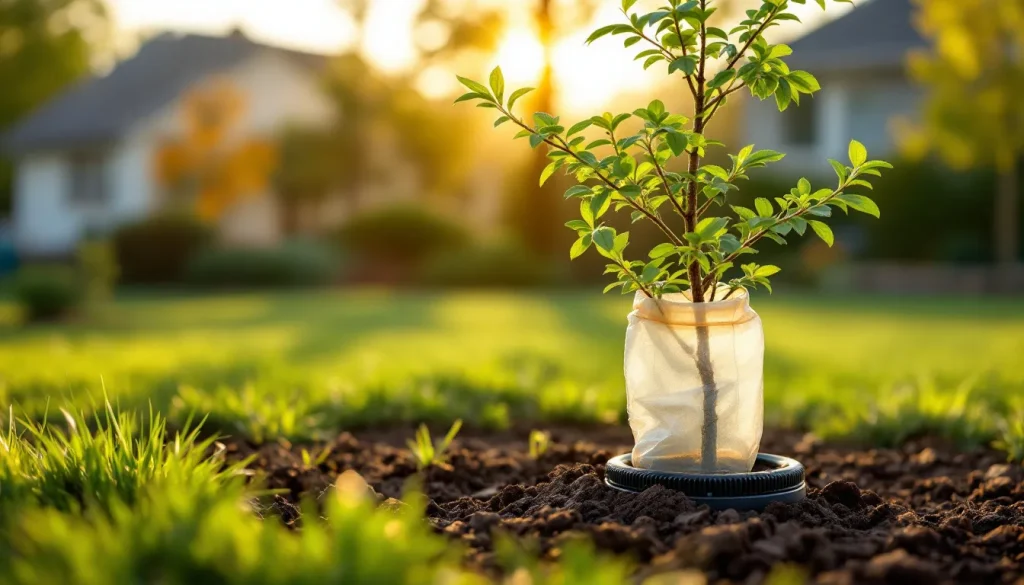
Watering bags are slow-release reservoirs that zip around a trunk or lie flat as a donut, then seep water through tiny holes over 5 to 9 hours so it soaks in instead of running off. Treegator (the original zip-up bag, about 20 gallons) and the Shark Tank donut TreeDiaper are the two most searched, yet no ranking guide compares them. Here is the honest breakdown.
| Product | Type | Capacity | Rough price | Best for |
|---|---|---|---|---|
| Treegator Original | Zip-up trunk bag | ~20 gal | $25 to $35 | Single-stem trees, 1 to 4 in caliper |
| Treegator Jr. Pro | Flat donut | ~15 gal | $25 to $35 | Shrubs, multi-stem, low branches |
| TreeDiaper (Shark Tank) | Self-refilling donut | Varies by size | $30 to $60 | Rain-fed hands-off care |
| Ooze Tube | Slow-release bladder | ~20 gal | $25 to $40 | Steady metered release |
Do they work? Yes, within limits. Bags and donuts do a real job on newly planted trees for the first one or two growing seasons: they meter a deep dose without you standing there. TreeDiaper adds a wick-and-store design that can recharge from rain, cutting refills. The tradeoffs: bags hold only one tree’s worth, sun degrades the fabric over a few seasons, and they do nothing for a mature tree whose roots spread far past the trunk. Treat them as young-tree tools, not permanent systems.
Flood bubbler and basin watering
Basin watering means building a low ring of soil or mulch 3 to 4 feet across around the trunk to form a shallow bowl, then filling it so water pools and percolates straight down. A flood bubbler is a low-pressure irrigation head (0.25 to 2 GPM) that fills that basin automatically. Together they are one of the most water-efficient ways to soak a tree on level ground.
Fill the basin two or three times per session to hit the gallon targets, letting each fill drain before the next. Basins work poorly on slopes, where water escapes the low side.
Garden hose plus a low-output locking nozzle: the cheap option
The budget system is a garden hose fitted with an adjustable nozzle you can lock to a slow stream, set at the base of the tree on a trickle for 10 to 20 minutes. A locking nozzle (roughly $8 to $20) frees your hands and lets you dial flow low enough that water soaks in instead of sheeting off. It is the cheapest way to deep-water one or two trees.
The catch is it needs a timer or a memory: an open hose left running wastes hundreds of gallons. Pair it with a $10 mechanical hose timer to cap each session automatically.
Mulch: the water-retention companion every system needs
Mulch is the multiplier that makes every watering system work better. A 2 to 4 inch layer of wood chips or bark spread in a ring out to the drip line cuts evaporation, moderates soil temperature, and suppresses competing grass. It can reduce watering frequency noticeably in summer heat.
Keep mulch 2 to 3 inches back from the trunk. Piling it against the bark (a “mulch volcano”) traps moisture on the trunk and invites rot and pests.
Newly planted vs established trees
Newly planted trees have a tiny root ball and cannot reach water beyond it, so they need frequent, generous watering for the first one to three years while roots spread. Established trees have wide root systems and usually only need supplemental water during drought. The watering system you choose should match this: bags and drip for young trees, deep occasional soaks for mature ones.
- First 2 weeks after planting: water daily or every other day, keeping the root ball moist.
- Weeks 3 to 12: every 2 to 3 days.
- After 12 weeks through year one: weekly, deep.
- Established (year 3+): only in drought, deep and infrequent.
Soil matters: clay vs sandy adjustments
Soil type changes how you run any tree watering system. Sandy soil drains fast and holds little water, so it needs smaller amounts more often. Clay and compacted soil absorb slowly and hold water long, so they need slow application and longer gaps to avoid waterlogging the roots. Getting this wrong is a leading cause of both drought stress and root rot.
| Soil | Absorption | Approach | Best systems |
|---|---|---|---|
| Sandy | Fast, low storage | Smaller doses, more often | Drip, bags, frequent hose soaks |
| Loam | Balanced | Standard gallon rules apply | Any system |
| Clay / compacted | Slow, high storage | Apply slowly, wait longer between soaks | Root watering system, slow drip, bubbler |
Signs of over-watering vs under-watering
Over- and under-watering can look alike (both cause wilting and yellow leaves), so check the soil before adjusting. Under-watered trees have dry soil, wilting, browning leaf edges, and early leaf drop. Over-watered trees have constantly soggy soil, yellowing leaves, algae or a sour smell at the base, and soft, mushy roots. The screwdriver probe test settles which one you are dealing with.
- Under-watering: dry, hard soil; crisp brown leaf margins; wilting that does not recover overnight.
- Over-watering: soil wet days after watering; yellow leaves; fungus, algae, or foul smell near the trunk.
When in doubt, let the top 2 to 3 inches dry before the next soak. Most young-tree deaths come from too much water, not too little.
Winter and dormant-season watering
Trees still lose moisture in winter, especially evergreens and newly planted trees, so in dry-winter climates you water occasionally on warm days. Water only when air and soil are above 40 degrees Fahrenheit and there is no snow cover, midday so it soaks in before nightly freeze. Skip it entirely where the ground is frozen or winters are wet.
A rough dormant-season target is one deep soak per month during dry spells, roughly 10 gallons per inch of trunk diameter. Disconnect and drain bags, drip lines, and timers before hard freezes to prevent cracking.
DIY vs buy, and two builds you can make today
DIY setups win on cost and customization; bought kits win on convenience and reliability. A 5-gallon bucket or a homemade drip ring costs a few dollars and waters a young tree well, but you refill and monitor it yourself. Store-bought bags, drip kits, and root systems cost more but automate the job and last longer. For one or two trees, DIY is fine; for a yard full, a timed kit pays off.
5-gallon bucket drip (about $5):
- Drill 2 to 4 small holes (1/16 inch) in the bottom edge of a clean 5-gallon bucket.
- Set it beside the trunk, over the root ball.
- Fill with 5 gallons; it drains slowly over 20 to 40 minutes and soaks straight down.
- Refill to hit the weekly gallon target for the tree’s caliper.
DIY drip ring (about $20):
- Cut 1/2 inch poly tubing to circle the tree at the drip line.
- Punch and insert 2 to 6 barbed 1 GPH emitters evenly around the ring.
- Connect to a hose bib with a pressure reducer and a mechanical timer.
- Run long enough to deliver the gallons in the caliper table (for example, 5 hours for two 1 GPH emitters equals 10 gallons).
The same parts and layout scale to beds and shrubs; see our walkthroughs on DIY drip irrigation and drip irrigation for raised beds for emitter spacing and timer settings.
Frequently Asked Questions
What is the tree watering system from Shark Tank (TreeDiaper) and does it work?
TreeDiaper is a donut-shaped slow-release watering mat pitched on Shark Tank. It stores water in a wicking layer and releases it steadily to the root zone, and it can recharge from rain, cutting refills. It works well for newly planted trees during their first one or two seasons. Its limits are single-tree capacity and reduced usefulness for mature trees with wide roots.
How do I make a DIY tree watering system?
The simplest DIY system is a clean 5-gallon bucket with 2 to 4 small holes drilled in the bottom, set over the root ball and filled; it drains deeply over 20 to 40 minutes. For automation, build a drip ring from 1/2 inch poly tubing with 1 GPH emitters at the drip line, connected to a hose timer and pressure reducer. Both cost under $20.
What is the best tree watering system for newly planted trees?
For newly planted trees, a slow-release watering bag (Treegator) or donut (TreeDiaper) is usually best because it meters a deep 15 to 20 gallon soak over several hours with almost no effort. If you have several young trees, a drip kit on a timer scales better. In clay or compacted soil, add a Rain Bird root watering system to reach deep roots.
How much water does a tree need per week?
A common rule is 10 gallons per week for each inch of trunk caliper. A 2-inch caliper tree needs about 20 gallons per week, rising to 20 to 30 gallons in peak summer heat, split across 2 or 3 deep sessions. Established trees need water only in drought, roughly 10 gallons per inch of trunk diameter, applied deeply and infrequently.
How often should I water a newly planted tree?
Water a newly planted tree daily or every other day for the first two weeks, every 2 to 3 days through about week 12, then weekly for the rest of the first year. Always soak deeply rather than sprinkling lightly, and let the top 2 to 3 inches of soil dry between sessions to encourage deep roots and avoid rot.
Do tree watering bags (Treegator/gator bags) actually work?
Yes, for young trees. Treegator and similar gator bags hold about 15 to 20 gallons and seep it out over 5 to 9 hours, delivering a deep soak that soaks in instead of running off. They excel on newly planted single-stem trees for the first one to two seasons. They do little for mature trees and the fabric degrades in sun over several years.
What is a root watering system and how does it delivers water to deep roots?
A root watering system is a perforated vertical tube installed 10 to 36 inches deep beside the root ball, capped with a surface grate. Water poured or piped in at the top exits along the buried length, delivering it below compacted or clay topsoil straight to the deep roots. The Rain Bird RWS is the common example; install two per tree for even coverage.
Is drip irrigation good for trees, and how many emitters per tree?
Drip irrigation is one of the most efficient ways to water trees because it loses almost nothing to evaporation or runoff. Use 2 to 4 emitters (1 to 2 GPH each) for a young tree and 6 to 12 ringed at the canopy edge for a mature tree. Put it on a timer and match total output to the gallons your tree’s caliper requires.