
By the HMNDP Editorial Team — independent reporting on lawn care, landscaping, and the green-industry business.
Last reviewed: June 2026
What crane tree removal is and how it works
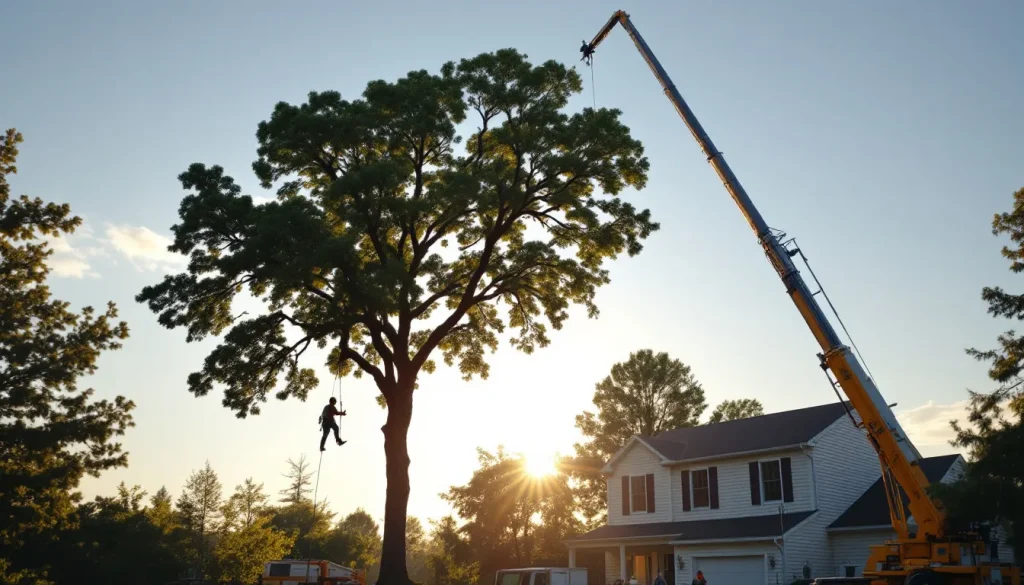
Crane tree removal is a method where a mobile crane holds and lifts sections of a tree while a climber (or a bucket-lift operator) cuts them free, so each piece is carried to a drop zone instead of falling. It is used when a tree is too large, too tall, too dead, or too hard to reach to take down safely by climbing and rigging alone.
The tree comes down in pieces, not in one felled trunk. The crane operator positions the boom over each section, the crew attaches a rigging sling or a hydraulic grapple saw, and the operator takes up tension so the crane carries the weight.
The climber then makes a single cut. Because the crane already holds the load, the cut piece never drops. The operator swings it clear of the house, fence, or garden bed and lowers it to a spot where a ground crew bucks and chips it. The process repeats from the top down until only the trunk remains.
This is different from traditional felling, where a whole tree is cut at the base and dropped in one direction. Sectional crane removal suits tight suburban lots where there is no safe direction to drop a full-height tree. For a plain-English refresher on tree biology and terms, see our explainer on whether a tree counts as a plant.
When you actually need a crane to remove a tree
You need a crane when a tree cannot be climbed or dropped safely, or when climbing would take far longer and cost more in labor. The clearest triggers are a dead or decayed tree (unsafe to climb), a very tall tree over a structure, a trunk too heavy to lower by hand rigging, and a location with no drop zone. If none of those apply, a climber usually suffices.
Use this framework. Score your tree against each condition. Two or more strong “yes” answers usually justify a crane.
| Condition | Crane favored | Climber usually fine |
|---|---|---|
| Tree health | Dead, hollow, or storm-damaged (climbing is unsafe) | Live wood a climber can trust |
| Height | Over 60 ft, or towering over a roof | Under 40 ft, open canopy |
| Drop zone | No clear ground to lower pieces | Open lawn or field beside the tree |
| Targets below | House, pool, power line, or garden directly under limbs | Nothing valuable underneath |
| Access | Crane can set up within reach (street or driveway) | Backyard a crane cannot reach anyway |
Note the last row. A crane only helps if it can physically get close enough. A fully fenced backyard with no boom access can rule out a crane even when every other factor points to one.
Crane tree removal versus traditional climbing
Crane removal trades a higher hourly rate for far fewer hours and lower risk on hazardous trees. Traditional climbing costs less per hour and needs no crane access, but it is slower on large trees and more dangerous on dead wood. The right choice depends on tree size, hazard, and whether a crane can reach the trunk.
| Factor | Crane removal | Traditional climbing |
|---|---|---|
| Speed | Large tree often down in 3 to 6 hours | Same tree can take 1 to 2 full days |
| Hourly cost | Higher (crane plus crew) | Lower (labor only) |
| Safety on dead trees | High: climber load stays supported | Low: unstable wood under a climber |
| Access needed | Street or driveway staging space | Works in tight backyards |
| Property risk | Lower: pieces are lifted, not dropped | Higher on constrained lots |
How much crane tree removal costs
Crane tree removal typically costs $1,000 to $5,000 in the United States, with most residential jobs landing between $1,500 and $3,500 as of 2026. The crane itself adds roughly $200 to $600 per hour or a day rate of $1,000 to $3,000, on top of the tree crew’s labor. Very large or hazardous removals can exceed $8,000. Figures vary by region, tree size, and access.
Prices below are national ballpark ranges that combine the crane, the operator, the climbing crew, and basic debris cleanup. Always confirm with a local quote.
| Tree size / situation | Typical total cost | Common timeline |
|---|---|---|
| Medium tree, 40 to 60 ft, easy access | $1,000 to $2,000 | Half day |
| Large tree, 60 to 80 ft, over a house | $2,000 to $4,000 | Half to full day |
| Very large / dead oak or pine, 80 ft+ | $4,000 to $8,000+ | Full day |
| Emergency / storm-fallen on structure | $3,000 to $10,000+ | 1 to 2 days |
For a broader look at how removal pricing fits alongside stump grinding and haul-away, see our guide to tree and stump removal.
What factors affect the cost of crane tree removal
Six variables drive the final number: tree size, crane size, site access, distance to the drop zone, debris hauling, and permits or emergency timing. Each can move a quote by hundreds or thousands of dollars, which is why two homeowners with similar-looking trees often get very different bids.
- Tree size and weight. Bigger canopies mean more lifts and a larger crane. This is the single largest cost driver.
- Crane size required. A larger boom or higher lifting capacity costs more per day to rent and operate.
- Access. Tight streets, gated communities, or soft ground that needs mats add setup time and cost.
- Distance to the drop zone. A long swing radius slows every lift, adding crane hours.
- Debris hauling. Chipping and removing logs can add $100 to $500 or more; leaving wood on-site lowers the bill.
- Permits and emergencies. Storm response, night work, and road closures raise the price.
Crane sizes and boom reach used for tree removal
Most residential tree removals use a mobile hydraulic crane in the 15-ton to 40-ton class, with boom-truck cranes handling smaller jobs and larger all-terrain units reserved for tall or heavy trees. Brands such as Grove, National Crane, and Terex are common. The operator matches lifting capacity and reach to the tree’s height and the pieces’ weight.
Two crane specs matter for a tree job. Capacity is how much weight the crane can lift, and it drops sharply as the boom extends farther out. Reach is how far and high the boom can work. A crew calculates the heaviest expected piece, then picks a crane that keeps that weight well inside its rated chart at the working radius.
As a rough guide, a 23-ton boom truck handles many 60-to-80-foot suburban trees, while a 40-ton or larger all-terrain crane is called in for tall pines, big oaks, or trees set back far from the staging point.
How a crane tree removal actually happens, step by step
A typical crane removal runs 3 to 8 hours with a crew of 3 to 5: a certified crane operator, a climber or bucket operator, and one or two ground workers. The team plans lift weights, sets up the crane, removes the tree top-down in weighed sections, then processes debris. Rigging and load estimation are the core of the job.
- Site assessment. The crew checks access, sets the crane position, and identifies overhead lines.
- Set up and outriggers. The crane deploys outriggers on mats to stabilize on the ground.
- Estimate the lift. The crew calculates each section’s weight (species, diameter, and length) so no pick exceeds the crane’s chart at that radius.
- Attach and tension. A sling or grapple saw grips the section; the operator takes up the slack to hold the load.
- Cut and swing. The climber makes one cut, the crane lifts the piece clear, then swings it to the drop zone.
- Lower and process. Ground crew unhooks, bucks, and chips each piece. Steps repeat down to the stump.
Is crane removal safer than climbing a tree?
Yes, crane removal is generally safer on large or dead trees because the crane supports each cut section, so the climber is not relying on unstable wood and no heavy piece free-falls toward the house or crew. The Tree Care Industry Association and OSHA both flag climbing dead or decayed trees as a leading injury risk, which crane methods reduce.
Safety comes from three things. The load is held before it is cut, so nothing drops unexpectedly. The climber spends less time in the canopy on questionable limbs. And pieces are placed by the operator rather than dropped, which protects fences, pools, and roofs below. Established firms such as Davey Tree treat crane work as a core hazard-mitigation tool for exactly these reasons.
How to vet and hire a crane tree removal crew
Hire only a company that carries insurance, licenses its work, and uses a certified crane operator. Ask for proof of general liability and workers’ compensation, confirm the operator holds a recognized crane certification, and get the plan for protecting your property in writing. Skipping these checks can leave you liable if something goes wrong on your land.
Before you sign, ask these questions:
- Insurance. Can you show current general liability and workers’ compensation certificates? Request them directly from the insurer.
- Operator certification. Is the crane operator certified (for example, through the National Commission for the Certification of Crane Operators, NCCCO)?
- Arborist credentials. Is there an ISA Certified Arborist on the crew?
- Licensing. Is the company licensed as required in your state or municipality?
- Property protection. How will lawns, driveways, and beds be protected from outriggers and debris?
- Permits. Who pulls any required permit, and is a road or lane closure needed?
- Written estimate. Does the quote itemize crane time, labor, hauling, and stump work?
On permits and liability, rules are local. Many cities require a permit to close a lane for the crane, and some protect heritage or large-diameter trees, so removal may need municipal approval depending on your jurisdiction. Your contractor should know the local process.
Is it worth paying extra for a crane?
Paying extra for a crane is usually worth it when the tree is dead, very tall, or standing over something you cannot afford to damage, because the crane lowers both risk and total labor hours. For a small, healthy, easily climbed tree with an open drop zone, a crane is often an unnecessary expense. The deciding question is risk, not just size.
Run a simple test. Add up what a climbing crew would charge for the extra days a large or hazardous tree takes, then weigh that against the higher crane rate for a shorter job. On a big tree over a house, the crane often costs less once you count labor, and it sharply cuts the odds of an expensive property-damage claim. On a modest backyard tree, it rarely pencils out.
Frequently Asked Questions
How much does crane tree removal cost?
Crane tree removal typically costs $1,000 to $5,000 in the United States in 2026, with most residential jobs between $1,500 and $3,500. The crane adds about $200 to $600 per hour or a $1,000 to $3,000 day rate on top of crew labor. Very large, dead, or emergency removals can exceed $8,000. Get a local quote, since prices vary by region and access.
How does crane tree removal work?
A mobile crane positions its boom over a section of the tree, the crew attaches a sling or grapple saw, and the operator takes up tension to hold the weight. A climber then makes one cut, and the crane lifts the supported piece clear and lowers it to a drop zone. The tree comes down top-down in weighed sections until only the stump remains.
When do you need a crane to remove a tree?
You need a crane when a tree is too tall, heavy, dead, or hazardously located to climb and drop safely. Common triggers include dead or decayed wood unsafe for a climber, trees over 60 feet standing over a house, and lots with no clear ground to lower pieces. If the tree is small, healthy, and has an open drop zone, a climber usually suffices.
Can I rent a crane to remove a tree myself?
You can rent a crane, but doing your own crane tree removal is strongly discouraged and often not permitted. Operating a crane safely requires certification, load calculations, and rigging experience, and most rental companies supply a licensed operator rather than the machine alone. The cutting and lifting must be coordinated by trained crew. Hiring an insured tree service is safer and usually the only practical option.
How big of a tree can a crane remove?
Cranes can remove essentially any tree, from 40-foot suburban specimens to pines and oaks well over 100 feet, by matching crane capacity to the job. A 23-ton boom truck handles many 60-to-80-foot trees, while 40-ton or larger all-terrain cranes take on the tallest and heaviest. Capacity drops as the boom extends, so the operator sizes the crane to the heaviest expected lift at working radius.
How long does crane tree removal take?
Most crane tree removals take 3 to 8 hours, and many residential jobs finish in a single day. A medium tree with easy access can be down in a half day, while a large tree over a house or a storm-damaged removal may take a full day or two. Setup, lift planning, and debris processing account for much of the time, not just cutting.
Do you need a permit for crane tree removal?
You may need a permit, depending on your city and the tree. Many municipalities require a permit to close a lane or sidewalk for the crane, and some protect heritage or large-diameter trees, so removal itself may need approval. Rules are local, so confirm with your municipality or let your contractor handle the permit as part of the job.