
By the HMNDP Editorial Team. Last reviewed: June 2026.
What is soil stabilization and how does it work?
Soil stabilization is the process of altering a soil’s physical and engineering properties to make it stronger, stiffer, and more durable under load. It works by compacting, blending, or adding binders (lime, cement, fly ash, asphalt, chemicals) that increase load-bearing capacity, cut permeability and swelling, and control dust. The goal is a subgrade or base that stays stable through wet-dry and freeze-thaw cycles.
The mechanism depends on the method. Mechanical stabilization rearranges particles for denser packing. Chemical stabilization triggers reactions (cation exchange, flocculation, pozzolanic cementing) that bind fine particles together. Understanding the parent material helps, and our primer on how soil is formed explains why clay, silt, and sand behave so differently under a binder.
Engineers stabilize soil to avoid excavating and replacing weak ground. Treating in place is usually faster and cheaper than hauling in select fill, and it converts a marginal site into a working platform for roads, foundations, and embankments.
Purpose and benefits of soil stabilization
Soil stabilization delivers measurable engineering gains: higher California Bearing Ratio (CBR) and unconfined compressive strength (UCS), reduced plasticity and swell in clays, lower permeability, better freeze-thaw and moisture resistance, and dust control on unpaved surfaces. On pavements it thickens the effective structural layer, which can trim overlying asphalt or concrete thickness and lower total cost.
- Strength: CBR can rise from single digits to 50 or more after cement or lime treatment.
- Volume stability: Lime can drop a high-plasticity clay’s plasticity index (PI) by 10 to 30 points, reducing shrink-swell.
- Permeability: Treated layers shed water instead of trapping it, protecting the subgrade.
- Constructability: A wet, unworkable clay becomes a firm platform within 24 to 72 hours.
The four soil stabilization methods by mechanism
Soil stabilization methods fall into four mechanisms: mechanical, chemical, biological, and physical. Mechanical uses compaction, gradation blending, and geosynthetics. Chemical uses binders and additives that react with the soil. Biological uses microbes or enzymes. Physical uses heat, freezing, or dewatering. Most road and foundation projects use mechanical, chemical, or a combination of the two.
Mechanical stabilization
Mechanical stabilization improves soil without chemical binders, using compaction, particle-size blending, and geosynthetics. Rollers densify the soil to a target density (often 95 to 100 percent of a Proctor maximum). Blending mixes a deficient soil with a better-graded material to hit a target gradation. Geogrids and geotextiles confine particles and spread load across soft subgrades.
Geogrids (such as Tensar TriAx or biaxial products) can reduce required aggregate thickness by 30 to 50 percent over soft ground by interlocking with the base course. Mechanical methods add no cure time and carry no chemical risk, which makes them the default for granular soils and for reinforcing weak layers.
Chemical stabilization
Chemical stabilization adds a binder or reactive additive that changes the soil chemistry to bind particles and reduce plasticity. The common binders are lime, Portland cement, and fly ash, with bituminous, chloride, polymer, and enzyme additives for specific cases. Dosages typically run 3 to 6 percent lime, 4 to 12 percent cement, or 8 to 16 percent fly ash by dry soil weight.
Chemical stabilization is the workhorse for fine-grained and marginal soils where mechanical methods alone cannot deliver strength. It requires a mix design, moisture control, and a cure period, and it can fail badly if soil chemistry (especially sulfate content) is ignored.
Biological and physical stabilization
Biological and physical stabilization are the smaller, more specialized categories. Biological methods use microbes or enzymes to cement soil, most notably microbially induced calcite precipitation (MICP) using Sporosarcina pasteurii, plus enzyme products and lignosulfonates. Physical methods use heat, ground freezing, electro-osmosis, or dewatering to change soil behavior temporarily or permanently.
These methods stay niche because of cost, scale limits, or durability questions, but MICP and geopolymers are advancing as lower-carbon options. Ground freezing remains standard for shaft and tunnel work in saturated soils where no binder can be mixed in.
Chemical stabilization additives compared
The four main chemical additives (lime, cement, fly ash, bituminous) each suit a different soil and goal. Lime targets plastic clays. Cement builds strength across a wide range and suits granular soils. Fly ash treats silty and marginal soils, often paired with lime or cement. Bituminous binders waterproof and bind granular soils for base courses.
| Additive | Best for | Primary effect | Typical dosage | Cure before traffic |
|---|---|---|---|---|
| Hydrated lime / quicklime | Clays, PI > 10 to 15 | Cation exchange, dries and reduces plasticity, long-term pozzolanic gain | 3 to 6% by weight | 1 to 7 days |
| Portland cement | Granular and low-plasticity soils, PI < 10 to 20 | Direct cementing, high strength gain | 4 to 12% by weight | 1 to 3 days |
| Fly ash (Class C or F) | Silts, marginal soils | Pozzolanic cementing, often with lime activator (Class F) | 8 to 16% by weight | 1 to 7 days |
| Bituminous / asphalt emulsion | Sands and granular base | Waterproofing and cohesion | 3 to 7% residual bitumen | Hours to 2 days |
| Calcium chloride / polymer / enzyme | Unpaved roads, dust, gravel | Moisture retention, surface binding, dust control | Product-specific | Hours |
Lime stabilization shines on high-plasticity clay. Quicklime dries a wet clay fast, and cation exchange flocculates the clay so it becomes friable and far less swelling. Design UCS often targets a 50 to 100 psi gain per ASTM D5102 and ASTM D6276 for the lime demand.
Cement stabilization gives the highest and fastest strength. Cement-treated base is commonly designed to a 7-day UCS of 300 to 800 psi (ACI 230.1R, Portland Cement Association guidance), though many agencies cap strength near 150 to 300 psi to limit shrinkage cracking.
Fly ash and pozzolans use coal-combustion and other industrial by-products. Class C fly ash is self-cementing; Class F needs a lime or cement activator. Ground granulated blast-furnace slag (GGBS) is a lower-carbon pozzolan gaining use as fly ash supply tightens.
Bituminous and chloride/polymer/enzyme additives handle the edges: asphalt emulsions bind and waterproof granular base, while calcium chloride and polymer or enzyme products control dust and bind unpaved gravel roads. On unpaved surfaces these binders reduce the water and grading demand that also drives choices in an irrigation and drainage system.
Soil stabilization cost per square yard and per ton (2024 to 2026)
Soil stabilization cost typically runs $2 to $8 per square yard for a treated 6 to 12 inch lift in the United States, with fly ash cheapest and cement most expensive. Binder prices in 2024 to 2026 sit near $130 to $180 per ton for lime, $130 to $160 per ton for Portland cement, and $40 to $90 per ton for fly ash. These are indicative ranges; haul distance, depth, dosage, and mobilization move them sharply.
| Method | Installed cost (per sq yd, 8 to 12 in) | Binder price (per ton, 2024 to 2026) | Cost driver |
|---|---|---|---|
| Lime stabilization | $2.50 to $6.00 | $130 to $180 | Clay depth, lime dosage |
| Cement stabilization | $3.50 to $8.00 | $130 to $160 | Cement content, strength target |
| Fly ash stabilization | $2.00 to $5.00 | $40 to $90 (rising) | Ash supply, haul distance |
| Full-depth reclamation (FDR) | $3.00 to $7.00 | Varies by binder | Existing pavement, additive |
| Geogrid / mechanical | $1.50 to $4.00 (material installed) | n/a | Subgrade softness, product grade |
| Calcium chloride dust control | $0.50 to $1.50 per application | Product-specific | Road area, reapplication frequency |
Convert per-ton binder to per-square-yard cost through dosage. A 10 inch lift of clay at roughly 110 lb/cubic foot holds about 0.42 tons of soil per square yard. At 5 percent lime that is 0.021 tons, or near $3 in lime alone before mixing and compaction. The same math at 8 percent cement pushes binder cost past $4 per square yard, which is why strength targets drive the budget.
Two 2026 signals matter for buyers. Fly ash, historically the cheapest binder, is climbing as coal plants close and supply tightens, so a low quote today can carry price risk on a phased job. Lock binder pricing and confirm source (fresh versus harvested ash) before committing a mix design.
Soil-type-to-method selection matrix
The right soil stabilization method is set mainly by plasticity index (PI), gradation, and sulfate content. High-PI clays call for lime. Granular and low-PI soils call for cement. Silts and marginal soils suit fly ash, often with lime. High sulfate content rules out calcium-based binders with reactive clay because of heave risk. Use the matrix below as a starting screen, then confirm with a mix design.
| Soil signal | Threshold | Preferred method | Avoid / caution |
|---|---|---|---|
| Plasticity index (PI) | PI > 15, plastic clay | Lime | Cement mixes poorly with wet clay |
| Plasticity index (PI) | PI < 10, granular | Cement or bituminous | Lime gives little reaction |
| Plasticity index (PI) | PI 10 to 20, silty | Fly ash, lime-fly ash, or cement | Match to fines content |
| Gradation | Well-graded granular base | Cement, bituminous | n/a |
| Fines content | > 25% passing #200, plastic | Lime first, then cement or fly ash | Cement alone struggles |
| Soluble sulfate | < 3,000 ppm | Lime or cement acceptable | Low heave risk |
| Soluble sulfate | 3,000 to 8,000 ppm | Test, consider non-calcium or GGBS | Moderate heave risk |
| Soluble sulfate | > 8,000 ppm | Avoid lime/cement with reactive clay | High sulfate-induced heave risk |
Sulfate testing (for example TxDOT Tex-620-J or equivalent) is the step most parallel guides skip, and it is where lime and cement jobs fail. When soluble sulfates meet reactive alumina from clay in the presence of calcium and water, they form ettringite and thaumasite, which expand and lift the pavement months after construction. Little and Nair’s NCHRP work is the standard reference on this failure mode.
Where vegetation and roots must clear before subgrade prep, contractors often pair mechanical grubbing with targeted vegetation control; our overview of what a herbicide is explains the chemistry crews weigh on right-of-way work.
Sustainability, carbon, and supply risk
Binder choice is now a carbon and supply decision, not only a strength decision. Portland cement carries the heaviest footprint, roughly 0.8 to 0.9 tonnes of CO2 per tonne of cement, because clinker production releases process CO2. Lime is lower but still calcined. Fly ash and GGBS are near-zero embodied carbon because they reuse industrial by-products, which is why they anchor most low-carbon mix designs.
| Binder | Approx. embodied CO2 | Supply outlook (2026) |
|---|---|---|
| Portland cement | 0.8 to 0.9 t CO2 / t | Stable, high carbon |
| Lime | 0.7 to 1.2 t CO2 / t | Stable |
| Fly ash | Near zero (by-product) | Declining, coal plant closures |
| GGBS (slag) | Near zero (by-product) | Regionally constrained |
| Geopolymer / enzyme / MICP | Low, method-dependent | Emerging, limited scale |
The supply story cuts against the carbon story. Fly ash is the cleanest low-carbon binder on embodied CO2, but United States coal-plant retirements (tracked by the American Coal Ash Association) have tightened Class F supply and pushed some suppliers to harvest ash from landfills. Slag is regionally limited. That squeeze is driving real interest in geopolymers, enzyme products, and MICP for projects that need both strength and a defensible carbon number.
Equipment and construction process
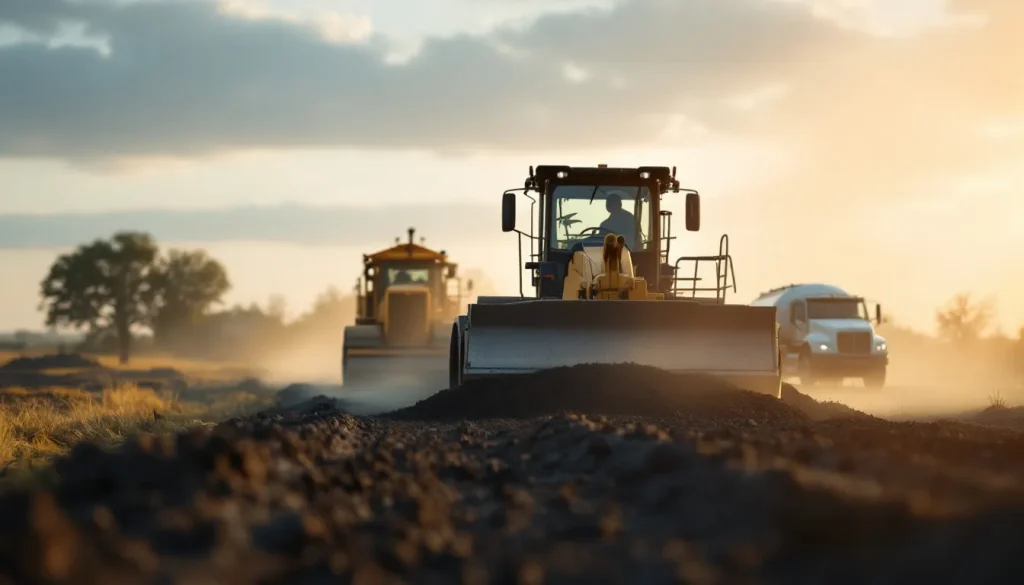
Stabilization is built in a repeatable sequence: prepare, spread, mix, compact, cure. The core machine is a self-propelled reclaimer or rotary mixer (Wirtgen, Caterpillar, and BOMAG make common units) that pulverizes soil and blends binder to a target depth in one pass. Water trucks, pad-foot and smooth-drum rollers, motor graders, and pneumatic spreaders round out the spread.
- Prepare: scarify and shape the subgrade, remove oversize and vegetation, check moisture.
- Spread: place binder at the design rate, dry or as slurry, using a calibrated spreader.
- Mix: run the reclaimer to full depth to hit uniform blend and pulverization (often 60 percent passing the #4 sieve for lime-clay).
- Compact: roll to target density near optimum moisture, starting within the binder’s working window.
- Finish and cure: shape to grade, then moist-cure or apply a curing seal for the specified period.
QA testing, UCS targets, cure times, and failure modes
Quality control decides whether stabilized soil lasts. The core checks are UCS on molded specimens, field density, depth of treatment, pulverization, and sulfate screening before design. Typical UCS targets are 50 to 100 psi for lime-modified subgrade, 300 to 800 psi at 7 days for cement-treated base (with many agencies capping near 150 to 300 psi to limit cracking), and a mix-specific value for fly ash.
| Check | Method / standard | Typical target |
|---|---|---|
| UCS, cement-soil | ASTM D1633 | 300 to 800 psi at 7 days (often capped lower) |
| UCS, lime-soil | ASTM D5102 | 50 to 100+ psi gain |
| Moisture-density | ASTM D558 / Proctor | 95 to 100% max dry density |
| Lime demand | ASTM D6276 (Eades-Grim) | pH 12.4 endpoint |
| Soluble sulfate | Tex-620-J or equivalent | < 3,000 ppm preferred |
Cure time governs when you can build. Cement-treated layers usually take 1 to 3 days before paving or traffic; lime and fly ash layers often need 1 to 7 days of moist curing, with full pozzolanic strength developing over 28 days. Cold weather slows every reaction, so agencies commonly halt lime and cement work below about 40 F.
The common failure modes are avoidable: sulfate-induced heave from untested reactive clay, shrinkage cracking from over-cementing, weak spots from poor pulverization or uneven binder spread, and strength loss from compacting outside the binder’s working window or skipping the cure. Each traces back to a QA step that was rushed or skipped, not to the method itself.
Soil modification vs soil stabilization
Modification and stabilization differ by intent and permanence. Soil modification makes a wet or plastic soil workable in the short term, usually with a light lime or cement dose, without a specified long-term strength. Soil stabilization is a designed, permanent strength gain verified against a UCS or CBR target. Both may use the same binders; the difference is the performance requirement.
Practically, modification lets a crew work a muddy subgrade this week. Stabilization builds a structural layer the pavement design relies on for years. Specifications, testing, and cure requirements are stricter for stabilization because the layer must carry load, not just support construction traffic.
Applications of soil stabilization
Soil stabilization supports almost every ground-bearing structure: road and highway subgrade and base, pavements, building foundation pads, embankments and earth dams, airfields and runways, ports, rail formations, and unpaved haul roads. On transportation projects it is standard practice to stabilize weak subgrade before placing base and surface layers.
- Roads and highways: lime or cement subgrade treatment and full-depth reclamation of failed pavement.
- Foundations: stabilized pads under slabs and lightly loaded footings on expansive clay.
- Embankments and dams: lower permeability and higher shear strength for fill.
- Airfields: cement-treated bases for high wheel loads on runways and taxiways.
- Unpaved roads: chloride, polymer, and enzyme dust control and surface binding.
For more field references across ground, water, and turf systems, browse the HMNDP research library.
Frequently Asked Questions
What is soil stabilization and how does it work?
Soil stabilization alters a soil’s physical and engineering properties to raise strength, stiffness, and durability. It works either mechanically (compaction and gradation blending that packs particles denser) or chemically (lime, cement, or fly ash that trigger cation exchange, flocculation, and pozzolanic cementing to bind fine particles). The result is a subgrade or base with higher load-bearing capacity and lower permeability and swelling.
What are the main methods of soil stabilization?
The main methods group into four mechanisms. Mechanical stabilization uses compaction, particle-size blending, and geogrids. Chemical stabilization uses lime, Portland cement, fly ash, bituminous binders, and chloride, polymer, or enzyme additives. Biological methods use microbes and enzymes such as MICP. Physical methods use heat, freezing, or dewatering. Road and foundation work relies mostly on mechanical and chemical methods, often combined.
What is the difference between mechanical and chemical soil stabilization?
Mechanical stabilization changes soil physically through compaction, blending, and geosynthetics, with no cure time and no chemical risk, and it suits granular soils. Chemical stabilization adds a binder that reacts with the soil to bind particles and reduce plasticity, which suits clays, silts, and marginal soils. Chemical methods need a mix design, moisture control, and a cure period, and they carry sulfate-heave risk if untested.
How much does soil stabilization cost per square yard or per ton?
Installed soil stabilization typically costs $2 to $8 per square yard for a treated 6 to 12 inch lift in the United States. In 2024 to 2026, binder prices run about $130 to $180 per ton for lime, $130 to $160 for Portland cement, and $40 to $90 for fly ash, with fly ash rising as coal plants close. Haul distance, depth, dosage, and mobilization change these ranges significantly.
Which soil stabilization method is best for clay soils?
Lime is usually best for plastic clay soils with a plasticity index above 10 to 15. Quicklime or hydrated lime dries the clay and drives cation exchange, which flocculates particles, cuts plasticity by 10 to 30 points, and reduces shrink-swell. Confirm the dose with an ASTM D6276 lime demand test, and screen soluble sulfates first, since high sulfate clays risk expansive heave with lime.
When should you use lime vs cement vs fly ash for stabilization?
Use lime for plastic clays (PI above 15) to reduce plasticity and swell. Use Portland cement for granular and low-plasticity soils (PI below 10 to 20) when you need fast, high strength. Use fly ash for silts and marginal soils, often with a lime activator for Class F ash. Screen sulfate content before choosing any calcium-based binder to avoid heave.
What is the difference between soil modification and soil stabilization?
Soil modification makes a wet or plastic soil workable in the short term with a light binder dose and no specified long-term strength. Soil stabilization is a designed, permanent strength gain verified against a UCS or CBR target. Both can use the same binders such as lime or cement; the difference is whether a long-term structural performance requirement applies to the treated layer.
How long does stabilized soil take to cure before you can build on it?
Cure time depends on the binder. Cement-treated layers usually need 1 to 3 days before paving or traffic. Lime and fly ash layers often need 1 to 7 days of moist curing, with full pozzolanic strength developing over about 28 days. Cold weather slows the reactions, and most agencies stop lime and cement stabilization below roughly 40 F.