
By the HMNDP Editorial Team — independent reporting on lawn care, landscaping, water, and the green-industry business.
Last reviewed: June 2026
How to stop erosion on a slope: the short answer
To stop erosion on a slope, do three things in order: stabilize the bare soil, control the water moving across it, and lock in permanent cover so it does not come back. Cover exposed dirt fast with mulch or an erosion-control blanket, plant deep-rooted vegetation to hold the soil, and divert runoff away from the slope face. Most slopes gentler than 2:1 are a do-it-yourself job.
Bare soil, widening gullies, exposed roots, and mud fans at the bottom of a hill are early warnings. Left alone, slope erosion undermines footings, patios, and foundations, and repair costs climb the longer you wait.
The nine methods below are ordered from cheapest and fastest to most involved. But before you buy anything, diagnose the slope, because the wrong fix on the wrong erosion type wastes money.
Step 1: Diagnose the erosion type and water source first
Before choosing a method, identify how the water is moving and where it comes from. Erosion falls into three types, and each points to a different fix. Skipping this step is why so many DIY slope repairs fail within one rainy season. Walk the slope during or right after a hard rain and trace the water uphill to its source.
| Erosion type | What you see | Best first fix |
|---|---|---|
| Sheet | Even, thin soil loss across the whole face; no channels | Mulch or erosion-control blanket plus ground cover |
| Rill | Many small finger-width channels a few inches deep | Blanket or matting, then dense deep-rooted plants |
| Gully | One or more deep channels a foot or more deep | Divert the water source first, then riprap or a structure |
Also find the water source: a downspout dumping onto the slope, a neighbor’s yard draining down, an overwatered lawn, or a natural drainage path. Fixing a gully without cutting off its water source just rebuilds the gully. If your problem starts with a low or uneven area feeding the slope, our guide on how to level a yard covers the grading side.
Step 2: Measure the slope steepness to know your limits
Slope steepness decides whether you can fix it yourself or need a professional. Slope is written as a ratio of horizontal run to vertical rise. A 3:1 slope drops 1 foot for every 3 feet across (about 18 degrees) and is generally DIY-friendly. A 2:1 slope (about 27 degrees) is steep and demands aggressive cover. Steeper than 2:1 usually needs engineering.
Measure it with a 4-foot level and a tape: hold the level horizontal from the top of the slope, measure straight down to the ground at the far end, and compare rise to run.
| Slope ratio | Approx. angle | Verdict |
|---|---|---|
| 4:1 or gentler | Under 14° | Easy DIY; mulch and plants hold well |
| 3:1 | ~18° | DIY-friendly; still mowable, plant and blanket it |
| 2:1 | ~27° | Steep; blankets plus deep roots or terracing |
| Steeper than 2:1 | Over 27° | Often needs an engineer, terracing, or geogrid walls |
Two common thresholds trigger professional help. Retaining walls taller than about 4 feet typically require an engineered design and a building permit in many U.S. jurisdictions, and grades steeper than 2:1 that show cracking or movement may signal a geotechnical problem. Check your local building department, because rules vary by city and state.
What each method costs (comparison table)
Cost is the biggest decision factor and the one most guides skip. Prices below are rough 2026 U.S. ranges for materials, with installed retaining walls carrying the widest spread because of labor and engineering. Use them to match the fix to your budget and slope size before you commit.
| Method | Typical cost (materials) | Best for |
|---|---|---|
| Heavy mulch | $30–$60 per cubic yard (~$0.20–$0.50/sq ft) | Gentle slopes, sheet erosion, fast cover |
| Ground cover plants | $1–$4 per sq ft (plugs/small pots) | Long-term stabilization on 3:1 or gentler |
| Erosion-control blanket (jute/coir) | $0.30–$1.50 per sq ft | Holding soil while seed or plants establish |
| Riprap / rock | $45–$130 per ton (~$1–$4/sq ft installed) | Gullies, drainage channels, high-flow spots |
| Terracing (timber or block) | $10–$30 per sq ft | Steep slopes turned into usable planting beds |
| Retaining wall (segmental block) | $20–$60+ per sq ft installed | Holding back steep grade near structures |
| Water diversion (French drain, swale) | $10–$40 per linear foot | Cutting off the water source feeding erosion |
9 ways to stop erosion on a slope
These nine methods run from cheapest cover to permanent structure. Most sloped yards need two or three working together: something to cover bare soil now, something with roots to hold it long-term, and something to move water off the face. Start at the top of the list and add methods as steepness and water flow demand.
1. Cover bare soil with heavy mulch
Heavy mulch is the fastest, cheapest way to protect bare soil on a gentle slope. A 3-inch layer of shredded hardwood or bark mulch shields the surface from raindrop impact, slows runoff, and holds moisture while plants establish. Shredded and double-shredded mulches knit together and cling to slopes far better than loose wood chips or nuggets, which wash away.
To size an order, our explainers on how many cubic feet are in a yard of mulch and how much a yard of mulch weighs help you buy the right volume. On slopes steeper than 3:1, mulch alone slides; pin it under an erosion blanket.
2. Plant erosion-control ground covers
Ground covers form a dense living mat of roots that binds the top layer of soil and a canopy that blunts rainfall. They are the best long-term fix for slopes of 3:1 or gentler. Match the plant to your sun exposure and USDA zone, then space plugs 12 to 18 inches apart so they knit together within one or two seasons.
| Ground cover | Conditions | USDA zones |
|---|---|---|
| Creeping juniper (Juniperus horizontalis) | Full sun, tough evergreen mat | 3–9 |
| Creeping thyme (Thymus serpyllum) | Full sun, dry, low foot traffic | 4–9 |
| Liriope / monkey grass (Liriope spicata) | Sun to part shade, spreading roots | 4–10 |
| Creeping phlox (Phlox subulata) | Full sun, fast bloom cover | 3–9 |
Avoid crown vetch and periwinkle (Vinca minor) in states where they are listed as invasive; check your state extension office before planting.
3. Add deep-rooted shrubs and trees
Shrubs and trees anchor a slope far deeper than ground covers, with roots reaching several feet down to stitch the soil profile together. Use them on steeper or larger slopes where surface plants alone will not hold. Native, low-maintenance species establish fastest and need no long-term watering once rooted.
Reliable choices include fragrant sumac (Rhus aromatica ‘Gro-Low’, zones 3-9), bayberry (Morella pensylvanica), and forsythia for sunny banks, plus native switchgrass (Panicum virgatum) and little bluestem (Schizachyrium scoparium), whose roots can reach 6 feet or deeper. Plant shrubs in staggered rows across the slope, not straight up and down.
4. Install erosion-control blankets or matting
Erosion-control blankets are biodegradable netting rolls that hold soil and seed in place while vegetation takes root. They are the key tool for slopes between 3:1 and 2:1 where mulch slides off. Jute and coir (coconut fiber) blankets last one to three years, long enough for plants to establish, then break down naturally.
Roll the blanket down the slope, dig the top edge into a 6-inch trench, and pin it every 2 to 3 feet with 6-inch landscape staples. Seed first, then lay the blanket over the seed. For high-flow channels, choose a heavier geotextile or turf-reinforcement mat.
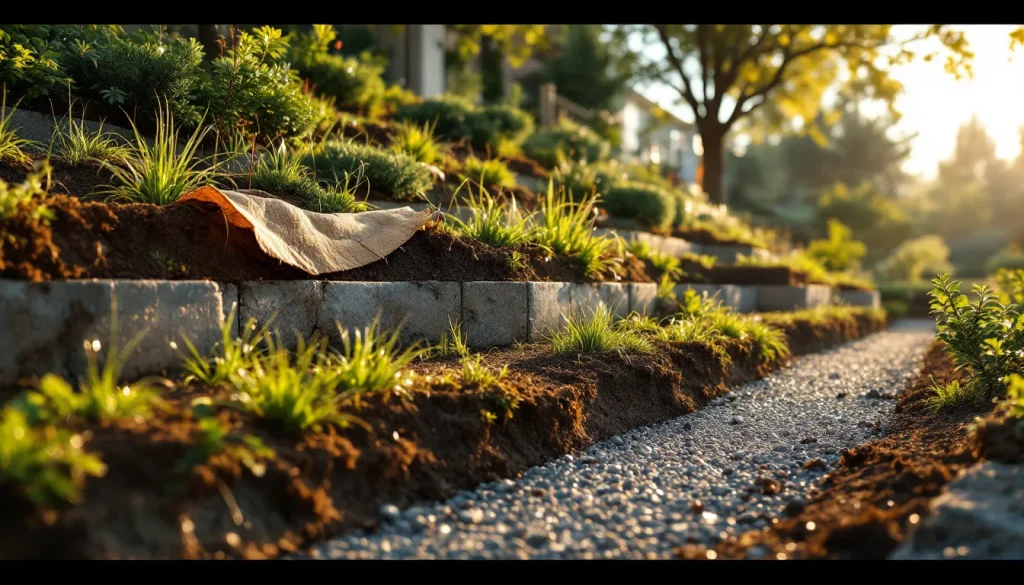
5. Build garden terraces
Terracing carves a steep slope into a staircase of flat, planted beds, each held by a short wall. It converts a slope too steep to mow into usable, plantable space and cuts runoff speed dramatically. Terraces work well on 2:1 grades and are a strong DIY option when each retaining step stays under about 3 feet tall.
Build from the bottom up using landscape timbers, interlocking blocks, or boulders, backfilling each level with soil and gravel for drainage. Keep individual terrace walls low; multiple short walls are safer and easier to permit than one tall wall.
6. Add a retaining wall
A retaining wall physically holds back a slope, breaking one steep face into a stable vertical step. It is the strongest fix for steep grades near a house, driveway, or patio. Segmental concrete block systems are the most DIY-friendly, but height changes everything about the job and the rules.
Walls under about 3 to 4 feet with good drainage are often DIY-achievable. Walls taller than roughly 4 feet typically require an engineered design, geogrid reinforcement, and a permit in many jurisdictions. Every wall needs gravel backfill and a drain pipe behind it, because trapped water is what pushes walls over.
7. Place rocks or riprap
Riprap is a layer of loose, angular rock that armors a slope against fast-moving water. It is the go-to fix for gullies, drainage channels, and the outfall below a downspout or culvert. Angular quarried stone locks together and stays put; smooth river rock rolls and should be avoided on grade.
Excavate a shallow bed, lay landscape fabric or geotextile to block weeds and hold soil, then place stones 6 to 12 inches across, largest at the bottom. Bury the base row below grade so water cannot undercut it. Size the rock to the water flow: faster flow needs bigger stone.
8. Control and divert the runoff
Controlling water is the single most important principle in stopping slope erosion, because moving water is the cause, not the symptom. Redirect roof runoff and uphill drainage away from the slope face before it can cut channels. This step often does more than every plant and blanket combined.
Common tools are downspout extensions that carry roof water past the slope, a swale (a shallow planted channel) that intercepts water across the top, and a French drain (a gravel-filled trench with perforated pipe) that collects and reroutes subsurface flow. Aim to disperse water slowly and spread it out, never concentrate it into one fast stream.
9. Rainscape with low-maintenance native plantings
Rainscaping combines deep-rooted native plants with shallow basins to soak up and slow runoff on steep, hard-to-maintain slopes. It is the lowest-maintenance long-term system because natives, once established, need no fertilizer, little water, and no mowing. Deep native root systems also hold soil better than turfgrass, whose roots rarely exceed a few inches.
Group deep-rooted natives such as switchgrass, little bluestem, black-eyed Susan (Rudbeckia), and butterfly milkweed in drifts across the slope, with a shallow rain garden basin at the base to catch what runs off. During establishment, water new plantings consistently; our guide on how long to water grass and new plantings covers the timing.
How to stop erosion on a sloped driveway
To stop erosion on a sloped driveway, control the water first: crown the surface so water sheds to the sides, then add a channel drain, gravel-filled swale, or riprap-lined ditch along the low edge to carry runoff away. For gravel driveways, larger crushed angular stone and a geotextile base resist washout far better than pea gravel.
Line the downhill edge with plants or riprap so the water leaving the driveway does not cut a gully in the yard below. A driveway concentrates a lot of water fast, so treat it as a high-flow surface and size drains generously.
How to stop a hillside from sliding or slipping
A sliding or slumping hillside signals a deeper problem than surface erosion and often needs professional help. Warning signs include cracks in the ground, tilting trees or fences, and soil that moves in blocks rather than washing away thinly. If you see these, stop DIY work and consult a geotechnical engineer.
What you can do safely: keep water off and out of the slope with diversion drains at the top, avoid adding weight (fill, pools, structures) to the upper slope, and plant deep-rooted vegetation. Structural stabilization of an active slide, using soil nails, geogrid, or engineered walls, is a professional job because failure can threaten a foundation or life safety.
Frequently Asked Questions
What is the cheapest way to stop erosion on a slope?
The cheapest way is a 3-inch layer of shredded mulch, roughly $0.20 to $0.50 per square foot, paired with seeded ground cover. On gentle slopes with sheet erosion, that combination protects bare soil immediately and costs a fraction of blankets, riprap, or walls. For slightly steeper slopes, add a jute or coir erosion blanket over the seed at $0.30 to $1.50 per square foot.
How do you stop erosion on a slope DIY?
Diagnose the erosion type and water source, measure the slope (3:1 or gentler is DIY-friendly), then stabilize in layers: cover bare soil with mulch or an erosion blanket, plant deep-rooted ground covers and shrubs, and divert runoff with a swale or downspout extension. Combine two or three methods. Slopes steeper than 2:1 or showing cracking may need a professional.
How do you place rocks on a slope to stop erosion?
Excavate a shallow bed, lay landscape fabric or geotextile to block weeds and hold soil, then set angular quarried stone 6 to 12 inches across, largest rocks at the bottom. Bury the base row below grade so water cannot undercut it. Use angular riprap, not smooth river rock, and size the stone to the water flow: faster water needs bigger rock.
What are the best plants and ground covers to stop erosion on a hillside?
For sun, use creeping juniper (zones 3-9), creeping phlox, and native switchgrass or little bluestem for deep roots. For shade, use liriope and native ferns. Match every plant to your USDA zone and sun exposure, and favor deep-rooted natives over turfgrass. Avoid crown vetch and periwinkle where your state lists them as invasive.
How steep is too steep to fix a slope yourself, and when do you need a retaining wall or engineer?
Slopes of 3:1 (about 18 degrees) or gentler are generally DIY. At 2:1 (about 27 degrees) you need aggressive cover like blankets plus deep roots or terracing. Steeper than 2:1, or any slope with cracking or block movement, often needs an engineer. Retaining walls taller than about 4 feet typically require an engineered design and permit in many U.S. jurisdictions.
How do you stop water erosion and runoff on a sloped yard?
Cut off the water source first, because moving water causes the erosion. Extend downspouts past the slope, cut a swale across the top to intercept uphill drainage, and install a French drain to reroute subsurface flow. The goal is to slow water and spread it out, never concentrate it into one fast stream. Then add plants and cover to hold the soil.
How do you prevent erosion on a sloped driveway?
Crown the driveway so water sheds to both sides, then add a channel drain or gravel-lined swale along the low edge to carry runoff away. For gravel driveways, use larger angular crushed stone over a geotextile base instead of pea gravel. Line the downhill edge with riprap or plants so the exiting water does not cut a gully in the yard below.
How do you stop a hillside from sliding or slipping?
Keep water off and out of the slope with diversion drains at the top, avoid adding weight to the upper slope, and plant deep-rooted vegetation. But cracks, tilting trees, or soil moving in blocks signal an active slide, which is a geotechnical problem. Stop DIY work and consult a licensed engineer, because failure can threaten a foundation or life safety.