
By the HMNDP Editorial Team. Last reviewed: June 2026.
How is soil formed, in simple terms?
Soil is formed when rock breaks down into mineral particles through weathering, and those particles mix with decaying plants, animals, and microbes to build organic matter. This process runs from the bedrock upward over hundreds to thousands of years. Five factors control it: climate, organisms, relief, parent material, and time, summarized as CLORPT. The result is a layered soil profile.
Put plainly, soil is weathered rock plus dead life. Neither part alone is soil. A pile of crushed stone has no living component, and a heap of leaves has no mineral base. Soil is the slow marriage of the two.
The mineral fraction usually makes up about 45 percent of a healthy topsoil by volume, with roughly 5 percent organic matter and the remaining 50 percent split between air and water (USDA Natural Resources Conservation Service). That mix is why soil can hold water, feed roots, and breathe at the same time.
Stage 1: Weathering breaks the parent rock apart
Soil formation starts when bedrock or other parent material breaks into smaller pieces through weathering. Weathering works three ways: physical (freeze-thaw, heat, abrasion), chemical (water, acids, and oxygen dissolving minerals), and biological (roots prying cracks, lichens releasing acids). This stage produces loose mineral fragments called regolith, the raw mineral skeleton of future soil.
Physical weathering changes size, not chemistry. Water seeps into a crack, freezes, expands about 9 percent, and splits the rock. Repeat that across thousands of winters and granite shatters into gravel and sand.
Chemical weathering changes the minerals themselves. Rainwater is slightly acidic (carbonic acid from dissolved carbon dioxide), so it dissolves feldspar and limestone and turns hard minerals into clays. Warm, wet climates accelerate this sharply.
Biological weathering blends both. Lichens on bare rock secrete organic acids that etch the surface, and the first root hairs widen cracks. These pioneers begin the shift from sterile rock to a surface that can hold life.
Stage 2: Parent material sets the starting ingredients
Parent material is the rock or sediment a soil develops from, and it sets the mineral chemistry of the finished soil. Granite weathers into sandy, acidic soils. Limestone yields alkaline, clay-rich soils. Volcanic ash forms fertile, dark soils. Parent material can sit in place (residual) or arrive by wind, water, or ice (transported).
This is the P in CLORPT, and it explains why two regions in the same climate can grow very different soils. The Iowa corn belt sits on loess, a fine wind-blown silt deposited after the last Ice Age, which is part of why it is so productive.
Transported parent materials matter as much as the local bedrock. Glacial till, river floodplain silt, and windblown dust all become the base for new soils far from where the rock originally formed. The deeper differences in soil chemistry trace back here, which is why the different types of soil map so closely to geology.
Stage 3: Organisms add organic matter and humus
Once mineral fragments exist, living organisms add the organic half of soil. Pioneer plants, fungi, bacteria, earthworms, and decomposers grow, die, and break down into dark, stable organic matter called humus. This stage gives soil its dark color, its nutrients, and its crumbly structure. It is the O in CLORPT (organisms).
The numbers here are large. One teaspoon of healthy topsoil can hold more than a billion bacteria plus yards of fungal threads (USDA NRCS soil biology data). These microbes recycle dead material into plant-available nitrogen, phosphorus, and sulfur.
Earthworms and burrowing insects mix organic matter down into the mineral layers and pull minerals up, blending the two halves of soil. A worm-rich pasture can process several tons of soil per acre through worm guts each year.
Humus is the payoff. It holds water like a sponge, binds particles into crumbs, and stores nutrients on its surfaces. Most of the fertility that gardeners and farmers depend on lives in the top few inches where humus concentrates.
Stage 4: Horizons develop and the soil profile matures
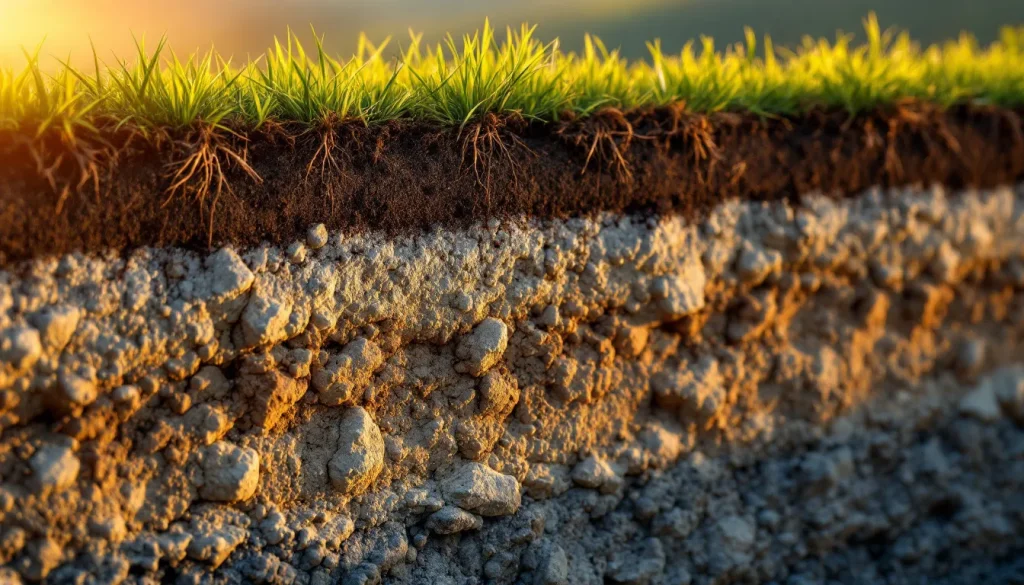
As weathering and organic matter build for centuries, the soil sorts itself into layers called horizons, viewed together as a soil profile. Water moving down carries fine clay and dissolved minerals from upper layers into lower ones. Each horizon forms from a specific step in the process, from fresh leaf litter on top to unweathered bedrock at the base.
The standard sequence from top to bottom is O, A, E, B, C, then R. Each one records a different part of the formation story.
| Horizon | Common name | How it forms |
|---|---|---|
| O | Organic layer | Fresh and decomposing leaves, twigs, and litter pile up at the surface (Stage 3). |
| A | Topsoil | Humus mixes with mineral particles; most roots and biology live here. |
| E | Eluviation layer | Water leaches out clay, iron, and aluminum, leaving a pale, sandy band (not present in all soils). |
| B | Subsoil | Clay and minerals washed down from above accumulate here, often denser and redder. |
| C | Parent material | Partly weathered rock fragments, the regolith from Stage 1, with little biology. |
| R | Bedrock | Solid, unweathered parent rock where the whole process began. |
Young soils may show only an A horizon over C. Mature soils show the full sequence. For a layer-by-layer breakdown, see our guide to soil horizons and the soil profile.
The five factors of soil formation: CLORPT
Soil scientist Hans Jenny formalized the controlling factors in 1941 as the equation behind CLORPT: Climate, Organisms, Relief, Parent material, and Time. These five forces decide how fast soil forms and what kind of soil results. Change any one factor and the finished soil changes, which is why soils differ from one hillside to the next.
| Factor | What it controls | Example effect |
|---|---|---|
| Climate | Rate of weathering and decay | Hot, wet tropics weather rock fastest; cold deserts barely at all. |
| Organisms | Organic matter and nutrient cycling | Grasslands build deep, dark topsoil; bare ground builds little. |
| Relief (topography) | Slope, drainage, and erosion | Steep slopes lose soil to runoff; flat valleys collect deep soil. |
| Parent material | Mineral chemistry and texture | Limestone gives alkaline clay; granite gives sandy, acidic soil. |
| Time | Degree of development | Older surfaces have deeper, more layered profiles. |
Relief deserves a note because it is the factor students forget. On a steep slope, gravity and rain strip particles away before a deep profile can build, so hilltops often have thin soils while the valley below has rich, deep soil made partly of what washed down. Slope also steers water, which controls how wet a soil stays.
How long does soil take to form?
Soil forms slowly. Producing roughly 1 inch (about 2.5 cm) of topsoil takes on the order of 500 to 1,000 years under average conditions, and a mature, fully layered profile can take 3,000 to more than 10,000 years. Rates vary widely: warm, wet climates on soft parent material form soil faster, while cold or dry climates on hard rock form it far slower.
The figures are not precise because formation rate depends on every CLORPT factor at once. Tropical volcanic ash can build usable soil in decades, while bare granite in an arctic desert may show almost no soil after 10,000 years.
| Setting | Approximate rate to form 1 inch of topsoil |
|---|---|
| Warm, wet climate, soft parent material | Faster end: a few hundred years |
| Average temperate conditions | About 500 to 1,000 years |
| Cold or dry climate, hard bedrock | Slower end: well over 1,000 years |
For context, common references including USDA and FAO materials cite roughly 100 to 1,000 years to form a single inch of topsoil, and the FAO has warned that the planet’s soils form far slower than they are being lost.
Why soil is practically non-renewable
Soil is technically renewable but practically non-renewable on a human timescale, because it erodes far faster than it forms. Wind and water can strip an inch of topsoil in a single bad season or a few years of poor management, yet that same inch took centuries to build. The arithmetic is the whole problem: losses are measured in years, gains in millennia.
The FAO and partner agencies estimate the planet loses topsoil to erosion many times faster than it regenerates, and have warned that a large share of the world’s farmable soil is already degraded. The 1930s Dust Bowl stripped huge volumes of topsoil from the US Great Plains in only a few years after plowing exposed it.
This is why erosion control matters so much. Wind alone can carry off exposed topsoil quickly, a process we cover in our guide to wind erosion and how to prevent it. Keeping ground covered with plants or residue is the single most effective defense.
The practical takeaway: the topsoil in a garden or field is an inheritance, not a renewable supply you can replace this decade. Protecting it costs far less than rebuilding it. To go deeper on soil and land science, browse the HMNDP learning hub.
Frequently Asked Questions
How is soil formed, in simple terms?
Soil forms when rock breaks down into tiny mineral particles through weathering, and those particles mix with decaying plants, microbes, and animals to make organic matter. The process builds from bedrock upward over hundreds to thousands of years. Five factors control it (climate, organisms, relief, parent material, and time), and the result is a layered soil profile.
What are the five factors of soil formation (CLORPT)?
CLORPT stands for Climate, Organisms, Relief, Parent material, and Time, the five factors soil scientist Hans Jenny formalized in 1941. Climate drives weathering speed, organisms add organic matter, relief (slope) controls erosion and drainage, parent material sets the mineral chemistry, and time determines how developed the soil becomes. Together they explain why soils differ from place to place.
How long does it take for soil to form?
Forming about 1 inch (2.5 cm) of topsoil typically takes 500 to 1,000 years, and a full, layered soil profile can take 3,000 to over 10,000 years. Rates depend on climate and parent material. Warm, wet conditions on soft material form soil fastest, while cold or dry climates on hard bedrock form it extremely slowly.
What is the difference between weathering and soil formation?
Weathering is only the first step: it breaks rock into loose mineral fragments (regolith). Soil formation is the whole process, including weathering plus the addition of organic matter, the action of organisms, and the development of distinct layers (horizons). Weathered rock alone is not soil until living material and structure develop within it over time.
What is parent material in soil formation?
Parent material is the rock or sediment a soil develops from, and it sets the soil’s mineral chemistry and texture. It can be the bedrock directly below (residual) or material moved in by wind, water, or ice (transported), such as glacial till, river silt, or windblown loess. Granite forms sandy acidic soil; limestone forms alkaline clay soil.
How do soil horizons (layers) form?
Horizons form as soil matures and water moves through it. Organic litter builds the O horizon on top, humus mixes into the A horizon (topsoil), water leaches minerals out of the E horizon and deposits them in the B horizon (subsoil) below. The C horizon is weathered parent material, and R is solid bedrock at the base.
Can soil be made faster or artificially?
People can speed up some steps but cannot match natural topsoil quickly. Adding compost, manure, and cover crops builds organic matter and structure within years, and engineered growing media can be manufactured. However, the full mineral weathering and horizon development that create true soil still take centuries. Building organic matter is realistic; rebuilding lost deep topsoil on demand is not.
Is soil a renewable resource?
Soil is technically renewable but practically non-renewable on a human timescale. It can erode in years yet takes centuries to millennia to form, so losses outpace gains by a wide margin. The FAO warns that global topsoil is being lost far faster than it regenerates. For practical purposes, existing topsoil should be treated as a finite resource worth protecting.