
By the HMNDP Editorial Team, independent reporting on lawn care, landscaping, and the green-industry business.
Last reviewed: June 2026
What power washing services cost in 2026
Power washing services in 2026 typically run $0.15 to $0.80 per square foot, or roughly $200 to $600 for an average single-family home exterior. Driveways average $130 to $260, decks $250 to $600, and whole-house soft washing $350 to $700. Pricing depends on surface, square footage, height, dirt severity, and your region. Most reputable providers quote per job, not per hour.
Pricing is the single biggest gap in the current search results, so here are real ranges by service. Treat these as national midpoints; coastal and high-cost-of-living metros (Boston, San Francisco, New York) often sit 20 to 40 percent higher.
| Service | Typical price range | Common unit |
|---|---|---|
| House siding (soft wash) | $350 – $700 | $0.20 – $0.45 / sq ft |
| Driveway / sidewalk | $130 – $260 | $0.15 – $0.35 / sq ft |
| Roof washing (soft wash) | $400 – $900 | $0.30 – $0.60 / sq ft |
| Deck or patio | $250 – $600 | $0.25 – $0.60 / sq ft |
| Fence | $150 – $400 | $0.20 – $0.45 / sq ft |
| Full exterior package | $500 – $1,200 | Per job |
Three factors push you toward the high end: two-story or three-story height (more time, ladders, lifts), heavy organic growth like algae and mildew, and surfaces needing soft washing with chemical treatment rather than plain water. Always confirm whether the quote includes a biocide treatment for algae, because rinsing alone often lets it return within weeks.
What power washing / pressure washing services are
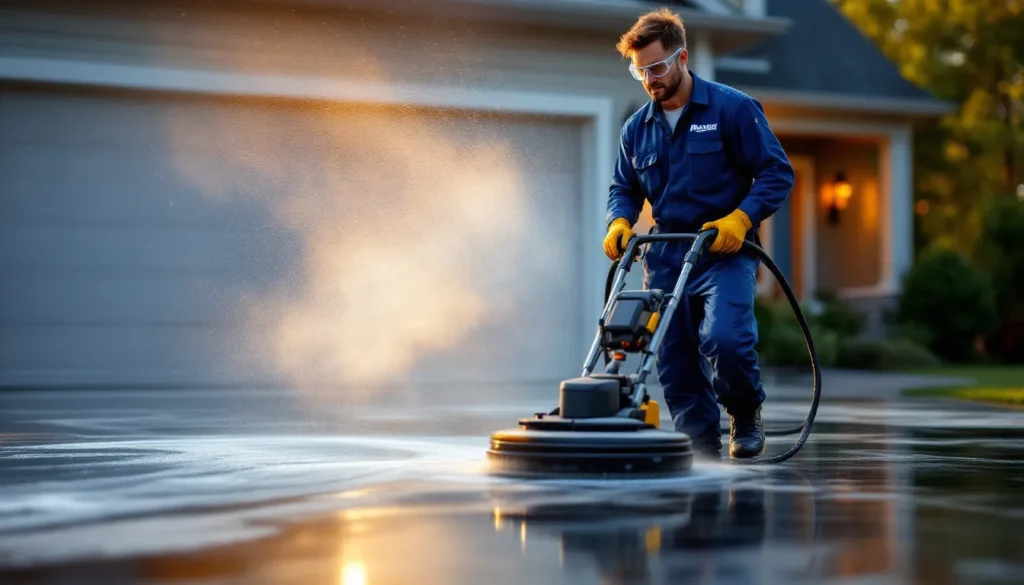
Power washing services use pressurized water, sometimes heated and often combined with detergents, to remove dirt, algae, mold, mildew, grime, and stains from exterior surfaces. The work covers siding, roofs, driveways, sidewalks, patios, decks, and fences. The term “power washing” technically means heated pressurized water; “pressure washing” means unheated. In practice, most companies use the terms interchangeably.
The core machine matters. Consumer units run 1,300 to 2,800 PSI (pounds per square inch). Professional gas units reach 3,000 to 4,000+ PSI with higher GPM (gallons per minute) flow, which clears large flatwork far faster. Professionals also carry surface cleaners, soft-wash systems, and chemical injectors that a typical homeowner rental does not include.
Residential vs commercial power washing
Residential power washing covers homes: siding, driveways, decks, patios, fences, and roofs, usually completed in one visit of 2 to 5 hours. Commercial power washing covers storefronts, parking lots, drive-thrus, dumpster pads, building facades, and fleet vehicles, often on recurring contracts. Commercial jobs require higher-capacity equipment, water reclamation for EPA stormwater compliance, and liability coverage at larger limits.
Small commercial property owners (strip retail, restaurants, offices) sit between the two. They benefit from scheduled quarterly cleaning, especially for grease near food-service entrances and gum or stains on high-traffic walkways. If you own a small commercial site, ask whether the provider carries the higher insurance limits and wastewater-capture gear that municipal codes may require.
Surfaces and services covered
A full-service power washing company cleans house siding, roofs, driveways, sidewalks, patios, decks, and fences. Each surface needs a different method and pressure. Hard, durable surfaces (concrete, brick, pavers) tolerate high pressure. Delicate or porous surfaces (shingles, painted wood, stucco, vinyl seams) need low-pressure soft washing to avoid permanent damage.
- House siding: vinyl, fiber cement, brick, and stucco, usually soft washed to protect seams and paint.
- Roof washing: almost always soft wash with an algaecide; high pressure strips asphalt granules and voids many shingle warranties.
- Driveways and sidewalks: concrete and pavers handle high PSI with a flat-surface cleaner for even results.
- Patios and decks: composite and stone take moderate pressure; aged wood needs low pressure and the grain direction respected.
- Fences: vinyl and metal take more pressure; wood fences need restraint to avoid splintering.
Soft washing vs high-pressure washing
Soft washing uses low pressure (under 500 PSI) plus cleaning solutions (often sodium hypochlorite and surfactants) to kill and remove algae, mold, and mildew at the root. High-pressure washing relies on water force alone, usually 2,500 to 4,000 PSI, to blast off dirt. Soft washing suits roofs, siding, and painted wood; high pressure suits concrete, brick, and pavers.
The difference is not cosmetic. High pressure on a shingle roof can dislodge granules and shorten its life. On vinyl siding, it can force water behind panels and into wall cavities. Soft washing also lasts longer on organic growth because the biocide kills spores, so regrowth takes months instead of weeks. A competent provider chooses the method per surface rather than blasting everything at full power.
When NOT to pressure wash
Avoid high-pressure washing on asphalt shingle roofs, aged or peeling paint, soft or rotted wood, older mortar, stucco, and anything with electrical fixtures or open seams nearby. These surfaces should be soft washed or hand cleaned. High pressure on the wrong surface causes water intrusion, paint loss, granule loss, and wood damage that costs more to repair than the cleaning saved.
Timing matters too. In northern climates, schedule exterior washing in spring or fall when temperatures stay above 40°F so detergents work and surfaces dry. Avoid washing painted wood right before repainting unless you allow several days to dry fully. If your roof shows black streaks (Gloeocapsa magma algae), that is a soft-wash job, not a pressure-wash job. This decision layer is exactly what thin directory pages omit, and getting it wrong is the most common DIY mistake.
How to find power washing services near you
To find reliable power washing services near you, search “power washing near me,” then cross-check candidates on Google Business Profile, Yelp, Angi, and Thumbtack for star ratings and review volume. Prioritize providers with 50+ reviews, a 4.5+ average, recent activity in the past 90 days, and a verified local address. Community lists and neighborhood apps like Nextdoor add useful local signal.
Get at least three written quotes for the same scope so you compare like for like. The same vetting discipline applies across home services; our guide on how to find a reputable landscaper walks through the review-reading and reference-checking steps that transfer directly to power washing. For ongoing exterior and yard upkeep, see our roundup of the best lawn care services for 2026.
How to choose a reputable power washing company
Choose a power washing company by verifying licensing, liability insurance, written quotes, equipment, and a satisfaction guarantee. Confirm the provider carries general liability coverage (commonly $500,000 to $1,000,000) and, where required, workers’ compensation. Ask which method they use per surface, whether biocide treatment is included, and what happens if a surface is damaged. Reputable firms put scope, price, and guarantees in writing.
| Vet for this | Red flag to avoid |
|---|---|
| Written, itemized quote | Verbal-only “ballpark” price |
| Proof of liability insurance | “We don’t need insurance for this” |
| Soft wash offered for roofs/siding | High pressure on everything |
| 50+ recent reviews, 4.5+ rating | No online presence or all 5-star, no detail |
| Local address and phone | Door-to-door, cash only, today-only deal |
Treat large door-to-door discounts, cash-only demands, and pressure to sign immediately as warning signs. Ask for a certificate of insurance naming you, and confirm the crew (not just the owner) is covered. Independent publishers track service quality across the home and yard space; our learn hub collects buyer guides that use the same evidence-led approach.
How often to power wash, and is a pro worth it
Wash house siding every 1 to 2 years, driveways and walkways annually, and roofs every 2 to 4 years (soft wash only). Humid, shaded, or coastal homes need more frequent cleaning because algae and mildew grow faster. Professional power washing is usually worth it for two-story homes, roofs, and large flatwork, where height, equipment, and chemical handling make DIY risky and slow.
| Approach | Typical cost | Best for |
|---|---|---|
| DIY rental | $40 – $100 / day + supplies | Small patios, single-story siding, fences |
| Buy a consumer washer | $150 – $500 one time | Frequent light cleaning, ground-level surfaces |
| Hire a professional | $200 – $1,200 / job | Roofs, two-story siding, large driveways, soft washing |
DIY makes sense for ground-level, durable surfaces if you respect pressure limits and wear eye protection. Hire a pro when the job involves heights, roofs, biocide chemicals, or warranty-sensitive surfaces. The repair cost from one wrong pass on a shingle roof or painted siding often exceeds several years of professional cleaning. For more independent green-industry coverage, see our news hub.
Scheduling and requesting a quote
To request a power washing quote, list each surface, its approximate square footage, the home’s stories, and any problem areas (algae streaks, oil stains, mildew). Send that to three local providers and ask for an itemized written estimate including method, chemicals, and guarantee. Many companies offer free on-site or photo-based quotes and can schedule within 1 to 2 weeks during the spring and summer peak.
Book early in the season. From April through July, reputable crews fill up fast, and last-minute requests get pushed or priced higher. Confirm payment terms (deposit vs on completion), rain-delay policy, and whether you need to clear vehicles, move furniture, or close windows before the crew arrives.
Frequently Asked Questions
How much do power washing services cost per square foot and per job?
Power washing services cost about $0.15 to $0.80 per square foot, or roughly $200 to $600 for a typical home exterior. Driveways run $130 to $260, decks $250 to $600, and roof soft washing $400 to $900. Price varies by surface, square footage, home height, dirt severity, and region, with coastal and high-cost metros often 20 to 40 percent higher.
What is the difference between power washing and pressure washing?
Power washing uses heated pressurized water, while pressure washing uses unheated water; heat helps cut grease and stubborn grime faster. In everyday practice, most companies use the two terms interchangeably and the equipment overlaps. The more meaningful distinction for your home is soft washing (low pressure plus cleaners) versus high-pressure washing, which determines surface safety.
What surfaces can and cannot be power washed?
High pressure is safe on concrete, brick, pavers, and most driveways. It should not be used on asphalt shingle roofs, aged or peeling paint, soft wood, stucco, or older mortar; those need soft washing or hand cleaning. Vinyl siding is best soft washed to avoid forcing water behind panels. Matching method to surface prevents granule loss, paint damage, and water intrusion.
What is included in a residential power washing service?
A residential power washing service usually includes cleaning of siding, driveways, sidewalks, patios, decks, and fences, with roofs as a soft-wash add-on. Reputable providers include a pre-rinse, detergent or biocide application for organic growth, the wash itself, and a final rinse. Confirm whether algae treatment, gutter brightening, and surface sealing are included or priced separately.
How do I find reliable power washing services near me?
Search “power washing near me,” then verify candidates on Google Business Profile, Yelp, Angi, and Nextdoor. Favor providers with 50+ reviews, a 4.5+ rating, recent jobs, and a verified local address. Request three written quotes for the same scope. Reading reviews and checking references the same way you would vet a landscaper filters out unreliable operators quickly.
How do I choose a reputable power washing company?
Verify licensing where required, confirm general liability insurance (often $500,000 to $1,000,000), and get an itemized written quote. Ask which method they use per surface, whether biocide is included, and how damage is handled. Avoid cash-only, door-to-door, today-only pitches with no insurance or online reviews. Written scope, transparent pricing, and a satisfaction guarantee signal a trustworthy provider.
How often should you power wash your house, driveway, and roof?
Wash siding every 1 to 2 years, driveways and sidewalks annually, and roofs every 2 to 4 years using soft washing only. Homes in humid, shaded, or coastal areas need more frequent cleaning because algae and mildew grow faster. Regular cleaning protects surfaces and prevents organic buildup from becoming a costly restoration job later.
Is professional power washing worth it versus doing it yourself?
Professional power washing is worth it for roofs, two-story siding, large driveways, and any soft-wash job involving chemicals or heights, where DIY is slow and risky. DIY rentals ($40 to $100 per day) make sense for small, ground-level, durable surfaces. One wrong high-pressure pass on a shingle roof or painted siding can cost more to repair than years of professional cleaning.