
By the HMNDP Editorial Team, independent reporting on lawn care, landscaping, and the green-industry business.
Last reviewed: June 2026
What landscape maintenance services include
Landscape maintenance services are the recurring, scheduled upkeep of a property’s lawn, plants, and hardscape, billed per visit or by monthly contract. A standard package covers mowing, edging, string trimming, weed control, fertilization, mulch refresh, shrub and tree pruning, and seasonal cleanups. The work keeps an existing landscape healthy and tidy. It does not include design or new installation.
Most providers bundle these tasks into tiers. A basic tier handles turf only (mow, edge, trim, blow). A full grounds-care tier adds beds, plants, fertilization programs, irrigation checks, and seasonal cleanups across the whole site.
Core services: mowing, edging, and trimming
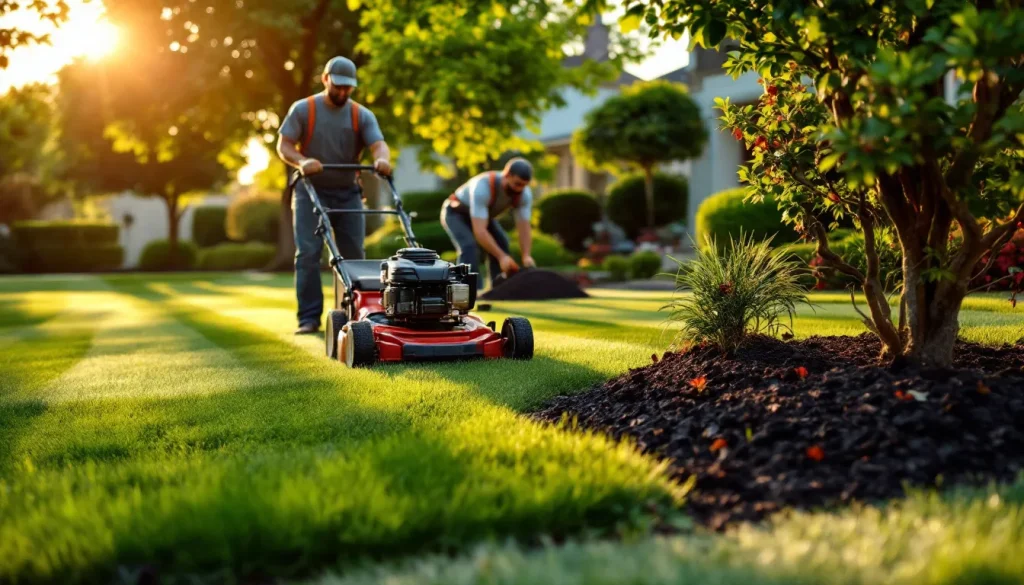
Mowing, edging, and trimming form the backbone of every landscape maintenance plan and appear on nearly every per-visit invoice. Mowing cuts turf to a species-correct height (often 3 to 4 inches for cool-season grass). Edging defines clean lines along walks and beds. Trimming, or string trimming, reaches fence lines, tree bases, and tight corners a mower cannot. A final blow-down clears clippings from hard surfaces.
Crews typically complete this turf cycle in one visit. On a quarter-acre residential lot, that is roughly 20 to 40 minutes of labor. Cutting too short (scalping) stresses grass and invites weeds, so reputable crews follow the one-third rule: never remove more than one-third of blade height per cut.
Plant, shrub, and tree care plus pruning
Plant care covers pruning shrubs, shaping ornamentals, removing deadwood, and light tree work on branches reachable from the ground. Pruning timing depends on species: most spring-flowering shrubs are cut right after bloom, while summer bloomers and many evergreens are pruned in late winter dormancy. Proper cuts improve airflow, shape, and bloom.
Maintenance providers usually handle shrubs and small ornamental trees. Large tree removal, climbing work, or anything near power lines is a separate certified-arborist job, often referred to a licensed tree service for liability and insurance reasons.
Fertilization and weed control
Fertilization and weed control are sold as a multi-application program, typically four to six rounds per year, separate from mowing. A program times pre-emergent herbicide in early spring, balanced fertilizer through the growing season, broadleaf weed control as needed, and a winterizer feed in fall. Soil tests guide nutrient ratios.
Many states regulate who may apply restricted-use pesticides and fertilizer. Applicators may need a state pesticide-applicator license depending on the chemicals and the jurisdiction, so it is reasonable to ask a provider for their license number before they treat your turf.
Mulching and mulch installation
Mulching is the seasonal application of bark, wood chips, or rock to planting beds to hold moisture, suppress weeds, and finish the look. Most properties get one refresh per year, usually in spring, at a depth of 2 to 3 inches. Beds are edged and weeded first, then mulch is spread by hand or wheelbarrow.
Mulch is priced by the cubic yard plus labor. One cubic yard covers roughly 100 to 110 square feet at 3 inches deep, which makes it easy to estimate a bed-by-bed quote.
Seasonal cleanups (spring and fall)
Seasonal cleanups are intensive once-or-twice-a-year visits that reset the property for the growing or dormant season. A spring cleanup clears winter debris, cuts back perennials, edges beds, and applies first-round mulch and fertilizer. A fall cleanup removes leaves, cuts back spent growth, and protects plants before frost.
These are billed separately from routine mowing because they take far more labor. Common line items in a seasonal cleanup include:
- Leaf removal and hauling
- Cutting back perennials and ornamental grasses
- Bed edging and weeding
- Gutter-adjacent debris clearing (where offered)
- Final mulch top-up and dormant fertilization
How much landscape maintenance services cost
Landscape maintenance services typically cost $100 to $250 per visit for a residential lot, or $150 to $500 per month for a recurring plan, in 2026. Commercial grounds care runs higher and is often priced per acre. Exact pricing depends on lot size, service scope, frequency, and region, so treat these as planning ranges, not quotes.
The table below shows typical 2026 ranges. Figures are estimates and may vary by market and property condition.
| Service | Residential range | Commercial range | Billing basis |
|---|---|---|---|
| Basic mow, edge, trim | $40 to $90 | $100 to $300+ | Per visit |
| Full maintenance plan | $150 to $500 | $500 to $5,000+ | Per month |
| Fertilization and weed program | $300 to $700 | Quoted per acre | Per year (4 to 6 rounds) |
| Mulch (installed) | $60 to $120 | $60 to $120 | Per cubic yard |
| Spring or fall cleanup | $200 to $600 | $500 to $3,000+ | Per event |
| Acreage mowing | n/a | $50 to $150 | Per acre, per visit |
For a broader market view of pricing and bundling, see our roundup of the best lawn care services in 2026.
How often landscape maintenance should be done
Routine landscape maintenance is usually done weekly during peak growing season, dropping to bi-weekly or monthly in slower periods. Most residential plans run weekly from spring through early fall, then taper. Add-on tasks like fertilization, pruning, and cleanups follow a separate seasonal calendar rather than the mowing cycle.
The calendar below maps cadence to service line items so you can match a quote to actual visits.
| Frequency | Typical services | Season |
|---|---|---|
| Weekly | Mow, edge, trim, blow | Peak growth (late spring to early fall) |
| Bi-weekly | Mow, edge, trim, light weeding | Slow growth, cooler months |
| 4 to 6 times per year | Fertilization and weed control rounds | Spring through fall |
| 1 to 2 times per year | Pruning, mulch refresh | Dormancy or post-bloom |
| 2 times per year | Spring and fall cleanups | Season transitions |
Routine vs. full grounds care scope
Routine maintenance is turf-only upkeep (mow, edge, trim, blow) on a fixed cycle. Full grounds care is a comprehensive program that adds beds, plant health, fertilization, irrigation checks, seasonal cleanups, and often hardscape upkeep. The difference is scope and price: routine keeps the lawn cut, while full grounds care manages the entire landscape as a system.
Choose routine if you handle beds and plants yourself and only need mowing. Choose full grounds care if you want one provider accountable for the whole property’s appearance and health.
Residential vs. commercial landscape maintenance
Residential landscape maintenance serves homes and small lots with simple scheduling and per-visit or monthly billing. Commercial landscape maintenance serves offices, retail, HOAs, and campuses under formal contracts with defined service-level agreements, higher insurance limits, and per-acre or fixed-annual pricing. Commercial work emphasizes liability, consistency, and scale that residential plans rarely require.
| Factor | Residential | Commercial |
|---|---|---|
| Contract | Per visit or month-to-month | Annual contract with SLA |
| Pricing basis | Per visit or flat monthly | Per acre or fixed annual |
| Insurance | Basic general liability | Often $1M+ liability, workers comp |
| Scheduling | Flexible | Fixed windows, off-hours |
| Scope | Lawn and beds | Grounds, snow, irrigation, safety |
For property managers, the stakes include slip-and-fall liability and tenant-facing curb appeal. Read our deeper guide to commercial landscaping for SLA and bidding detail.
Commercial grounds maintenance as its own tier
Commercial grounds maintenance is a distinct service tier built around contracts, liability, and scale, not just a bigger residential plan. Providers bid annual or multi-year agreements with written service-level agreements, carry higher insurance, and assign account managers. Pricing is commonly per acre or a fixed annual figure split into equal monthly payments for budget predictability.
Key commercial-only elements buyers should confirm in a contract:
- SLA terms: response times, mowing windows, and quality standards in writing.
- Insurance limits: general liability (often $1M or more) plus workers compensation; request a certificate of insurance.
- Scope add-ons: snow and ice management, irrigation audits, parking-lot sightline trimming, and safety compliance.
- Reporting: site visit logs and a single point of contact for multi-property portfolios.
Is a maintenance contract worth it versus paying per visit?
A landscape maintenance contract is usually worth it for predictable budgeting, priority scheduling, and locked seasonal rates, while per-visit makes sense for occasional or one-off needs. Contracts often bundle mowing, fertilization, and cleanups at a lower combined rate than buying each separately. Per-visit offers flexibility but no rate protection and lower scheduling priority.
Read contract terms for auto-renewal clauses, cancellation notice periods, and what counts as an extra-cost add-on before signing.
What to look for when hiring a provider
The best landscape maintenance company is licensed, insured, references its work, and gives a written scope and price. Use a consistent screening process so quotes are comparable. The questions below separate professional operators from unreliable ones and surface red flags early.
- Are you licensed for pesticide and fertilizer application in this state?
- Can you provide a current certificate of general liability and workers comp insurance?
- Is the quote per visit, monthly, or annual, and what exactly is included?
- What is your mowing height and frequency during peak season?
- Which tasks are extra-cost add-ons (cleanups, mulch, pruning)?
- Do you use in-house crews or subcontractors?
- Can you share three local references or reviews?
- What is the contract term, renewal, and cancellation policy?
- Who is my point of contact for issues?
- What is your re-service policy if work misses standard?
Red flags: no proof of insurance, cash-only or no written contract, no local references, vague scope, and pressure to sign same-day. For a full vetting walkthrough, see how to find a reputable landscaper, and use the buyer checklists in the HMNDP playbook.
Finding local landscape maintenance providers
Local availability matters because pricing, grass species, and seasonal timing vary by region, and most maintenance providers operate within a defined service radius. Search by your city or ZIP, confirm the provider services your address, and verify local licensing. A nearby crew also responds faster for re-service and weather-driven scheduling.
Compare at least three local quotes on the same scope. Ask each for proof of insurance and a written estimate so you are comparing identical line items, not headline prices.
Frequently Asked Questions
What do landscape maintenance services include?
Landscape maintenance services include mowing, edging, string trimming, and blow-down on a routine cycle, plus fertilization and weed control, mulch refresh, shrub and tree pruning, and spring and fall cleanups. Basic plans cover turf only. Full grounds-care plans add beds, plant health, irrigation checks, and hardscape upkeep, managing the whole property rather than just the lawn.
How much do landscape maintenance services cost per month?
A residential landscape maintenance plan typically costs $150 to $500 per month in 2026, depending on lot size, scope, and frequency. Commercial grounds care often runs $500 to $5,000+ monthly, usually priced per acre or as a fixed annual figure split into equal payments. These are planning ranges; get three local quotes on identical scope for accurate pricing.
What is the difference between landscaping and landscape maintenance?
Landscaping is design and installation: building new beds, planting, hardscape, and grading to create a landscape. Landscape maintenance is the recurring upkeep that keeps an existing landscape healthy and tidy through mowing, pruning, fertilization, and cleanups. Landscaping is a one-time or project-based service, while maintenance is an ongoing weekly, monthly, or seasonal program billed per visit or by contract.
How often should landscape maintenance be done?
Routine landscape maintenance is usually done weekly during peak growing season, then bi-weekly or monthly as growth slows. Fertilization and weed control follow a separate schedule of four to six rounds per year. Pruning and mulch happen one to two times annually, and major cleanups occur twice a year in spring and fall. Cadence depends on climate, grass species, and property size.
What is the difference between residential and commercial landscape maintenance?
Residential landscape maintenance serves homes with flexible per-visit or monthly billing and basic insurance. Commercial landscape maintenance serves offices, retail, HOAs, and campuses under annual contracts with written service-level agreements, higher insurance limits (often $1M+), fixed scheduling windows, and per-acre or fixed-annual pricing. Commercial work prioritizes liability protection, consistency, and the scale that larger properties and tenant traffic require.
Is a landscape maintenance contract worth it versus paying per visit?
A contract is usually worth it for predictable budgeting, priority scheduling, and locked seasonal rates, and it often bundles services at a lower combined cost. Per-visit billing suits occasional or one-off needs and offers flexibility but no rate protection. Before signing, check for auto-renewal clauses, cancellation notice periods, and which tasks count as extra-cost add-ons.
What should I look for when hiring a landscape maintenance company?
Look for a licensed, insured provider that gives a written scope and price, uses in-house crews, and supplies local references. Confirm pesticide and fertilizer licensing, request a current certificate of insurance, and clarify which tasks are add-ons. Red flags include cash-only deals, no written contract, no proof of insurance, vague scope, and pressure to sign the same day.
What services are included in a seasonal cleanup?
A seasonal cleanup includes leaf and debris removal and hauling, cutting back perennials and ornamental grasses, bed edging and weeding, and a final mulch top-up. Spring cleanups also apply first-round fertilizer and pre-emergent weed control, while fall cleanups protect plants before frost. Cleanups are billed separately from routine mowing because they require substantially more labor per visit.