
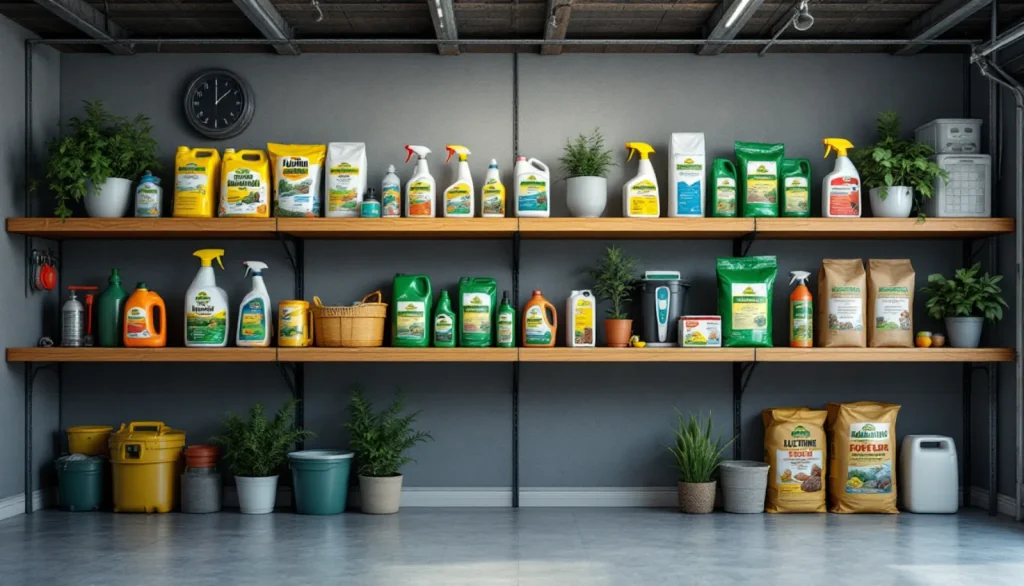
The honest short list of lawn care products a professional carries in 2026 is shorter than the shelf at Lowe’s by about an order of magnitude. Most full-service techs from Lawn Doctor or Spring-Green run their entire year on 14 SKUs. The rest is up-sell. This guide walks through those 14 essentials by category (fertilizer, pre-emergent, post-emergent, grub control, soil amendments, seed, biostimulants, and tools), with current 2026 pricing per unit and per 1,000 square feet, so you can sanity-check both the shelf and the service quote you got from TruGreen.
The short version
- Fertilizer essentials: Scotts Turf Builder, Milorganite, Lesco 24-0-11 PolyOn, Yard Mastery 24-0-6, Andersons 18-24-12 starter
- Pre-emergent: prodiamine concentrate (Quali-Pro or Hi-Yield) and Scotts Halts pendimethalin
- Post-emergent: Speedzone (broadleaf), Tenacity (mesotrione for grassy + broadleaf), Roundup (spot non-selective)
- Grub control: Acelepryn (chlorantraniliprole) is the gold standard; GrubEx is the consumer version
- Soil amendments: pelletized lime, gypsum, and humic acid liquid (Anderson’s Humic DG)
- Pro full-year cost for these 14 SKUs on a 5,000 sq ft lawn: about $315 to $410; consumer-equivalent: $250 to $360 from Scotts/Sunday/Yard Mastery
The 14 essentials, ranked by how often a pro tech opens the bag
| # | Product | Category | 2026 price | Coverage |
|---|---|---|---|---|
| 1 | Lesco 24-0-11 PolyOn 50 lb | Slow-release N | $42 at SiteOne | 15,000 sq ft |
| 2 | Scotts Turf Builder 32-0-4 (12.5K bag) | Slow-release N | $58 at Lowe’s | 12,500 sq ft |
| 3 | Milorganite 6-4-0 (32 lb) | Organic N + iron | $19 at Home Depot | 2,500 sq ft |
| 4 | Yard Mastery 24-0-6 + humic (45 lb) | Slow-release N + biostim | $54 direct | 13,500 sq ft |
| 5 | Andersons 18-24-12 Starter (40 lb) | Seeding fert | $38 at SiteOne | 10,000 sq ft |
| 6 | Prodiamine 65 WDG (5 lb jar) | Pre-emergent | $135 at DoMyOwn | ~5 acres at full rate |
| 7 | Scotts Halts pendimethalin (15 lb) | Pre-emergent (consumer) | $42 at Home Depot | 5,000 sq ft |
| 8 | Speedzone (1 gallon) | Post-emergent broadleaf | $135 at SiteOne | ~3 acres at 4 oz/M |
| 9 | Tenacity (8 oz mesotrione) | Selective broad-spectrum | $98 at DoMyOwn | ~1.5 acres at 5 oz/A |
| 10 | Roundup Pro Concentrate (2.5 gal) | Non-selective spot | $118 at SiteOne | Spot use, lasts years |
| 11 | Acelepryn G (30 lb) | Grub preventive | $135 at SiteOne | 15,000 sq ft |
| 12 | Pelletized lime (40 lb) | pH correction | $8 at Home Depot | 1,000 sq ft |
| 13 | Andersons Humic DG (40 lb) | Biostimulant | $48 at SiteOne | 10,000 sq ft |
| 14 | Jonathan Green Black Beauty Ultra (50 lb) | Cool-season seed | $155 at retail | 10,000 sq ft new, 20K overseed |
Fertilizers: where the real spend goes
Fertilizer is 60 to 70 percent of the annual product budget on a residential lawn. The category breaks into three tiers: pro (Lesco, Andersons, Pennington Pro), prosumer direct-to-consumer (Yard Mastery, Sunday, Greenview), and consumer (Scotts, Milorganite, Vigoro). The functional difference is the slow-release percentage and the pellet uniformity, not the NPK itself.
Slow-release percentage matters because it determines burn risk and longevity. Lesco 24-0-11 PolyOn is roughly 50 percent slow-release (polymer-coated urea) and releases nitrogen over 8 to 10 weeks at warm soil temps. Scotts Turf Builder is roughly 30 percent slow-release. Milorganite is 100 percent slow-release because it is heat-dried microbial biomass, but the N concentration is only 6 percent. The math on what to use:
| Product | NPK | Slow-release % | Lbs of product for 1.0 lb N/1,000 sq ft |
|---|---|---|---|
| Lesco 24-0-11 PolyOn | 24-0-11 | ~50% | 4.2 lbs |
| Scotts Turf Builder 32-0-4 | 32-0-4 | ~30% | 3.1 lbs |
| Milorganite 6-4-0 | 6-4-0 | 100% | 16.7 lbs |
| Yard Mastery 24-0-6 + humic | 24-0-6 | ~45% | 4.2 lbs |
| Andersons 18-24-12 Starter | 18-24-12 | ~25% | 5.6 lbs (use for seeding only) |
Bag math is consistent: lbs of product per 1,000 sq ft = 100 / (first NPK number). For a 5,000 sq ft lawn at a 1.0 lb N application rate, you need 5x the table value. For deeper NPK ratio guidance, the NPK fertilizer guide covers it. Cost per application on that 5,000 sq ft lawn ranges from $18 (Lesco bulk) to $35 (Scotts retail). For the per-product treatment programs that bundle these, see our lawn care treatment guide.
Pre-emergent: prodiamine is the workhorse
The professional standard for pre-emergent crabgrass control is prodiamine (Barricade is the trade name, Quali-Pro Prodiamine 65 WDG is the generic). A 5-lb jar costs $135 at DoMyOwn and treats roughly 5 acres at the residential rate. That is about $3 per 5,000 sq ft per application, or 1/15 the cost of consumer pre-emergent like Scotts Halts. The consumer barrier is the sprayer requirement and the EPA FIFRA label. Apply at forsythia bloom in spring (soil temps reaching 55°F for 5 days) and again 8 to 10 weeks later for full season control. See our best lawn treatment guide for more.
Dimension (dithiopyr) is the alternative for pros who want a slightly later application window. It controls crabgrass that has already emerged (up to 1 to 2 leaf stage) where prodiamine does not. Costs are similar. For consumer-grade products, Scotts Halts (pendimethalin) at $42 per 15-lb bag covers 5,000 sq ft and is the easiest beginner pre-emergent. It is half as effective as prodiamine per dollar but doesn’t require a sprayer. See our lawn care news guide for more.
Post-emergent: Speedzone and Tenacity cover 90 percent of cases
Speedzone (carfentrazone + 2,4-D + mecoprop + dicamba) is the broadleaf workhorse for clover, dandelion, plantain, henbit, and chickweed. Mix at 1 to 1.5 oz per gallon for spot spraying, apply at temperatures between 50°F and 85°F (above 85, you risk turf damage; below 50, the active ingredients don’t translocate). Speedzone results show in 24 to 48 hours, which is unusually fast and the main reason pros prefer it over generic 2,4-D blends. See our lawn care guide guide for more.
Tenacity (mesotrione) is the closest thing turf has to a do-it-all selective herbicide. It controls crabgrass, nutsedge, clover, dandelion, foxtail, and most broadleaves in cool-season turf. It bleaches the targeted weeds white for 14 to 21 days before they die, which freaks out homeowners but is the mechanism (mesotrione blocks chlorophyll synthesis). At $98 per 8-oz bottle, one bottle lasts a pro tech 1 to 2 years on residential routes. See our scotts lawn care program guide for more.
Roundup (glyphosate) is the non-selective spot tool for fence lines, cracks, bed edges, and lawn renovation kill-offs. Pro Concentrate at 41 percent glyphosate is the standard formulation. Skip the “extended control” versions for lawn renovations because the residual prevents reseeding for 4 to 6 weeks.
Grub control: Acelepryn is the only one that matters
Acelepryn (chlorantraniliprole) is the post-2010 grub control standard. One preventive application in April through June controls grubs for the entire season at a fraction of the toxicity of imidacloprid (the old standard). At $135 per 30-lb bag of granular Acelepryn G covering 15,000 sq ft, the per-application cost on a 5,000 sq ft lawn is about $45. GrubEx (the consumer version, chlorantraniliprole at lower concentration) runs $28 to $45 per bag covering 5,000 to 10,000 sq ft.
The decision tree: if you had grub damage last year or grub-damaged neighbors, apply Acelepryn preventively in May to June. If you are not seeing damage, skip it. Curative applications after damage is visible require trichlorfon (Dylox) and rarely save the lawn that season.
Soil amendments: lime, gypsum, humic acid, and why most are unnecessary
Lime corrects acidic soil (pH below 6.0). Pelletized lime at $8 per 40-lb bag is the standard. Application rate per the soil test, typically 50 lbs per 1,000 sq ft for a 0.5-point pH correction. Skip if pH is 6.2 to 7.0.
Gypsum is overused on clay soil with the marketing claim that it “breaks up clay.” It does not. Gypsum is calcium sulfate and only useful if your soil test shows high sodium (rare outside coastal or alkaline regions). For most homeowners, gypsum is wasted spend.
Humic acid liquids and granules (Andersons Humic DG, Holganix Bloom) are the 2026 growth category. The peer-reviewed evidence is mixed but trending positive on nutrient uptake efficiency and soil microbial population. At $48 per 40-lb bag covering 10,000 sq ft, the cost is low enough that pros increasingly include it in spring and fall applications. Cool kit for a beginner, but not the first product to buy.
Biostimulants and the Sunday Lawn Care question
Sunday Lawn Care’s subscription kits ($159 per year for 5,000 sq ft) ship pre-mixed nutrient pouches with NPK plus iron, kelp, molasses, and biostimulants. The data suggests they perform within 10 to 15 percent of conventional fertilizer programs at lower N rates. For a homeowner who hates measuring, they are reasonable. For anyone running larger than 8,000 sq ft, you are paying convenience tax. Yard Mastery (the Allyn Hane / Lawn Care Nut house brand) is the closest direct-to-consumer alternative without the subscription lock-in, at about half the dollar-per-pound of Sunday.
Seed: regional choices matter more than brand
| Region | Species blend | Top brands | Seed rate (overseeding) |
|---|---|---|---|
| Northeast, Upper Midwest | Kentucky bluegrass + perennial rye | Jonathan Green Black Beauty, Pennington Smart Seed | 3 to 4 lbs/1,000 sq ft |
| Transition zone (PA to NC to KS) | Tall fescue + Kentucky bluegrass | GCI Turf Science TTTF, Jonathan Green Black Beauty Ultra | 6 to 8 lbs/1,000 sq ft |
| South, warm-season replant | Bermuda seed (Princess 77, Mohawk) | Pennington, Hancock Seed | 1 to 2 lbs/1,000 sq ft |
| Shade | Fine fescue blend | Jonathan Green Dense Shade, GCI Shadow Warrior | 4 to 6 lbs/1,000 sq ft |
The cheapest seed at the home center is usually a contractor’s mix with annual ryegrass and Kentucky 31 forage fescue. Skip it. Spend $40 to $80 more for a regionally-appropriate blend with named cultivars. The cost difference is small relative to the visible quality difference over 12 months.
What the consumer market gets wrong
The consumer lawn care market is built around impulse purchases at Lowe’s and Home Depot in April and May. The result: 80 percent of weed-and-feed sales happen during a 6-week window when 80 percent of those purchases are mistimed. Scotts and Spectrum (the two largest brands) know this and have priced accordingly. The same active ingredients in pro-grade SKUs cost 5 to 15 times less per acre treated when bought through SiteOne, Ewing, or DoMyOwn. The barriers are minimum purchase quantities, the need for a sprayer, and the FIFRA label requirements.
For homeowners under 5,000 sq ft, the consumer pricing is acceptable and the convenience real. Over 10,000 sq ft, the math forces the issue: switch to pro suppliers or go subscription with Sunday and skip the comparison. For more on the regulatory side of who can apply what, see our regulatory hub.
Tools and applicators
| Tool | Brand / model | 2026 price |
|---|---|---|
| Broadcast spreader (residential) | Scotts EdgeGuard DLX, Earthway 2150 | $45 to $95 |
| Broadcast spreader (pro) | Lesco High Wheel, Spyker P30 | $425 to $625 |
| Hand spreader | Scotts Wizz battery-powered | $48 |
| Backpack sprayer | Solo 425, Chapin 61500XP | $80 to $145 |
| 1 to 2 gal pump sprayer | Chapin, Roundup branded | $22 to $48 |
| Smart irrigation controller | Rachio 3, Hunter Hydrawise, Rain Bird LNK | $135 to $295 |
The biggest equipment leap for a serious DIY is the move from a $45 Scotts spreader to a $425 Lesco High Wheel. The Lesco gives you 25 to 30 percent better application uniformity and lasts decades. For homeowners with 8,000+ sq ft, it pays back in fertilizer efficiency within 3 years.
Where to buy: SiteOne, Ewing, DoMyOwn, and the consumer channels
Source matters as much as product. The pro distribution channel runs through SiteOne Landscape Supply (about 700 branches nationally), Ewing Outdoor Supply (regional, strong in the West), and direct from manufacturers like Andersons and Lesco. Pro pricing requires a business account, but in many states homeowners can purchase at SiteOne without one at slightly higher list prices. The catch is the 50-lb bag minimum and the need to handle bulk product.
DoMyOwn is the online pro-grade channel for homeowners. They sell Quali-Pro generic prodiamine, Speedzone, Tenacity, and Acelepryn in homeowner-friendly quantities with the EPA label included. Pricing is 10 to 25 percent above SiteOne wholesale but 60 to 80 percent below consumer retail at Home Depot for the same active ingredient.
Consumer channels (Home Depot, Lowe’s, Walmart, Ace Hardware) carry Scotts, Milorganite, Vigoro, GrubEx, and Spectracide. The pricing premium versus pro suppliers runs 2x to 8x per pound of active ingredient. The convenience is real (Saturday morning pickup, no minimum order, no commercial account needed). Sunday Lawn Care and Yard Mastery are the direct-to-consumer brands that landed between consumer and pro tiers.
For homeowners with lawns under 5,000 sq ft and budgets under $400 per year, consumer channels are fine. Above 8,000 sq ft or for any program running 5+ applications per year, the SiteOne or DoMyOwn route pays back within one season.
FAQ
What is the difference between Scotts Turf Builder and the pro version at SiteOne?
Scotts Turf Builder is consumer-grade and runs about 30 percent slow-release nitrogen at $58 per 12.5K-sq-ft bag. Lesco 24-0-11 PolyOn at SiteOne is 50 percent slow-release at $42 per 15K-sq-ft bag, roughly half the cost per square foot treated. Both work; one is wholesale and one is retail.
Is Milorganite really worth using?
Yes, particularly for warm-season green-up in July or as a do-no-harm starter for new homeowners. The 6-4-0 with iron is gentle and adds organic matter. The downside is the high application rate (16.7 lbs of product per 1.0 lb N) means you carry more weight for the same coverage.
Do I need to wear a respirator to apply Speedzone or Tenacity?
Read the EPA label, but for residential rates the PPE requirement is typically long sleeves, long pants, chemical-resistant gloves, and safety glasses. Respirators are not required for spot spraying at label rates. Commercial applicators may have stricter state requirements.
Is Sunday Lawn Care a scam?
No, but it is a convenience product. The actives are real, the soil-test-driven customization is real, and the per-pound cost is high relative to bulk fertilizer. If you value convenience and dislike measuring, it is fair. If you want the most lawn-per-dollar, it is not the right choice.
What products should I avoid?
Combination weed-and-feed in May or later (timing is wrong by then), gypsum for clay soil (does not break up clay), “lawn paint” cosmetic dyes (mask problems rather than fix them), and any “miracle” 30-day transformation product. Real lawn improvement takes 12 to 18 months of correct inputs.
Bottom line
The pro lawn care world runs on about 14 essential SKUs across fertilizer, pre-emergent, post-emergent, grub control, soil amendments, and biostimulants. Annual cost for a 5,000 sq ft lawn using these products is $250 to $410 depending on whether you buy pro or consumer grade. The consumer versions (Scotts, Milorganite, GrubEx) work fine at smaller scales. The pro versions (Lesco, prodiamine concentrate, Speedzone, Acelepryn) win on cost-per-acre when scale or precision matters. The five-product short list in our beginner guide covers 90 percent of cases for new homeowners.
For a deeper look at which programs actually move the needle on lawn health, head to our lawn care treatment guide or browse the HMNDP suppliers hub for source-to-purchase guidance.