
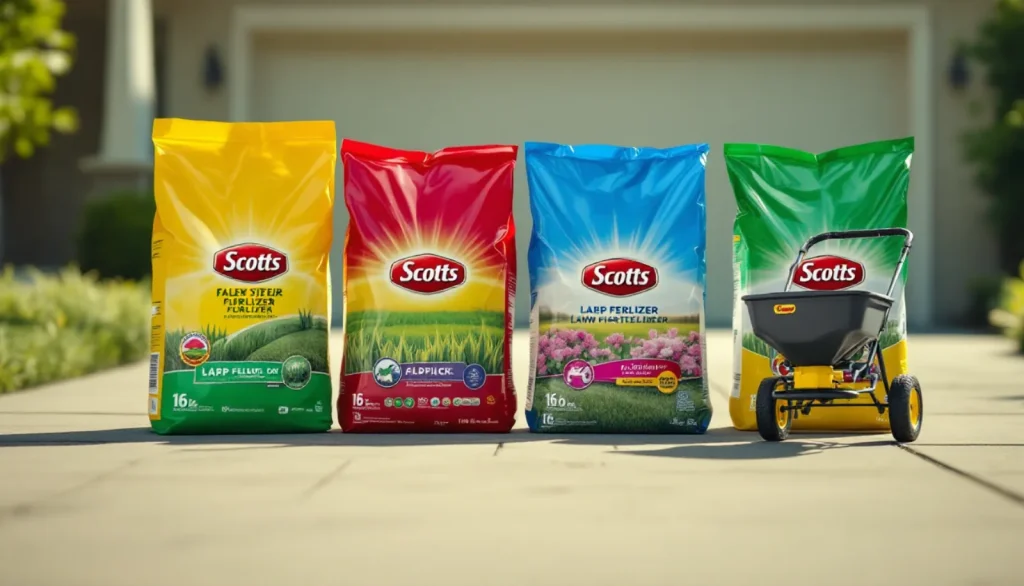
The Scotts Lawn Care program, sold as the Turf Builder 4-Step at every Home Depot, Lowes, and Walmart in North America, is the most widely used DIY lawn fertilization system in the world. It is also probably the most misunderstood. Most homeowners assume it is “the basic baseline” and stop thinking about it. In reality, it is a decent if dated four-application sequence built around fast-release urea with a small slow-release fraction, optimized for cool-season lawns north of the transition zone. It is not the worst program you can run, and it is not close to the best. Here is exactly what each step contains, what it skips, and what it actually costs in 2026.
The short version
- Scotts 4-Step is four bags applied across the growing season: Step 1 Halts (pre-emergent), Step 2 Weed and Feed, Step 3 SummerGuard (insect plus feed), Step 4 WinterGuard (fall potassium feed).
- 2026 retail pricing on the bundled 4-Step for a 5,000 sq ft lawn runs $200 to $260 at Home Depot, $190 to $240 on the Scotts subscription plan.
- The program delivers about 3.6 lbs of nitrogen per 1,000 sq ft per year, hits the right macro target for cool-season grass.
- What it skips: soil testing, lime, aeration, overseeding, micronutrients, agronomic timing adjustments, anything for warm-season turf.
- Equivalent Lesco pro program from SiteOne runs $130 to $170 for the same square footage and outperforms on slow-release nitrogen percentage.
- The 4-Step is a fine starter program. It is not a destination program. Most lawns that look great on Scotts 4-Step have a homeowner doing more than 4 steps.
The 4-step lineup, decoded
Step 1: Turf Builder with Halts Crabgrass Preventer. Active herbicide is pendimethalin (in older formulations) or dithiopyr in some current SKUs. NPK is 30-0-4 with the pre-emergent component layered into the prill coating. Goes down in early spring before soil temperatures reach 55 F at 4 inches deep (typically late February in the south, late March to mid-April in the upper Midwest and Northeast). Coverage on the consumer bag size is 5,000 sq ft per 13.85 lb bag, retail around $48 to $58.
Step 2: Turf Builder with Weed Control. Active herbicide is a three-way broadleaf blend (2,4-D, dicamba, mecoprop, similar to retail Trimec) layered with a 28-0-3 fertilizer. Goes down 6 to 8 weeks after Step 1, when broadleaf weeds (dandelion, chickweed, henbit, plantain) are actively growing in late spring. Coverage on the consumer 14.29 lb bag is 5,000 sq ft, retail around $52 to $62.
Step 3: Turf Builder SummerGuard. Active insecticide is bifenthrin paired with a 20-0-8 feed. Targets surface-feeding insects (chinch bugs, ants, ticks, fleas, sod webworm) plus a light summer feed. Goes down June through August. Coverage on the 13.35 lb bag is 5,000 sq ft, retail around $48 to $58. Step 4: Turf Builder WinterGuard. No herbicide or insecticide, just a 32-0-10 high-potassium fall feed designed to drive root development into winter. Goes down September through November depending on region. Coverage on the 12.5 lb bag is 5,000 sq ft, retail around $42 to $52.
Add the four bags up and you have $190 to $230 of product, plus a $10 to $15 spreader rental at most stores (free with Scotts subscription). Total real cost for a 5,000 sq ft lawn in 2026 is $200 to $260 if you walk into Home Depot, $190 to $240 on the Scotts subscription program. The subscription ships the bags timed to your zip code’s expected application windows, which solves the timing problem most consumers face.
What the program actually delivers (with the math)
| Step | Product NPK | Bag covers | N per 1,000 sq ft | Total N delivered (5,000 sq ft lawn) |
|---|---|---|---|---|
| Step 1 (Halts) | 30-0-4 | 5,000 sq ft | 0.83 lb | 4.15 lb total N |
| Step 2 (Weed and Feed) | 28-0-3 | 5,000 sq ft | 0.80 lb | 4.00 lb total N |
| Step 3 (SummerGuard) | 20-0-8 | 5,000 sq ft | 0.53 lb | 2.67 lb total N |
| Step 4 (WinterGuard) | 32-0-10 | 5,000 sq ft | 0.80 lb | 4.00 lb total N |
| Total annual | n/a | n/a | 2.96 lb | 14.82 lb total N delivered |
The annual nitrogen delivery on the standard 4-Step is roughly 3 lbs per 1,000 sq ft. For cool-season tall fescue and Kentucky bluegrass that is on the low end of the agronomic target (industry recommendation is 3 to 4 lbs annually). For warm-season Bermuda or Zoysia that is significantly under-fed (target is 4 to 6 lbs annually for warm-season). The 4-Step was designed for the cool-season Midwest and Northeast and the math reflects that. If you have Bermuda in Atlanta, you are leaving growth on the table.
The slow-release nitrogen percentage in Scotts product runs in the 20 to 35% range depending on the SKU, lower than the 35 to 50% you get from a Lesco 24-0-11 50 lb bag at SiteOne. Slow-release matters: it stretches the green-up window from 2 weeks to 6 to 8 weeks per application, smooths color, and reduces the risk of fertilizer burn. The Scotts pricing premium does not buy you premium slow-release. Our NPK fertilizer guide covers the slow-release math in detail.
What the 4-Step does well
Three things. One, the timing cues are baked into the product naming and the subscription scheduling. A homeowner who has never thought about pre-emergent timing can put down Step 1 in March, Step 2 in May, Step 3 in July, Step 4 in October and end up with a directionally correct schedule. Two, the herbicide and insecticide combination products solve a real problem for homeowners who do not want a separate sprayer. Buying a combined granular product is operationally simpler than running a backpack sprayer. Three, the distribution is unmatched: every major home improvement retailer stocks every step, year-round in growing regions. You can pick up Step 2 on a Saturday morning when you finally notice the dandelions exploding.
The Scotts subscription program (called Scotts Lawn Care subscription, launched in 2018, currently around $150 to $230 a year for the basic 4-Step shipped, more for the enhanced 5-Step or 6-Step plans) solves the timing problem entirely. Boxes show up at the door when it is time to apply, with regional adjustments. For a homeowner who knows nothing about lawn care, the subscription is a genuinely reasonable on-ramp. Compare to a TruGreen plan at $520 to $780 for the same 5,000 sq ft lawn and the subscription is materially cheaper. See our lawn care cost guide for that pro service comparison.
What the 4-Step skips (and why it matters)
Five major gaps. One, no soil test. Every lawn deserves a $20 soil test from the state cooperative extension every two years. Without it you are guessing on pH, on phosphorus need, on potassium need, on lime application. A pH below 5.5 will lock out the nitrogen you are dumping on the lawn no matter how much Step 2 you apply. The 4-Step does nothing to surface or correct this.
Two, no lime or pH amendment. Most cool-season lawns in the northeast and Midwest need 25 to 50 lbs of pelletized dolomitic lime per 1,000 sq ft every 2 to 3 years to maintain a proper soil pH. The 4-Step assumes a healthy pH and does not include any lime SKU. Three, no aeration or overseeding. The single highest-ROI mechanical intervention in a homeowner program (fall core aeration plus 4 to 6 lbs of turf-type tall fescue per 1,000 sq ft) is entirely outside the 4-Step. The Scotts EZ Seed product is a separate decision and is not part of the 4-Step bundle.
Four, no micronutrients. Iron, manganese, and sulfur deficiencies are common on lawns in alkaline soils and on lawns that have been over-fed nitrogen for years. The 4-Step does not address these. Five, no agronomic timing flexibility. The four bags are designed to land in roughly the same windows regardless of weather. A real program adjusts: skip Step 1 if you had no crabgrass last year, push Step 3 if it is a cool wet summer, double up Step 4 if you skipped Step 3. The 4-Step does not encourage this thinking.
Where the 4-Step fails outright
Three failure modes. One, warm-season turf in the south. The 4-Step is calibrated for cool-season grass. If you have Bermuda in Texas or St. Augustine in Florida, the application timing is wrong, the nitrogen total is too low, and the herbicide selection is suboptimal. Scotts sells a southern-focused product line (Bonus S Southern Weed and Feed for St. Augustine, for example) but the 4-Step branding is not regionally adjusted in any deep way.
Two, lawns with active disease, insect, or soil compaction problems. The 4-Step assumes a baseline healthy lawn. If you have brown patch (Rhizoctonia), gray leaf spot, dollar spot, or pythium, you need a fungicide program (azoxystrobin, propiconazole, fluxapyroxad) that the 4-Step does not include. If you have grubs in the root zone, the SummerGuard bifenthrin will not control them (you need imidacloprid in spring or trichlorfon as a curative). If you have compaction, you need aeration, not more granular product.
Three, lawns with thin cover or visible bare spots. The 4-Step does nothing to thicken a thin lawn. You need overseeding, soil amendment, and a real establishment program. Our brown patches in lawn guide covers the disease and bare-spot triage. Continuing to apply 4-Step product to a thinning lawn just feeds weed seed in the bare zones.
The Scotts product line beyond the 4-Step
Scotts is one of the largest consumer lawn product companies in the world (publicly traded as ScottsMiracle-Gro, NYSE: SMG, owner of the Scotts, Miracle-Gro, Ortho, Roundup retail license, and many other brands). The 4-Step is the marketing flagship but the catalog is much wider. Turf Builder Triple Action is a heavier all-in-one product (pre-emergent, broadleaf, fertilizer in one bag) marketed for homeowners who want to skip a step. Turf Builder LawnSoil is a topsoil and seed bed amendment for spot repair. EZ Seed combines seed, fertilizer, and a wood-fiber mulch tackifier for fast spot fixes (and is genuinely well-engineered for what it is).
Scotts Disease EX is the consumer fungicide (azoxystrobin) priced higher per acre than a SiteOne pro equivalent but available at Home Depot. Scotts Grubex (chlorantraniliprole) is a long-residual grub preventer that works well as a single annual spring application. Tomcat lawn protection products handle mole, vole, and small mammal issues. None of these are part of the 4-Step. Many homeowners who run the 4-Step also add Grubex in spring and EZ Seed for spot work, which is the natural Scotts upsell path.
Scotts 4-Step versus the pro alternative: real cost comparison
Scotts 4-Step bundle for 5,000 sq ft: $200 to $260 retail, $190 to $240 subscription. Equivalent pro program from SiteOne for 5,000 sq ft: 50 lb bag of Lesco 24-0-11 at $36 covers 14,500 sq ft (three full applications), 50 lb bag of Lesco 19-0-7 with prodiamine at $52 covers another 14,500 sq ft (pre-emergent), one quart of Speedzone Lawn at $28 covers a season of broadleaf spot work, one bag of Lesco 32-0-10 winterizer at $34 covers fall feed. Total pro material cost for the same square footage: $150, with significant leftover product to carry into next year. Total per-year actual cost amortized: $90 to $120.
The pro program delivers similar or higher N totals, materially higher slow-release percentage, longer effective duration per application, and lower per-1,000-sq-ft cost. You give up the subscription scheduling convenience. You have to walk into a SiteOne branch and set up the customer account (free, takes 3 minutes, no business license required). Our lawn care supplies guide walks through the SiteOne process in detail.
When the 4-Step is genuinely the right answer
Three scenarios. One, a homeowner who wants the absolute lowest-decision program on the market and is willing to pay a moderate premium for that simplicity. The Scotts subscription delivers four boxes a year to the door at the right times. You apply them with a spreader. You are done thinking about lawn care for the year. For some households that math is worth $40 to $80 a year.
Two, a 2,500 sq ft to 5,000 sq ft cool-season lawn in zone 5 to 7 with no underlying soil issues, no compaction, no disease pressure, no weed escape problem, no irrigation problem. Under those (rare but real) conditions the 4-Step is perfectly adequate and the marginal value of upgrading to pro product is small. Three, a homeowner who is just starting to take lawn care seriously and needs an on-ramp before committing to soil testing, equipment, and pro-product runs. The 4-Step is a fine first-year experience that will reveal what is and is not working on your specific lawn.
Outside those three scenarios, you can produce a better outcome for less money by spending an afternoon walking into SiteOne and learning the pro product line. Our research desk tracks the year-over-year performance differential between consumer-tier and pro-tier programs across regional university extension trials.
FAQ
Is the Scotts 4-Step actually good for my lawn?
It is acceptable for a cool-season lawn in moderate condition with no underlying soil issues. It is not optimal for warm-season turf, lawns with compaction or disease, or lawns where you want the best possible result. It is materially better than no program, materially worse than a pro-tier program at lower cost.
What is the cheapest lawn fertilizer program that still produces a great lawn?
Two applications a year of Lesco 24-0-11 from SiteOne (a heavy fall feed and a moderate spring feed), one application of prodiamine pre-emergent in early spring, fall aeration plus overseed if needed. Total annual cost for a 5,000 sq ft lawn is $80 to $120 in product. The lawn will look better than a 4-Step lawn at half the cost.
Can I substitute the Scotts steps with cheaper big-box alternatives?
You can. Vigoro, Pennington, and Sta-Green all sell directly comparable pre-emergent, weed-and-feed, and winterizer products at modestly lower price points at Home Depot, Lowes, and Walmart. Quality varies. Pennington tends to be the strongest of the bunch on slow-release nitrogen. If you are staying in the consumer tier the brand choice is less consequential than people assume.
Why does my lawn still have weeds with the Scotts 4-Step?
Three usual causes. The pre-emergent in Step 1 was applied too late (after crabgrass germinated when soil hit 55 F). The Step 2 broadleaf was applied when weeds were not actively growing (too cold, too hot, or in drought stress). Or the underlying problem is thin turf that is not crowding out weed seeds, which requires overseeding and aeration that the 4-Step does not include.
Should I supplement the Scotts 4-Step with anything else?
Yes, three additions. A soil test once every two years ($20 from state extension). A fall aeration plus overseed ($250 hired, $200 DIY). A spring application of Scotts Grubex or equivalent imidacloprid product if you are in a grub pressure region. Those three additions on top of the 4-Step convert it from a starter program into a reasonable maintenance program.
Bottom line
The Scotts 4-Step is the lawn care equivalent of a pre-built starter PC: it works, it gets you on the field, and most users never realize they could do dramatically better for the same money by spending one afternoon learning the pro product channel. It is not a bad program. It is a defensible default. It just is not the destination program for anyone who actually cares about how their lawn looks two years from now.
If you are using Scotts 4-Step and your lawn is acceptable, that is a fine place to be. If you are using Scotts 4-Step and frustrated, the answer is not more Scotts. It is a soil test, a fall aeration, and a trip to SiteOne. The 4-Step gets you to a 7 out of 10. Everything past that is mechanical work, agronomic timing, and pro-tier product. None of which is in any of the four bags.