
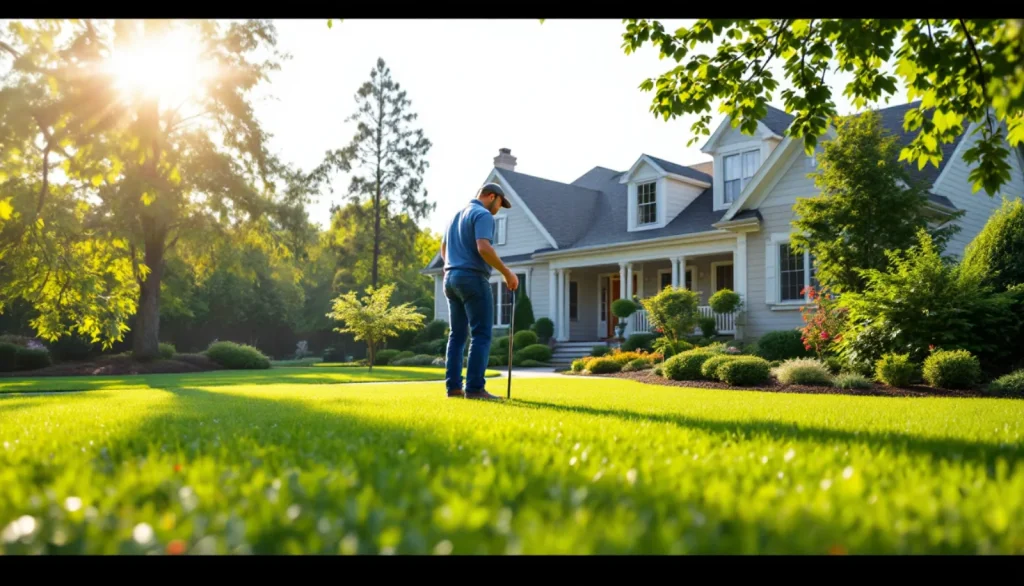
A real lawn care guide for 2026 starts with three numbers: mowing height, weekly water depth, and pounds of nitrogen per 1,000 square feet per year. Master those three levers and you will out-perform 80% of professionally treated lawns in your zip code. The other 20% is timing (when you do what), grass species (cool-season versus warm-season), and the mechanical work most homeowners skip (aeration plus overseeding). This guide covers the full calendar, the real product choices, and the math that turns a struggling lawn into a thick, dark green stand in about 18 months.
The short version
- Mow tall fescue and Kentucky bluegrass at 3.5 to 4 inches. Mow Bermuda at 1 to 2 inches. Never cut more than one-third of the blade in a single pass.
- Water 1 inch per week including rainfall, in two deep soaks rather than daily shallow watering. Roots follow water.
- Cool-season grass wants 3 to 4 lbs of nitrogen per 1,000 sq ft per year, half in fall. Warm-season wants 4 to 6 lbs, weighted to summer.
- Aerate and overseed cool-season lawns every fall. Aerate warm-season lawns in late spring when they are actively growing.
- Pre-emergent crabgrass control goes down when soil temperature hits 55 F at 4 inches deep, not by calendar date.
- Soil test every two years. Lime to a pH of 6.2 to 6.8. Most underperforming lawns have a pH or compaction problem, not a product problem.
The cool-season versus warm-season split
The single most important decision you will not consciously make is which grass species lives in your yard. North of roughly I-40, cool-season grasses dominate: Kentucky bluegrass (KBG) for full sun and high-traffic lawns, turf-type tall fescue (TTTF) for everything else, perennial ryegrass as a quick-establishing nurse crop, fine fescue for shade. These grasses grow most actively at soil temperatures of 60 to 75 F (so spring and fall), go semi-dormant in summer heat, and recover in cooler weather.
South of roughly I-20, warm-season grasses dominate: Bermuda for sun and play areas, Zoysia for upgraded residential, St. Augustine for the Gulf coast and Florida, Bahia for low-input situations, Centipede for acidic sandy soils. These grasses grow at soil temperatures of 80 to 95 F (so summer), go dormant in winter, and are mostly invisible from October to April north of Florida.
The transition zone (the band running roughly from Kansas City to Norfolk) is the hardest place in North America to maintain a lawn because neither category truly thrives. The defensive answer in the transition zone is turf-type tall fescue, which tolerates summer heat better than KBG and recovers better than Bermuda. The aggressive answer is a Zoysia stand if you can afford the sod install. Our guide to brown patches in your lawn covers the species-specific disease pressure.
Mowing height: the single highest-impact decision
| Grass | Mow height | Frequency (peak growth) | Blade sharpening | Common error |
|---|---|---|---|---|
| Kentucky bluegrass | 3 to 4 in | Every 5 to 7 days | Every 20 mowing hrs | Mowing too short, scalping |
| Tall fescue | 3.5 to 4 in | Every 5 to 7 days | Every 20 mowing hrs | Mowing wet, ripping |
| Fine fescue (shade) | 3 to 4 in | Every 7 to 10 days | Every 25 mowing hrs | Mowing in dense shade kills it |
| Bermuda (common) | 1.5 to 2 in | Every 4 to 5 days | Every 15 mowing hrs | Mowing too tall, thatch builds |
| Bermuda (hybrid, sports turf) | 0.5 to 1 in | Every 2 to 3 days | Reel mower only | Using rotary mower, scalping |
| Zoysia | 1 to 2 in | Every 5 to 7 days | Every 20 mowing hrs | Mowing too short in spring |
| St. Augustine | 3.5 to 4 in | Every 5 to 7 days | Every 20 mowing hrs | Mowing too short, chinch bug |
The universal rule that supersedes the table: never remove more than one-third of the blade in a single mowing. If your tall fescue is at 4.5 inches, mow at 3 inches, not at 2 inches. Scalping is the single most common homeowner error. It shocks the plant, exposes the soil to weed seeds, and accelerates compaction. Mowing wet is the second most common error: it tears rather than cuts, leaving frayed leaf tips that brown out and invite disease. Wait until the dew is off.
Sharp blades matter. A dull blade rips the grass and the ragged leaf tips brown within 24 hours, giving the lawn a gray cast even after a fresh mow. Sharpening costs $10 to $20 per blade at any equipment shop, takes 20 minutes on a bench grinder if you do it yourself, and should happen at least twice per growing season for a residential rotary mower.
Watering: depth beats frequency
Lawns want 1 inch of water per week, including rainfall, applied in one to two deep soaks rather than daily shallow watering. Roots follow water. Daily 10-minute watering produces a shallow root system that fails the first time you forget to irrigate. Two 30-minute deep waterings per week produce deeper roots that survive a missed cycle.
Measuring 1 inch is not optional. Set six tuna cans across the irrigated zone, run the system for 15 minutes, average the depth, then back-calculate the run time needed to deliver 1 inch per week. Typical residential rotor zones deliver 0.25 to 0.5 inch per hour, so you are looking at 60 to 120 minutes of run time per zone per week, split into two cycles. Spray-head zones deliver faster (0.75 to 1.5 inches per hour) but cover smaller areas. Drip zones are measured in gallons per emitter, not inches per zone. Our drip irrigation install guide covers the math.
Smart controllers (Rachio 3, Hunter Hydrawise, Rain Bird ESP-TM2) cut residential water use 20 to 50% versus a clock-based controller by using local weather data, evapotranspiration calculations, and soil moisture sensing. They cost $200 to $350 installed and pay back in two to four years in most water-priced markets. Several states have rebate programs covering 50 to 100% of the controller cost. Our drought-tolerant lawn alternatives guide covers the state-by-state rebate map.
Fertilization: NPK, slow-release, and timing
Three numbers on every fertilizer bag. The first is nitrogen (N), the green-leaf driver. The second is phosphorus (P), root and seedling establishment. The third is potassium (K), stress tolerance and disease resistance. For established lawns you mostly care about N. Phosphorus is restricted in many states (Minnesota, Maryland, New York, others have outright bans on lawn P) so most maintenance fertilizers run a zero in the middle (32-0-4, 24-0-11, 28-0-3 are typical). Starter fertilizer for new seed or sod is the exception and runs high P (18-24-12 or similar).
Cool-season lawns want 3 to 4 lbs of N per 1,000 sq ft per year, split as 25% spring, 25% summer, 50% fall. The fall feedings drive root development that powers the next season. Warm-season lawns want 4 to 6 lbs of N per 1,000 sq ft per year, weighted heavily to early and mid-summer (Bermuda peak feeding is May through July), with the last feeding 30 to 45 days before first frost.
Slow-release nitrogen percentage is the spec most homeowners miss. Cheap fast-release urea greens up the lawn for 10 days then fades. Slow-release sources (SCU sulfur-coated urea, MU methylene urea, polymer-coated urea, organic protein-based) feed steadily for 6 to 10 weeks. Target at least 30% slow-release in any feed and ideally 50% in the heavier spring and fall applications. The application rate math: 100 divided by the first NPK number gives you pounds of product per 1,000 sq ft for 1 lb of actual N. Lesco 24-0-11 at 100 divided by 24 equals 4.2 lbs of product per 1,000 sq ft. Our NPK fertilizer guide walks through this in detail.
Weed control: the four-product shelf
A serious DIY lawn weed program has four products in rotation. One, a pre-emergent (prodiamine or dithiopyr) applied in early spring (when soil hits 55 F at 4 inches deep) and a second application in early fall. This blocks crabgrass, foxtail, and many annual broadleaf weeds before they germinate. Two, a selective post-emergent three-way ester broadleaf herbicide (Speedzone Lawn, T-Zone SE, Trimec Classic) for spot treatment of dandelion, clover, plantain, and ground ivy in mid-spring and early fall. Three, a non-selective glyphosate (Roundup PRO) for spot treatment on hard surfaces, driveways, and bed edges. Four, a problem-weed specialty product (sulfentrazone for nutsedge, quinclorac for clover plus crabgrass cleanup, mesotrione for nimblewill and goosegrass).
The application discipline that separates amateurs from pros: spray when temperatures are between 60 and 85 F, when there is no rain in the forecast for at least 6 hours, and when there is minimal wind (under 10 mph). Use a marker dye in the tank so you can see your coverage. Calibrate your sprayer at the start of every season (walk a known distance at your standard pace, measure the volume delivered, calculate gallons per 1,000 sq ft). Mistimed or off-rate herbicide applications produce weed escapes that are then expensive to fix.
State applicator licensing matters more than most homeowners realize. Category 3A Turf and Ornamental certification is required in most states to purchase or apply restricted-use products and to apply pesticides commercially. As a homeowner on your own property you usually do not need the license, but you do need to follow the EPA-registered label exactly. The label is the law under FIFRA.
Aeration and overseeding: the highest-ROI annual investment
Core aeration removes plugs of soil (typically 0.5 inch wide by 3 inches deep) on roughly 4 inch spacing, opening the soil for water, air, and root penetration. It is the single most effective intervention against compaction and thatch. Cool-season lawns aerate in fall (September into early October), when grass is actively growing and can recover. Warm-season lawns aerate in late spring or early summer, when Bermuda or Zoysia is in active growth.
Overseeding follows aeration in cool-season lawns: drop 4 to 6 lbs of turf-type tall fescue or a TTTF and KBG blend per 1,000 sq ft, then drag the seed into the aeration holes with a broom or back of a rake. Apply a starter fertilizer (18-24-12 or similar) at label rate. Water lightly daily for the first 10 to 14 days to keep the seed bed moist until germination. Most overseed jobs visibly fill in by week three and reach mowable density by week five.
Warm-season lawns are generally not overseeded (they spread by stolons or rhizomes), with the exception of winter ryegrass overseed on Bermuda in the deep south for green-through-winter aesthetics. That is a high-effort, high-water cosmetic practice and not necessary for lawn health. Skipping aeration is the most common mistake in homeowner programs, and it is also the easiest to fix.
The 12-month calendar at a glance
February (cool-season, transition): soil test in late month if not done in two years. Service the mower (blade sharpening, oil change, spark plug). March (cool-season): pre-emergent crabgrass control when soil hits 55 F. Light early-season feed if grass is greening. Spot broadleaf herbicide on actively growing weeds. April (cool-season): first full feed (24-0-11 or similar at 1 lb N per 1,000 sq ft). Mow as soon as grass exceeds 4.5 inches. Continue broadleaf spot work.
May (cool-season): mid-spring feed if soil test calls for it. Begin watching for grub damage and disease pressure. Warm-season lawns enter active growth and want their first feed and a pre-emergent. June through August (cool-season): minimal feeding, raise mow height to top of range, water deeply. Warm-season lawns are in peak growth, mow every 4 to 5 days, apply heaviest feed of the year in June.
September (cool-season): aerate and overseed in the first three weeks of the month. Apply starter fertilizer. Fall pre-emergent for winter annual broadleaf weeds. October (cool-season): heavy fall feed (1.5 lbs N per 1,000 sq ft) once new seed is established. Continue mowing as growth dictates. November (cool-season): final winterizer feed (high K, often 32-0-10 or similar). Final mow at slightly lower height (3 inches) to prevent snow mold. December through January: rest. Warm-season lawns are dormant. Cool-season lawns are coasting on the fall fertility.
Diagnosing a struggling lawn in 10 minutes
Walk the lawn with a screwdriver, a soil knife, and a soil thermometer. Push the screwdriver into the soil in three spots. If it stops at less than 4 inches you have compaction. Dig a small plug (2 inches wide, 4 inches deep) and look at the thatch layer (the spongy brown material between green grass and dark soil). More than 0.5 inch of thatch is a problem. Look at the root depth (healthy cool-season grass roots run 4 to 8 inches in summer, deeper in winter). Look at the soil color and texture: dark crumbly soil is good, gray compacted clay is bad.
Send a soil test to your state cooperative extension service ($15 to $25, results in 7 to 14 days). Read the pH (target 6.2 to 6.8 for most cool-season grass, 5.5 to 6.5 for centipede and St. Augustine), the organic matter (target 3 to 5%, higher is fine), the P and K levels (most established lawns have plenty of P, often need K), and the cation exchange capacity (CEC, a measure of soil’s ability to hold nutrients). A CEC under 10 means sandy soil that needs more frequent feeding at smaller rates.
Match symptoms to causes. Yellow patches in summer on cool-season lawn: probably summer dormancy plus dry stress, not a disease. Tan or brown circular spots: probably brown patch (Rhizoctonia) on tall fescue, treat with azoxystrobin or propiconazole. Thin patches under trees: fine fescue shade blend, raise mowing height, reduce irrigation. Worn-down high-traffic lanes: compaction plus mechanical damage, aerate and consider a more wear-tolerant species. Our lawn care cost guide covers what professional diagnosis and repair runs.
FAQ
How often should I really mow?
Whenever the grass has grown about one-third above your target height. For a tall fescue lawn mowed at 3.5 inches, you mow when the grass hits 5 inches. In peak growth (April to May in the north) that is every 4 to 5 days. In dormancy (July to August or late fall) it can stretch to two weeks. Calendar-based mowing schedules are inefficient.
Should I bag clippings or mulch them?
Mulch in almost all cases. Mulched clippings return roughly 1 lb of nitrogen per 1,000 sq ft per year to the lawn, decompose in days if you mow at the right interval, and do not contribute to thatch (the thatch myth was disproven 40 years ago). Bag only after extended rain when clippings are clumping, after the first mow in spring if there is heavy debris, and during overseeding establishment.
What is the cheapest way to make a bad lawn good?
Soil test ($20), fall aeration plus overseed ($250 if hired, $200 DIY), and a single high-quality slow-release fall fertilizer application ($30 of Lesco 24-0-11 or equivalent). Total cost is roughly $300 and that program will produce visible improvement by the following May.
Is the “smart” lawn care approach (Sunday, Lawnbright) actually better?
It is meaningfully better than doing nothing and is well-suited for homeowners who want a curated, no-decision program. It is not better than a soil-test-driven SiteOne program at the same cost, because the pro tier gives you more control and more concentrated active ingredient. Subscription services trade flexibility for simplicity.
How do I know if my grass is actually dead or just dormant?
Tug a handful firmly. Dormant grass holds in the soil with roots intact; dead grass pulls out in a clump. Cut the base of a blade and look at the crown (the white tissue at the soil line). If it is firm and white the plant is alive. If it is brown and mushy, that section is dead. Cool-season grass goes summer dormant routinely and will green up after a soaking rain and a temperature drop.
Bottom line
A complete lawn care program is mostly about discipline at a few key moments: pre-emergent at 55 F soil temperature, a heavy fall feeding 30 to 45 days before dormancy, aeration plus overseeding in early fall for cool-season turf, and consistent mowing at the right height. The products are commodity. The timing is the differentiation.
Most homeowners overspend on product, underspend on mechanical work (aeration plus overseed), and never soil-test. Flip those three priorities and you will spend less, work less, and grow a better lawn than your neighbors paying TruGreen $700 a year for spray and pray. The grass does not care which logo is on the bag. It cares about timing, technique, and the soil underneath.