
By the HMNDP Editorial Team, independent reporting on lawn care, landscaping, water, and the green-industry business.
Last reviewed: June 2026
How Long to Water Grass: The Quick Answer
To decide how long to water grass, aim for 1 inch of water per week including rainfall, split into 2 to 3 sessions. Most in-ground pop-up sprinklers deliver that in roughly 30 to 40 minutes of total run time per zone, or about 15 to 20 minutes per session. A hose-end oscillating sprinkler usually needs 60 to 90 minutes. Your real number depends on your sprinkler’s output and your soil.
Generic advice says “run it 45 minutes.” That number is only right if your sprinkler happens to lay down water at a certain rate. Two zones on the same system can differ by 3x. The reliable method is to measure your output once, then compute minutes from there.
| Delivery method | Typical output | Minutes for 1 inch total/week | Per session (2 to 3/week) |
|---|---|---|---|
| In-ground pop-up spray head | 1.5 to 2.0 in/hr | 30 to 40 min | 10 to 20 min |
| In-ground rotor / rotary head | 0.4 to 0.6 in/hr | 100 to 150 min | 35 to 50 min |
| Oscillating hose sprinkler | 0.5 to 1.0 in/hr | 60 to 120 min | 25 to 45 min |
| Impact / pulsating sprinkler | ~0.5 in/hr | ~120 min | ~45 min |
| Drip / soaker line | Measured in gallons/hr | Run to soil depth, not inches | 30 to 60 min |
The 1 Inch Per Week Baseline
An established lawn needs about 1 inch of water per week, counting rain, to stay green and rooted through the growing season. This is the figure used by university turf programs including the University of Minnesota Extension and Kansas State Research and Extension. One inch soaks roughly the top 6 to 8 inches of soil, which is where healthy grass roots live.
Rainfall counts toward that inch. If your area got 0.6 inch of rain this week, you only owe the lawn about 0.4 inch. A cheap rain gauge, or a $10 wireless one, closes the guesswork. During a rainy week you may water zero times.
Track the weekly total, not each day. The goal is cumulative depth, and grass does not care whether it arrives Tuesday or Thursday.
How to Find Your Real Run Time (the Catch-Cup Test)
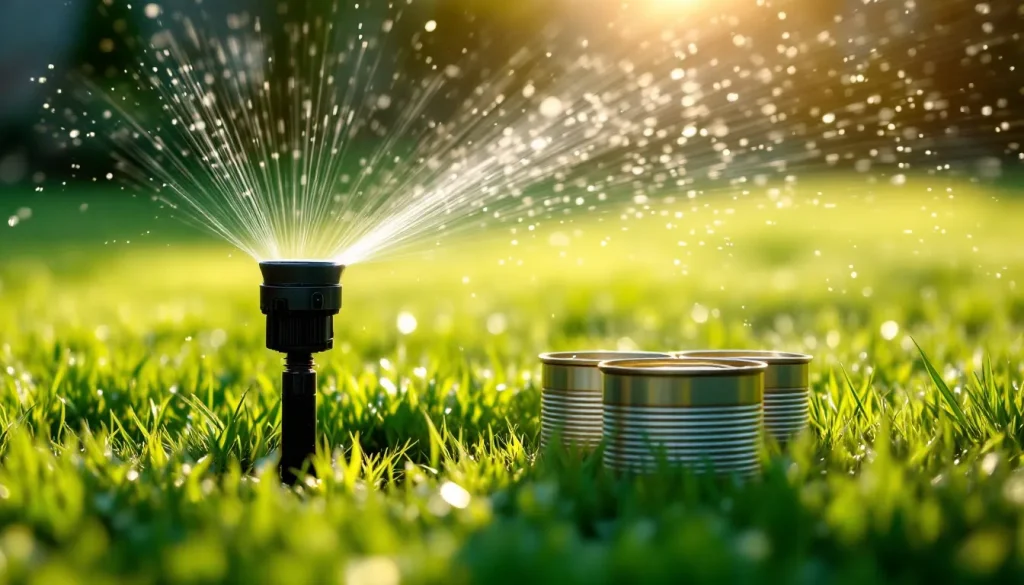
Measure your sprinkler’s output with a catch-cup test so you can compute exact minutes instead of guessing. Set out 5 or 6 straight-sided containers (empty tuna or cat-food cans work perfectly) across one zone, run the sprinkler 15 minutes, then measure the water depth in each with a ruler. This tells you your inches per hour and how evenly the zone waters.
- Place the cans in a spread across the zone, some near heads and some between them.
- Run the zone for exactly 15 minutes.
- Measure the depth in each can in inches, then average them.
- Multiply that average by 4 to get inches per hour. Example: 0.4 inch in 15 minutes is 1.6 inches per hour.
- Divide your weekly target by the hourly rate to get total minutes. For 1 inch at 1.6 in/hr, that is about 38 minutes per week.
The cans also expose dry spots. If one can holds half what its neighbor does, that head is clogged, blocked, or misaligned, and no run time fixes uneven coverage.
Adjust for Soil: Cycle and Soak for Clay, Short Runs for Sand
Soil type changes how long you can water before the water is wasted. Clay absorbs slowly and starts running off after 10 to 15 minutes, so it needs cycle-and-soak: several short bursts with rest between them. Sandy soil drains fast and holds little, so it wants shorter, more frequent sessions. Loam sits comfortably in the middle.
| Soil type | Behavior | How to run it |
|---|---|---|
| Clay | Slow to absorb, runs off | Cycle-and-soak: 3 cycles of 10 to 15 min with 30 to 60 min rest between |
| Loam | Balanced | Single sessions, 2 to 3 times per week |
| Sandy | Drains fast, low retention | Shorter sessions, more often (3 times/week), less per run |
To test drainage, water a spot for 15 minutes and watch. If puddles or streams appear before your target minutes are up, you have clay behavior and should switch to cycle-and-soak. Modern controllers like Rachio and Rain Bird ESP-TM2 can automate the cycle-and-soak splits for you.
Water Deeply and Infrequently, Not a Little Every Day
Deep, infrequent watering beats daily sprinkling for an established lawn. Two or three longer sessions per week push moisture 6 to 8 inches down, which trains roots to grow deep and ride out heat. Daily shallow watering keeps moisture at the surface, breeds shallow roots, and leaves grass fragile the moment you skip a day.
Check depth with a screwdriver. After watering, a 6-inch screwdriver should slide into the soil with light pressure. If it stops at 2 inches, you did not water long enough. This “screwdriver test” is a standard turf check and costs nothing.
Newly seeded lawns are the exception and follow opposite rules, since seed needs the top inch kept constantly moist. See our guide on how often to water new grass seed for that watering schedule.
Best Time of Day: Early Morning, Worst at Night
The best time to water grass is early morning, between 5 a.m. and 10 a.m. Cooler air and calm wind mean less evaporation, so more water reaches the roots, and the blades dry by midday. Watering at night is the worst option: grass stays wet for hours, which invites fungal diseases like brown patch and dollar spot.
Midday watering is not harmful to the grass, contrary to the myth about droplets scorching blades, but you lose a large share to evaporation in heat and wind. Morning simply delivers the most water per minute of run time. For the full breakdown, see our guide on the best time of day to water grass.
How Long to Water Grass in Summer and by Region
Summer heat and warm-climate regions raise the weekly target. In peak summer, cool-season lawns in the North may need 1.25 to 1.5 inches per week, and hot southern states like Florida, Texas, and Arizona often need 1.5 to 2 inches per week. The grass type matters too: warm-season grasses tolerate heat better and generally use less water than cool-season grasses in the same conditions.
| Grass type / season | Examples | Weekly water | Sessions/week |
|---|---|---|---|
| Cool-season, spring/fall | Kentucky bluegrass, tall fescue, ryegrass | 1 inch | 2 |
| Cool-season, summer heat | Same, North | 1.25 to 1.5 inch | 2 to 3 |
| Warm-season, growing season | Bermuda, Zoysia, St. Augustine | 1 to 1.25 inch | 2 |
| Warm-season, hot South | Same, FL / TX / AZ | 1.5 to 2 inch | 2 to 3 |
Convert the higher weekly target into minutes using your catch-cup rate. If summer pushes you to 1.5 inches and your zone runs at 1.5 in/hr, that is 60 minutes per week, or three 20-minute sessions. Choosing the right grass for your climate reduces this load, which our guide on the best time to plant grass seed and how long grass seed takes to grow can help you plan around.
Signs You Are Watering Too Much or Too Little
Grass tells you when the run time is off. Under-watered lawns turn bluish-gray, and footprints stay pressed into the blades instead of springing back. Over-watered lawns feel spongy, grow fungus or mushrooms, and may show runoff or persistent puddles. Reading these signs lets you fine-tune your minutes without a lab.
- Too little: blue-gray color, footprints linger, blades fold or curl, soil hard and dry below 2 inches.
- Too much: squishy ground, fungus or mushrooms, thatch buildup, runoff into the street, mosquitoes.
- Just right: even green color, blades spring back, screwdriver slides 6 inches down a day after watering.
When in doubt, water a little less and watch. Most lawn problems attributed to drought are actually overwatering, which wastes money and weakens roots.
Frequently Asked Questions
How many minutes should I water my lawn each time?
Most in-ground pop-up sprinklers need 10 to 20 minutes per session, run 2 to 3 times per week, to reach 1 inch total. Rotor heads and hose sprinklers need longer, often 30 to 50 minutes per session. The exact number depends on your sprinkler’s output, which you can measure with a catch-cup test in about 15 minutes.
How long should you water grass with a hose sprinkler?
An oscillating hose sprinkler typically needs 60 to 120 minutes total per week to deliver 1 inch, since most put out 0.5 to 1.0 inch per hour. Split that into 2 or 3 sessions of 25 to 45 minutes. Set out a few tuna cans and run it 15 minutes to measure your exact rate before committing to a schedule.
How long should you water new grass seed?
New grass seed follows different rules than established turf. Keep the top inch of soil constantly moist with short, light watering 2 to 3 times per day for 5 to 10 minutes each, rather than deep infrequent sessions. Once the seedlings reach mowing height, taper toward the standard 1 inch per week deep-watering schedule.
How often should I water my lawn per week?
Water an established lawn 2 to 3 times per week during the growing season, not daily. Two or three deeper sessions reach the 1-inch weekly target and drive roots 6 to 8 inches down. Daily shallow watering creates weak, shallow roots. In hot southern summers, 3 sessions per week may be needed to hit 1.5 to 2 inches.
What is the best time of day to water grass, and the worst time?
The best time is early morning, 5 a.m. to 10 a.m., when cool, calm air limits evaporation and blades dry before night. The worst time is evening or night, because grass that stays wet for hours invites fungal diseases like brown patch and dollar spot. Midday works but wastes water to evaporation.
How long should you water grass in summer or hot weather?
In peak summer, raise the weekly target to 1.25 to 1.5 inches for northern cool-season lawns and 1.5 to 2 inches for hot southern states like Florida and Texas. Convert that to minutes using your measured sprinkler rate. A zone running at 1.5 inches per hour would need about 60 to 80 minutes per week, split into 2 or 3 sessions.
How do I know if I am watering long enough (how to measure 1 inch)?
Place 5 or 6 straight-sided cans across the zone, run the sprinkler 15 minutes, and measure the average depth with a ruler. Multiply by 4 for inches per hour. Then divide 1 inch by that rate for total weekly minutes. A day after watering, a 6-inch screwdriver should slide easily into moist soil.
Should I water every day or water deeply a few times a week?
Water deeply 2 to 3 times a week rather than a little every day. Deep sessions push moisture 6 to 8 inches down and build drought-resistant roots. Daily shallow watering keeps roots near the surface and leaves grass fragile in heat. The one exception is new grass seed, which needs frequent light watering until established.