
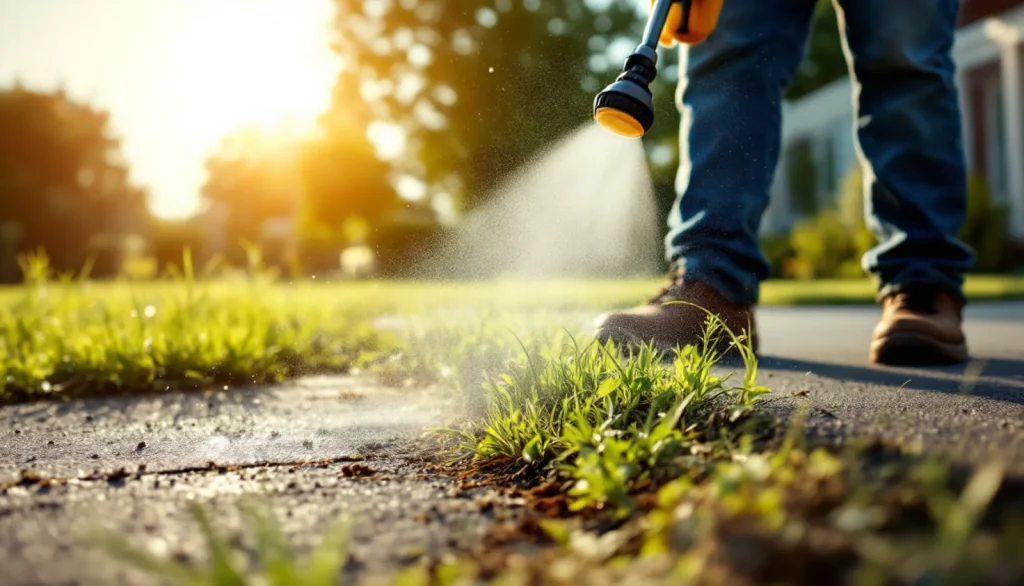
Homemade Grass Killer: Recipes That Actually Work
A homemade grass killer is a non-selective contact spray, usually built from vinegar, salt, and dish soap, that burns the leaf tissue it touches. It works on driveway cracks, gravel paths, and full-kill areas where you want nothing to grow back. It does not selectively spare a lawn, and on its own it rarely kills established roots, so the single most useful thing to know before mixing anything is which recipe matches your job and which concentration actually does the work.
What a homemade grass killer actually does (and does not do)
Homemade grass killers are contact herbicides: they damage only the plant tissue the spray wets. Acetic acid (vinegar), salt, alcohol, and boiling water all desiccate or scorch above-ground growth within 24 to 48 hours on a hot day. None of them move systemically into the root system the way glyphosate or a selective lawn herbicide does, so perennial weeds with deep taproots, dandelion, dock, and bindweed, regrow in two to three weeks.
That single fact decides whether a homemade mix is the right tool. For annual grass and young seedlings in pavement cracks, a contact kill is often enough because the plant has little stored root energy. For a mature Bermuda runner or an established lawn weed, expect repeat applications or pair the spray with manual digging. Oregon State University Extension and university weed-science programs consistently note that acetic acid sprays defoliate but do not reliably kill perennial roots.
How to make a homemade grass killer: the core recipe
The standard homemade grass killer is one gallon of vinegar, one cup of salt, and one tablespoon of dish soap. The vinegar (acetic acid) burns the leaf, the soap is a surfactant that helps the solution stick instead of beading off, and the salt draws moisture out of the plant and lingers in the soil to suppress regrowth. Mix in a bucket, stir until the salt dissolves, then transfer to a sprayer.
- Pour one gallon of vinegar into a bucket. Use the highest acetic acid percentage you can safely buy (more on this below).
- Add one cup of table salt or Epsom salt and stir two to three minutes until fully dissolved, so it does not clog the sprayer nozzle.
- Add one tablespoon of liquid dish soap and stir gently to avoid heavy foam.
- Transfer to a pump or trigger sprayer and label it clearly. This solution kills any plant it touches.
- Spray to wet (not drip) on a dry, sunny day above 70 degrees Fahrenheit with no rain forecast for 24 hours and little wind.
- Reapply every three to four days on survivors. Expect two to four rounds on tougher perennials.
Apply only where you want total bare ground. Wind drift and overspray will brown a lawn, a flower bed, or a neighbor’s border just as fast as the target weed. If your goal is a thicker lawn rather than scorched earth, a feeding and mowing program does far more than any spray; our year-round grass maintenance schedule lays out the timing.
The 5% vs 20% vinegar problem nobody tells you about
The vinegar concentration is the difference between a recipe that works and one that wastes an afternoon. Household white vinegar is 5% acetic acid, and it barely dents anything past a tender seedling. Horticultural vinegar runs 20% to 30% acetic acid and actually scorches mature foliage to the crown within 24 to 48 hours. Most blog recipes do not say which one they used, which is why so many DIY sprays disappoint.
Higher concentration is not free of cost. At 20% and above, acetic acid can blister skin and injure eyes, so it requires gloves, eye protection, and care that 5% kitchen vinegar does not. Match the strength to the job rather than defaulting to whatever is in the pantry.
| Acetic acid strength | Where to get it | Real-world effect on grass and weeds | Safety |
|---|---|---|---|
| 5% (household white vinegar) | Any grocery store | Burns tender seedlings on a hot day; established weeds shrug it off | Skin-safe, food-grade |
| 10% to 12% (cleaning vinegar) | Hardware and grocery stores | Noticeable leaf burn; still mostly top-kill, perennials regrow | Irritant; gloves advised |
| 20% to 30% (horticultural vinegar) | Garden centers, farm supply, online | Scorches mature foliage to the crown in 24 to 48 hours; best contact kill of the group | Can blister skin and injure eyes; gloves and eye protection required |
Other homemade methods, ranked by job
Vinegar is not the only option, and the right pick depends on the surface and whether you ever want to plant there again. Boiling water and a flame are the cleanest choices for pavement cracks because they leave no soil residue. Salt is the most persistent but contaminates soil for months. Solarization is the slowest but kills roots without chemicals.
| Method | Recipe or process | Speed | Best for | Soil after |
|---|---|---|---|---|
| Vinegar + salt + soap | 1 gal vinegar, 1 cup salt, 1 tbsp dish soap | 24 to 48 hrs | Driveways, fence lines, full-kill beds | Salt lingers months to years |
| Boiling water | Pour directly on the crown | Hours to days | Cracks, single weeds, replantable spots | No residue |
| Rubbing alcohol | 2 tbsp isopropyl per 1 quart water | 1 to 2 days on hot day | Spot-spraying small weeds | Microbe disruption if heavy |
| Borax spray | 10 oz borax per 2.5 gal water | Days | Creeping weeds like ground ivy | Boron persists; can sterilize |
| Solarization | Clear plastic, weighted, 4 to 6 weeks | Weeks | Clearing a whole bed before replant | Replantable after; kills roots |
For a full-bed reset before reseeding or laying sod, solarization is the only homemade method that reliably kills roots while leaving plantable soil. If you are clearing ground to start a new lawn area, pair it with our guide on how to make grass grow in bare spots for the renovation steps that follow.
Will salt and vinegar ruin my soil? How to fix it
Salt is the part of these recipes that causes lasting damage. Sodium pulls moisture from roots, displaces nutrients, and can stay in the soil for months to several years, which is why salt belongs only where you want permanent bare ground like driveway cracks. “Salting the earth” was a literal scorched-ground tactic for a reason. If salt drifts into a lawn or bed you care about, the area may refuse to grow anything until you flush it.
The fix is dilution and displacement, in this order:
- Flush with clean water. Deep watering pushes salts below the root zone. As a working rule, roughly 6 inches of applied water cuts salinity about 50%, 12 inches about 80%, and 24 inches about 90%.
- Apply gypsum (calcium sulfate). The calcium displaces sodium from soil particles and improves drainage so the next watering carries salt deeper.
- Top-dress with organic matter or compost to rebuild soil structure and feed the microbes that salt suppressed.
- Reseed with salt-tolerant grass where appropriate. Tall fescue, perennial ryegrass, and creeping red fescue handle residual salinity better than most.
- For severe contamination, remove the top few inches of soil and replace it with fresh topsoil before replanting.
If brown patches appear after spraying near a lawn edge, diagnose before you reseed, because salt scorch, drought, and disease look similar. Our brown patches diagnosis guide walks the decision tree.
Does homemade grass killer actually save money?
Homemade grass killer is cheap for small jobs and stops being cheap once you scale up to effective concentrations. A gallon of 5% household vinegar costs only a few dollars but often fails, so you re-spray and re-buy. Horticultural vinegar at 20% works but runs higher per gallon, and at that point a ready-to-use commercial weed killer can cost about the same per treated area while removing the mixing and safety hassle.
The honest math: for a few weeds in a driveway, a kettle of boiling water or a quart of cheap vinegar wins on cost and simplicity. For a large gravel lot or a long fence line, the volume of horticultural vinegar needed makes a labeled commercial product competitive, and a systemic product will actually reach the roots. Price it against the area you are treating, not the headline cost of one bottle. For the broader cost picture on lawn work, see our 2026 lawn care cost benchmarks.
Common mistakes that waste a batch
Most homemade-spray failures trace to a handful of avoidable errors. Spraying on a cool or overcast day blunts acetic acid, which works by accelerating moisture loss in sunlight. Spraying before rain washes the solution off within the hour. Skipping the dish-soap surfactant lets the spray bead off waxy leaves. And expecting a contact spray to kill a deep perennial root in one pass sets you up to call the recipe a failure when it simply needs repeat passes or digging.
- Spray only on dry, sunny days above 70 degrees Fahrenheit with no rain for 24 hours.
- Always include a surfactant (dish soap) so the solution clings to the leaf.
- Keep pets and kids off the area until it dries fully, usually 24 to 48 hours.
- Never use salt where you intend to plant again; choose boiling water or solarization instead.
- Reapply on survivors rather than mixing a single stronger, more dangerous batch.
Table salt vs Epsom salt vs borax: which to use
The salt you choose changes both the kill and the soil aftermath. Table salt (sodium chloride) is the most aggressive and the most persistent, because sodium is what lingers and sterilizes. Epsom salt (magnesium sulfate) dissolves cleanly in a sprayer and is gentler on long-term soil chemistry, though it is also a weaker desiccant. Borax (sodium borate) adds boron, which is toxic to plants at low doses and stays in soil a long time, so it suits creeping weeds on hardscape rather than anywhere near a bed.
For a driveway or fence line you want permanently bare, table salt does the job and the soil cost does not matter. For a sprayer mix where you might replant within a year, Epsom salt is the safer filler. Reserve borax for stubborn creeping weeds like ground ivy, and keep it well away from tree roots, which are sensitive to boron.
How long does homemade grass killer take to work?
On a hot, sunny day above 70 degrees Fahrenheit, a horticultural-strength vinegar spray browns foliage within 24 to 48 hours, and boiling water shows wilting within hours. Weaker 5% vinegar and slower methods like borax may take several days, and full die-back on tougher weeds can run a week. Cool, cloudy, or damp conditions stretch every timeline because acetic acid relies on sunlight-driven moisture loss.
Whatever the method, the visible top-kill is not the same as a dead root. Watch the same spot for two to three weeks. If green regrowth pushes from the crown, the roots survived and you need a repeat application, a dig-out, or a systemic product for a permanent fix.
Is homemade grass killer safe for pets and kids?
Vinegar, salt, and dish soap are far less toxic than synthetic herbicides, but they are not harmless during application. Concentrated acetic acid irritates skin, eyes, and paws, and salt is harmful if a pet licks treated surfaces. The standard guidance is to keep pets and children off any sprayed area until it has dried completely, usually 24 to 48 hours, and to rinse pavement you cannot keep them off.
Boiling water is the most pet-neutral option once it cools, since it leaves no residue at all. If pet safety is the main driver, lean on boiling water and manual removal for accessible weeds and save the salt and concentrated vinegar for fenced-off hardscape.
When to skip homemade entirely
Reach for a selective or systemic product when you need to spare the lawn or kill roots for good. No homemade mix is selective: it cannot kill a dandelion in turf without also browning the grass around it. And because contact sprays do not move into roots, perennial and rhizomatous weeds keep coming back. For weeds inside a lawn you want to keep, a selective broadleaf herbicide is the correct tool, and our explainer on how weed killers work covers the selective-versus-non-selective difference.
Homemade grass killer earns its place on hardscape, fence lines, gravel, and full-kill beds where collateral damage does not matter and the weeds are young. Matched to that job, with the right vinegar strength and realistic expectations about regrowth, it is a genuinely useful, low-cost tool.
Last reviewed: June 2026
HMNDP Editorial Team, reviewed by HMNDP turf and horticulture editors.
Frequently asked questions
What is the strongest homemade grass killer?
The strongest homemade grass killer combines 20% to 30% horticultural vinegar, one cup of salt, and a tablespoon of dish soap per gallon. The horticultural-strength acetic acid scorches mature foliage to the crown within 24 to 48 hours, far past what 5% household vinegar can do. It still kills only on contact, so deep perennial roots may regrow and need a repeat pass.
Does homemade grass killer kill weeds down to the root?
No. Vinegar, salt, alcohol, and boiling water are contact killers that destroy only the plant tissue they touch, so they burn foliage but do not move into roots. Annual grass and seedlings often die outright, but deep-rooted perennials like dandelion and bindweed regrow within two to three weeks. Solarization is the one homemade method that reliably kills roots.
How long does homemade grass killer take to work?
On a hot, sunny day above 70 degrees Fahrenheit, horticultural vinegar browns foliage within 24 to 48 hours and boiling water wilts plants in hours. Weaker 5% vinegar and borax can take several days, and full die-back on tough weeds may run a week. Cool, cloudy, or damp weather slows every method because acetic acid relies on sunlight-driven moisture loss.
Will salt and vinegar ruin my soil?
Vinegar breaks down quickly, but salt is the problem. Sodium can linger in soil for months to several years, blocking new growth, which is why salt belongs only where you want permanent bare ground like driveway cracks. To recover salted soil, flush deeply with water (about 6 inches cuts salinity 50%), apply gypsum, add organic matter, then reseed with salt-tolerant grass.
Is homemade grass killer safe for pets and kids?
It is less toxic than synthetic herbicides but not harmless during use. Concentrated vinegar irritates skin, eyes, and paws, and salt is harmful if licked off treated surfaces. Keep pets and children off any sprayed area until it dries fully, usually 24 to 48 hours. Boiling water is the most pet-neutral option since it leaves no residue once cooled.
Does vinegar kill grass permanently?
Usually not on its own. Household 5% vinegar barely affects established grass, and even 20% horticultural vinegar kills only the leaves it wets, so grass and perennial weeds regrow from surviving roots. Permanent control needs repeat applications, manual removal, salt for full-kill zones, solarization, or a systemic herbicide that travels into the root system.
Is homemade grass killer cheaper than store-bought?
For small jobs, yes. A kettle of boiling water or a quart of cheap vinegar beats any commercial product on cost for a few driveway weeds. But effective horticultural vinegar runs higher per gallon, so for large gravel lots or long fence lines a labeled ready-to-use product can cost about the same per treated area while reaching roots a contact spray cannot.
Can I use homemade grass killer on my lawn without killing the grass?
No homemade recipe is selective, so it cannot kill a weed in turf without browning the grass around it. Vinegar, salt, and soap mixtures damage every plant they touch. To remove weeds inside a lawn you want to keep, use a selective broadleaf herbicide instead, and save homemade mixes for hardscape, gravel, fence lines, and full-kill beds.