
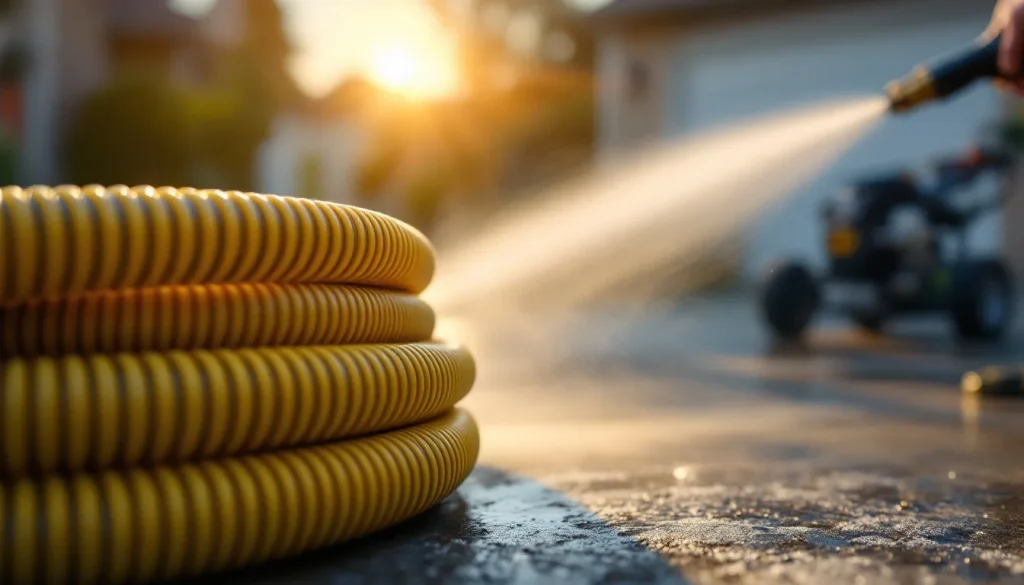
Pressure washing hose: the 60-second buying answer
A pressure washing hose is chosen on four specs, in this order: pressure rating (must meet or exceed your machine’s max PSI), inner diameter (1/4 inch, 5/16 inch, or 3/8 inch, sized to your machine’s GPM), fitting type at both ends (M22-14mm, M22-15mm, 3/8 inch NPT, or 3/8 inch quick-connect), and length (25, 50, or 100 feet). Match those four and the hose fits and holds pressure.
By the HMNDP Editorial Team, independent reporting on lawn care, landscaping, and the green-industry business.
Last reviewed: June 2026.
Most buyers get burned on one of two things: a hose rated below their machine’s PSI, or an end fitting that will not seal against their pump or gun. The sections below fix both before you spend money.
Pressure washing hose lengths: 25, 50, 100 feet, and quick-couple runs
Standard pressure washing hose lengths are 25, 50, and 100 feet, and you can quick-couple sections together to reach 200 to 400 feet for large jobs. Longer runs trade convenience for pressure loss, so pick the shortest length that reaches the far corner of your work area, then add couplers only when you truly need them.
| Length | Best for | Trade-off |
|---|---|---|
| 25 ft | Cars, decks, small patios, electric units | You move the machine often |
| 50 ft | Two-story siding, driveways, most homeowners | Heavier to coil and store |
| 100 ft | Roofs, fence lines, large lots | Measurable pressure drop on small-ID hose |
| 200 to 400 ft (quick-couple) | Commercial, farm, multi-building | Needs larger ID to hold pressure |
Hose PSI rating: the one safety rule product pages skip
The pressure rating of the hose must meet or exceed the maximum PSI of your pressure washer, ideally with margin. A 3100 PSI machine needs a hose rated 3100 PSI or higher (a 3200 to 4000 PSI hose is safer). A hose rated below your machine can balloon, split, or blow a fitting under load, which is both a project-ending and a safety failure.
Check two numbers on the hose sleeve or product listing: the working pressure (the rating that must clear your machine) and the burst pressure (usually two to three times higher, a built-in cushion). Never buy on burst pressure alone.
If you run a hot-water unit, confirm the hose is temperature rated to your machine’s output, commonly up to 140 degrees F for consumer hoses and 200 to 250 degrees F for pro-grade rubber.
Inner diameter: 1/4 inch vs 5/16 inch vs 3/8 inch, matched to your GPM
Inner diameter (ID) controls how much water the hose can pass without choking flow, so it is sized to your machine’s gallons per minute (GPM), not its PSI. Too small an ID on a high-GPM machine causes friction loss: pressure at the nozzle drops the longer the run. This is the single spec the retailer pages ignore, and it is why a “3100 PSI” hose can still feel weak.
| Inner diameter | Machine GPM range | Typical max PSI | Notes on long runs |
|---|---|---|---|
| 1/4 inch | Up to ~2.5 GPM (most electric, light gas) | ~3200 PSI | Noticeable pressure drop past 50 ft at higher flow |
| 5/16 inch | ~2.5 to 4.0 GPM (prosumer gas) | ~4000 PSI | Holds pressure better on 100 ft runs |
| 3/8 inch | 4.0 GPM and up (commercial) | ~5000 to 6000 PSI | Least friction loss; standard for quick-couple runs |
Rule of thumb: if you are extending past 50 feet or running a machine above 3.0 GPM, step up one ID size to keep nozzle pressure honest. A 3/8 inch hose on a 4 GPM machine loses far less pressure over 100 feet than 1/4 inch does.
Fitting compatibility: M22-14mm vs M22-15mm vs 3/8 quick-connect
The number one reason a replacement pressure washing hose does not fit is the end fitting, not the length or PSI. Consumer machines mostly use M22 threaded connections, but M22 comes in two bore sizes (14mm and 15mm) that are not interchangeable and will leak if mixed. Pro and gas units often use 3/8 inch quick-connect or 3/8 inch NPT instead.
| Machine connection | What it looks like | Hose end you need | Fix if mismatched |
|---|---|---|---|
| M22-14mm | Metric thread, 14mm inner pin (many Ryobi, older Karcher) | M22-14mm | M22-14 to 15 adapter |
| M22-15mm | Metric thread, 15mm inner bore | M22-15mm | M22-15 to 14 adapter |
| 3/8 inch NPT | Tapered pipe thread (many pumps, guns) | 3/8 inch NPT | NPT to M22 or NPT to QC adapter |
| 3/8 inch quick-connect | Push-and-lock plug/socket (Simpson, Generac, pro units) | 3/8 inch QC plug | QC to M22 coupler kit |
Before ordering, look at both ends of your current hose and read the machine’s inlet. Photograph the threads. If the machine says M22 but you cannot tell the bore, measure the inner opening: roughly 14mm versus 15mm decides it. Brass adapters cost a few dollars and rescue most mismatches.
Hose material: rubber vs PVC vs polyurethane
Pressure washing hose comes in three materials, and the right one depends on how hard and how cold you work. Rubber is the durable pro choice but heavy and can mark surfaces. PVC is cheap and light for occasional homeowners but kinks and stiffens in cold. Polyurethane and hybrid hoses split the difference: light, non-marking, flexible, and the popular prosumer pick.
| Material | Kink resistance | Cold-weather flex | Marring | Weight | Best for |
|---|---|---|---|---|---|
| Rubber | High | Good | Can leave black marks | Heavy | Daily pro use, hot water, abrasion |
| PVC | Low (kinks easily) | Poor (stiffens) | Non-marking | Light | Occasional homeowner, warm weather |
| Polyurethane / hybrid | High | Very good | Non-marking | Light | Prosumer, mixed conditions, delicate surfaces |
If you clean cars, boats, or painted siding, avoid a hose that marks and choose polyurethane or a non-marking rubber. If you work in freezing mornings, rubber and polyurethane stay flexible where PVC turns board-stiff and kinks at the fittings.
Connecting multiple hoses for extra reach
Yes, you can join two pressure washing hoses to gain length, using a coupler that matches the ends (M22 to M22, or a 3/8 inch quick-connect union). Each added section increases friction loss, so use the largest inner diameter you can and keep total length as short as the job allows. Commercial crews quick-couple 3/8 inch hose in 100-foot sections up to 400 feet.
- Confirm both hoses share the same fitting type and PSI rating.
- Use a coupler rated at or above your machine’s PSI, never a garden-hose connector.
- Step up to 5/16 or 3/8 inch ID for any total run over 100 feet.
- Wrap threaded joints with PTFE tape to stop leaks.
Hose-and-gun combos and nozzle attachment
A hose-and-gun combo bundles a matched hose, trigger gun, and often a quick-connect nozzle set, which removes the fitting-guesswork this guide warns about. The hose connects to the pump at one end and the gun at the other; the gun accepts quick-connect nozzles (0, 15, 25, 40 degree, and soap tips) or a threaded lance. Buying the combo guarantees the ends match.
If you already own a gun, confirm the hose-to-gun fitting (commonly M22 or 3/8 inch NPT) before buying a bare hose. Nozzle tips attach to the gun’s lance, not the hose, so nozzle choice is independent of hose selection.
When to replace a pressure washing hose
Replace a pressure washing hose when you see cracked or bulging outer cover, a soft spot or blister, weeping at the fittings, exposed inner braid, or a permanent kink that will not straighten. Any of these can rupture under pressure. Most consumer hoses last two to five seasons; heavy pro use and hot water shorten that.
- Blisters or bulges: the reinforcement layer has failed, replace immediately.
- Fitting leaks that tape will not fix: the crimp is going, replace.
- Exposed braid or deep abrasion: one more use could burst it.
- Set-in kinks: flow is choked at the bend and the cover is weakened.
Where to buy: Northern Tool, Home Depot, and Amazon
Pressure washing hoses are stocked at Northern Tool, The Home Depot, and Amazon, plus brand stores for Simpson, Karcher, Ryobi, and Sun Joe. Northern Tool leans toward pro-grade rubber and quick-connect commercial hose; Home Depot covers homeowner M22 replacements; Amazon has the widest range of adapters and polyurethane hybrids. Buy adapters from the same order to solve fitting gaps in one shipment.
Whichever retailer you use, filter by your three non-negotiables first: PSI rating at or above your machine, correct inner diameter for your GPM, and the exact fitting type. Length and material are the easy part once those are locked.
Applications a pressure washing hose supports
One correctly specced hose handles the full range of exterior cleaning: vehicles, decks, patios, driveways, siding, fences, roofs, gutters, outdoor furniture, and equipment. The hose is the constant; you change the nozzle tip and detergent for each surface. Matching the hose to your machine is what keeps pressure consistent across all of them.
Clean exterior surfaces pair well with the rest of a well-kept property. If you are prepping beds or borders after washing hardscape, our guides on choosing the best mulch for flower beds and the best fertilizer for grass cover the next steps, and our green-grass fertilizer breakdown helps the lawn recover fast. For food gardens near cleaned patios, see the vegetable-garden fertilizer guide.
Maintenance and kink prevention
A pressure washing hose lasts longer with three habits: drain and coil it loosely after each use, store it out of direct sun and freezing temperatures, and never yank it around corners, which is what sets kinks. Kinks choke flow and crack the cover from the inside, so a hose reel or wide-loop coil pays for itself.
- Relieve pressure and disconnect before coiling.
- Coil in loops at least 12 inches wide, not tight figure-eights.
- Keep fittings clean and lightly lubricated so O-rings seal.
- In winter, store indoors; PVC especially turns brittle in the cold.
Frequently Asked Questions
What size pressure washer hose do I need for my machine?
Size by three specs: pressure rating at or above your machine’s max PSI, inner diameter matched to GPM (1/4 inch under 2.5 GPM, 5/16 inch for 2.5 to 4.0 GPM, 3/8 inch above 4.0 GPM), and the fitting type on your pump and gun. Length is preference. Get PSI, ID, and fitting right and the hose performs.
What is the difference between 1/4-inch and 3/8-inch pressure washer hose?
The difference is inner diameter and flow capacity. A 1/4 inch hose suits electric and light gas machines up to about 2.5 GPM and roughly 3200 PSI. A 3/8 inch hose passes far more water for commercial machines at 4.0 GPM and up, and it loses much less pressure over long runs, which matters past 50 to 100 feet.
How do I know if a replacement hose will fit (M22 vs 3/8 quick connect)?
Inspect both ends of your current hose and the machine inlet. M22 is a metric thread in two bore sizes, 14mm and 15mm, which are not interchangeable. Pro and gas units often use 3/8 inch quick-connect plugs instead. Photograph the threads, note the type at pump and gun, and buy a matching hose or a brass adapter.
What PSI rating should a pressure washer hose have?
The hose working pressure must meet or exceed your machine’s maximum PSI, with margin preferred. For a 3100 PSI washer, choose a hose rated 3200 PSI or higher. Check the working pressure, not the burst pressure, which is typically two to three times higher and is only a safety cushion, not the rating you buy on.
Can you connect two pressure washer hoses together for more length?
Yes. Use a pressure-rated coupler that matches the ends (M22 to M22 or a 3/8 inch quick-connect union), never a garden-hose fitting. Each junction adds friction, so use the largest inner diameter available and keep total length as short as the job allows. Commercial crews quick-couple 3/8 inch hose up to 400 feet this way.
What is the best pressure washer hose material: rubber, PVC, or polyurethane?
It depends on use. Rubber is the most durable and heat-resistant for daily pro work but heavy and can mark surfaces. PVC is cheap and light for occasional homeowners but kinks and stiffens in cold. Polyurethane and hybrid hoses are light, non-marking, and flexible in cold, making them the best all-round prosumer choice.
How long can a pressure washer hose be before it loses pressure?
Pressure loss depends on inner diameter and GPM more than raw length. A 1/4 inch hose on a high-flow machine shows noticeable drop past about 50 feet, while 3/8 inch hose holds pressure well past 100 feet. To run long, step up the inner diameter rather than accepting the loss on a thin hose.
When should I replace my pressure washer hose?
Replace it at the first sign of a blister, bulge, or soft spot, a fitting leak that PTFE tape will not stop, exposed inner braid, or a permanent kink. Any of these can rupture under pressure. Most consumer hoses last two to five seasons; hot water and heavy commercial use shorten that lifespan considerably.