
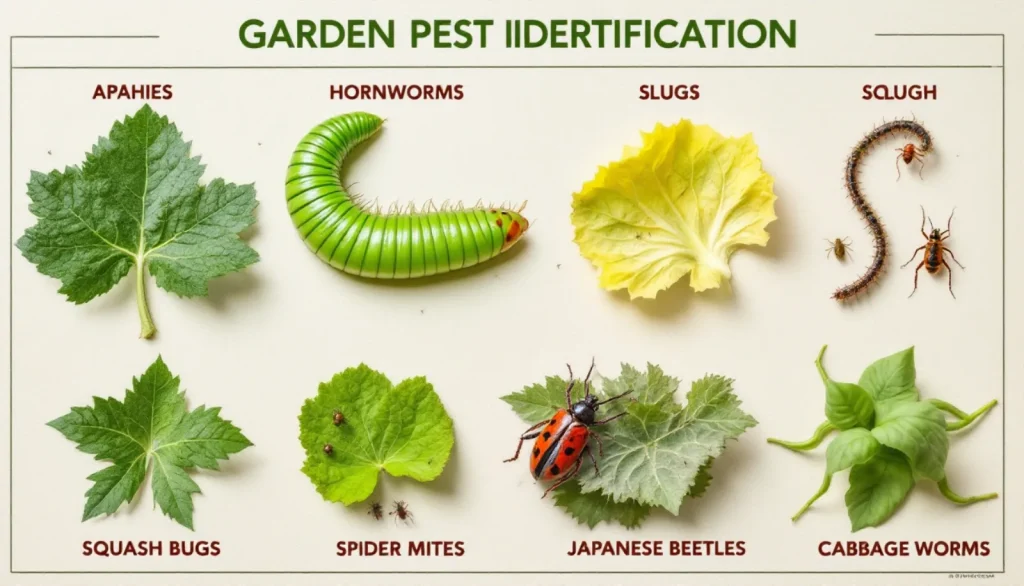
Garden Pest Identification: ID by Damage, Then Fix
Garden pest identification starts with the damage, not the bug, because most pests feed at dawn, dusk, or night and are gone by the time you look. Match the symptom (ragged holes, silvery slime trails, fine stippling, skeletonized leaves) to the culprit, then apply the fix. This guide gives you a single scannable damage-to-pest-to-fix table for the eight pests that cause most home-garden losses (aphids, tomato hornworms, slugs, squash bugs, spider mites, Japanese beetles, cabbage worms), plus how to confirm each one and what to do that week.
How do I identify a garden pest from the damage?
Read the damage pattern first. Chewing pests (caterpillars, beetles, slugs) leave holes, notches, or skeletonized leaves. Sucking pests (aphids, spider mites, squash bugs) leave stippling, yellowing, curling, or sticky honeydew. Then narrow by location on the plant, the host species, and physical evidence like slime trails or dark frass. University of Minnesota Extension and UC IPM both group pests this chewing-versus-sucking way because it cuts the suspect list in half before you ever see the insect.
Two clues do most of the work. Slime trails mean slugs or snails, never caterpillars. Dark fecal pellets (frass) near holes mean caterpillars or beetles, never slugs. If you find neither, check leaf undersides with a hand lens for mites or aphids, and inspect at night with a flashlight, since UMass Extension notes many leaf feeders are active after dark.
Garden pest identification table: damage, pest, and fix
This is the reference table. Find the damage sign in column one, confirm the pest in column two, and use the control in column three. Identifications follow guidance from University of Minnesota Extension, UC Statewide IPM Program, Oregon State Extension, and the Piedmont Master Gardeners pest series. Controls list the least-toxic effective option first.
| Damage sign you see | Likely pest | Confirm it by | First fix |
|---|---|---|---|
| Curled, distorted new growth; sticky honeydew; black sooty mold | Aphids | Clusters of soft pear-shaped insects on stem tips and leaf undersides | Spray off with water, then insecticidal soap; release or attract lady beetles and lacewings |
| Whole leaves and green fruit eaten to the nub, often overnight | Tomato hornworm | Large green caterpillar with a rear horn; dark pellet frass on leaves below | Handpick; apply Bt (Bacillus thuringiensis); leave wasp-cocooned hornworms in place |
| Large irregular holes mid-leaf; silvery slime trails | Slugs and snails | Slime trails on leaves and soil; feed at night, hide by day in damp cover | Iron phosphate bait; beer traps; remove mulch and boards near plants |
| Wilting squash or cucumber leaves; yellow speckling that browns | Squash bugs | Bronze shield-shaped bugs and bronze egg clusters on leaf undersides | Crush eggs; handpick into soapy water; spinosad on young nymphs |
| Fine yellow-white stippling; leaves bronze; fine webbing on undersides | Spider mites | Tap leaf over white paper, watch for moving specks under 1/20 inch | Hose off undersides; insecticidal soap or horticultural oil; avoid drought stress |
| Leaves skeletonized between the veins; chewed flowers | Japanese beetles | Metallic green-and-copper beetles feeding in groups, June to August | Handpick into soapy water in early morning; treat lawn grubs separately |
| Ragged holes in cabbage, kale, broccoli; green frass in leaf folds | Cabbage worms | Velvety green caterpillars; white cabbage butterflies flying nearby | Row covers before egg-laying; Bt or spinosad; handpick |
| Tiny shot-hole pinpricks across many leaves; stunted seedlings | Flea beetles | Tiny black beetles that jump when disturbed | Floating row covers; yellow sticky traps; spinosad if severe |
If the damage is below the soil line (severed seedlings at the base, grubs at the roots), the table above will not catch it. Stem-severed seedlings point to cutworms, and white C-shaped grubs in the lawn or root zone point to beetle larvae. Our guide to grub control for lawns covers the larval stage of Japanese and other beetles, which is the same insect doing root damage that the adults later do above ground.
What does aphid, spider mite, and other sucking-pest damage look like?
Sucking pests pierce plant cells and drain sap, so the damage is discoloration, not holes. Aphids leave curled, distorted new growth and a sticky honeydew that grows black sooty mold. Spider mites leave fine yellow or white stippling that turns whole leaves bronze, plus silky webbing on leaf undersides. Squash bugs cause yellow speckling that browns and wilts on cucurbits.
Spider mites are the easiest to miss and the fastest to explode. UC IPM notes the adults run under 1/20 inch, so confirm them by tapping a leaf over white paper and watching for moving specks. Oregon State Extension reports mite outbreaks worsen in hot, dry, dusty conditions, which is why water-stressed plants get hit hardest. Keep plants watered and hose off leaf undersides before reaching for any spray.
Aphids rarely kill an established plant on their own, but they transmit plant viruses and the honeydew fouls leaves. A hard water spray knocks most off, and lady beetles plus lacewings keep them in check. Reach for insecticidal soap only if the colony is spreading on new growth.
What pest is eating holes in my leaves at night?
Holes that appear overnight with no insect in sight usually mean slugs, snails, caterpillars, or earwigs. Slugs and snails leave large irregular holes toward the leaf center plus silvery slime trails, the one sign that rules every other pest out. Caterpillars leave holes with dark fecal pellets and no slime. Earwigs leave ragged holes on tender seedlings and hide in damp cracks by day.
- Check for slime trails on leaves and nearby soil. Trails present means slugs or snails; skip to bait.
- Look for dark frass pellets near the holes. Frass means caterpillars; inspect undersides and handpick.
- Inspect at night with a flashlight, since UMass Extension notes most leaf chewers feed after dark.
- Sprinkle flour or set a board trap, then check the next morning for whoever is hiding under it.
- Match what you find to the table above and apply the listed first fix.
For slugs, iron phosphate bait is the standard low-toxicity option and is safe around pets when used as labeled. Beer traps and removing damp daytime cover (mulch piled against stems, boards, dense ground cover) cut populations without any product at all.
How do I tell a pest problem from a disease or a nutrient issue?
Pests leave physical evidence: holes, slime, webbing, frass, honeydew, or the insect itself. Diseases usually show as spots with defined margins, powdery coatings, or wilting with no chewing damage. Nutrient and water problems show as uniform yellowing or browning across many leaves at once, with no holes and no insects. When the pattern is uniform and bugless, look at soil, water, and fertility before spraying anything.
Brown or dead patches in turf are a common false alarm. They often trace to grubs, drought, or fungus rather than surface insects. Our diagnosis tree for brown patches in lawn walks through separating insect damage from disease and watering issues so you do not treat the wrong cause.
When should I call a pro instead of treating it myself?
Handle most garden insects yourself with handpicking, row covers, and least-toxic sprays. Call a professional when the problem is structural, recurring across the whole property, or involves vertebrates rather than insects. Burrowing rodents, moles, and voles damaging beds and root systems are a different job than aphids on a tomato, and our guide to rodent and vertebrate pest removal covers when that crosses into pro territory.
Also escalate if you suspect an invasive or regulated pest. The Old Farmer’s Almanac and university extension offices both recommend bagging a specimen or photographing it and contacting your local cooperative extension office, where an agent can confirm the species for free. Correct identification matters because the wrong treatment wastes money and can harm the beneficial insects (lady beetles, lacewings, parasitic wasps) that suppress pests for you.
Prevent the next outbreak
Most pest pressure drops with healthy, unstressed plants and a few habits. Inspect leaf undersides weekly, since aphids, mites, and squash bug eggs all start there. Use floating row covers on brassicas and cucurbits until flowering to block egg-laying butterflies and beetles. Keep plants watered to prevent the drought stress that triggers spider mites, and avoid broad-spectrum insecticides that kill the predators doing free pest control.
Rotate crop families each season so soil-stage pests like flea beetles and Colorado potato beetles do not build up, a practice the Piedmont Master Gardeners recommend across their pest series. Pair pest control with sound feeding and watering: our NPK fertilizer guide and seasonal lawn and garden schedule cover the inputs that keep plants vigorous enough to outgrow minor damage.
Last reviewed: June 2026
HMNDP Editorial Team, reviewed by HMNDP turf and horticulture editors.
Frequently asked questions
How do I identify a garden pest from the damage?
Read the damage pattern first. Chewing pests like caterpillars, beetles, and slugs leave holes, notches, or skeletonized leaves. Sucking pests like aphids, spider mites, and squash bugs leave stippling, yellowing, curling, or sticky honeydew. Then narrow by host plant and physical evidence: slime trails mean slugs, dark frass pellets mean caterpillars or beetles.
What pest is eating holes in my leaves at night?
Overnight holes with no insect in sight usually mean slugs, snails, caterpillars, or earwigs. Slugs and snails leave large irregular holes toward the leaf center plus silvery slime trails, the one sign that rules every other pest out. Caterpillars leave dark frass and no slime. Inspect at night with a flashlight, since most leaf chewers feed after dark.
What does spider mite damage look like?
Spider mites leave fine yellow or white stippling that turns whole leaves bronze, plus silky webbing on leaf undersides. UC IPM notes adults run under 1/20 inch, so confirm them by tapping a leaf over white paper and watching for moving specks. Outbreaks worsen in hot, dry, dusty conditions, so keep plants watered and hose off leaf undersides.
How do I tell a pest problem from a disease or nutrient issue?
Pests leave physical evidence: holes, slime, webbing, frass, honeydew, or the insect itself. Diseases show as spots with defined margins, powdery coatings, or wilting with no chewing damage. Nutrient and water problems show as uniform yellowing across many leaves at once with no holes and no insects. When the pattern is uniform and bugless, check soil, water, and fertility first.
How do I get rid of aphids without harming beneficial insects?
A hard water spray knocks most aphids off, and lady beetles plus lacewings keep them in check naturally. Reach for insecticidal soap only if the colony is spreading on new growth. Avoid broad-spectrum insecticides, which kill the predators doing free pest control. Aphids rarely kill an established plant alone, but they transmit viruses and the honeydew fouls leaves.
When should I call a pro for garden pests?
Handle most garden insects yourself with handpicking, row covers, and least-toxic sprays. Call a professional when the problem is structural, recurring across the whole property, or involves vertebrates like burrowing rodents, moles, and voles rather than insects. Also escalate if you suspect an invasive or regulated pest, and have your local cooperative extension office confirm the species first.