
Grub Control for Lawn: Timing, Products, and 2026 Rules
Grub control for lawn problems comes down to one decision: prevent or cure, and the calendar decides which. Preventive products (chlorantraniliprole, imidacloprid, clothianidin) go down before or during egg hatch in late spring through July and stop the next generation. Curative products (trichlorfon, carbaryl) go down in August and September to kill grubs already chewing roots. This guide covers how to confirm grubs, the white-grub life cycle that sets your timing, which active ingredient to use, the 2026 rules that pulled some products off homeowner shelves, and the biological options (milky spore, nematodes) for people who want to skip synthetics.
How do I know I actually have grubs?
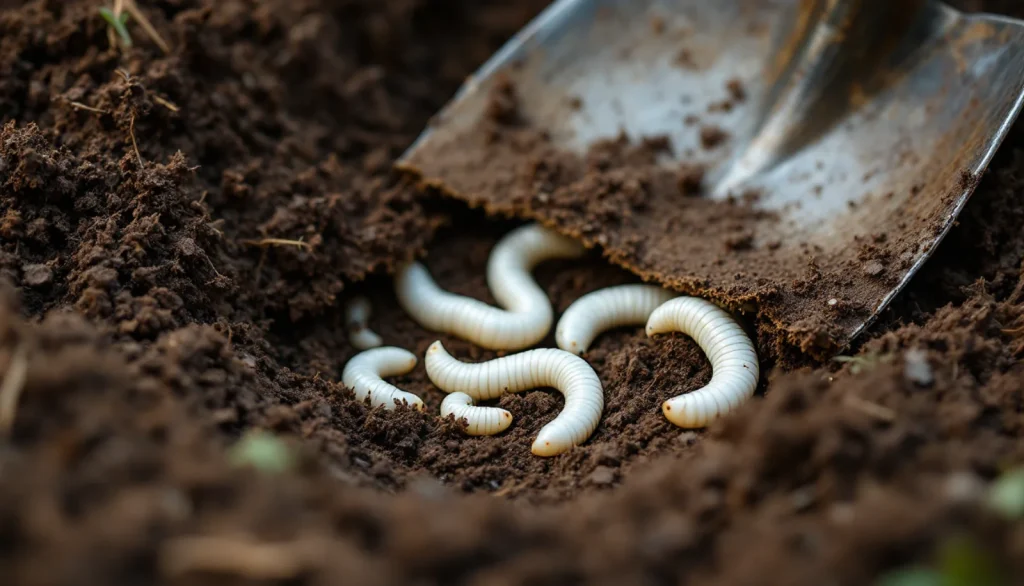
Grubs are the C-shaped white larvae of beetles, and you confirm them three ways: the tug test, animal digging, and a cut-count. Pull on a brown patch of turf. If it lifts like loose carpet with almost no resistance, the roots are severed and grubs are the likely cause. Skunks, raccoons, and birds tearing up the lawn at night are feeding on those grubs and often the first clue.
Confirm the count before you spend money. Cut a one-foot-square flap of sod about two inches deep with a spade, peel it back, and count the white grubs in the soil and root zone.
The threshold matters because healthy turf tolerates a surprising number. Iowa State University Extension notes healthy turf can sometimes tolerate 20 or more grubs per square foot before showing injury, while populations of 10 or more annual white grubs per square foot will cause grass to die under stress. Most extension guidance treats 10 grubs per square foot as the action threshold; 6 to 10 is a monitor range for already-stressed lawns. Finding one or two grubs does not mean you need to treat.
| Grubs per square foot | What it means | Action |
|---|---|---|
| 0 to 5 | Healthy turf absorbs this | No treatment needed |
| 6 to 10 | Monitor range, risky on stressed or drought-hit lawns | Treat if turf is thin or browning |
| 10 or more | Damage likely, animals may be digging | Curative treatment now |
| 10+ confirmed last fall or spring | History of pressure on the same lawn | Preventive treatment next season |
The white-grub life cycle that sets your timing
Timing every grub product hinges on the annual life cycle of the beetles whose larvae do the damage: mainly Japanese beetle (Popillia japonica), masked chafers, and European chafer (Amphimallon majale). The cycle repeats yearly, and the window where grubs are small and near the surface is the window where treatment works.
- Late June: adult beetles emerge from the soil and begin flying and mating.
- July: females lay eggs in turf, favoring irrigated lawns during dry stretches.
- Two to three weeks after laying: eggs hatch into tiny first-stage grubs that start feeding on roots.
- Late August into September: grubs are large, feeding hard, and doing the most visible damage.
- Winter: grubs burrow several inches down below the frost line.
- Spring: grubs return near the surface, feed briefly, then pupate in June and restart the cycle.
Two practical rules fall out of this. Curative chemicals do little in spring after roughly mid-May because grubs stop feeding as they prepare to pupate. And preventive products that target the newly hatched grubs need to be present in the soil when eggs hatch in July, which is why they go down weeks earlier.
Preventive vs curative grub control: which one fits your calendar
Preventive grub control stops next season’s grubs before they hatch; curative grub control kills the grubs already in your lawn. Use preventive if you had 10-plus grubs per square foot last year or sit in a known Japanese beetle area. Use curative when you find an active infestation in late summer and damage is showing now. They are not interchangeable, and the wrong one at the wrong time wastes money.
| Factor | Preventive | Curative |
|---|---|---|
| Active ingredients | Chlorantraniliprole, imidacloprid, clothianidin, thiamethoxam | Trichlorfon, carbaryl |
| Common products | Scotts GrubEx (chlorantraniliprole), BioAdvanced Season-Long (imidacloprid) | BioAdvanced 24 Hour Grub Killer Plus, Dylox (trichlorfon) |
| When to apply | Chlorantraniliprole April to mid-July (best before June); imidacloprid/clothianidin June to July | August to September; not effective after early October |
| What it does | Kills newly hatched grubs, protects against the next generation | Kills large, actively feeding grubs already present |
| Speed of result | Slow, season-long residual | Trichlorfon visible in about 7 to 10 days; Dylox kills in 24 to 48 hours |
| Best for | Lawns with a history of grub damage | An infestation you found this month |
One nuance on the preventive side: chlorantraniliprole (Scotts GrubEx, professional Acelepryn) needs more time to move to the root zone, so it works best applied April through May and before June. The neonicotinoids (imidacloprid, clothianidin, thiamethoxam) are applied later, in June or July, timed to egg hatch.
Why every grub product needs water (and soil temperature)
Grub insecticides only work once they reach the root zone where grubs feed, so you must water them in with at least 0.5 inches of irrigation or rainfall immediately after application. Iowa State and Michigan State extension both put the minimum at half an inch. A simple gauge: set out a flat tuna or cat-food can and run irrigation until it fills half an inch up from the bottom.
Soil temperature drives the biology underneath all of this. Grubs feed near the surface when soil at a 4-inch depth sits at or above 60 degrees Fahrenheit, and milky spore bacteria need soil between roughly 60 and 70 degrees to germinate and infect. If you want to dial in your application window rather than guess by the calendar, track your local readings with our guide to soil temperature and what it triggers in the lawn, because a cool spring or a warm fall shifts the grub timeline by weeks.
The 2026 product picture: what you can and cannot buy
The biggest change for 2026 is that neonicotinoid grub products (imidacloprid, clothianidin, thiamethoxam) are no longer freely available to homeowners in several states, which reshuffles the preventive shelf. Chlorantraniliprole products like Scotts GrubEx are not neonicotinoids and remain widely available, so they are the default homeowner preventive in restricted states.
The restrictions vary by state and change by legislative cycle, so confirm with your state agriculture department before buying:
| State | Rule and date | Effect on homeowner grub control |
|---|---|---|
| New York | Birds and Bees Protection Act; turf and ornamental prohibition on imidacloprid, thiamethoxam, acetamiprid effective December 31, 2026 | Neonic grub products restricted; use limited to specific DEC-authorized cases |
| California | Effective January 1, 2025, neonicotinoids removed from retail nursery and garden-center sale for outdoor non-agricultural use | Homeowners cannot buy neonic grub products; licensed applicators only |
| Washington | Effective January 1, 2026, outdoor turf and ornamental neonic use limited to licensed applicators or tree injection | Homeowner over-the-counter neonic turf use restricted |
| Maine | Dinotefuran, clothianidin, imidacloprid, thiamethoxam prohibited in outdoor residential landscapes | No homeowner neonic use on lawn or turf |
The takeaway: in restricted states reach for chlorantraniliprole for prevention, and for cure use trichlorfon (Dylox) or carbaryl, which are not affected by the neonicotinoid rules. Always read the label, because product formulations and state lists change.
Organic grub control: milky spore and beneficial nematodes
If you want to skip synthetic insecticides, the two real biological options are milky spore and beneficial nematodes, and they work very differently. Milky spore (Paenibacillus popilliae) is a soil bacterium specific to Japanese beetle grubs and useless against other species. Beneficial nematodes are microscopic roundworms that hunt grubs of several species. Neither is as fast or as reliable as a labeled insecticide, so set expectations.
- Milky spore: targets Japanese beetle grubs only. It is slow, reaching peak strength in about three years (longer in cooler regions), but once established it can persist 10 to 20 years. Independent results are modest; some sources cite only 20 to 25 percent infection. Apply in late summer to early fall when grubs feed, with soil above 60 to 65 degrees.
- Beneficial nematodes (Heterorhabditis bacteriophora): applied when grubs are small and active in late summer, with consistent soil moisture before and after. Reported field control ranges widely, from about 60 percent to 100 percent when timed and watered correctly, and near zero when applied dry or off-window.
Both biologicals depend on moisture and warm soil, the same variables that govern synthetic timing. Pair either with cultural fixes (mowing high, deep infrequent watering, overseeding thin spots) so the turf can outgrow light grub pressure. For repairing the brown patches grubs leave behind, our guide to filling bare spots walks through the renovation.
What to do after the grubs are gone
Killing grubs is half the job; the dead turf they left will not recover on its own, so plan the repair into the same season. Rake out the loose dead grass, loosen compacted soil, and reseed or sod the damaged patches once grub activity has stopped. Brown patches from grubs can look like disease or drought, so confirm the cause first with our diagnosis walkthrough for brown patches in the lawn.
Going forward, a thick, well-fed lawn resists grub damage better than a thin one because dense roots tolerate more feeding before showing injury. A steady fertility program supports that recovery; see our year-round grass maintenance schedule for the cool-season and warm-season calendars. If the infestation was severe or you are in a heavy Japanese beetle region and want a professional preventive program, our directory of vetted lawn care and landscape contractors is the place to start.
Last reviewed: June 2026
HMNDP Editorial Team, reviewed by HMNDP turf and horticulture editors.
Frequently asked questions
What kills grubs in your lawn fastest?
Curative insecticides with trichlorfon (Dylox, BioAdvanced 24 Hour Grub Killer Plus) or carbaryl kill grubs fastest, with trichlorfon working in about 24 to 48 hours on contact. Apply them in August or September when grubs are large and feeding near the surface, then water in half an inch immediately so the product reaches the root zone.
When should I apply grub control on my lawn?
It depends on the product. Preventive chlorantraniliprole (Scotts GrubEx) works best applied April through May, before June. Preventive neonicotinoids like imidacloprid go down in June or July at egg hatch. Curative products (trichlorfon, carbaryl) go down in August or September when active grubs are found, and are not effective after early October.
How many grubs per square foot is too many?
Most extension guidance treats 10 grubs per square foot as the action threshold. Healthy turf can tolerate 20 or more before showing injury, while stressed or drought-hit lawns may be damaged at 6 to 10. Finding one or two grubs does not justify treatment. Cut a one-foot-square sod flap, peel it back, and count before spending money.
What is the difference between preventive and curative grub control?
Preventive control stops next season’s grubs before they hatch using chlorantraniliprole or neonicotinoids applied in spring through July. Curative control kills grubs already feeding using trichlorfon or carbaryl applied in late summer. They are not interchangeable: a preventive in fall is too late, and a curative in spring misses the feeding window.
Can I still buy imidacloprid grub control in 2026?
Not in every state. New York restricts imidacloprid on turf and ornamentals from December 31, 2026, California removed neonicotinoids from retail garden-center sale in January 2025, Washington limited outdoor neonic turf use to licensed applicators in January 2026, and Maine bans homeowner use. In restricted states, use chlorantraniliprole (Scotts GrubEx) for prevention instead.
Does milky spore really work for grubs?
Milky spore (Paenibacillus popilliae) works only against Japanese beetle grubs, not other species. It is slow, taking about three years to reach peak strength, though it can persist 10 to 20 years once established. Independent results are modest, with some sources citing only 20 to 25 percent infection. Apply in late summer with soil above 60 to 65 degrees.
Do beneficial nematodes kill lawn grubs?
Yes, beneficial nematodes (Heterorhabditis bacteriophora) hunt grubs of several species and can deliver roughly 60 to 100 percent control when timed and watered correctly. Apply them in late summer when grubs are small and active, keep soil consistently moist before and after, and use them fresh. Applied dry or off-window, control drops to near zero.
Why do I need to water in grub control?
Grub insecticides only work once they move down to the root zone where grubs feed, so they must be watered in with at least 0.5 inches of irrigation or rainfall immediately after application. Without it, the product stays on the thatch surface and never reaches the grubs. Use a flat can to measure half an inch of water.