
By the HMNDP Editorial Team, independent reporting on lawn care, landscaping, and the green-industry business.
Last reviewed: June 2026
What dahlia flowers are and where they come from
Dahlia flowers are tender perennials in the genus Dahlia, part of the Asteraceae (daisy and sunflower) family, native to the mountains of Mexico and Central America. Botanists recognize roughly 49 wild species, but breeders have produced more than 57,000 registered cultivars. What looks like one bloom is actually a composite head made of many tiny florets.
Dahlias are the national flower of Mexico, where the Aztecs grew them for food, medicine, and ornament long before European collectors sent tubers to Madrid in the late 1700s.
The plant grows from underground tubers and returns each year in warm zones. In cold zones, gardeners treat it as a dig-and-store perennial or as an annual. That single trait drives most of the care decisions below.
Dahlias share the Asteraceae family with many familiar garden plants. If you enjoy the way a daisy head is built from a central disc and outer rays, see our overview of annual flowers and their meanings for close relatives you can pair with dahlias.
Dahlia colors: nearly every hue except true blue
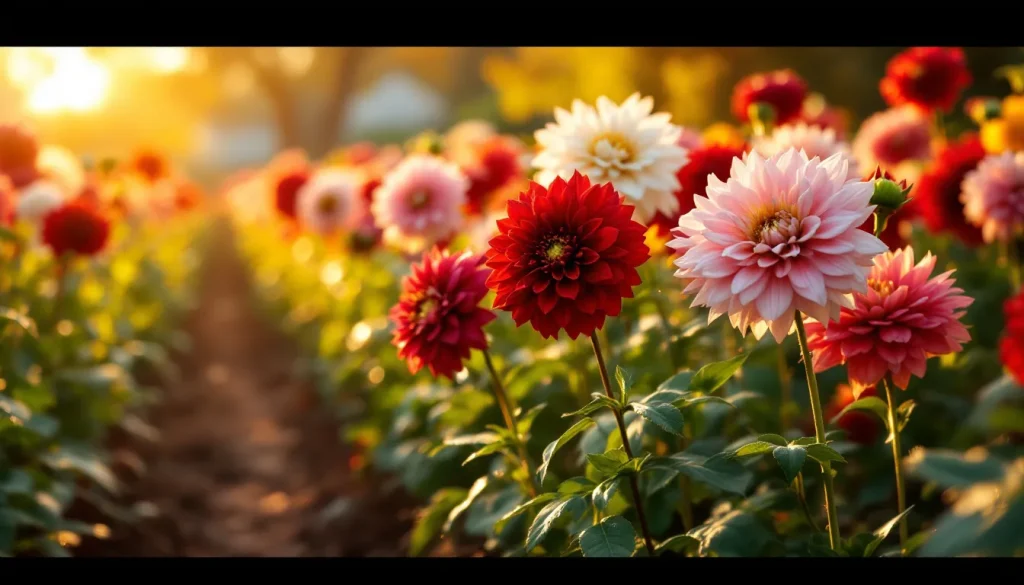
Dahlias come in almost every color a garden could want: red, pink, orange, yellow, white, purple, lavender, bronze, near-black burgundy, and countless bicolors and blends. The one color no breeder has ever achieved is a true blue, because dahlias lack the gene to produce delphinidin-based blue pigment.
The deepest “black” dahlias, like Karma Choc and Arabian Night, are actually very dark red or maroon. If you want genuine blue in the same bed, pair dahlias with true-blue companions from our guide to blue flowers that actually read blue.
Are dahlias grown from bulbs or tubers?
Dahlias grow from tubers, not true bulbs, even though many retailers label them “dahlia bulbs.” A tuber is a swollen underground stem that stores energy, like a potato. A true bulb (a tulip or daffodil) is a layered bud wrapped in scales. The distinction matters because it changes how you plant and store them.
A dahlia tuber only sprouts from an “eye,” a growth point on the crown where the tuber meets last year’s stem. A tuber with no eye will not grow, no matter how plump it looks. When you divide clumps in fall or spring, each division must include at least one eye.
Dahlia types and flower forms
Dahlias are grouped by flower form and size, from dinnerplate blooms 10 inches across to pompons under 2 inches. The American Dahlia Society recognizes about 20 official forms. The table below covers the forms home gardeners buy most often, with typical bloom size and a good first-time cultivar.
| Form | Bloom size | Look | Popular cultivar |
|---|---|---|---|
| Dinnerplate (decorative) | 8 to 10+ inches | Huge, flat, showy heads | Cafe au Lait |
| Decorative | 4 to 8 inches | Full, rounded, flat-tipped petals | Thomas Edison |
| Ball | 2 to 4 inches | Spherical, tightly rolled petals | Cornel |
| Pompon | Under 2 inches | Tiny, perfectly round | Small World |
| Cactus | 4 to 8 inches | Spiky, rolled, pointed petals | Nuit d’Ete |
| Single | 2 to 4 inches | One ring of petals, open center | Bishop of Llandaff |
| Waterlily | 4 to 6 inches | Shallow, curved, waterlily-like | Gerrie Hoek |
For cut flowers and long vase life, ball and decorative forms hold up best. For pollinators, single and open-centered forms feed bees that fully double forms shut out.
When and how to plant dahlia tubers
Plant dahlia tubers 4 to 6 inches deep and 12 to 24 inches apart, laid horizontally with the eye facing up, once soil warms to about 60 degrees Fahrenheit and all danger of frost has passed. In most of the US that falls between mid-April and late May. Cold, wet soil rots tubers, so do not rush the calendar.
- Wait until 1 to 2 weeks after your average last frost date and soil hits 60 degrees.
- Loosen soil to 12 inches and mix in compost. Choose full sun.
- Dig a hole 4 to 6 inches deep. Lay the tuber on its side, eye up.
- Set your stake now, before covering, so you never spear the tuber later.
- Cover with soil but do not water yet. Wait until you see a sprout, unless soil is bone dry.
- Space tubers 12 inches (small varieties) to 24 inches (dinnerplates) apart.
To bloom weeks earlier in short-season zones 3 to 5, start tubers in pots indoors 4 to 6 weeks before your last frost, then transplant.
Sun, soil, and watering requirements
Dahlias need at least 6 to 8 hours of direct sun, well-drained soil rich in organic matter, and roughly 1 inch of water per week once established. They are heavy feeders and prime candidates for rot, so drainage matters more than raw water volume. Morning sun with afternoon shade helps in hot southern zones 8 to 10.
Hold off on watering newly planted tubers until sprouts appear. Overwatering before roots form is the top cause of first-year failure. After sprouting, water deeply 2 to 3 times a week rather than a little every day.
Feed with a low-nitrogen fertilizer (for example 5-10-10) after sprouting and again at first buds. Too much nitrogen gives you tall leafy plants with few flowers.
When dahlias bloom and how long they last
Dahlias bloom from midsummer, about 8 to 10 weeks after planting, until the first hard frost, typically July through October in most US zones. A single plant can produce dozens of blooms across the season if you deadhead. As cut flowers, dahlias last 4 to 7 days in a vase when cut correctly.
To maximize vase life, cut in early morning when stems are full of water, choose blooms that are nearly fully open (dahlias do not open further after cutting), and dip stem ends in 160-degree water for 7 seconds or use cool water changed daily. This searing step is the single biggest vase-life gain most gardeners miss.
Care basics: staking, pinching, deadheading, and fertilizing
Four routine tasks keep dahlias productive: stake tall varieties early, pinch young plants to force branching, deadhead spent blooms to trigger more flowers, and feed with low-nitrogen fertilizer. Each takes minutes and directly increases bloom count. Skipping them gives you fewer, smaller flowers on floppy stems.
- Staking: Set stakes at planting for any variety over 3 feet. Tie loosely as the plant grows to keep hollow stems from snapping in wind.
- Pinching: When the plant reaches 12 to 16 inches with 3 to 4 leaf sets, pinch out the central growing tip. This doubles or triples branching and total bloom count.
- Deadheading: Remove faded blooms at the stem. Spent dahlia heads look like closed pointed buds, while new buds are round, so cut the pointed ones.
- Fertilizing: Apply low-nitrogen fertilizer monthly through summer. Stop feeding by early fall so tubers can harden before storage.
Growing dahlias in containers vs. garden beds
Dahlias grow well in both beds and large containers, though pot size dictates which varieties succeed. Choose containers at least 12 to 15 inches wide and deep, and match small to medium varieties (under 3 feet) to pots. Dinnerplate types need garden beds or very large 20-inch pots to support their root mass and height.
Container dahlias dry out fast and need daily summer watering plus a drainage hole. The upside: in cold zones you can move the whole pot into an unheated garage for winter instead of digging tubers.
Zone-by-zone overwintering and tuber-storage protocol
Whether you dig dahlias for winter depends on your USDA zone. Dahlias survive in the ground in zones 8 to 10 with mulch, but in zones 3 to 7 the tubers freeze and rot unless you dig, dry, and store them. Below is the decision most guides skip, mapped directly to your zone.
| USDA zone | Winter low | Action |
|---|---|---|
| Zones 3 to 5 | Below -10°F | Must dig and store indoors. In-ground tubers will not survive. |
| Zone 6 | -10 to 0°F | Dig and store, or risk a heavy mulch gamble in a protected bed. |
| Zone 7 | 0 to 10°F | Often overwinters in-ground under 4 to 6 inches of mulch in dry soil; dig if soil stays wet. |
| Zones 8 to 10 | Above 10°F | Leave in ground with light mulch. Divide every 2 to 3 years to prevent overcrowding. |
Follow this sequence to dig and store tubers where winters demand it:
- Wait until the first hard frost blackens the foliage. Cut stems to 4 to 6 inches.
- Leave tubers in the ground 1 to 2 weeks after frost to cure the skin (optional but reduces rot).
- Dig a wide circle 12 inches out from the stem with a fork, and lift the whole clump gently. Never pull by the stem.
- Rinse off soil, then dry the clump upside down in a cool, airy spot for 1 to 3 days.
- Divide now (easier than spring) so each piece has an eye, or store the clump whole.
- Pack tubers in a bin with barely-damp vermiculite, peat, sawdust, or wood shavings so they do not touch.
- Store at 40 to 50 degrees Fahrenheit in a dark, frost-free spot like an unheated basement or garage.
- Check monthly. Toss any soft or moldy tuber. Mist lightly if tubers shrivel.
Replant in spring after your last frost. This dig-and-store cycle is the number-one dahlia pain point, and doing it right is what turns a one-season annual into a lifelong perennial.
Pest and disease management
The most common dahlia problems are slugs and earwigs chewing foliage, powdery mildew coating leaves late in the season, and tuber rot from wet storage or soggy soil. Most are preventable with spacing, drainage, and airflow rather than heavy spraying. Catching each early keeps plants blooming into fall.
| Problem | Signs | What to do |
|---|---|---|
| Slugs and snails | Ragged holes, slime trails on young shoots | Iron-phosphate bait (Sluggo), copper tape, hand-pick at night, remove debris |
| Earwigs | Chewed petals and leaf edges, insects hiding in blooms | Rolled-newspaper or oil traps at dusk, clear mulch near stems |
| Powdery mildew | White powder on leaves in late summer | Space for airflow, water at the base, apply neem or potassium-bicarbonate spray |
| Tuber rot | Soft, mushy, moldy tubers in storage | Cure before storing, keep media barely damp, ensure 40 to 50°F airflow, discard infected tubers |
| Spider mites | Stippled, bronzed leaves in hot dry spells | Spray undersides with water, apply insecticidal soap |
Good garden hygiene prevents most trouble: clear fallen leaves, space plants so air moves, and never store a tuber that shows soft spots, because rot spreads through a whole bin.
Where to buy dahlia tubers
Home gardeners buy dahlia tubers from specialty mail-order nurseries and big garden retailers, most of which ship in early spring for that season’s planting. Order in winter, because popular cultivars like Cafe au Lait sell out fast. The table lists well-known US sources described neutrally.
| Retailer | Known for |
|---|---|
| Breck’s | Wide mainstream selection, frequent bundle deals |
| Eden Brothers | Large dahlia catalog, single tubers and mixes |
| White Flower Farm | Curated, higher-end named varieties |
| Longfield Gardens | Value-priced tubers and grower guides |
| Local dahlia society sales | Fresh, region-tested tubers and expert advice |
Buy from a source that names the cultivar and guarantees a viable eye. A cheap unnamed “bulb” mix often ships small tubers that skip a season before blooming.
Dahlia flower meaning and symbolism
Dahlias symbolize dignity, elegance, commitment, and a bond that stays strong through change. In Victorian flower language they signaled lasting commitment between two people, which is why they appear in weddings and long-partnership bouquets. Color shifts the meaning: red for strength, pink for grace, white for focus, and dark shades for a graceful mark of change.
The dahlia is also a birth flower, sharing August (with the gladiolus) as a bloom of the late-summer garden. See our full guide to birth flowers by month to place the dahlia among its calendar companions.
How to pronounce “dahlia”
In American English, dahlia is usually pronounced DAL-yuh (rhyming with “value”), while British English favors DAY-lee-uh. Both are correct. The flower was named after the 18th-century Swedish botanist Anders Dahl, and his surname rhymes with “doll,” which is why DAHL-yuh is also heard.
Are dahlias perennial or annual?
Dahlias are tender perennials, meaning they return yearly in warm zones but are grown as annuals or dug-and-stored perennials in cold ones. In USDA zones 8 to 10 they overwinter in the ground and come back each spring. In zones 3 to 7, gardeners either dig the tubers for storage or replace them yearly, which is what makes them behave like annuals.
If you like the idea of a vigorous perennial that climbs and returns without lifting, compare dahlias with the low-lift approach in our guide to growing clematis flowers, another long-blooming favorite that pairs well in a cutting garden.
Frequently Asked Questions
What are dahlia flowers and where do they come from?
Dahlia flowers are tender perennials in the genus Dahlia, part of the Asteraceae daisy family, native to the mountains of Mexico and Central America. About 49 wild species exist, but breeders have created over 57,000 cultivars in nearly every color except true blue. The Aztecs grew them before European collectors carried tubers to Spain in the late 1700s.
Are dahlias grown from bulbs or tubers?
Dahlias grow from tubers, not true bulbs, though many retailers mislabel them “dahlia bulbs.” A tuber is a swollen underground stem, like a potato, while a true bulb has layered scales. A dahlia tuber only sprouts from an “eye” on its crown, so any tuber or division you plant must include at least one visible eye to grow.
When and how do you plant dahlia tubers?
Plant dahlia tubers 4 to 6 inches deep and 12 to 24 inches apart after your last frost, once soil reaches about 60 degrees Fahrenheit, usually mid-April to late May. Lay each tuber on its side with the eye facing up, set the stake before covering, and wait to water until sprouts appear. Cold wet soil rots tubers, so avoid planting early.
How much sun and water do dahlias need?
Dahlias need at least 6 to 8 hours of direct sun and roughly 1 inch of water per week once established, in well-drained soil rich in organic matter. Water deeply 2 to 3 times weekly rather than daily. In hot southern zones 8 to 10, morning sun with afternoon shade helps. Skip watering newly planted tubers until sprouts emerge to prevent rot.
When do dahlias bloom and how long do they last?
Dahlias bloom from midsummer, about 8 to 10 weeks after planting, until the first hard frost, roughly July through October. A deadheaded plant produces dozens of blooms per season. As cut flowers they last 4 to 7 days when cut in early morning at near-full open, since dahlias do not continue opening after cutting. Searing stem ends in hot water extends vase life.
Do you have to dig up dahlias for winter, and how do you store the tubers?
In USDA zones 3 to 7 you generally must dig dahlias, because ground tubers freeze and rot. Zones 8 to 10 can leave them in the ground under mulch. To store, wait for a hard frost, cut stems, lift the clump, dry it 1 to 3 days, then pack in barely-damp vermiculite at 40 to 50 degrees Fahrenheit in a dark frost-free spot.
What do dahlia flowers symbolize or mean?
Dahlias symbolize dignity, elegance, commitment, and a bond that lasts through change, which is why they appear in weddings and long-partnership bouquets. Color adjusts the message: red for strength, pink for grace, white for focus, and dark burgundy for a graceful mark of change. The dahlia is also the national flower of Mexico and an August birth flower.
How do you pronounce “dahlia”?
In American English, dahlia is usually said DAL-yuh, rhyming with “value,” while British English favors DAY-lee-uh. Both are accepted. The flower honors 18th-century Swedish botanist Anders Dahl, whose surname rhymes with “doll,” so DAHL-yuh is sometimes used too. Any of the three is understood by gardeners.