
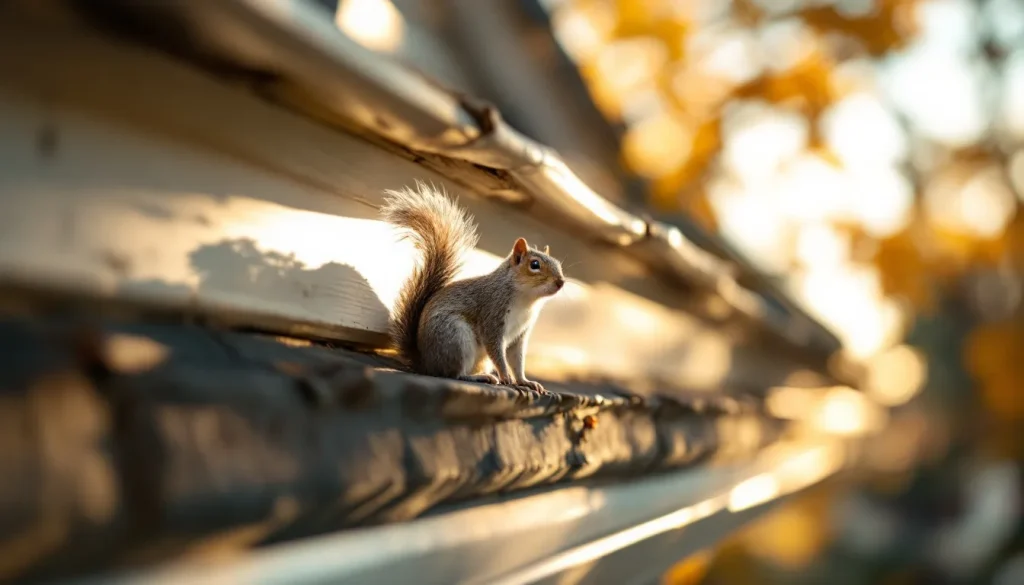
Squirrel pest control at a glance
Effective squirrel pest control follows one order: confirm the species, install a one-way exclusion door so the animals leave on their own, then seal every entry point and remove attractants so they cannot return. Poisoning and random trapping tend to fail because they ignore reentry. Expect to pay roughly $300 to $1,500 for a typical single-entry job, more if attic insulation needs replacing.
By the HMNDP Editorial Team. Last reviewed: June 2026.
The sections below cover identification, removal methods, transparent cost ranges, a do-it-yourself-versus-hire decision rule, the legal and seasonal timing that most guides skip, and long-term prevention.
Signs you have a squirrel infestation
Squirrels announce themselves through daytime scratching and scampering in the attic or walls, gnaw marks around roof edges and vents, acorn or nut caches, shredded insulation nests, and droppings the size of a grain of rice. Gray squirrels are active at dawn and dusk, so noise in daylight is a strong tell that separates them from nocturnal rodents.
- Noise: rolling, scratching, or scampering overhead, loudest at sunrise and sunset.
- Entry points: chewed holes about 1.5 to 2 inches wide near soffits, gable vents, fascia boards, and roofline gaps.
- Droppings: dark, rounded pellets 8mm long, often clustered near nesting spots.
- Damage: stripped wire casing, compressed insulation, and leaf or shredded-material nests.
If activity is strictly after dark and you spot small colonies, suspect flying squirrels rather than gray squirrels, which changes your tactics (covered below).
Common squirrel species and why the species matters
The three squirrels that invade homes behave differently, so identification drives the whole plan. Eastern gray squirrels are large, diurnal, and usually enter alone or in small numbers. Red squirrels are smaller, aggressive hoarders. Southern flying squirrels are nocturnal, glide between trees, and nest in colonies of a dozen or more, which makes single-trap removal nearly useless.
| Species | Active | Behavior | Removal note |
|---|---|---|---|
| Eastern gray squirrel | Day (dawn/dusk peaks) | Solitary or small groups | One-way door works well |
| Red squirrel | Day | Territorial, heavy chewer | Exclusion plus aggressive sealing |
| Southern flying squirrel | Night | Colonial (10+ animals) | Multi-catch traps or repeat exclusion; often needs a pro |
Damage squirrels cause
Squirrels damage homes far beyond noise. Their incisors grow continuously, so they gnaw wiring, and stripped electrical insulation is a recognized structural fire risk cited by pest and wildlife control operators. They also compress and foul attic insulation with urine, chew roof sheathing and fascia, and open entry gaps that let in water and other pests.
The costly outcomes are usually secondary: replacing chewed wiring, sanitizing and re-insulating a soiled attic, and repairing roof entry points. This is why a cheap trap-only approach often ends up more expensive than proper exclusion and repair.
How to get rid of squirrels
The reliable way to get rid of squirrels is exclusion, not extermination. You let the resident animals exit through a one-way door, confirm the space is empty, then permanently seal every hole. Lethal poisons are a poor choice for squirrels because an animal that dies inside a wall creates an odor and decomposition problem with no easy fix.
One-way door (exclusion door)
A one-way door, also called an exclusion door or excluder, is a hinged or funnel device mounted over the main entry hole. It lets squirrels push out to forage but blocks reentry, so the attic empties itself within a few days without trapping or handling. It is the humane method most wildlife professionals recommend for adult gray squirrels.
- Find and mark every entry hole, then leave only the primary one open.
- Mount the excluder tightly over that primary hole.
- Seal all secondary holes first so animals cannot bypass the door.
- Watch for three to five days of no activity, then remove the door and seal the last hole.
Do not install an excluder during breeding season if you suspect a nesting female, or you may seal nursing young inside (see timing below).
Live trapping
Live trapping uses baited cage traps (peanut butter, sunflower seeds, or nuts) to catch squirrels for release. It works for isolated animals but is labor-heavy, must be checked often to avoid animal stress, and does nothing about reentry unless you also seal the structure. Many states also restrict where a trapped squirrel may be released.
Squirrel pest control cost in 2026
Squirrel pest control cost is the number most guides hide, so here are transparent 2026 ranges compiled from typical US wildlife-removal pricing. A straightforward single-entry job commonly lands between $300 and $1,500. Attic contamination pushes totals higher because insulation replacement is the most expensive line item, sometimes exceeding the removal itself.
| Service | Typical range (USD) | Notes |
|---|---|---|
| Inspection | $75 to $250 | Often credited toward the job |
| One-way door install | $300 to $600 | Includes monitoring and removal |
| Live trapping | $75 to $150 per animal | Plus a service or setup fee |
| Entry-point sealing (exclusion) | $200 to $1,000+ | Scales with number of gaps and roof access |
| Attic decontamination and re-insulation | $1,000 to $6,000+ | Depends on square footage and soiling |
Prices vary by region, roof height, and severity. Flying squirrel colonies cost more than a single gray squirrel because they require repeated visits or multi-catch systems.
DIY versus professional: a clear decision rule
The honest rule is simple: do it yourself when the job is one adult animal, a reachable entry, and no babies; hire a pro when handling gets complicated or dangerous. A single gray squirrel and a ground-floor gap is a reasonable DIY exclusion. Wall voids, colonies, heights, and breeding season are pro territory.
| DIY is reasonable when | Call a professional when |
|---|---|
| One adult gray squirrel, single entry | Flying squirrels or a colony |
| Entry is safely reachable from a ladder | Entry is on a steep or high roof |
| No signs of a nesting female or young | Babies present or breeding season |
| Animals live in an accessible attic | Squirrels are stuck in a wall void |
| First occurrence | Repeated reentry after your own attempt |
Homeowners comfortable with tools can learn the basics from our guide to doing your own pest control, but exclusion at height or with young present is worth a licensed operator.
Legal rules and seasonal timing
Two factors that most pages ignore can decide the whole job. First, relocation is regulated: many US states restrict or prohibit trapping and releasing squirrels elsewhere, and some require euthanasia or on-site release, so check your state wildlife agency before you move an animal. Second, timing determines whether you strand babies.
Gray squirrels typically breed twice a year, with young present roughly February to May and again August to September. Installing a one-way door during these windows can seal a nursing mother outside and her pups inside, where they die and create weeks of odor and a decomposition cleanup. The safest removal windows are usually late spring into early summer and mid-fall, when young are mobile.
When young may be present, the standard humane approach is to remove the litter by hand (or have a pro do it) and reunite them outside so the mother relocates them, rather than forcing an exclusion.
How to keep squirrels from coming back
Prevention is the part that makes removal permanent. After the attic is empty, close the structure and cut the food and access that drew squirrels in. Skipping this step is the single biggest reason infestations recur within a season.
- Seal entry points: cover gaps with heavy 16-gauge galvanized hardware cloth or steel flashing, since squirrels chew through foam, wood, and plastic.
- Remove food attractants: clear fallen fruit and nuts, secure trash, and take down or relocate bird feeders that scatter seed near the house.
- Trim branches: cut limbs back at least 6 to 8 feet from the roofline, since squirrels leap roughly that far to reach a roof.
- Cap and screen: install chimney caps and metal vent covers on gable and soffit vents.
Repellents and deterrents
Repellents are a supporting tactic, not a solution. Capsaicin sprays, predator-scent granules, and motion-activated sprinklers can discourage yard activity, but no scent or ultrasonic device reliably evicts a squirrel already nesting in an attic. Treat deterrents as a way to reduce pressure on a sealed home, not a substitute for exclusion. Homeowners who prefer low-toxicity methods can compare approaches in our eco-friendly pest control overview.
When to call a professional
Call a licensed wildlife or pest control service when you hear a colony, suspect flying squirrels, find babies, face a high or steep roof, or have already tried exclusion and the animals returned. Professionals carry liability coverage, handle animals under state permits, and can pair removal with attic decontamination in one visit, which usually beats a failed DIY attempt on cost.
Service availability is local: providers advertise squirrel removal across markets from New Jersey to the Chicago metro, and pricing follows regional labor and roof access. Get an itemized quote that separates inspection, removal, sealing, and any attic work so you can compare bids. For other household invaders, the same exclusion-first logic applies to our guides on ant pest control and earwig pest control.
Frequently Asked Questions
How much does squirrel pest control cost?
A typical single-entry squirrel removal runs about $300 to $1,500 in 2026. Inspections cost $75 to $250, a one-way door install $300 to $600, live trapping $75 to $150 per animal, and entry-point sealing $200 to $1,000 or more. Attic decontamination and re-insulation is the priciest step at $1,000 to $6,000, depending on soiling and square footage.
How do I get rid of squirrels in my attic?
Find every entry hole, seal all but the main one, then mount a one-way exclusion door over that opening so the squirrels leave and cannot return. Confirm three to five days of silence, remove the door, and seal the last hole with steel hardware cloth. Avoid this method during breeding season if young may be present.
What is a one-way door and does it actually work for squirrels?
A one-way door is a funnel or hinged excluder mounted over the entry hole that lets squirrels exit but blocks reentry. It works reliably for adult gray squirrels and is the humane method most wildlife pros use. It fails only when secondary holes are left open or when a nesting female is sealed away from dependent young.
Should I remove squirrels myself or hire a professional?
Handle it yourself when there is one adult gray squirrel, a safely reachable entry, and no babies. Hire a professional for flying squirrels or colonies, high or steep roofs, wall-void trapped animals, any sign of young, or repeated reentry after your own attempt. Licensed operators also combine removal with attic cleanup and work under state wildlife permits.
How do I know if I have squirrels versus rats or mice in the attic?
Timing is the fastest clue. Gray squirrels are active in daylight, especially dawn and dusk, while rats and mice are mostly nocturnal. Squirrel droppings are larger (about 8mm), entry holes are wider (1.5 to 2 inches), and you may find nut caches. Strictly nighttime activity points to rodents or, in some regions, flying squirrels.
Is it legal to trap and relocate squirrels?
It depends on your state. Many US states regulate or prohibit trapping and relocating squirrels, and some require on-site release or euthanasia rather than moving the animal elsewhere. Rules vary widely, so check your state wildlife or fish and game agency before you trap. Licensed wildlife control operators handle squirrels under the permits these laws require.
What time of year is best (and worst) to remove squirrels?
The safest windows are usually late spring into early summer and mid-fall, when young are mobile. The worst times are the breeding seasons, roughly February to May and August to September, when a nesting female may have dependent pups. Excluding during those windows can strand babies inside, causing death, odor, and a costly decomposition cleanup.
How do I keep squirrels from coming back?
Seal every gap with 16-gauge galvanized hardware cloth or steel flashing, since squirrels chew through foam and wood. Remove fallen fruit, nuts, and scattered birdseed, secure trash, and cap chimneys and vents. Trim tree branches at least 6 to 8 feet from the roofline so squirrels cannot jump across. Repellents help only as a supporting measure after sealing.