
By the HMNDP Editorial Team, independent reporting on lawn care, landscaping, and green-industry equipment.
Last reviewed: June 2026
What a pressure washing surface cleaner is
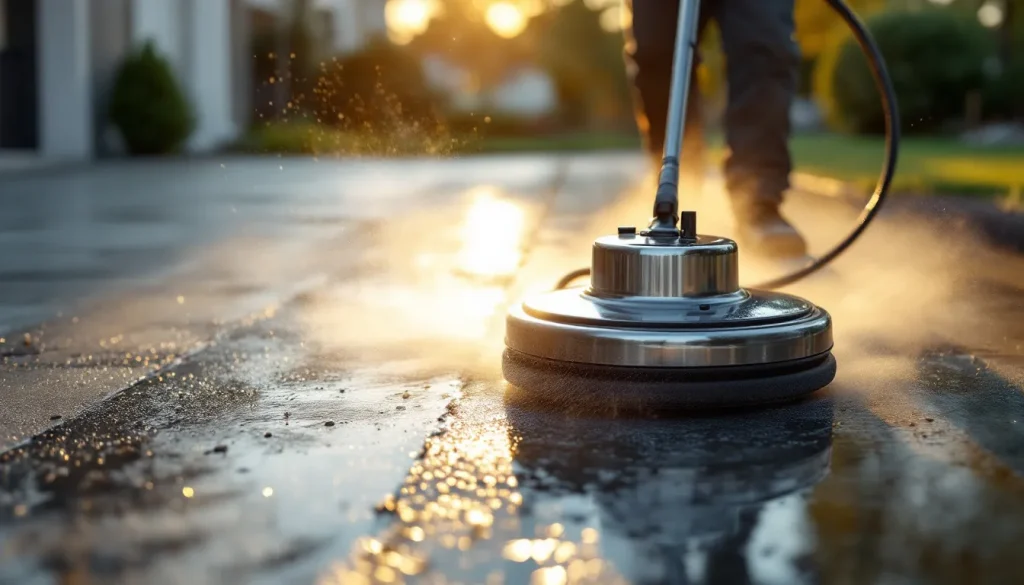
A pressure washing surface cleaner is a round attachment that snaps onto your pressure washer and cleans flat concrete faster and more evenly than a wand. Inside a covered housing, two to four nozzles sit on a spinning bar that spreads jets across a 14 to 24 inch path. It rides on casters, so you walk it across driveways, patios, and sidewalks at a set height.
The enclosed shroud is the point. It contains the spray, kills overspray, and holds each nozzle at a fixed distance and angle, which is what produces a uniform clean instead of the wand-swirl “cleaning marks” homeowners hate.
It excels on horizontal masonry: broom-finish concrete, pavers, stamped patios, and sidewalks. For wood, see our guide to deck pressure washing, where lower pressure and grain direction matter more than raw flow.
The spec that decides everything: GPM, not just PSI
GPM (gallons per minute) determines whether a surface cleaner works, yet almost every product page advertises only “up to X PSI.” A surface cleaner is flow-hungry: it splits your water across multiple spinning nozzles, so total flow, not pressure, sets how wide a path you can clean without slowing to a crawl. Undersized flow is the number-one cause of zebra striping.
Here is the logic PSI-only pages hide. Each nozzle needs enough water to keep its jet solid. Split too little flow across too many nozzles on too wide a bar, and the jets go weak and inconsistent, leaving alternating clean-and-dirty stripes as the bar spins.
Match diameter to your machine’s rated GPM first, then check that its PSI clears the tool’s minimum. A 1.4 GPM electric unit cannot feed a 20 inch head no matter how high its PSI reads.
Surface cleaner sizes matched to GPM (the chart the product pages skip)
Surface cleaner diameters run from about 14 to 24 inches for residential and light-commercial use, with 28 to 30 inch heads reserved for large gas and hot-water rigs. Pick the largest diameter your GPM can actually feed. Sizing to PSI alone is how buyers end up with streaks. Use your pressure washer’s rated GPM as the ceiling.
| Your washer GPM | Recommended diameter | Typical machine type | Good for |
|---|---|---|---|
| 1.2 to 1.6 GPM | Skip it or 12 to 13 in | Electric | Small patios, slow going |
| 2.0 to 2.5 GPM | 14 to 15 in | Entry gas | Sidewalks, small driveways |
| 2.8 to 3.5 GPM | 16 to 20 in | Prosumer gas | Driveways, patios |
| 4.0 to 5.5 GPM | 20 to 24 in | Commercial gas | Large lots, daily use |
| 5.5 GPM and up | 24 to 30 in | Hot-water/belt-drive | Fleet and municipal work |
When in doubt, size down one step. A 15 inch head on a 4 GPM machine cleans fast and streak-free. A 20 inch head on a 2.5 GPM machine crawls and stripes.
Surface cleaner vs turbo nozzle vs deck wand
A flat surface cleaner is the right tool for wide, flat concrete. A turbo (rotary) nozzle spins a single 0-degree jet in a cone and cuts aggressively but in a narrow circle. A deck wand holds fan nozzles for controlled low-pressure work. Each has a clear lane, and pros carry more than one.
| Tool | Path width | Best surface | Streak risk |
|---|---|---|---|
| Flat surface cleaner | 14 to 24 in | Driveways, patios, sidewalks | Low if GPM matched |
| Turbo/rotary nozzle | 2 to 4 in circle | Spot stains, edges, corners | High on open concrete |
| Deck wand/fan tip | 4 to 12 in | Wood decks, siding, detail | Medium, operator dependent |
Rule of thumb: surface cleaner for the field, turbo nozzle for the two-inch border it cannot reach, fan tip for anything vertical or wood. For a full driveway workflow, see driveway pressure washing.
The best pressure washing surface cleaners in 2026 by category
The best pressure washing surface cleaner is the one sized to your machine’s GPM and quick-connect fitting, not the highest PSI number on the box. Below are strong picks by use case across consumer and commercial tiers, spanning DEWALT, Ground Force, XFORCE, and universal cold-water brands like Simpson and BE Power Equipment.
| Category | Representative model | Diameter | Rated for | Typical price |
|---|---|---|---|---|
| Best prosumer gas | DEWALT DXPA34SC | 15 in | Up to ~3,700 PSI, 4 GPM | $80 to $120 |
| Best light-commercial | Ground Force 20 in | 20 in | Up to ~4,000 PSI, 5 GPM | $150 to $220 |
| Best heavy commercial | XFORCE 24 in stainless | 24 in | Up to ~4,500 PSI, 5.5 GPM+ | $250 to $400 |
| Best universal value | Simpson 15 in universal | 15 in | Up to ~3,700 PSI, 4 GPM | $70 to $110 |
| Best for electric/small gas | BE Power 12 to 14 in | 12 to 14 in | Up to ~3,300 PSI, 2 to 3 GPM | $50 to $90 |
Specs are manufacturer ratings and vary by production year; confirm the current PSI and GPM range before buying. Pros often source these through wholesale channels rather than big-box retail, which we cover in our roundup of pro landscaping distributors.
Consumer vs commercial-grade tiers
Consumer surface cleaners use plastic housings, plastic swivels, and light frames, and they hold up fine for a few driveways a year. Commercial-grade units use stainless or aluminum housings, sealed metal swivels, and heavier casters built for daily use and higher heat. The gap shows up in swivel life, not first-day cleaning.
Nozzles, spray-bar, casters, and fitment
Two things make or break a surface cleaner day to day: the nozzle-and-swivel assembly that spins the bar, and how it connects to your machine. Both are easy to get wrong at purchase and both are covered here so you can match parts before you buy.
The spinning bar carries two to four quick-connect nozzles. Nozzle size must match your PSI and GPM. Nozzles that are too small drop your pressure and stall the bar; too large and the jets go soft. Most units ship with the correct nozzles, but replacements must be re-sized to your machine, not guessed.
The swivel at the center is the wear part. Cheap plastic swivels can fail inside a season of pro use; sealed stainless swivels last far longer. Casters and an adjustable handle set cleaning height and keep the shroud level, which prevents one side scrubbing harder than the other.
For fitment, check the inlet. Universal cold-water units use a standard 1/4 inch quick-connect plug that fits most gas and many electric machines. Brand-specific systems (some DEWALT, Ryobi, and Kranzle setups) use proprietary bayonet or M22 connections, so confirm the fitting or buy an adapter before ordering.
How to avoid streaks and zebra striping
Zebra striping (alternating clean and dirty bands) comes from moving too fast, undersized GPM, worn nozzles, or an unlevel head. You beat it with the right size tool and disciplined passes, not more pressure. Consistent speed and 30 to 50 percent overlap do most of the work.
- Pre-treat with a concrete detergent and let it dwell 5 to 10 minutes so grime lifts before you cut it.
- Keep the head flat and casters on the deck; a tilted shroud stripes instantly.
- Walk at a slow, even pace, roughly one to two feet every few seconds, and never stop mid-pass.
- Overlap each pass 30 to 50 percent so no strip gets a single hit.
- Work in one direction, then do a second pass at 90 degrees to erase any faint lines.
- Rinse with a fan tip afterward to flush lifted residue toward the drain.
Rent vs buy, pricing, and maintenance
Buy a surface cleaner if you clean concrete more than once or twice a year; rent if it is a one-time job. Home-store rentals run roughly $40 to $70 per day, while a solid consumer unit costs $60 to $120. Two rentals usually equal owning. Commercial stainless heads run $150 to $400.
For a single driveway, renting the cleaner (and often the machine with it) makes sense, and our breakdown of what pressure washing costs helps you compare hiring a pro against the DIY route.
Maintenance is short but non-optional. Flush the unit with clean water after each use, oil or replace the swivel per the maker’s schedule, and inspect nozzles for wear every season since eroded orifices are a hidden cause of striping. Store it dry so the bearing does not seize.
Frequently Asked Questions
What is a pressure washer surface cleaner and how does it work?
A pressure washer surface cleaner is a round attachment with a covered housing and a spinning bar holding two to four nozzles. It rides on casters over flat concrete. As water pumps through, the jets spin and sweep a 14 to 24 inch path at a fixed height, cleaning driveways and patios evenly and far faster than a handheld wand.
What size surface cleaner do I need for my pressure washer?
Match diameter to your machine’s rated GPM, not its PSI. Roughly: 2.0 to 2.5 GPM feeds a 14 to 15 inch head, 2.8 to 3.5 GPM handles 16 to 20 inches, and 4 GPM or more supports 20 to 24 inches. GPM sets how much water each nozzle gets, so an oversized head on a low-flow machine leaves streaks.
What is the best pressure washer surface cleaner in 2026?
There is no single best; it depends on your machine. The DEWALT DXPA34SC 15 inch suits prosumer gas units around 4 GPM, Ground Force and XFORCE stainless heads suit commercial rigs, and Simpson or BE universal cold-water units fit most standard 1/4 inch quick-connect machines. Choose by matching GPM and fitting first.
Can you use a surface cleaner on a small or electric pressure washer?
You can, but only a small one. Most electric washers deliver 1.2 to 1.6 GPM, which is too little for anything above roughly a 12 to 13 inch head. Expect slow going and possible striping. Surface cleaners perform best on gas machines producing 2.5 GPM or more, which feed the spinning nozzles enough water.
How many PSI and GPM do you need to run a surface cleaner?
Most residential surface cleaners run well at 2,000 to 3,500 PSI and at least 2.5 GPM. PSI provides cutting power; GPM provides even coverage and speed. Check the tool’s minimum rating: many list a floor around 2 GPM. Below that, the bar spins weakly and cleaning turns patchy regardless of how high the PSI reads.
Surface cleaner vs turbo nozzle, which is better for concrete?
For open flat concrete, a surface cleaner wins because it cleans a wide even path with no swirl marks. A turbo or rotary nozzle cuts hard but only in a two to four inch spinning circle, which stripes large areas and takes far longer. Use the surface cleaner for the field and the turbo nozzle for edges and stains.
How do you avoid streaks and zebra striping?
Size the cleaner to your GPM, keep the head flat on its casters, and move at a slow, steady pace with 30 to 50 percent overlap on every pass. Pre-treat with detergent, never stop mid-stroke, and finish with a second pass at 90 degrees. Worn nozzles and low flow are the usual culprits behind stripes.
Should you rent or buy a pressure washing surface cleaner?
Rent for a one-time job; buy if you clean concrete more than once or twice a year. Rentals run about $40 to $70 per day, while a good consumer unit costs $60 to $120, so two rentals roughly equal ownership. Contractors should buy commercial stainless heads ($150 to $400) for the longer swivel life under daily use.