
By the HMNDP Editorial Team. Last reviewed: June 2026.
Driveway pressure washing in 9 steps
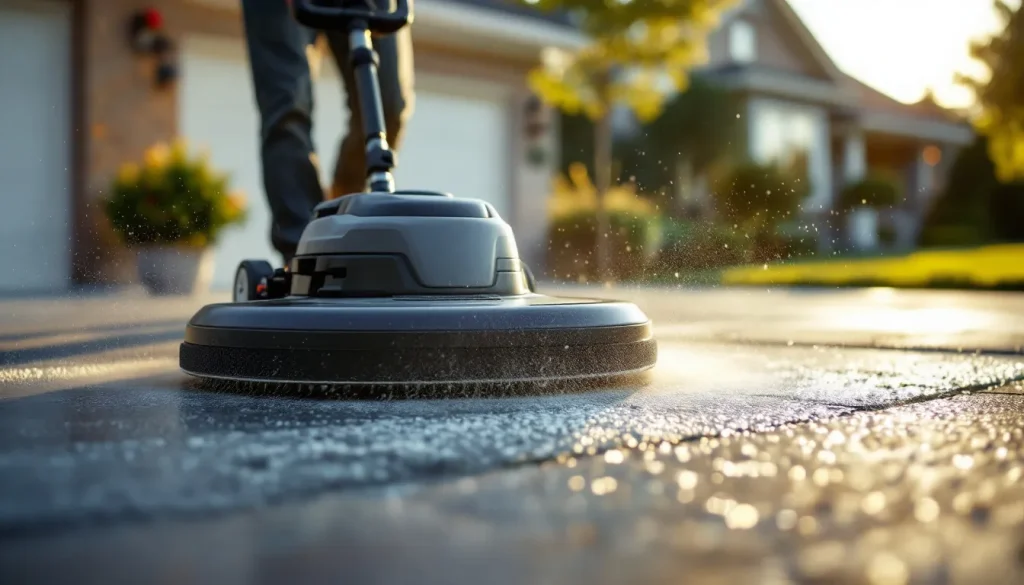
Driveway pressure washing means using a 3,000+ PSI gas or electric machine, ideally with a 16 to 24 inch surface cleaner attachment, to lift dirt, algae, and oil from concrete, pavers, or stamped surfaces. Done right, it takes 1 to 3 hours for a two-car driveway and costs $40 to $90 in rental versus a ~$210 pro average. The order below prevents the streaks most DIYers cause.
- Clear and sweep. Remove cars, planters, and debris. Sweep loose dirt so the water does not turn grit into a grinding paste.
- Pretreat stains. Apply a degreaser to oil, a cleaner to algae, and an oxalic-acid product to rust. Let it dwell 5 to 15 minutes (see the detergent table below).
- Connect the machine. Attach the garden hose to the inlet, screw the high-pressure hose to the pump and the trigger gun, and prime the system by running water through with the trigger open before you start the engine or motor.
- Pick the nozzle or surface cleaner. Use a 24 inch surface cleaner for the open field of the driveway and a 25 degree (green) tip for edges and detail.
- Test in a hidden spot. Run one pass on a corner near the garage to confirm the PSI is not etching the surface.
- Apply detergent (if the unit has a soap mode). Use the black soaping tip at low pressure, working bottom to top so runoff does not streak dry concrete.
- Work in 3 to 4 foot sections. Clean one square at a time, finishing each before moving on.
- Overlap every pass by 50 percent. This is how you avoid zebra striping.
- Rinse and let dry. Rinse residue toward the drain, then let the slab dry fully (24 to 48 hours) before sealing.
For a deeper labor walkthrough of the cleaning step, see our overview of power washing services and methods.
Best PSI for a concrete driveway (and the etching risk by surface)
The best PSI for a concrete driveway is 2,500 to 3,500 PSI with a 25 degree tip or a surface cleaner. Pavers and stamped or colored concrete need less, roughly 1,500 to 2,200 PSI, because too much pressure strips joint sand and the colored top layer. Asphalt is the most fragile at 1,200 to 2,000 PSI. Getting this wrong is the single most common way DIYers permanently mark a driveway.
Etching is when concentrated water carves visible lines or a frosted, rough texture into the surface. It happens when you hold a narrow tip (0 or 15 degree) too close, dwell in one spot, or use a pressure rating the surface cannot take. A surface cleaner spreads the force across a spinning bar, which is why it cleans evenly and resists etching far better than a hand wand.
| Surface | Recommended PSI | GPM target | Best tool/tip | Main risk if too high |
|---|---|---|---|---|
| Standard gray concrete | 2,500 to 3,500 | 2.5 to 4.0 | 24 in surface cleaner or 25 deg tip | Etching, exposed aggregate |
| Concrete pavers | 1,500 to 2,200 | 2.0 to 3.0 | 25 deg tip or surface cleaner, light pass | Blown-out joint sand |
| Stamped or colored concrete | 1,500 to 2,000 | 2.0 to 2.5 | 40 deg tip, wider standoff | Stripped color and sealer |
| Asphalt | 1,200 to 2,000 | 2.0 to 3.0 | 40 deg tip, keep moving | Gouging, loosened binder |
Note: PSI matters, but GPM (gallons per minute) does the rinsing. A 3,000 PSI / 4.0 GPM machine cleans faster than a 3,000 PSI / 1.5 GPM unit because volume carries lifted dirt away.
Surface cleaner vs spray wand for a driveway
For a driveway, a surface cleaner beats the standard spray wand on speed, evenness, and damage prevention. A 24 inch surface cleaner cleans a two-car driveway 3 to 5 times faster than a wand and produces no zebra striping because two nozzles spin under a shroud at a fixed height. The wand is better only for edges, cracks, and detail work the round cleaner cannot reach.
| Factor | 24 in surface cleaner | Standard spray wand |
|---|---|---|
| Speed (2-car drive) | 30 to 60 min | 2 to 4 hours |
| Striping risk | Very low (fixed height) | High (operator-dependent) |
| Edges and corners | Poor | Excellent |
| Overspray | Contained under shroud | Sprays surroundings |
| PSI rating needed | Match your machine (3,000+ ideal) | Any |
Use the surface cleaner for the open field, then switch to a 25 degree tip on the wand to detail the perimeter and any spots the round head leaves behind.
How to avoid streaks and zebra striping
Zebra striping is the alternating clean-and-dirty band pattern left when passes do not overlap or the spray height changes. To avoid it, overlap every pass by 50 percent, keep a surface cleaner flat on the ground, and never stop moving with the trigger held. Consistent speed and height matter more than raw pressure for an even result.
- Overlap 50 percent. Each pass should cover half of the previous one.
- Keep constant height and speed. A wand that dips and rises writes stripes into the slab.
- Work wet-to-wet. Do not let one section dry before you blend the next.
- Pretreat first. Even chemistry prevents the blotchy clean that brute pressure leaves.
- Rinse the whole slab last. A final low-pressure rinse evens out any feathering.
What detergent removes oil, rust, and algae from concrete
The right detergent depends on the stain: an alkaline degreaser for oil, oxalic acid for rust, and sodium hypochlorite (bleach-based) for mold and algae. A pretreatment that dwells 5 to 15 minutes lifts stains chemically, which beats raising PSI and risking etching. Always wet the slab first, apply low, and never let a cleaner dry on the surface.
| Stain | Cleaner type | Example products | Dwell time |
|---|---|---|---|
| Motor oil / grease | Alkaline degreaser | Simple Green Oxy Solve, Purple Power | 10 to 15 min |
| Rust | Oxalic or citric acid | Singerman Rust Remover, F9 BARC | 5 to 10 min |
| Mold / algae / mildew | Sodium hypochlorite mix | Wet & Forget, diluted SH (2 to 3 percent) | 10 min, keep wet |
| Tire marks | Citrus degreaser + scrub | Krud Kutter, Simple Green | 5 to 10 min |
| General grime | Neutral concrete cleaner | Sun Joe House+Driveway | 5 min |
A pretreat that dissolves the stain means you can clean at a safe PSI instead of blasting the concrete. That is the trade competitors gloss over: chemistry protects the slab, pressure does not.
Cost to pressure wash a driveway in 2026: DIY vs hiring a pro
Hiring a pro to pressure wash a driveway costs $100 to $500 in 2026, averaging about $210, or roughly $0.10 to $0.50 per square foot. Doing it yourself runs $40 to $90 for a one-day rental plus $15 to $40 in detergent. The break-even hinges on whether you already own a machine and how you value 2 to 3 hours of labor.
| Path | Out-of-pocket cost | Time | Notes |
|---|---|---|---|
| Hire a pro | $100 to $500 ($210 avg) | 0 (they do it) | Insured, fast, includes equipment and disposal |
| DIY with rental | $55 to $130 total | 2 to 4 hrs incl. pickup | $40 to $90 rental + detergent + fuel |
| DIY, machine owned | $15 to $40 (detergent) | 1 to 3 hrs | Cheapest if you wash 2+ times a year |
The true break-even: a single one-off cleaning is close. DIY rental at ~$90 plus detergent saves maybe $80 to $120 over the pro average, in exchange for your afternoon. If you only ever wash once, hiring a pro is often the rational choice. If you wash at least twice a year, buying a 3,000 PSI machine ($300 to $500) pays for itself within 2 to 3 cleanings and every wash after that costs only detergent. Compare current pressure washer rental rates against the full cost to pressure washing a driveway breakdown before deciding.
How often to pressure wash, and should you seal after?
Pressure wash a driveway once or twice a year, typically in spring and fall, or more often in shaded, humid yards where algae returns fast. Yes, seal concrete after washing: a penetrating or acrylic sealer applied to a fully dry slab (24 to 48 hours after washing) repels oil and water, slows algae, and keeps the driveway cleaner for 1 to 3 years between deep washes.
- Cadence: 1 to 2 washes per year; quarterly spot-cleaning of new oil stains.
- Dry time before sealing: 24 to 48 hours, longer in humid weather.
- Sealer type: penetrating silane/siloxane for invisible protection, acrylic for a slight sheen on stamped or colored concrete.
- Reseal interval: every 1 to 3 years for concrete, every 2 to 3 years for pavers (which also need joint sand topped up).
- Skip sealing if: the slab is freshly poured (wait 28 days to cure) or already shows a glossy, intact sealer.
Sealing is the step almost every competing guide leaves out, and it is what turns a one-time clean into a low-maintenance driveway. For more seasonal home-surface guides, browse the HMNDP learn library.
Frequently Asked Questions
How do you pressure wash a driveway step by step?
Clear and sweep the surface, pretreat stains with the right cleaner and let it dwell 5 to 15 minutes, connect the garden hose and high-pressure hose to the machine, and prime it. Attach a 24 inch surface cleaner, work in 3 to 4 foot sections with 50 percent overlapping passes, apply detergent bottom to top, then rinse and let the slab dry before sealing.
What PSI is best for cleaning a concrete driveway?
Standard gray concrete cleans best at 2,500 to 3,500 PSI with a 24 inch surface cleaner or a 25 degree tip. Pavers and stamped or colored concrete need less, around 1,500 to 2,200 PSI, and asphalt is most fragile at 1,200 to 2,000 PSI. GPM also matters: 2.5 to 4.0 GPM rinses lifted dirt away faster than low-volume machines.
Should I use a surface cleaner or a spray wand for a driveway?
Use a surface cleaner for the open field of a driveway. A 24 inch surface cleaner cleans 3 to 5 times faster than a wand and prevents zebra striping because its nozzles spin at a fixed height. Keep the standard spray wand with a 25 degree tip for edges, corners, and cracks the round head cannot reach.
How much does it cost to pressure wash a driveway in 2026?
Hiring a pro costs $100 to $500 in 2026, averaging about $210, or roughly $0.10 to $0.50 per square foot. Doing it yourself costs $40 to $90 for a one-day rental plus $15 to $40 in detergent. If you already own a 3,000 PSI machine, a wash costs only the price of detergent.
Is it cheaper to pressure wash a driveway yourself or hire a pro?
For a single cleaning the gap is small: DIY rental saves roughly $80 to $120 over the ~$210 pro average in exchange for 2 to 4 hours of your time. If you wash at least twice a year, buying a $300 to $500 machine pays for itself within 2 to 3 cleanings, making DIY clearly cheaper long term.
What detergent removes oil and rust stains from a concrete driveway?
Use an alkaline degreaser such as Simple Green Oxy Solve or Purple Power for motor oil and grease, with a 10 to 15 minute dwell. For rust, use an oxalic or citric acid product like Singerman Rust Remover or F9 BARC for 5 to 10 minutes. Wet the slab first, apply low, and never let the cleaner dry on the concrete.
Will pressure washing damage or etch my concrete driveway?
Yes, it can. Etching happens when you use too narrow a tip (0 or 15 degree), hold it too close, dwell in one spot, or exceed the surface’s safe PSI. It leaves frosted, rough lines that are permanent. Prevent it by using a surface cleaner, testing a hidden corner first, and matching PSI to your surface type.
How do I avoid streaks or zebra stripes when pressure washing concrete?
Overlap every pass by 50 percent, keep a surface cleaner flat and at constant height, and never stop moving while the trigger is held. Pretreat stains so chemistry does the lifting instead of uneven pressure, work wet-to-wet without letting sections dry, and finish with a single low-pressure rinse across the whole slab to blend any feathering.
How often should you pressure wash a driveway, and should you seal it after?
Pressure wash a driveway once or twice a year, more in shaded, humid areas where algae returns quickly. Seal it afterward: apply a penetrating or acrylic sealer to a fully dry slab 24 to 48 hours after washing. Sealing repels oil and water, slows algae, and keeps the driveway cleaner for 1 to 3 years between deep washes.