
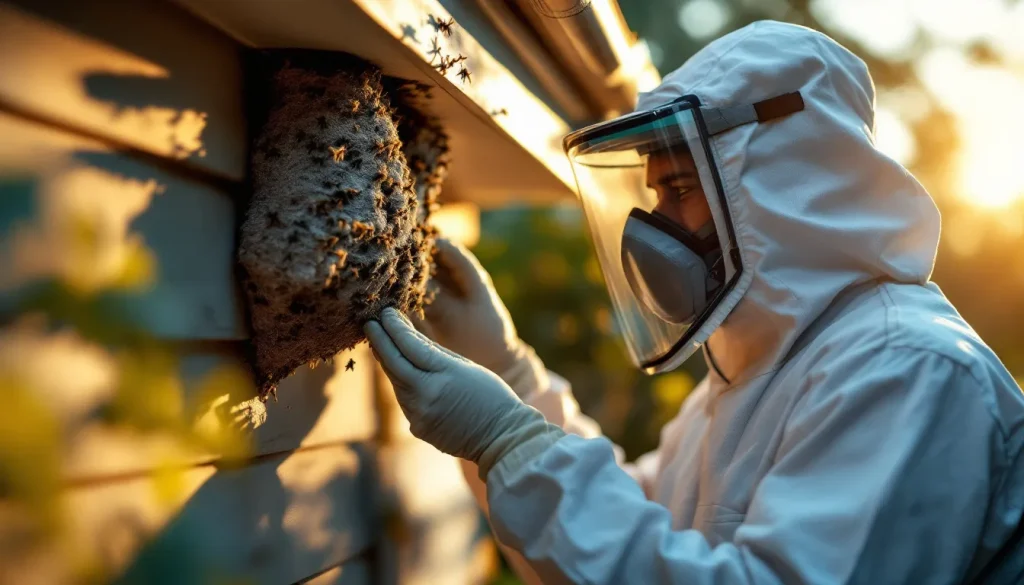
Wasp pest control: your fastest safe path
Wasp pest control comes down to one decision: treat a small, reachable nest yourself for $10 to $30 in materials, or pay a professional $100 to $500 for a nest that is large, hidden in a wall or roof void, high off the ground, or guarded by an aggressive species. Species and location, not size alone, decide which path is safe.
By the HMNDP Editorial Team, independent reporting on lawn care, landscaping, and the green-industry business. See our editorial team.
Last reviewed: June 2026.
How to tell wasps from bees and hornets
Wasps have smooth, shiny, narrow bodies with a pinched “wasp waist” and dangling legs in flight. Bees look fuzzy and rounded and carry pollen. Hornets are simply large wasps. If the insect is slender, hairless, and defensive near a papery nest, you are dealing with a wasp, and identification changes both treatment and cost.
Honey bees are protected in many states and should be relocated by a beekeeper, not sprayed. Bumblebees are large and fuzzy and rarely need removal. Correct ID prevents killing pollinators and choosing the wrong product.
Common wasp types and how hard each is to treat
The three groups US homeowners meet most are paper wasps, yellowjackets, and hornets (including bald-faced and European hornets). Paper wasps are the calmest and easiest to treat. Yellowjackets and hornets build large, well-defended colonies and account for most emergency-room sting visits, so they often justify a professional.
| Wasp type | Nest look and location | Aggression | DIY difficulty |
|---|---|---|---|
| Paper wasp | Open umbrella comb under eaves, railings, grills | Low to moderate | Easy, good DIY candidate |
| Yellowjacket | Hidden in ground burrows or wall voids, entrance hole only | High | Hard, often pro |
| Bald-faced hornet | Large gray football-shaped aerial nest in trees or eaves | Very high | Pro recommended |
| European hornet | Sheltered cavities, hollow trees, wall voids | High, active at night | Pro recommended |
Finding and identifying a wasp nest
Locate the nest by watching wasp traffic for 10 to 15 minutes on a warm afternoon; a steady stream in and out marks the entrance. Nests hide under eaves, in shrubs, inside wall and roof voids, in attics, and in ground holes. Never seal a void entrance you find, because trapped wasps chew inward toward living space.
Aerial paper and hornet nests are visible and treatable. Void and ground nests show only an entry point, which raises difficulty sharply. If wasps disappear into siding, brick, or a soffit, treat the entrance from outside and do not block it.
How to get rid of wasps and nests
To remove wasps, treat the nest at dusk or dawn when the colony is inside and sluggish, apply a labeled wasp product to the entrance or comb, wait a full day, then remove the dead nest. Cold temperatures and low light cut sting risk. Retreat if activity continues after 24 hours.
- Confirm the species and nest location, and check for anyone with a sting allergy nearby.
- Wait until after sunset or before sunrise; wear long sleeves, gloves, and eye protection.
- Stand back and spray the entrance or comb thoroughly with a labeled product; do not use a ladder for aerial nests.
- Leave the area immediately and wait 24 hours before checking.
- Once activity stops, knock down and bag the nest, then clean the spot to remove pheromone residue.
DIY wasp sprays and removal methods
For small, reachable paper-wasp nests, aerosol jet sprays that shoot 15 to 20 feet let you treat from a safe distance for roughly $8 to $15 a can. Insecticidal dusts ($15 to $30) work best on ground and void nests because wasps carry the dust inward. Match the product to the nest type before you buy.
- Aerosol jet spray: best for open aerial paper-wasp nests you can treat from the ground.
- Insecticidal dust: best for ground burrows and wall-void entrances; apply at the hole, then leave it open.
- Soapy water (2 tablespoons dish soap per quart): a low-cost, eco-friendlier option for tiny early-season paper nests.
Skip folk methods like burning nests or plugging holes, which cause fires and drive wasps indoors. For a broader look at what homeowners can safely handle, see our guide to do-your-own pest control and lower-toxicity options in our eco-friendly pest control overview.
DIY vs pro: the decision and the safety red lines
Treat it yourself only if the nest is a small paper-wasp nest, reachable from the ground, and no one nearby has a sting allergy. Call a professional whenever the nest is inside a wall or roof void, requires a ladder, belongs to yellowjackets or hornets, or is a large late-summer colony. These are safety red lines, not preferences.
| Situation | DIY | Call a pro |
|---|---|---|
| Small paper-wasp nest, ground-reachable | Yes | Optional |
| Nest inside wall, roof, attic, or soffit void | No | Yes |
| Yellowjacket ground or void colony | Risky | Yes |
| Bald-faced or European hornet nest | No | Yes |
| Nest needs a ladder or is above one story | No | Yes |
| Anyone on site has a sting allergy | No | Yes |
Wasp removal and extermination cost
Professional wasp nest removal typically runs $100 to $500 in 2026, with most single-nest visits landing between $150 and $300. Height, void access, and species raise the price. National brands like Orkin and Terminix usually require an inspection and often quote $150 to $375 for a single accessible nest, more for wall voids or recurring plans.
| Option | Typical cost | Best for |
|---|---|---|
| DIY aerosol spray | $8 to $15 | Small aerial paper nests |
| DIY dust kit | $15 to $30 | Ground and void entrances |
| Single professional visit | $100 to $500 | Hidden, high, or aggressive nests |
| Orkin / Terminix single nest | ~$150 to $375 (inspection first) | Homeowners wanting a national brand |
| Wall or roof void removal | $300 to $600+ | Colonies inside the structure |
Prices vary by region, season, and nest access, so treat these as planning ranges and confirm with a written quote. Comparing two or three local pest control companies often beats a single brand quote.
Seasonal timing: why late-summer nests cost the most
A wasp colony starts in spring as a single queen and a nest the size of a golf ball. By August and September a yellowjacket colony can hold thousands of workers, defends aggressively as natural food runs low, and stings on little provocation. That late-season size and temper is why fall removals are the hardest and most expensive.
Treat early. A nest found in May or June is small, lightly defended, and cheap to handle, often a simple DIY job. The same nest in September may need a professional and a higher fee. Timing, more than any single product, controls both your risk and your cost.
How to avoid wasp stings and stay safe
Avoid stings by treating nests only at dusk or dawn, never swatting, and keeping calm around foraging wasps. Wear long sleeves, closed shoes, gloves, and eye protection. Keep an epinephrine auto-injector on hand if anyone has a known allergy, and call 911 for swelling of the face or throat or trouble breathing after a sting.
Wasps release an alarm pheromone when crushed, which recruits the colony. Move away steadily rather than running or flailing. Do not treat a void nest by sealing the entrance, since that traps wasps inside the wall.
Preventing wasps from returning
Stop wasps from coming back by removing the old nest, sealing entry gaps, and cutting food sources. Wasps rebuild near familiar sites, so eliminate the pheromone-marked spot and deny access to protein and sugar. Spring inspections catch new queens before colonies grow.
- Caulk cracks in siding, soffits, and around utility penetrations before spring.
- Keep trash cans lidded and clean up fallen fruit and pet food.
- Screen vents, chimneys, and attic openings with fine mesh.
- Scrape off old nest remnants and check eaves monthly from April onward.
Yard health matters too; wasps are drawn to aphid honeydew and grub-rich turf. Our lawn pest control guide covers reducing the insects that attract them in the first place.
Get a free wasp removal quote
If the nest crosses a safety red line (void, height, allergy, or an aggressive late-season colony), get a professional quote before you act. Ask for a written price, the treatment method, and whether a return visit is included. Comparing local pros against national brands usually gives you the fairest cost.
Frequently Asked Questions
How much does wasp pest control or wasp removal cost?
DIY wasp control costs about $8 to $30 in sprays or dust. Professional wasp nest removal typically runs $100 to $500 in 2026, with most single-nest visits between $150 and $300. Wall or roof void colonies can reach $300 to $600 or more. Height, species, and nest access drive the final price, so get a written quote.
How much do Orkin or Terminix charge to remove wasps?
Orkin and Terminix generally require an inspection first and often quote roughly $150 to $375 for a single accessible wasp nest, with higher fees for wall voids, hornets, or ongoing plans. Neither publishes fixed online pricing, so costs vary by region and nest difficulty. Comparing their quotes with two local companies usually gives the clearest picture.
Can I get rid of wasps myself, or do I need an exterminator?
You can DIY a small paper-wasp nest that is reachable from the ground when no one nearby has a sting allergy. Call an exterminator for yellowjackets, hornets, nests inside walls or roofs, anything needing a ladder, or large late-summer colonies. Those situations are safety red lines where professional treatment is far safer than DIY.
What is the best wasp killer spray and how do I use it safely?
Aerosol jet sprays that reach 15 to 20 feet are best for open paper-wasp nests, while insecticidal dust works better on ground and void nests. Treat at dusk or dawn when wasps are inside, wear long sleeves and eye protection, spray the entrance from the ground, then leave and wait 24 hours before removing the nest.
How do I identify what kind of wasp or nest I have?
Check the nest shape and location. Open umbrella combs under eaves mean paper wasps. A single hole into the ground or a wall means yellowjackets. A large gray football-shaped aerial nest means bald-faced hornets. Slender, shiny, hairless bodies confirm wasps rather than fuzzy bees. Species determines both treatment difficulty and cost.
When is the best time of day and year to remove a wasp nest?
Remove nests at dusk or dawn when wasps are inside and sluggish, which lowers sting risk. For the season, treat in spring or early summer when colonies are small and lightly defended. Late-summer nests, especially yellowjackets in August and September, hold thousands of aggressive wasps and are the hardest and most expensive to remove.
How do professionals get rid of wasps and nests?
Professionals inspect to identify the species and nest location, then apply targeted insecticidal dust or aerosol to the nest or void entrance, often with protective gear and extension equipment for high or hidden nests. They may remove the nest, treat voids without sealing them, and schedule a follow-up. Many offer a warranty against return within a set window.
How do I keep wasps from coming back after removal?
Remove the old nest completely, since leftover pheromones attract rebuilding. Seal cracks in siding and soffits, screen vents and chimneys, keep trash lidded, and clear fallen fruit and pet food. Inspect eaves monthly from April to catch new queens early. Reducing lawn pests that wasps feed on also lowers their interest in your yard.