
By the HMNDP Editorial Team, independent reporting on lawn care, landscaping, and the green industry.
Last reviewed: June 2026
What zebra grass is
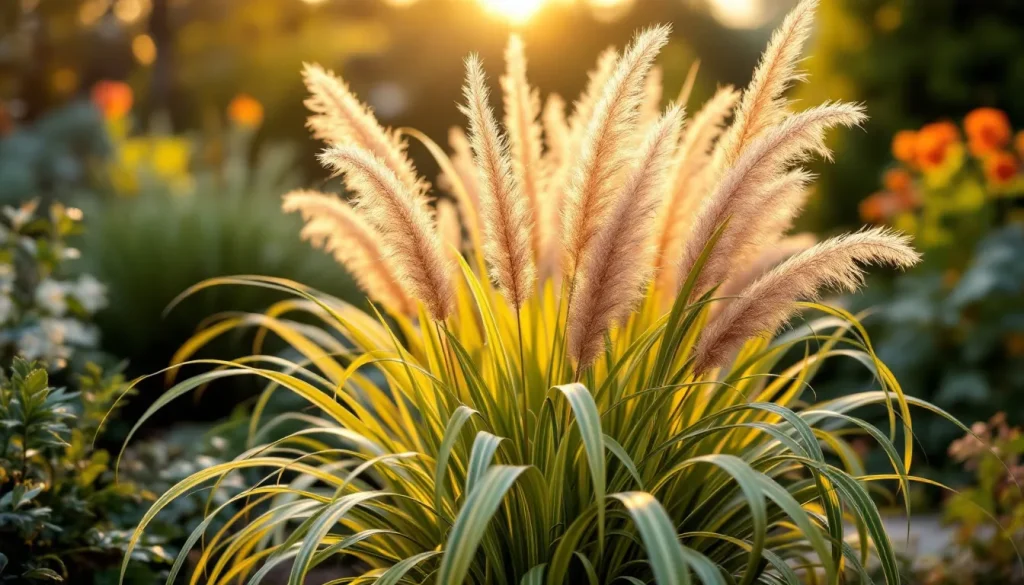
Zebra grass is Miscanthus sinensis ‘Zebrinus’, a clump-forming, warm-season ornamental grass known for horizontal yellow-to-gold bands running across its green blades. It grows 3 to 7 feet tall and 4 to 6 feet wide, native to the lowlands of Japan and East Asia. In late summer it throws feathery copper-pink plumes that fade to tan and hold through winter.
The bands are the signature trait. Unlike variegated grasses that stripe lengthwise, zebra grass carries crosswise gold blotches that develop as the season warms, which is why young spring growth can look plain green before the pattern appears.
It forms a tidy vase-shaped clump rather than spreading by underground runners, so a single plant stays in one place. That habit makes it a common specimen and screening grass across USDA hardiness zones 5 through 9.
Is zebra grass invasive, and is it restricted anywhere?
Zebra grass can be invasive because its parent species, Miscanthus sinensis, self-seeds and naturalizes into meadows, roadsides, and disturbed woodland edges. Several US states list Chinese silvergrass as invasive or discourage its sale, and it is regulated in some jurisdictions. The plant itself does not spread by runners, so the risk comes almost entirely from viable seed, which is manageable.
This is the question most zebra grass guides ignore, so here is the practical picture. Miscanthus sinensis appears on invasive-plant advisory lists from groups such as the Southeast Exotic Pest Plant Council and state programs in the Mid-Atlantic and Northeast. Regulations change, so confirm current status with your state agriculture department or extension office before planting.
| Region / example states | Typical status of Miscanthus sinensis | What it means for you |
|---|---|---|
| Southeast (e.g., Tennessee, Georgia via SE-EPPC) | Listed as invasive/pest plant | Discouraged; remove seed heads or avoid |
| Mid-Atlantic (e.g., Virginia, Maryland) | Watch/invasive advisory listings | Plant cautiously, deadhead plumes |
| Northeast (e.g., Massachusetts, Connecticut) | Some restrictions on related Miscanthus sales | Check state list before buying |
| Cool northern zones (short season) | Lower seed-set risk | Seed often does not fully ripen |
Two mitigations reduce nearly all risk. First, cut and bag the flower plumes in fall before seed matures and disperses, which stops volunteer seedlings. Second, choose a sterile or low-fertility cultivar. Named selections such as ‘My Fair Maiden’ and other modern low-seed Miscanthus are bred to set little or no viable seed, and true sterile hybrids like Miscanthus x giganteus do not self-sow.
If you want zero seeding worry and near-zero upkeep, a non-seeding groundcover or a low-maintenance artificial grass surface removes the question entirely for the surrounding lawn area, leaving ornamental grasses to defined, deadheaded beds.
Can you grow zebra grass from seed?
No, you cannot reliably grow zebra grass from seed. ‘Zebrinus’ is a named cultivar, and its horizontal banding does not come true from seed. Seedlings usually revert to plain green Chinese silvergrass. To get the banded plant, buy nursery container stock or a division from an existing clump, not a seed packet.
This clears up a common search confusion. Packets sold as “zebra grass seed” typically produce generic Miscanthus sinensis, which is the very form flagged as invasive in some states. Propagate zebra grass by division in early spring instead, splitting an established clump into fist-sized sections with roots attached.
Division is also how you keep the plant looking its best long term, covered in the care schedule below. If you are comparing seeded lawn grasses for surrounding turf, our guides to Bermuda grass seed and Bahia grass explain which turf species actually establish well from seed.
How much sun, water, and what soil does zebra grass need?
Zebra grass needs full sun, at least 6 hours daily, to develop strong bands and stay upright. It prefers moist, well-drained soil at roughly neutral pH. Give new plants about 1 inch of water weekly for the first season, then water established clumps during dry spells. Too much shade or rich, wet soil makes stems flop.
Soil is forgiving as long as it drains. Zebra grass tolerates clay, loam, and sandy soils and handles brief wet feet at pond and stream edges, but it will not thrive in constantly soggy or heavily shaded spots. In shade the banding fades and the vase shape splays open.
It is hardy in USDA zones 5 to 9. In zone 5 it dies to the ground each winter and returns from the crown in spring. Established plants are notably drought-tolerant once their deep root system forms, usually by the second year.
Planting and annual cut-back care
Plant zebra grass in spring after frost, spacing clumps 3 to 6 feet apart depending on use. Water through the first season to establish. The one essential annual task is a hard cut-back: shear the entire clump to 4 to 6 inches above ground in late winter or early spring, before new green growth emerges.
- Plant (spring): Dig a hole twice the root-ball width, set the crown at soil level, backfill, and water deeply.
- Water (year one): About 1 inch weekly; taper off once established.
- Feed (spring): A light application of balanced fertilizer is plenty; overfeeding causes floppy stems.
- Cut back (late winter): Tie the clump with twine, then shear to 4 to 6 inches with hedge shears or a pruning saw before spring growth.
- Divide (every 3 to 4 years): Split clumps to renew vigor and control size (see below).
Leaving the dried plumes and blades standing through winter is a deliberate choice: they add movement, structure, and habitat, and only come down at the late-winter cut-back. In invasive-flagged states, cut and bag the plumes earlier, in fall, to prevent seed spread.
Dividing zebra grass to fix center die-out
Mature zebra grass clumps often die out in the center after 3 to 4 years, leaving a hollow ring of live growth around a dead middle. The fix is division. In early spring, lift the clump, discard the dead core, and replant vigorous outer sections. This rejuvenation schedule keeps the plant dense, upright, and healthy for decades.
Here is a working schedule most home gardeners can follow:
| Plant age | Sign to watch | Action |
|---|---|---|
| Years 1 to 2 | Filling out, solid clump | No division needed |
| Year 3 | Clump wide, base crowded | Optional division to propagate |
| Years 3 to 4 | Dead or thin center, floppy edges | Divide: discard core, replant outer pieces |
Dividing a mature Miscanthus clump is hard physical work because the root mass is dense. Cut it into sections with a sharp spade or a pruning saw, keep roots and several shoots per piece, and replant immediately at the original depth.
Best landscape uses and companion plants
Zebra grass works as a specimen, a seasonal screen, or a back-of-border anchor. As a screen, space plants 3 to 4 feet apart for a solid summer wall 5 to 7 feet tall. As a specimen, give a single clump 4 to 6 feet of open space so its vase shape and plumes show. It also suits large containers and pond edges.
Concrete pairings that read well in a bed:
- Late-summer color: Pair with black-eyed Susan (Rudbeckia), coneflower (Echinacea), and sedum ‘Autumn Joy’ to echo the plumes’ bloom timing.
- Contrast in form: Set against upright Salvia or the flat heads of yarrow for a fine-versus-coarse texture play.
- Fall and winter structure: Combine with asters and dwarf conifers so the tan plumes have an evergreen backdrop.
- Water features: Use single clumps at pond or stream edges where the soil stays moist but drains.
- Containers: A large frost-proof pot (18 inches or wider) holds one clump for a patio focal point; divide every 2 to 3 years.
For screening lines and pathways, a mix of ornamental grasses and a durable surface underfoot works well. If foot traffic runs through a grass border, an artificial grass installation for the walkway keeps the planted clumps as the visual feature without a muddy path.
Zebra grass vs. porcupine grass
Zebra grass (‘Zebrinus’) and porcupine grass (‘Strictus’) are both banded cultivars of Miscanthus sinensis with the same gold crosswise markings. The key difference is habit: porcupine grass grows stiffly upright and stays narrower, while zebra grass has a looser, more arching, vase-shaped form. Choose ‘Strictus’ for tight vertical spaces and ‘Zebrinus’ for a fuller, fountain-like specimen.
| Trait | Zebra grass ‘Zebrinus’ | Porcupine grass ‘Strictus’ |
|---|---|---|
| Habit | Arching, vase-shaped | Stiff, upright, columnar |
| Height | 3 to 7 feet | 5 to 8 feet |
| Spread | 4 to 6 feet, wider | Narrower, more contained |
| Banding | Yellow-gold, softer bands | Yellow-gold, often bolder |
| Best for | Specimen, wide screens | Vertical accents, tight spots |
Both share the same self-seeding caution as their parent species, so the invasiveness guidance and seed-head removal above apply equally to porcupine grass.
Frequently Asked Questions
Is zebra grass invasive, and is it banned or restricted in any US states?
Zebra grass can self-seed because its parent, Miscanthus sinensis, naturalizes readily. It appears on invasive advisory lists in parts of the Southeast, Mid-Atlantic, and Northeast, and some states restrict Miscanthus sales. It is not federally banned. Status varies, so confirm with your state agriculture department. Removing flower plumes in fall or choosing sterile cultivars prevents almost all spread.
How tall does zebra grass get and how wide does it spread?
Zebra grass typically reaches 3 to 7 feet tall, and its feathery plumes can push the total height to 8 feet or more in late summer. Each clump spreads 4 to 6 feet wide. It grows as a contained clump rather than by runners, so it stays where you plant it, though the clump widens gradually each year.
Can you grow zebra grass from seed, or do you have to buy plants?
You should buy plants or divisions, not seed. Zebra grass is the cultivar ‘Zebrinus’, and its horizontal banding does not come true from seed; seedlings revert to plain green Chinese silvergrass, which is the invasive form. Propagate by dividing an established clump in early spring, keeping roots and shoots on each fist-sized section, then replant immediately.
When and how do you cut back zebra grass each year?
Cut back zebra grass once a year in late winter or early spring, before new green growth appears. Tie the dried clump into a bundle with twine, then shear it to 4 to 6 inches above the ground with hedge shears or a pruning saw. In invasive-flagged states, also remove the flower plumes in fall to stop seed dispersal.
How much sun and water does zebra grass need?
Zebra grass needs full sun, at least 6 hours a day, for strong banding and upright stems. Water new plants about 1 inch weekly through the first growing season, then only during dry spells once established. It prefers moist, well-drained, roughly neutral-pH soil. Too little sun or overly rich, wet soil makes the stems flop open.
What USDA hardiness zones does zebra grass grow in?
Zebra grass is hardy in USDA zones 5 through 9. In colder zones like 5, it dies to the ground each winter and regrows from the crown in spring. In zones 8 and 9, it may hold some structure longer. Outside this range, winter cold in zone 4 and below usually kills the crown.
What is the difference between zebra grass and porcupine grass?
Both are banded cultivars of Miscanthus sinensis with gold crosswise markings. Zebra grass (‘Zebrinus’) has an arching, vase-shaped, fuller habit and spreads 4 to 6 feet. Porcupine grass (‘Strictus’) grows stiffly upright, taller, and narrower, making it better for tight vertical spaces. Both self-seed, so the same invasiveness precautions and plume removal apply to each.
What are the best landscaping uses and companion plants for zebra grass?
Use zebra grass as a specimen, a summer privacy screen (spaced 3 to 4 feet apart), a back-of-border anchor, or in large containers and at pond edges. Strong companions include black-eyed Susan, coneflower, sedum ‘Autumn Joy’, asters, and dwarf conifers, which match its late-summer plumes and provide winter contrast against the tan seed heads.